NFPA 730 Premises Security Risk Assessments and Security Planning

NFPA 730 is the Guide for Premises Security. NFPA’s current product and standard-development pages describe it as a guide offering strategies for reducing vulnerabilities and improving protection, with the current edition listed as 2026 and focused on reducing security vulnerabilities to life and property. That makes NFPA 730 the front-end planning document in your NFPA security cluster, not the device-installation standard. (NFPA)

In Pennsylvania, the planning conversation still exists inside a real code and enforcement environment. The Commonwealth says the Uniform Construction Code is Pennsylvania’s statewide building code, that more than 90 percent of municipalities administer and enforce it locally, that the Department handles commercial enforcement in opt-out municipalities, and that the current triennial update became effective on January 1, 2026. That means security planning can turn into real design, permit, inspection, and enforcement consequences later in the project. (Pennsylvania.gov)

This page is intentionally narrow. It is about premises security risk assessments, vulnerability assessment, and security planning under NFPA 730. It is not the installation standard for electronic premises security systems. NFPA says NFPA 731 was developed in parallel with NFPA 730 and is the standard for installing and maintaining electronic premises security systems, including areas such as access control, CCTV, and cybersecurity. When the issue becomes installation, performance, testing, and maintenance of electronic security systems, the deeper page should be NFPA 731 and Electronic Premises Security Systems. (NFPA)

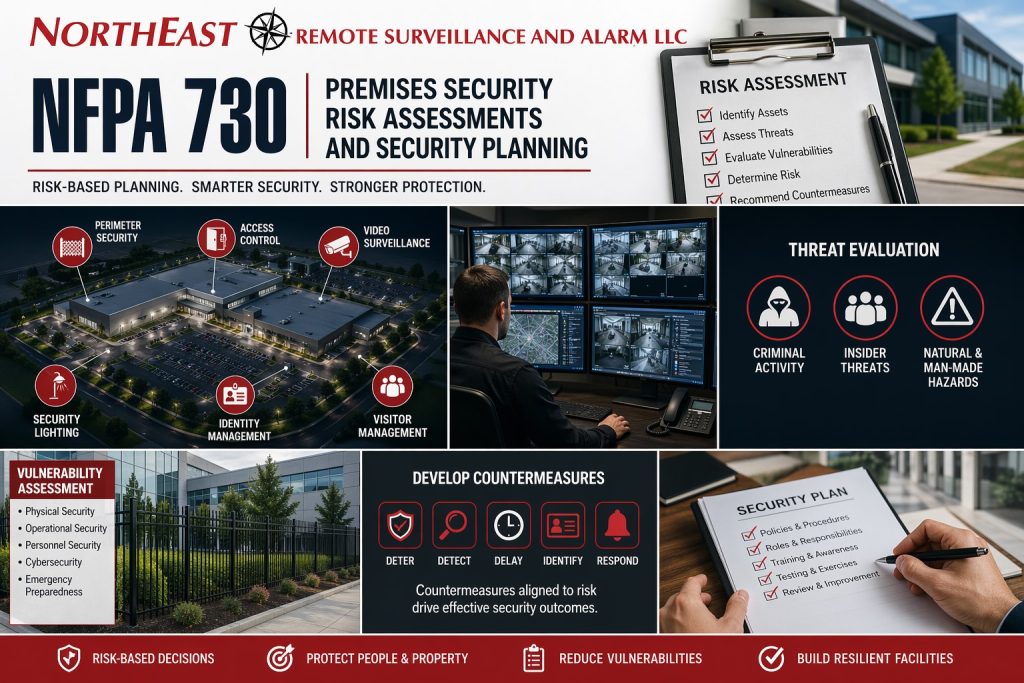
NFPA 730 security planning graphic showing facility risk assessment, perimeter security, access control, video surveillance, threat evaluation, vulnerability assessment, monitoring, and security plan development for commercial properties.

Why NFPA 730 Matters

One of the biggest mistakes in commercial security is jumping straight to equipment selection before the site’s risks are clearly defined. NFPA committee materials say NFPA 730 is a guide for all threats within the physical campus, which is a useful reminder that the document is meant to sit above the hardware pages. It is the planning spoke that helps define what needs to be protected, what threats matter most, and what the security program is actually trying to accomplish before cameras, readers, alarms, or barriers are chosen. (NFPA Document Information)

That is why this page belongs high in your NFPA structure. It helps explain why a property may need layered access control, video surveillance, perimeter hardening, identity management, hostile-incident planning, or stronger documentation before the more tactical installation pages take over. NFPA 730 is the planning guide; NFPA 731 is the installation and maintenance standard. (NFPA)

Security Vulnerability Assessment Comes Before Device Selection

NFPA committee materials tied to the 2026 cycle state that a security vulnerability assessment includes a risk assessment and a threat assessment, along with other components that may be added to complete the evaluation. Those same materials say the results of the SVA are used in developing countermeasures to address adversarial events. That is one of the clearest reasons this page should stay focused on assessment and planning rather than drifting into a product catalog. (NFPA Document Information)

In practical terms, this is the page where the project should define what is being protected, what the threat picture looks like, what the operational vulnerabilities are, and what level of protection is actually appropriate for the site. Once that work is done, the more tactical child pages can handle how those countermeasures are installed and maintained. (NFPA Document Information)

Countermeasures Should Match the Defined Threats

NFPA 730 committee materials also state that an effective countermeasure is one that drives improvements in mitigating the defined threats. That is an important planning rule. A security countermeasure should not be chosen because it is popular, visually impressive, or easy to sell. It should be chosen because it improves the site’s ability to deal with the specific threat conditions identified during the assessment process. (NFPA Document Information)

That is why this spoke should sit above the system pages. It is the place where the security program decides whether the right answer is deterrence, detection, delay, identification, monitoring, better site control, stronger procedures, or a combination of those measures before hardware details take over. NFPA 730 is the planning layer that keeps the program from becoming a random pile of devices. (NFPA Document Information)

Identity, Access Control, and Site-Control Planning

NFPA 730 committee materials describe access control systems as ranging from simple push-button locks to computerized access control systems integrated with video surveillance systems. Those same materials say the primary objective of access control is to screen or identify people before allowing entry, and that these systems generally require a machine-readable credential. That makes NFPA 730 relevant at the planning stage even before the project becomes a detailed access-control installation. (NFPA Document Information)

This is where a property should decide which openings truly need control, how identity will be established, where visitor and contractor flow should be managed, and where security goals end and life-safety rules begin. When the project moves from planning into the detailed security-system side, the next page should be NFPA 731 and Electronic Premises Security Systems. When the issue becomes egress behavior, door release, electrified locking, and means-of-egress compliance, the next page should be NFPA 101, Door Hardware, and Access Control Egress Compliance. (NFPA Document Information)

Video Surveillance, Security Lighting, and Technology Planning

NFPA 730 committee materials from the current cycle show the guide continuing to address modern technology selection, including updated recommendations around means of establishing identity, iris verification systems, video surveillance equipment, and security-lighting references. That is a strong signal that NFPA 730 is not frozen in an older guard-tour mindset. It remains a planning document for modern premises security strategy. (NFPA Document Information)

That makes this the right page for deciding what role video surveillance, lighting, credentialing, biometric technologies, and related tools should play in the site strategy. When the question becomes actual installation quality, equipment integration, control units, testing, and maintenance, the work should move into the tighter system-specific spokes. (NFPA Document Information)

Hostile-Incident and Campus-Level Planning

NFPA 730 committee materials also note added resources for pre-planning against an active shooter or hostile incident. Combined with the committee statement that NFPA 730 is a guide for all threats within the physical campus, that reinforces the role of this page as the campus-level and site-level planning spoke rather than a narrow equipment page. (NFPA Document Information)

This does not mean every property needs the same hostile-event posture. It means the planning guide is built to help the site think through broader security threats and operational response before tactical design decisions are finalized. That is exactly why this page should stay upstream in the NFPA hub. (NFPA Document Information)

Why This Page Matters for Commercial and Industrial Properties

Commercial and industrial properties usually have more entrances, more employee and visitor movement, more perimeter exposure, more delivery and contractor activity, more operational dependencies, and more consequences when a security design is mismatched to the actual risk. A warehouse, manufacturing site, logistics facility, office campus, school, or multi-building property benefits from a formal security-planning process more than a small simple site does. NFPA 730 matters because it helps structure that planning work before the installation pages take over. (NFPA)

In Pennsylvania, that planning work also lives inside a real project-delivery environment shaped by the statewide UCC and the applicable local or Department enforcement path. So while this page is about risk assessment and planning, it still supports later compliance outcomes by helping the project define the right security approach before design and installation move forward. (Pennsylvania.gov)

If the issue becomes installation and maintenance of intrusion, access control, video surveillance, or integrated electronic security systems, use NFPA 731 and Electronic Premises Security Systems. If the issue becomes means of egress, electrified locking, and occupant release, use NFPA 101, Door Hardware, and Access Control Egress Compliance]. If the issue becomes fire alarm and signaling, use NFPA 72 and Commercial Fire Alarm Systems. If the issue becomes pathways, power-limited circuits, or field wiring methods, use NFPA 70 NEC and Low-Voltage Security System Wiring. (NFPA)

Schedule a Security Planning Review

If your facility is evaluating threats, trying to define a layered security strategy, planning upgrades across multiple systems, or deciding what countermeasures actually fit the site, the next step is a planning-focused review before more hardware is specified. NFPA 730 is the right framework for that front-end work because it is built around vulnerability reduction, protection improvement, and premises-level planning. (NFPA)

Northeast Remote Surveillance and Alarm, LLC helps commercial, warehouse, industrial, and logistics facilities plan security programs around real building conditions, real operating risks, and supportable long-term strategy.

Call 1-888-344-3846 to schedule a site assessment.

Code Note

This page is general informational content for commercial planning purposes. The adopted edition, the authority having jurisdiction, the actual occupancy and threat profile, and the real field conditions control the project. In Pennsylvania, that sits inside the statewide UCC framework and the applicable local or Department enforcement path. (Pennsylvania.gov)

Scroll to Top
1-888-344-3846