
NFPA 731 and Electronic Premises Security Systems

NFPA 731 is the NFPA standard built around electronic premises security systems. NFPA says the standard provides requirements for the application, location, installation, performance, testing, and maintenance of electronic premises security systems, and its product page describes it as the comprehensive standard for installing and maintaining premises security systems to help protect buildings and occupants. (NFPA)
In Pennsylvania, that conversation also sits inside the statewide Uniform Construction Code environment. The Commonwealth says the UCC is Pennsylvania’s statewide building code, that more than 90 percent of municipalities administer and enforce it locally, that the Department handles commercial code enforcement in opt-out municipalities, and that the current triennial update became effective on January 1, 2026. That means electronic security design can become a real code, plan-review, inspection, and enforcement issue rather than just a technology decision. (Pennsylvania.gov)

This page is intentionally narrow. It is about NFPA 731 as the core installation and performance standard for electronic premises security systems. It is not the full fire alarm page, not the life-safety egress page, and not the low-voltage wiring page. When the issue becomes fire alarm and signaling, use [NFPA 72 and Commercial Fire Alarm Systems. When the issue becomes means of egress, electrified locking, and occupant release, use NFPA 101, Door Hardware, and Access Control Egress Compliance. When the issue becomes pathways, cabling, and electrical installation discipline, use NFPA 70 NEC and Low-Voltage Security System Wiring. NFPA itself describes NFPA 70 as the benchmark for safe electrical design, installation, and inspection. (NFPA)

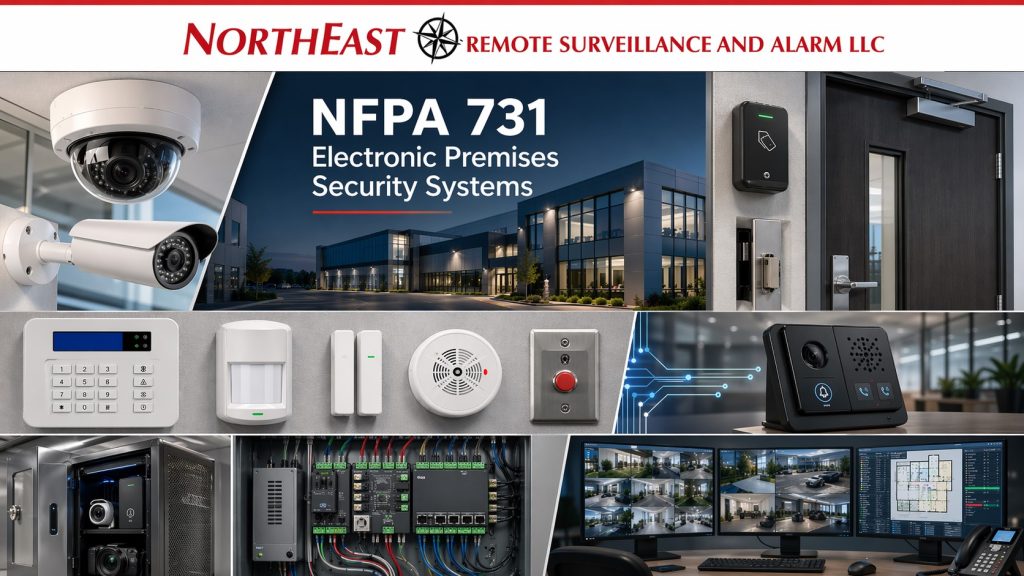
Branded NFPA 731 collage showing electronic premises security system devices including surveillance cameras, access control door hardware, alarm keypad, motion detector, door contact, panic button, intercom, security control panel, and monitoring workstation.

What NFPA 731 Actually Covers

Committee materials for NFPA 731 describe premises security systems as including one or more of the following categories: intrusion detection, access control, video surveillance, asset protection, environmental detection, holdup and duress, integrated systems, and monitoring services and systems. That is one of the clearest reasons this page belongs under your NFPA / compliance structure. NFPA 731 is not just an intrusion page and not just an access control page. It is the standards page for the broader electronic premises security ecosystem. (NFPA Document Information)

That broader scope matters because commercial owners often evaluate these systems one at a time while the standard treats them as related system types inside a shared framework of installation quality, performance, testing, and maintenance. A site may begin with intrusion detection, add access control, expand to video surveillance, and later incorporate integrated monitoring and response workflows. NFPA 731 is the spoke that keeps those layers from being treated like unrelated add-ons. (NFPA)

Intrusion Detection and Perimeter Protection

Intrusion detection is one of the clearest system types inside NFPA 731. That matters for commercial and industrial properties because intrusion design is not just about placing a motion detector or contact where it seems convenient. It is about application, performance, testing, and maintenance under real conditions. NFPA 731 committee materials also show the technical committee tightening language around detector technology and environmental performance, which reflects the standard’s larger goal of reducing nuisance conditions and improving real-world reliability. (NFPA Document Information)

For sites with warehouses, offices, exterior yards, or controlled building perimeters, that makes NFPA 731 more than a burglar-alarm reference. It becomes the standards framework for how the intrusion layer should be installed, supported, and maintained as part of a larger premises security program. (NFPA)

Access Control Is Part of NFPA 731, but It Is Not Outside Life Safety

Access control is also squarely inside NFPA 731. Committee materials for the standard address access control system units, certified locking hardware, request-to-exit system components, and use on controlled access areas and means-of-egress applications. Those materials also describe modern access control as ranging from simple push-button or credentialed locking to more integrated electronic systems. (NFPA Document Information)

But access control under NFPA 731 does not erase life-safety obligations. NFPA’s NFPA 101 guidance says the Life Safety Code’s locking provisions are aimed at preventing locked door assemblies in the means of egress from trapping occupants during a fire, and only certain locking arrangements are permitted. That is why this page should mention access control, but when the real issue becomes egress, release logic, delayed egress, or fail-safe behavior, the deeper page should be NFPA 101, Door Hardware, and Access Control Egress Compliance. (NFPA)

Video Surveillance and Modern Electronic Security

NFPA 731 also reaches directly into video systems. Committee materials show the terminology evolving from “CCTV” toward “video surveillance” and digital imaging systems, which reflects the way commercial security has moved beyond closed-loop camera systems into networked video environments. The same materials also address control units and interconnecting devices used with video surveillance equipment. (NFPA Document Information)

That matters because a commercial video system is not just a camera purchase. Under the NFPA 731 lens, it becomes part of a governed premises security installation with expectations around location, performance, control equipment, and ongoing support. Where the issue becomes lawful deployment, privacy-sensitive placement, microphones, or Mid-Atlantic audio law, the right related page is Commercial Video Surveillance Compliance. (NFPA Document Information)

Asset Protection, Environmental Detection, Holdup and Duress, and Integrated Systems

One of the biggest strengths of NFPA 731 is that it does not stop at the three most familiar system types. Committee materials show the scope extending to asset protection systems, environmental detection systems, holdup and duress systems, integrated systems, and monitoring services and systems. That makes NFPA 731 especially useful for facilities that need more than a basic alarm-and-camera package. (NFPA Document Information)

For a commercial or industrial property, this matters because the security program may need to protect more than doors and corridors. It may need to address cash or high-value asset protection, environmental conditions tied to risk, duress signaling, and integrated response workflows. NFPA 731 gives those systems a standards home instead of leaving them as miscellaneous features bolted onto another platform. (NFPA Document Information)

Power, Backup, Testing, and Maintenance Still Matter

NFPA 731 is not only about device placement. Committee materials for the standard address secondary supply and backup capacity, and the committee specifically tied some of those revisions to alignment with NFPA 72 and to reducing unwanted alarms when power is interrupted. That is a strong reminder that electronic premises security systems have to remain supportable when normal conditions change. (NFPA Document Information)

That is also why this page should connect naturally to NFPA 111 Stored-Energy Backup Power for Security and Life Safety Systems and NFPA 110 Emergency and Standby Power Systems for Fire Alarm and Security when the alternate-power discussion becomes a real design issue. And because NFPA 731 itself is about application, performance, testing, and maintenance, it should also connect to Security System Documentation, Testing, and Inspection Readiness so the system does not become harder to verify and support over time. (NFPA)

Privacy, Biometrics, and Modern Security Governance

Committee materials for NFPA 731 also address modern governance issues, including a requirement that biometric implementations follow local, state, and federal privacy laws. That is an important signal for commercial security buyers. The standard is not just concerned with whether a system functions. It also recognizes that some security technologies create additional compliance and data-governance obligations. (NFPA Document Information)

That makes NFPA 731 especially relevant for facilities using electronic credentials, biometric readers, cloud-managed access, integrated monitoring, and other more advanced security layers. A system can be technically impressive and still be weak if the deployment ignores privacy, data handling, or lifecycle governance. (NFPA Document Information)

Why This Page Matters for Commercial and Industrial Properties

Commercial and industrial properties usually have more distributed devices, more controlled areas, more perimeter issues, more user roles, and more monitoring needs than smaller simple sites. A warehouse, manufacturing plant, logistics facility, office complex, or multi-building campus is more likely to rely on intrusion detection, access control, video surveillance, integrated monitoring, and backup power as one coordinated security environment rather than as separate products. NFPA 731 is valuable precisely because it treats electronic premises security as a standards-driven system category. (NFPA)

In Pennsylvania, that all lives inside a real code-administration environment. The UCC is statewide, most enforcement is local, and commercial enforcement in opt-out municipalities sits with the Department. So even though this page is focused on NFPA 731, the actual project still exists inside plan review, inspection, and enforcement realities. (Pennsylvania.gov)

Keep This Spoke Narrow

This page should stay focused on NFPA 731 as the standards framework for electronic premises security systems. It should not turn into a second fire alarm page, a second egress page, or a general privacy page. If the issue is fire alarm and signaling, use NFPA 72 and Commercial Fire Alarm Systems. If the issue is door hardware and egress behavior, use NFPA 101, Door Hardware, and Access Control Egress Compliance. If the issue is low-voltage wiring and installation methods, use NFPA 70 NEC and Low-Voltage Security System Wiring. If the issue is lawful camera deployment and microphones, use Commercial Video Surveillance Compliance. (NFPA)

Schedule a Compliance-Focused Review

If your facility is planning or upgrading intrusion detection, access control, video surveillance, asset protection, integrated monitoring, or broader electronic premises security infrastructure, the next step is a compliance-focused review based on the building, the risks, and the operating conditions. This page is grounded in NFPA’s current description of NFPA 731 and in the way recent committee materials frame the standard’s system categories and performance issues. (NFPA)

Northeast Remote Surveillance and Alarm, LLC helps commercial, warehouse, industrial, and logistics facilities plan electronic premises security systems around real building conditions, long-term supportability, and code-aware design.

Call 1-888-344-3846 to schedule a site assessment.

Code Note

This page is general informational content for commercial planning purposes. The adopted edition, the authority having jurisdiction, the actual system types, the building conditions, and the field installation all control the project. In Pennsylvania, that sits inside the statewide UCC framework and the applicable local or Department enforcement path. (Pennsylvania.gov)

Scroll to Top
1-888-344-3846