NFPA 80 Fire Doors, Opening Protectives, and Door Hardware

NFPA 80 is the core standard for fire doors and other opening protectives. NFPA says the standard regulates the installation and maintenance of assemblies and devices used to protect openings in walls, floors, and ceilings, and its product page describes NFPA 80 as providing comprehensive provisions for installing, inspecting, testing, and maintaining fire doors and other opening protectives. For commercial buildings, warehouses, industrial facilities, schools, health care occupancies, and other business environments, that makes NFPA 80 one of the most important standards affecting rated door openings and the hardware attached to them. (NFPA)

In Pennsylvania, that conversation also sits inside the statewide Uniform Construction Code framework. The Commonwealth says the UCC applies statewide, that the current triennial update became effective on January 1, 2026, and that commercial enforcement is handled locally in most municipalities and by the Department in opt-out municipalities. That means fire door and opening-protective issues are not just shop-floor details. They can become permit, plan review, inspection, enforcement, and liability issues in the field. (Pennsylvania.gov)

This page is intentionally narrow. It is about rated fire doors, opening protectives, and door hardware under NFPA 80. It is not a general access control page, not a full egress page, and not a fire alarm design page. When the issue becomes egress locking and occupant release, the right related page NFPA 101, Door Hardware, and Access Control Egress Compliance. When the issue becomes fire alarm release logic and life-safety signaling, the right related page is NFPA 72 and Commercial Fire Alarm Systems. When the issue becomes records, testing logs, and readiness governance, the right related page is Security System Documentation, Testing, and Inspection Readiness. (NFPA Document Information)

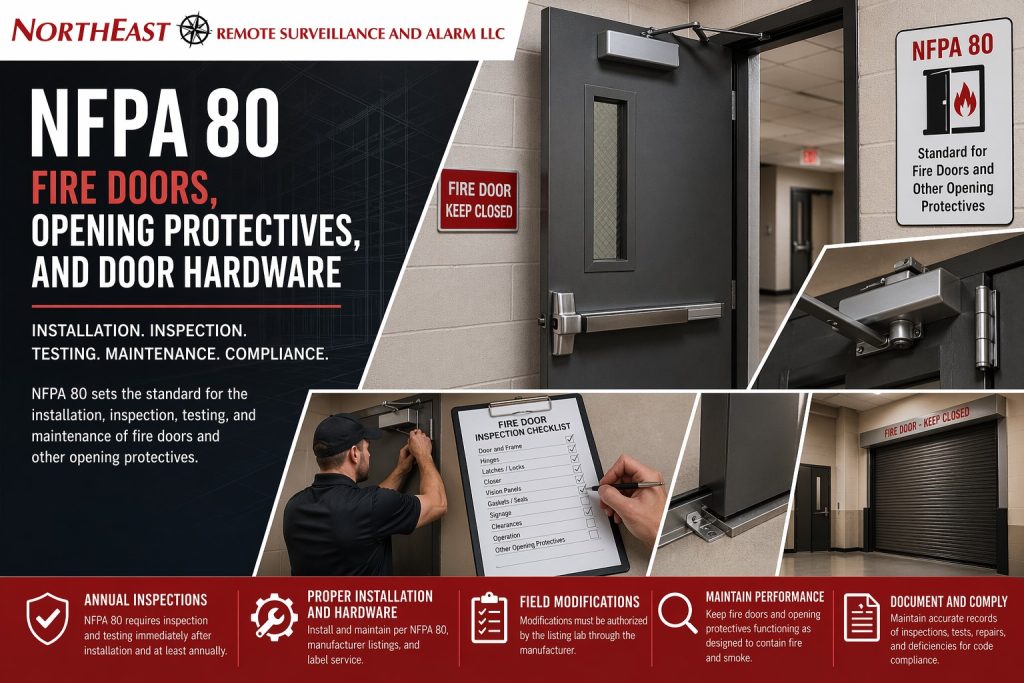
Branded NFPA 80 fire door compliance graphic showing a rated fire door, door closer, inspection checklist, technician adjusting hardware, rolling fire door, and signage for installation, inspection, testing, maintenance, and code compliance.

Why NFPA 80 Matters

One of the biggest mistakes in commercial security and door hardware work is treating a rated opening like an ordinary door opening with a few extra parts. NFPA 80 exists because fire doors and other opening protectives are part of the building’s fire-protection strategy, not just part of the finish schedule. Once the opening is rated, installation, maintenance, inspection, testing, repair, and hardware changes all matter in a different way than they do on a standard non-rated door. (NFPA)

That is especially important when security hardware enters the picture. Access control, electrified locks, closers, latches, vision panels, remotely operated hardware, and monitored hardware can all affect a rated opening. NFPA’s current code-development materials specifically address preparation of fire door assemblies for locks, latches, hinges, remotely operated or remotely monitored hardware, concealed closers, glass lights, vision panels, louvers, astragals, and split astragals, and they tie that work to the manufacturer’s listings and label service. In plain English, hardware work on a rated opening is not casual retrofit work. (NFPA Document Information)

Fire Doors and Opening Protectives Are a Compliance Category of Their Own

NFPA 80 is broader than one door type. NFPA describes it as the standard for assemblies and devices used to protect openings in walls, floors, and ceilings, which is why the title includes “other opening protectives” and not just swinging fire doors. This broader scope is important because commercial properties can involve more than one protected opening type, even though day-to-day security projects most often intersect with swinging doors, rolling doors, and hardware on rated openings. (NFPA)

This is also why the page belongs under the NFPA and compliance structure rather than under a generic access control service page. A rated opening is not just a door leaf, frame, and lockset. It is part of a listed and regulated assembly that has to keep performing as intended after installation, after hardware changes, and after years of use. (NFPA)

Door Hardware on Rated Openings Must Be Treated Differently

Door hardware is one of the most common ways a rated opening gets compromised. Locks, latches, hinges, closers, strikes, electrified hardware, monitored hardware, and related accessories are often where security goals and fire-door requirements collide. NFPA’s code-development materials are clear that preparation of fire door assemblies for many of these hardware items must be performed in accordance with the manufacturer’s listings and under label service. That means the rated opening cannot be treated like a blank canvas for field improvisation. (NFPA Document Information)

This matters in real commercial projects because many of the changes owners want are hardware-driven. They want card access, electrified trim, monitored openings, new closers, upgraded latching, new readers, or altered door behavior. On a non-rated opening, those decisions are already important. On a rated opening, they also become NFPA 80 decisions. That is one reason this spoke should sit beside the egress and access-control compliance page rather than inside it. (NFPA Document Information)

Field Modifications Are Not a Free-for-All

NFPA 80 does not assume field modifications are harmless. NFPA’s code-development materials state that where a field modification to a fire door or fire door assembly is desired, the listing laboratory for the product or component being modified is to be contacted through the manufacturer and given a written or graphic description of the modification. Those same materials state that field modifications can be permitted without a field visit from the laboratory when there is written authorization from that laboratory. (NFPA Document Information)

That is one of the most important practical rules on this page. Drilling, cutting, changing hardware prep, altering the opening, or adding components to a rated assembly should not be treated like ordinary after-the-fact carpentry or locksmith work. If the opening is rated, the modification path matters. This is especially relevant when commercial buildings add access control or monitored hardware after the original fire door assembly is already in service. (NFPA Document Information)

NFPA 80 and NFPA 101 Work Together

NFPA 80 does not replace NFPA 101, and NFPA 101 does not replace NFPA 80. They intersect. NFPA code-development materials for the Life Safety Code state that modifications to fire door assemblies, including door hardware, are to be in accordance with NFPA 80. That means once an access-control or door-hardware project touches a fire-rated opening, the fire-door standard comes into the compliance conversation directly. (NFPA Document Information)

Inspection, Testing, and Maintenance Are Not Optional

NFPA’s 2025 fire door FAQ says NFPA 80 requires fire doors to be inspected and tested immediately after initial installation and then at a minimum annually after that. NFPA also separately notes that rolling fire doors are to be inspected, tested, and maintained in accordance with NFPA 80, including an annual inspection. That makes inspection and testing part of the life cycle of the opening, not just a one-time closeout item. (NFPA)

This is one of the biggest real-world reasons the page matters. A rated opening can look fine in daily use and still fall out of compliance over time. Hardware gets replaced. Closers drift. Clearances change. Doors are propped, adjusted, or modified. Service work is performed without enough attention to the assembly as a rated system. NFPA 80 exists to keep the opening from becoming less reliable the longer it stays in service. (NFPA)

Inspection Readiness and Records Still Matter

A fire door program is harder to manage when there is no record of what the opening is, what hardware belongs on it, what modifications were made, what was inspected, and what deficiencies were found. NFPA 80’s inspection and maintenance framework is one reason rated openings should connect directly to Security System Documentation, Testing, and Inspection Readiness instead of being treated like a separate facilities issue with no documentation trail. (NFPA)

In commercial and industrial environments, that usually means owners need more than a visual walk-through. They need a supportable record of the opening, the hardware condition, the inspection status, any authorized modifications, and any deficiencies that still need correction. Otherwise the same opening can keep failing for the same reasons every year. (NFPA)

Why This Page Matters for Commercial and Industrial Properties

Commercial and industrial properties tend to create harder rated-opening problems than small uncomplicated spaces. They may have stair doors, corridor doors, tenant separations, equipment-room openings, rated service doors, rolling fire doors, access-controlled openings, and retrofits layered onto older assemblies. That is where NFPA 80 becomes more than a technical reference. It becomes a planning and risk-management standard. (NFPA)

In Pennsylvania, this also sits inside a real enforcement environment. The UCC is statewide, the 2026 update is in effect, and commercial work can move through local or Department enforcement depending on the municipality. So even though this page is focused on NFPA 80, the actual project still lives inside plan review, inspection, and code-administration realities. (Pennsylvania.gov)

Keep This Spoke Narrow

This page should stay focused on rated fire doors, other opening protectives, listed hardware, field modifications, and ongoing inspection/testing under NFPA 80. It should not turn into a second access control page, a second egress page, or a full fire alarm page. (NFPA)

If the issue is occupant release, delayed egress, electrified locking, or means-of-egress behavior, use NFPA 101, Door Hardware, and Access Control Egress Compliance. If the issue is fire alarm release coordination or broader fire alarm system design, use NFPA 72 and Commercial Fire Alarm Systems. If the issue is field wiring and electrical installation methods, use NFPA 70 NEC and Low-Voltage Security System Wiring. That keeps this spoke tight and prevents it from turning into another parent hub. (NFPA Document Information)

Schedule a Compliance-Focused Review

If your facility is adding hardware to a rated opening, retrofitting access control onto fire doors, reviewing annual fire door inspections, cleaning up older modifications, or trying to determine whether a fire-rated opening is still supportable and compliant, the next step is a compliance-focused review. (NFPA)

Northeast Remote Surveillance and Alarm, LLC helps commercial, warehouse, industrial, and logistics facilities review fire-rated openings, door hardware, and related security changes with long-term performance and compliance in mind. (NFPA)

Call 1-888-344-3846 to schedule a site assessment.

Code Note

This page is general informational content for commercial planning purposes. The adopted edition, the authority having jurisdiction, the listing status of the opening, the manufacturer’s instructions, and the actual field condition of the assembly control the project. In Pennsylvania, that sits inside the statewide UCC framework and the applicable local or Department enforcement path. (Pennsylvania.gov)

Scroll to Top
1-888-344-3846