Route 22 Industrial Corridor security systems in the Lehigh Valley should be planned around commercial, warehouse, logistics, manufacturing, office, healthcare, institutional, municipal, contractor yard, and multi-tenant properties that operate with constant movement. Northeast Remote Surveillance and Alarm, LLC designs and installs commercial and industrial security systems for Route 22 corridor properties that need stronger visibility, controlled access, intrusion protection, after-hours awareness, documentation, and long-term reliability. For broader regional planning, visit Lehigh Valley Commercial and Industrial Security Systems.
Call 1-888-344-3846 to request a Route 22 corridor commercial security assessment.
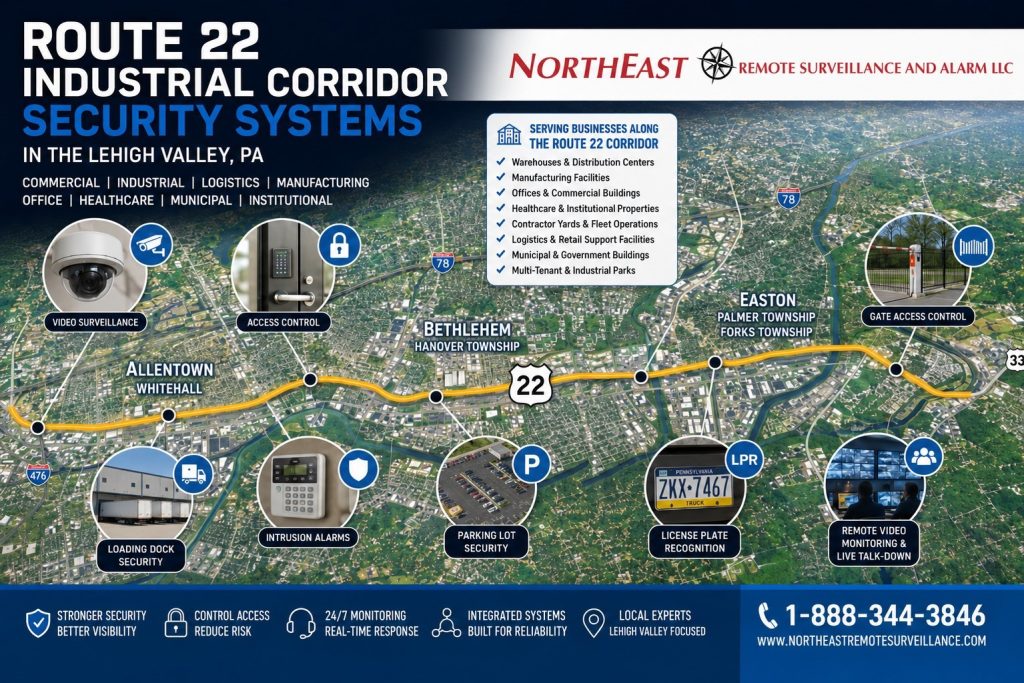
What This Route 22 Industrial Corridor Security Page Covers
This page is the main Route 22 corridor security hub for commercial and industrial properties in the Lehigh Valley.
It is designed for businesses operating along or near Route 22 in Allentown, Whitehall, Bethlehem, Hanover Township, Easton, Palmer Township, Forks Township, and nearby Lehigh Valley commercial and industrial areas.
Route 22 properties often include:
- Warehouses
- Distribution centers
- Manufacturing facilities
- Office buildings
- Healthcare properties
- Schools and institutional facilities
- Municipal buildings
- Contractor yards
- Fleet and service operations
- Retail logistics properties
- Multi-tenant commercial buildings
- Truck courts and trailer areas
- Airport-area commercial properties
- Industrial park and flex-space buildings
These properties may use the same general security technologies, but they do not have the same risk profile. A warehouse near Route 22 may need dock visibility, trailer yard coverage, employee entrance control, intrusion alarms, and remote video monitoring. An office or healthcare property may need visitor visibility, access control, parking lot cameras, restricted-room protection, and alarm verification. A contractor yard may need gate control, exterior cameras, yard surveillance, live talk-down, and after-hours alarm response.
The goal is not to sell a generic camera or alarm package. The goal is to design a security system around how the property actually works.
Why Route 22 Corridor Security Requires a Different Approach
Route 22 is not one single property type. It is a busy Lehigh Valley business corridor where employees, vendors, visitors, tenants, contractors, service vehicles, delivery drivers, and freight activity may all interact with the same site.
That creates security needs that are different from a small standalone office or a basic retail location.
A Route 22 corridor security plan should answer practical questions:
- Who enters the property?
- Which doors should be controlled?
- Where do employees, visitors, vendors, and drivers enter?
- Are loading docks and receiving areas visible?
- Are parking lots covered with usable camera views?
- Are exterior doors protected after hours?
- Can alarms be verified with video?
- Are truck entrances, gates, and service drives documented?
- Are restricted rooms and office areas controlled?
- Can management review incidents quickly?
- Is the system scalable as the building changes?
A strong Route 22 security design should protect people, property, inventory, vehicles, equipment, access points, evidence, and daily operations.
Route 22 Industrial Corridor Coverage Areas
Allentown and Whitehall
Allentown and Whitehall properties near Route 22 often include warehouses, offices, commercial buildings, service businesses, healthcare properties, retail support operations, contractor spaces, and mixed commercial sites.
Common needs include parking lot cameras, access control, alarm protection, exterior door coverage, warehouse cameras, visitor visibility, and after-hours monitoring.
For city-level planning, visit Allentown Commercial Security Systems.
Bethlehem and Hanover Township
Bethlehem and Hanover Township properties often connect Route 22 traffic with industrial parks, airport-area business activity, office buildings, warehouses, healthcare properties, logistics sites, schools, and manufacturing operations.
Common needs include controlled access, employee entrance cameras, dock visibility, parking lot surveillance, intrusion alarm protection, visitor management, and integrated systems that support both office and industrial use.
For Bethlehem-area industrial planning, visit Bethlehem Manufacturing and Industrial Security Systems.
Easton, Palmer Township, and Forks Township
Easton, Palmer Township, and Forks Township properties often connect Route 22 traffic with Route 33, industrial parks, warehouses, contractor yards, commercial buildings, and logistics activity.
Common needs include truck court visibility, loading dock cameras, yard security, gate planning, intrusion alarms, access control, employee parking visibility, and remote video review for management.
For Easton-area planning, visit Commercial and Industrial Security Systems in Easton, PA.
Security Systems for Route 22 Corridor Properties
Route 22 properties often need several security layers working together. Northeast Remote Surveillance and Alarm, LLC designs systems that may include video surveillance, access control, intrusion alarms, gate access control, remote video monitoring, intercoms, low-voltage infrastructure, security networking, documentation support, and code-aware planning.
Route 22 Warehouse Security Systems
Warehouses and distribution centers along Route 22 need security systems designed around dock activity, freight movement, employee entrances, receiving areas, trailer-adjacent doors, inventory areas, parking lots, truck courts, and after-hours exposure.
A warehouse security plan may include interior cameras, exterior cameras, dock cameras, employee entrance access control, restricted-area access control, intrusion alarm protection, video retention, gate visibility, and remote review.
For warehouse-focused corridor planning, visit Route 22 Warehouse Security Systems.
Route 22 Commercial Video Surveillance Systems
Commercial video surveillance along Route 22 should be designed around usable visibility, not just camera count.
Camera placement should help document entrances, loading areas, employee doors, visitor areas, parking lots, drive lanes, exterior doors, restricted rooms, truck activity, and after-hours movement.
A strong camera system should support incident review, vehicle documentation, employee and visitor visibility, dock activity review, parking lot coverage, and management oversight.
For camera coverage and incident-review planning, visit Route 22 Commercial Video Surveillance Systems.
Route 22 Access Control Systems
Access control systems along Route 22 help businesses manage who enters the property, when they enter, and where they are allowed to go.
This is especially important for employee entrances, tenant suites, warehouse-to-office doors, IT rooms, utility rooms, management offices, shipping offices, controlled corridors, and restricted storage areas.
Instead of relying only on keys, businesses can use cards, fobs, mobile credentials, schedules, permissions, access logs, and door event history to improve accountability.
For controlled doors, employee entrances, credentials, audit trails, and restricted-area planning, visit Route 22 Access Control Systems.
Route 22 Intrusion Alarm Systems
Commercial intrusion alarm systems along Route 22 should be designed around unauthorized entry, after-hours exposure, vulnerable doors, overhead doors, office areas, warehouse interiors, storage rooms, exterior-connected openings, and restricted areas.
Alarm planning may include door contacts, overhead door contacts, motion detection, glass-break detection, panic or duress buttons, keypad placement, alarm partitions, user codes, cellular communication, monitoring, and video verification.
For alarm zone planning, monitoring, and unauthorized-entry protection, visit Route 22 Intrusion Alarm Systems.
Route 22 Gate Access Control and Vehicle Entry Security
Many Route 22 commercial and industrial properties depend on vehicle movement. Truck entrances, employee parking entrances, service drives, gated yards, delivery lanes, contractor entrances, and trailer areas may all need better control and documentation.
Gate access control can help manage authorized vehicle entry, employee access, vendor access, contractor traffic, after-hours access, gate event history, and yard activity.
For truck yards, gated entrances, and industrial vehicle control, visit Commercial Gate Access Control Systems for Truck Yards and Industrial Facilities.
Route 22 Remote Video Monitoring and Live Talk-Down
Some Route 22 properties need more than recorded video. Sites with exterior exposure, trailer areas, fenced yards, after-hours activity, remote parking lots, gate lanes, equipment storage, or repeated trespassing concerns may benefit from remote video monitoring and live talk-down.
Remote monitoring can help detect suspicious activity, verify events, support real-time review, and create a stronger response process for outdoor areas and unattended property zones.
For monitoring and live talk-down planning, visit Remote Video Monitoring and Live Talk-Down.
Route 22 Loading Dock and Shipping Area Security
Loading docks are one of the most active security points along the Route 22 corridor. Trucks, drivers, vendors, employees, pallets, overhead doors, staged product, and shipping activity may all move through the same area throughout the day.
Dock security planning may include camera placement, door status awareness, access control, intrusion alarm protection, lighting review, remote video review, and documentation for freight disputes or after-hours events.
Dock coverage should be planned around actual use. A camera that only sees the wall or the top of a trailer may not provide enough useful detail when an incident needs to be reviewed.
Route 22 Truck Yard and Trailer Security
Truck yards, trailer areas, service drives, fenced storage areas, and vehicle-heavy exterior zones often require stronger visibility than the front entrance of the building.
These areas may remain exposed overnight even when the main building is locked or lightly staffed. Security planning may include wide-area cameras, LPR camera views, gate cameras, remote monitoring, live talk-down, intrusion detection, lighting review, and access control.
The goal is to document who entered, what vehicle was present, what area was accessed, and whether activity matched authorized operations.
Route 22 Parking Lot Security Cameras
Parking lots along Route 22 often serve employees, visitors, customers, vendors, fleet vehicles, delivery vehicles, and contractors. Poor visibility in these areas can affect employee safety, incident review, vehicle damage claims, after-hours activity, and management oversight.
Parking lot camera planning should account for entrances, walk paths, building approaches, employee parking areas, visitor parking, lighting conditions, camera height, vehicle movement, and blind spots.
Parking lot cameras should be placed for usable evidence, not just general observation.
Route 22 License Plate Recognition Systems
Some Route 22 properties need stronger vehicle documentation at entrances, gates, truck lanes, parking lot entrances, fleet yards, service drives, or delivery points.
License plate recognition systems can help support vehicle review when they are positioned correctly. LPR planning should consider lane layout, camera angle, mounting location, lighting, vehicle speed, distance, and whether the goal is vehicle documentation, gate review, event search, or integration with a broader system.
LPR should not be treated as a standard overview camera. It is a specific camera view for a specific vehicle-documentation purpose.
Route 22 Low-Voltage and Security Network Infrastructure
Security systems depend on the infrastructure behind them. Cameras, access control panels, intrusion alarm devices, intercoms, monitoring equipment, wireless bridges, network switches, PoE devices, and remote access tools all require clean design and reliable support.
A Route 22 facility may need structured cabling, fiber, PoE switching, network segmentation, backup power, equipment racks, weather-rated pathway planning, wireless bridge design, and serviceable device locations.
Weak infrastructure can turn a strong security concept into an unreliable system. NERSA designs low-voltage and security infrastructure around long-term serviceability, expansion, and commercial use.
Common Route 22 Security Failure Points
Route 22 properties often lose control where people, vehicles, freight, employees, visitors, vendors, and tenants overlap.
Common failure points include:
- Uncontrolled employee entrances
- Poor loading dock camera coverage
- Limited parking lot visibility
- Unprotected exterior doors
- Weak alarm coverage near warehouse openings
- Unclear visitor or vendor access
- Unmanaged keys and door permissions
- Poor video angles at entrances and exits
- No camera coverage at truck lanes or gates
- Limited visibility across trailer or yard areas
- No video verification for alarm events
- No documentation of after-hours access
- Outdated alarm communication paths
- Weak coverage around restricted rooms
- Disconnected cameras, alarms, and access control
- Poor lighting around exterior activity areas
- Incomplete low-voltage or network planning
A locked security plan should identify who enters the property, where activity occurs, what needs to be recorded, which areas require controlled access, how alarms should be zoned, and how the business will review incidents when something goes wrong.
Integrated Security Systems for Route 22 Facilities
Route 22 corridor properties are often too active for disconnected systems.
A camera system that does not connect to alarms may record video but fail to support fast verification. An access control system that does not match door hardware can create service problems. An intrusion alarm that is not zoned correctly may tell management that something happened without showing where the event began. A gate system without usable camera coverage may control entry without documenting vehicles.
NERSA designs integrated security systems that may connect:
- Video surveillance
- Access control
- Intrusion alarms
- Gate access control
- Intercoms
- Remote video monitoring
- Live talk-down speakers
- LPR cameras
- Low-voltage infrastructure
- Network equipment
- Fire alarm and life-safety coordination where required
The system should match the site, not the other way around.
Compliance and Life-Safety Awareness Along Route 22
Commercial security systems along Route 22 should be planned with awareness of building use, emergency egress, fire alarm coordination, accessibility, low-voltage wiring, workplace safety, documentation, and inspection expectations.
Access control should not block required egress. Door hardware should be selected with life-safety awareness. Low-voltage cabling should be installed cleanly and serviceably. Alarm systems should be documented. Camera systems should be designed for usable visibility and long-term support.
Security systems do not replace code compliance programs, fire alarm requirements, OSHA programs, internal policies, or AHJ review. They can, however, support safer operation, better documentation, access accountability, alarm review, and long-term system serviceability.
For broader code and standards planning, visit Regulatory and Compliance Hub for Commercial Security, Fire Alarm and Life Safety.
For NFPA-aware corridor planning, visit Route 22 NFPA Standards for Commercial Security Systems.
What This Page Does Not Cover
This page is the main Route 22 Industrial Corridor security hub for commercial and industrial properties in the Lehigh Valley.
It is not the primary service page for warehouse security, video surveillance, access control, intrusion alarms, remote monitoring, NFPA standards, fire alarm systems, loading dock security, truck yard security, parking lot cameras, or regulatory compliance.
Those topics may be part of a Route 22 corridor security plan, but each should be evaluated through its own dedicated page when the primary need is a specific system design.
This page exists to help Route 22 property owners, facility managers, operations leaders, and decision-makers understand how those systems connect across buildings, parking lots, docks, gates, yards, exterior areas, and high-traffic commercial environments.
Route 22 Corridor Security Assessment
If your warehouse, distribution center, manufacturing site, contractor yard, office building, healthcare facility, school, municipal property, retail logistics property, fleet operation, or industrial facility operates along the Route 22 corridor, Northeast Remote Surveillance and Alarm, LLC can help evaluate the property and design a system around the actual exposure points.
A Route 22 corridor security assessment may review:
- Entrances
- Dock activity
- Parking areas
- Employee access
- Visitor movement
- Truck traffic
- Exterior doors
- Lighting conditions
- Camera coverage
- Alarm points
- Access control needs
- Gate activity
- Monitoring options
- Compliance-sensitive openings
- Network and low-voltage infrastructure
- Future expansion needs
The goal is to build a security plan that fits the property, supports daily operation, and gives management better control over risk, access, video, alarms, monitoring, and documentation.
For site-specific planning, visit Physical Plant Security Assessment or call 1-888-344-3846.
Frequently Asked Questions About Route 22 Industrial Corridor Security Systems
What types of properties does NERSA secure along Route 22?
Northeast Remote Surveillance and Alarm, LLC secures commercial and industrial properties along the Route 22 corridor, including warehouses, distribution centers, manufacturing facilities, offices, healthcare buildings, schools, municipal properties, contractor yards, retail logistics sites, fleet operations, and multi-tenant commercial buildings.
Why do Route 22 properties need specialized security planning?
Route 22 properties often combine heavy vehicle traffic, employee access, vendor activity, customer movement, freight activity, exterior exposure, parking lots, loading docks, and after-hours risk. Security systems should be designed around those movement patterns instead of using a generic layout.
What security systems are common along the Route 22 corridor?
Common systems include commercial video surveillance, access control, intrusion alarms, warehouse cameras, loading dock cameras, parking lot cameras, gate access control, remote video monitoring, intercoms, low-voltage cabling, LPR cameras, and video verification.
Do warehouses along Route 22 need loading dock cameras?
Yes. Loading docks are major activity points for freight, employees, drivers, staged product, and shipping documentation. Dock cameras can help support incident review, claims review, theft investigation, workplace review, and after-hours activity documentation.
Can access control help Route 22 commercial buildings?
Yes. Access control can help manage employee entrances, restricted rooms, tenant spaces, warehouse-to-office doors, IT rooms, shipping offices, utility spaces, and other sensitive areas. It also provides stronger accountability than unmanaged keys.
Should Route 22 properties use intrusion alarm systems?
Many Route 22 properties benefit from intrusion alarm systems, especially when they have exterior doors, warehouse areas, offices, storage rooms, overhead doors, restricted spaces, or after-hours exposure.
Can cameras and alarms work together?
Yes. Cameras and alarms can be designed to support each other so alarm events can be reviewed with usable video. This can help management determine whether an event involved unauthorized activity, employee access, contractor activity, delivery activity, weather, animals, or a false alarm.
Do contractor yards along Route 22 need different security than buildings?
Yes. Contractor yards, fleet yards, trailer areas, and outdoor storage sites need security planning around gates, fence lines, vehicle movement, equipment storage, lighting, remote areas, and after-hours visibility.
Is remote video monitoring useful for Route 22 properties?
Remote video monitoring can be useful for Route 22 properties with exterior exposure, truck yards, parking lots, loading docks, fenced areas, equipment yards, or repeated after-hours activity. It can help verify events, support live talk-down, notify contacts, and improve documentation.
Does NERSA install residential security systems along Route 22?
No. Northeast Remote Surveillance and Alarm, LLC focuses on commercial, industrial, institutional, logistics, municipal, healthcare, and enterprise security systems. NERSA does not install residential security systems.
How do I start a Route 22 corridor security project?
Call Northeast Remote Surveillance and Alarm, LLC at 1-888-344-3846 to request a Route 22 corridor commercial security assessment. NERSA will review the property layout, risk areas, operating conditions, existing systems, and security goals before recommending a system design.
Protecting Route 22 Commercial and Industrial Properties
Route 22 is one of the Lehigh Valley’s most important commercial, industrial, and logistics corridors. Properties along this route often face security challenges created by traffic flow, freight movement, employee access, vendor activity, parking lots, loading docks, exterior doors, tenant movement, and after-hours exposure.
Northeast Remote Surveillance and Alarm, LLC designs commercial and industrial security systems for Route 22 corridor properties that need stronger visibility, controlled access, intrusion protection, monitoring, documentation, and long-term reliability.
Systems can support warehouse security, commercial video surveillance, access control, intrusion alarms, gate access control, loading dock security, truck yard security, parking lot visibility, LPR, remote video monitoring, low-voltage infrastructure, and multi-site commercial security.
If your facility operates along Route 22 in Allentown, Whitehall, Bethlehem, Hanover Township, Easton, Palmer Township, Forks Township, or the surrounding Lehigh Valley corridor, Northeast Remote Surveillance and Alarm, LLC can design a system around the way your property actually works.
Call 1-888-344-3846 to request a Route 22 corridor commercial security assessment.