
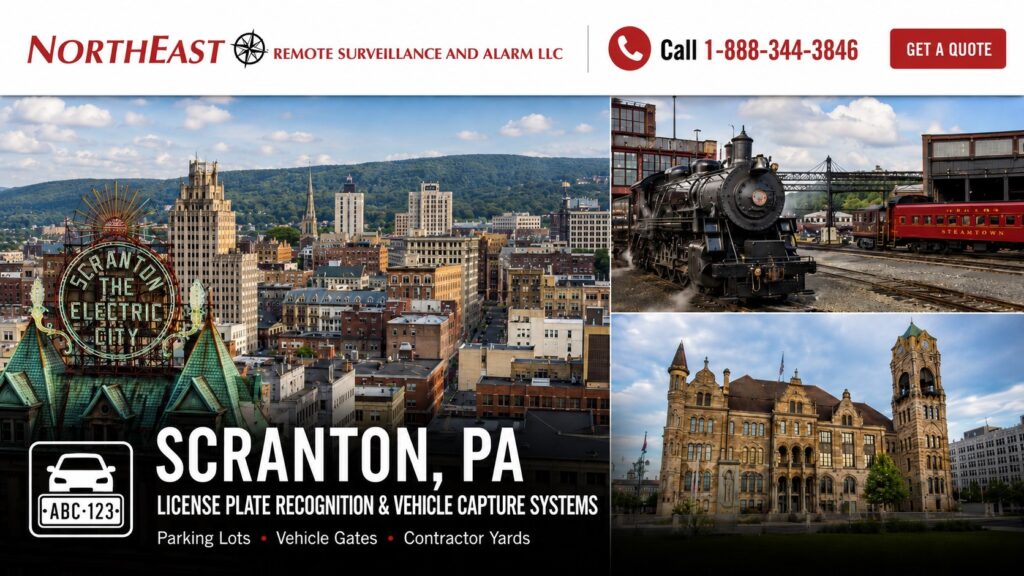
Plan Scranton license plate cameras around where vehicles approach, slow down, and pass through your property.

For the broader system plan and related facility applications, visit the Scranton commercial video surveillance guide.
Northeast Remote Surveillance and Alarm, LLC (NERSA) designs, installs, upgrades, integrates, and supports commercial license plate recognition, license plate capture, and vehicle-identification surveillance systems throughout Scranton, Lackawanna County, and the surrounding Northeastern Pennsylvania market.
These systems can be valuable for:
- Warehouses
- Distribution centers
- Manufacturing facilities
- Contractor yards
- Fleet operations
- Truck and trailer yards
- Industrial parks
- Commercial parking lots
- Controlled vehicle gates
- Multi-building campuses
- Municipal and institutional properties
- Multi-site commercial organizations
Reliable plate capture is not simply a matter of pointing a high-resolution camera toward a driveway.
Vehicle speed, distance, camera angle, lighting, headlights, plate size, exposure, lane geometry, and the operational purpose of the system all influence whether the resulting image is usable.
For broader Scranton surveillance planning, visit:
Commercial Video Surveillance Systems in Scranton, PA →
Explore this guide: License Plate Recognition vs.
License Plate Capture · Why Ordinary Overview Cameras Often Fail to Capture Plates · Vehicle Entrance and Exit Camera Design · License Plate Capture at Commercial Gates · Scranton License Plate Recognition FAQs
License Plate Recognition vs. License Plate Capture
License plate systems can serve different operational purposes.
License Plate Capture
A dedicated camera is positioned to produce a usable image of a vehicle and its plate as it moves through a defined location.
This can help investigators review:
- Vehicle arrivals
- Vehicle departures
- Time of entry
- Direction of travel
- Vehicle appearance
- Plate imagery
License Plate Recognition
License plate recognition, commonly called LPR, uses supported software or analytics to detect and interpret visible license plate characters.
Depending on the selected platform, LPR may provide:
- Searchable plate records
- Time and date history
- Vehicle event lists
- Watch-list capability
- Plate-based investigations
- Integration with other security events
Not every property requires automated recognition.
Some applications only require a dependable plate-quality image.
NERSA designs the system around the actual operational requirement rather than assuming every site needs the same LPR platform.
Why Ordinary Overview Cameras Often Fail to Capture Plates
One of the most common mistakes in commercial surveillance is expecting a wide-angle parking-lot or gate camera to provide reliable plate identification.
An overview camera may show:
- A vehicle entering
- Vehicle color
- General vehicle type
- Direction of travel
- Surrounding activity
But the plate itself may occupy only a very small portion of the image.
Other problems can include:
- Excessive camera angle
- Vehicle speed
- Headlight glare
- Overexposure
- Motion blur
- Poor nighttime lighting
- Long capture distance
- Insufficient focal length
For dependable vehicle identification, the camera should be designed specifically around the vehicle path.
Vehicle Entrance and Exit Camera Design
Entrances and exits are among the strongest locations for vehicle capture because traffic is naturally concentrated into predictable paths.
A commercial entrance may use separate cameras for different objectives.
Vehicle Overview Camera
Provides situational awareness and documents the complete vehicle.
Plate-Capture Camera
Uses a narrower field of view focused on the plate-capture zone.
Driver-Side Camera
May provide additional information about the driver or side of the vehicle where appropriate.
Gate Camera
Documents gate movement, access activity, and surrounding conditions.
Separating these functions often produces stronger evidence than asking one camera to handle every requirement.
License Plate Capture at Commercial Gates
Controlled vehicle gates create strong opportunities for plate capture because vehicles usually slow down or stop.
Potential applications include:
- Employee vehicle entry
- Truck entrances
- Contractor gates
- Fleet yards
- Industrial facilities
- Distribution centers
- Restricted parking areas
A gate-based system may combine:
- LPR
- Access control
- Video intercom
- Vehicle credentials
- Gate-position monitoring
- General surveillance
- Remote release
The gate should be treated as an integrated security point rather than an isolated camera location.
License Plate Recognition for Scranton Warehouses and Distribution Centers
Warehouse and distribution facilities often receive a significant volume of vehicle traffic.
Potential users include:
- Employees
- Delivery vehicles
- Tractor trailers
- Contractors
- Vendors
- Service vehicles
- Fleet vehicles
LPR and vehicle capture may help document:
- Vehicle arrival times
- Vehicle departure times
- Gate activity
- Truck movement
- Trailer-yard access
- Parking activity
For broader warehouse surveillance planning:
Truck and Trailer Yard Vehicle Capture
Truck and trailer yards can contain a large volume of vehicle movement, making targeted vehicle capture particularly valuable.
Potential locations include:
- Main truck entrance
- Exit lanes
- Trailer-yard entrances
- Loading-dock approaches
- Employee vehicle gates
A system may use:
- Vehicle overview cameras
- Dedicated plate cameras
- AI vehicle analytics
- Gate access control
- Remote video monitoring
Large logistics properties should not rely on one distant camera to identify every vehicle entering a multi-acre yard.
Contractor Yard License Plate Capture
Contractor yards frequently contain company vehicles, employee vehicles, equipment, trailers, vendors, and service traffic.
Dedicated vehicle capture can support investigation around:
- Unauthorized vehicle entry
- After-hours activity
- Fleet movement
- Equipment incidents
- Material deliveries
- Gate activity
For broader yard planning:
Contractor Yard Video Surveillance Systems in Scranton, PA →
Parking Lot Vehicle Capture
Commercial parking lots often require both broad surveillance and targeted vehicle identification.
The system may combine:
- Parking-lot overview cameras
- Entrance cameras
- Exit cameras
- Plate-capture cameras
- Building-entrance cameras
The overview camera answers:
What happened in the lot?
The vehicle camera answers:
Which vehicle entered or left?
Those are different surveillance objectives and often require different camera positions.
For parking-specific planning:
Commercial Video Surveillance Planning in Scranton, PA →
Nighttime License Plate Capture
Nighttime vehicle capture is particularly challenging because license plates, headlights, and surrounding lighting can create extreme contrast.
Successful nighttime design may require:
- Dedicated exposure settings
- Infrared illumination
- Specialized plate-capture cameras
- Controlled shutter speed
- Appropriate mounting angle
- Proper capture distance
A camera that produces an attractive nighttime overview image may still fail to capture a readable plate.
LPR performance should therefore be evaluated under the conditions in which vehicles actually enter the property.
Vehicle Speed and Plate Capture
Vehicle speed directly influences plate-capture design.
A car moving through an open commercial driveway requires a different camera configuration from a truck stopping at a controlled gate.
Factors can include:
- Shutter speed
- Exposure
- Lens selection
- Camera angle
- Capture-zone length
- Lane position
Where reliable identification is required, the vehicle path should be evaluated before final camera placement is selected.
Camera Angle and Plate Visibility
License plates should remain large enough and sufficiently square to the camera for dependable capture.
Poor geometry can cause:
- Distorted plates
- Reduced character recognition
- Excessive perspective angle
- Motion blur
- Reflection problems
A convenient mounting location is not necessarily the correct capture position.
NERSA evaluates the relationship between the lane, vehicle approach, camera position, and capture distance before selecting the final view.
Vehicle Classification and AI Analytics
Modern video platforms may provide additional vehicle analytics beyond plate recognition.
Depending on the selected system, capabilities may include:
- Vehicle detection
- Vehicle classification
- Direction-of-travel analysis
- Color-based searching
- Appearance-based search
- Vehicle-event filtering
These analytics can help investigators narrow large amounts of recorded video.
For broader analytics planning:
AI Video Surveillance Systems in Scranton, PA →
Watch Lists and Plate Alerts
Some commercial LPR platforms may support watch lists or notification rules.
Potential operational uses can include alerts for:
- Authorized vehicles
- Restricted vehicles
- Service vehicles
- Known fleet vehicles
Watch-list use should be based on legitimate organizational security requirements and appropriate internal policies.
NERSA configures supported features around the selected platform and customer requirements rather than assuming every deployment needs automated plate alerts.
LPR and Access Control Integration
Vehicle access can be coordinated with commercial access-control systems.
Depending on the platform and application, vehicle access may involve:
- Plate recognition
- Long-range credentials
- Mobile credentials
- RFID
- Gate transmitters
- Intercom release
- Manual operator approval
LPR may serve as:
- An investigative tool
- A secondary verification layer
- Part of a supported vehicle-access workflow
It should not automatically be treated as the sole gate safety or access-control device.
For broader controlled-entry planning:
Commercial Access Control Systems in Scranton, PA →
License Plate Recognition and Video Surveillance Integration
LPR becomes more useful when plate records are associated with surrounding video.
An investigation might begin with a plate event and then continue through:
- Gate overview video
- Parking-lot video
- Warehouse exterior cameras
- Loading-dock cameras
- Building entrance cameras
This creates a broader incident timeline rather than an isolated plate image.
Multi-Lane Vehicle Entrances
Commercial properties with more than one lane require additional planning.
Potential factors include:
- Lane width
- Direction of travel
- Vehicles crossing between lanes
- Trucks blocking smaller vehicles
- Entrance and exit separation
- Camera placement
- Number of plate cameras
One camera may not reliably cover multiple independent lanes.
Each lane should be evaluated according to the required capture objective.
Truck License Plate Capture
Commercial trucks create different capture conditions than passenger vehicles.
Factors can include:
- Tractor front plates
- Trailer plates
- Vehicle length
- Higher plate positions
- Wide turning movements
- Multiple lane positions
- Slower or variable speeds
The system should identify whether the objective is to capture:
- Tractor plate
- Trailer plate
- Vehicle overview
- Company markings
- Driver activity
These may require different views.
Recording and Retention
Vehicle-capture systems should preserve sufficient video history for the organization’s operational requirements.
Storage planning depends on:
- Number of cameras
- Resolution
- Frame rate
- Recording mode
- Compression
- Retention period
- Analytics metadata
- LPR event history
Plate analytics and recorded video should be considered together when planning retention.
Network Infrastructure
Modern LPR cameras may require network connectivity similar to other IP surveillance devices.
Infrastructure may include:
- PoE
- Managed switches
- Fiber
- Wireless bridges
- Outdoor network enclosures
- VLANs
- UPS backup
- Surge protection
Vehicle entrances are often located far from the primary building, so network distance must be considered early in the design.
Pole-Mounted LPR Cameras
Some commercial entrances require cameras positioned on dedicated or existing poles.
Pole installations may provide stronger lane geometry but require planning for:
- Power
- Network connectivity
- Fiber
- Wireless links
- Weather exposure
- Surge protection
- Service access
A pole should be selected because it provides the correct capture geometry—not simply because it is available.
Upgrading Existing Gate and Parking Cameras
Many commercial properties already have cameras aimed toward entrances but still cannot reliably identify vehicles.
Common problems include:
- Excessively wide lenses
- Cameras mounted too high
- Poor nighttime exposure
- Headlight glare
- Obsolete resolution
- Insufficient frame rate
- Poor angle
- No dedicated capture zone
An upgrade may involve:
- Repositioning cameras
- Adding dedicated plate cameras
- Replacing selected cameras
- Adjusting lighting
- Improving network connectivity
- Adding LPR analytics
- Integrating gate video
Existing infrastructure should be evaluated before unnecessary replacement.
Common License Plate Recognition Design Mistakes
Using a Parking-Lot Overview Camera for LPR
A wide scene often provides too little plate detail.
Mounting the Camera Too High
Excessive vertical angle can distort the plate.
Ignoring Headlights
Nighttime headlights can overwhelm an improperly configured camera.
Capturing Too Far Away
Plate detail decreases rapidly with distance.
Covering Several Lanes With One Camera
Multiple lanes can reduce predictable vehicle positioning and plate size.
Assuming More Megapixels Solves Everything
Resolution cannot compensate for poor geometry, motion, lighting, or exposure.
Ignoring Vehicle Speed
Fast-moving traffic requires appropriate capture settings.
Treating LPR as a Standalone System
The strongest deployments connect vehicle identification to broader gate, parking, yard, or facility surveillance.
Design Vehicle Capture Around the Question
Before selecting equipment, determine exactly what the organization needs to know.
Possible questions include:
- Which vehicle entered?
- Which plate was visible?
- When did the vehicle arrive?
- When did it leave?
- Which gate was used?
- Was the vehicle associated with another security event?
- Did the vehicle travel into a yard or parking area?
- Is automated plate recognition required?
- Is a plate-quality image sufficient?
Those answers determine whether the site requires basic vehicle capture, dedicated plate capture, full LPR, or a combined system.
Commercial License Plate Recognition Installation in Scranton, PA
NERSA provides commercial vehicle-capture and LPR planning for businesses throughout Scranton and the surrounding Northeastern Pennsylvania market.
Applications may include:
- Commercial gates
- Employee entrances
- Parking lots
- Warehouses
- Logistics facilities
- Truck yards
- Trailer yards
- Contractor yards
- Manufacturing facilities
- Industrial parks
- Fleet facilities
- Multi-building campuses
System services may include:
- Site assessment
- Lane analysis
- Camera design
- Dedicated LPR cameras
- Vehicle overview cameras
- AI analytics
- Gate integration
- Access-control integration
- NVR/VMS configuration
- Network infrastructure
- Fiber connectivity
- Existing-system upgrades
- Multi-site deployment
Scranton License Plate Recognition FAQs
What is the difference between LPR and a normal security camera?
A normal security camera may provide general surveillance, while an LPR or dedicated plate-capture camera is positioned and configured specifically to capture vehicle license plates within a controlled viewing area.
Can any security camera read license plates?
Not reliably. Plate capture depends on camera angle, distance, speed, lighting, exposure, lens selection, and image detail.
Can LPR work at night?
Yes, when the camera and scene are designed for nighttime plate capture, including headlight management, exposure, infrared, and proper geometry.
Can license plate cameras work at a warehouse gate?
Yes. Warehouse and logistics gates are strong applications because vehicle traffic follows predictable entrances and often slows or stops.
Can LPR integrate with access control?
Depending on the selected systems, plate data may be incorporated into vehicle-access workflows or used alongside other gate credentials.
Can LPR identify trucks and trailers?
Dedicated cameras can be designed around tractor or trailer plate positions, but the required view should be determined during planning.
Can an existing parking-lot camera be converted into an LPR camera?
Sometimes a camera may be repositioned or reconfigured, but many overview cameras lack the required lens, angle, exposure control, or dedicated capture geometry.
Can LPR search historical plate events?
Supported LPR platforms may provide searchable plate histories and event records depending on the selected software and system architecture.
Does every business need automated license plate recognition?
No. Some organizations only need dependable vehicle or plate-quality recorded video rather than automated character recognition.
Can vehicle capture be used with remote video monitoring?
Yes. Vehicle events can be part of a broader monitored surveillance workflow where supported and appropriate.
Build Vehicle Identification Into the Scranton Security Architecture
Commercial vehicle identification works best when it is connected to the rest of the property’s security system.
The plate camera documents a vehicle at a specific chokepoint.
The surrounding surveillance system explains where that vehicle traveled and what occurred next.
The gate system controls entry.
Access control manages authorized users.
Monitoring provides a response layer where required.
For broader Scranton video-surveillance planning:
Commercial Video Surveillance Systems in Scranton, PA →
For commercial parking areas:
Commercial Video Surveillance Planning in Scranton, PA →
For contractor and fleet properties:
Contractor Yard Video Surveillance Systems in Scranton, PA →
For Scranton warehouse and logistics operations:
Northeast Remote Surveillance and Alarm, LLC
Commercial & Industrial Security Systems
Call 1-888-344-3846
Plan Your Next Security Improvement
Tell NERSA about your commercial facility, existing systems, and project priorities. We can help you plan an installation, evaluate an upgrade, or coordinate security across multiple locations.