
NERSA provides commercial security installation in Scranton, PA for businesses, warehouses, manufacturing facilities, and professionally managed properties.

Request a Scranton security assessment
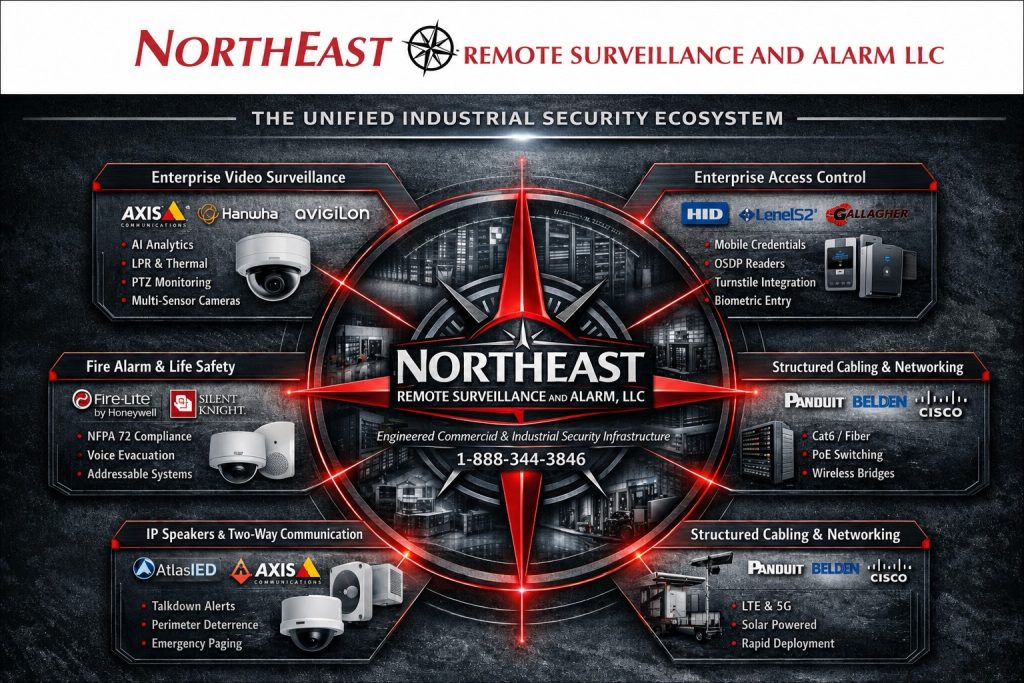
We design, install, upgrade, and support cameras, access control, intrusion alarms, and monitoring as one coordinated commercial security system.
For an occupied facility, we also plan installation windows, assess existing equipment and account access, and test the agreed functions before handover.
Request a Scranton security assessment for your property.
NERSA supports business and professionally managed facilities including:
- Warehouses
- Logistics facilities
- Manufacturing plants
- Distribution centers
- Professional offices
- Healthcare properties
- Schools and institutional buildings
- Municipal facilities
- Contractor yards
- Industrial properties
- Multi-tenant buildings
- Commercial campuses
- Multi-site organizations
A properly designed commercial security system should help answer practical questions:
- Who entered the property?
- Which doors were used?
- What happened before and after an alarm?
- Can important activity be identified on recorded video?
- Who has access to restricted areas?
- Are parking lots, loading docks, gates and exterior approaches visible?
- Can existing equipment be retained where appropriate?
- Can multiple facilities be managed efficiently?
- Is the system documented well enough to support future service and expansion?
For local project experience, see Village Park Apartments in Scranton, where NERSA’s published case study describes security cameras, access control, intrusion alarms, and service dating to 2008.
You can also verify NERSA in the Greater Scranton Chamber member directory and review our chamber and trade memberships.
For properties spanning several communities, coordinate local requirements through Northeastern Pennsylvania Commercial & Industrial Security Systems.
For organizations comparing commercial security installation in Scranton, PA, NERSA can coordinate video surveillance, access control, intrusion alarms, monitoring, intercoms, and upgrade work under one project plan.
Commercial and Industrial Systems Only • Scranton • Warehouses • Manufacturing • Logistics • Offices • New Installations • Upgrades • Monitoring
Explore this guide: Commercial Security Installation Planning for Scranton Facilities · Scranton Commercial Video Surveillance · Scranton Commercial Access Control · Scranton Commercial Intrusion Alarm Systems · Frequently Asked Questions About Commercial Security Systems in Scranton
Commercial Security Installation Planning for Scranton Facilities
For commercial security installation in Scranton, PA, NERSA begins with the property layout, work schedules, entrances, existing equipment and the events the business needs to investigate. That scope guides security camera coverage, controlled doors, intrusion detection, recording, monitoring and long-term support instead of treating each device as a separate purchase.
A warehouse may require:
- Loading-dock visibility
- Trailer-area coverage
- Employee entrance control
- Truck-gate security
- Inventory protection
- After-hours monitoring
A manufacturing facility may require:
- Production-area video
- Restricted-room access
- Contractor entry
- Tool and parts protection
- Shipping security
- Multi-shift administration
An office or institutional property may require:
- Visitor entry
- Employee credentials
- Parking coverage
- Restricted-room protection
- Intrusion detection
- Centralized administration
The correct security system should be designed around the facility, workflow, existing infrastructure, risk and long-term operating requirements.
Scranton Commercial Video Surveillance
NERSA plans Scranton camera installations around the events staff need to review: an entrance, freight handoff, vehicle arrival or activity after closing. The scope should identify camera views, recording needs, cable and network work, authorized users and any equipment suitable for reuse. At handover, confirm that staff can find and export a recorded event from each priority area.
Choose views for entrances, freight movement and exterior activity with Commercial Security Camera Installation & Video Surveillance in Scranton, PA.
Compare recording, camera and evidence requirements in Commercial & Industrial Video Surveillance Systems.
For facilities with freight operations, the Greater Scranton warehouse and logistics guide connects docks, yards, controlled entrances and operating responsibilities.
Scranton Commercial Access Control
Commercial access control can help manage employee entrances, restricted rooms, offices, warehouse transitions, IT rooms, controlled storage and other selected openings.
Plan credentials, door hardware and administrator responsibilities with Commercial Access Control Systems in Scranton.
Scranton Commercial Intrusion Alarm Systems
Commercial intrusion protection should reflect how the property operates after hours, including personnel doors, overhead doors, restricted rooms, interior spaces and alarm partitions.
Match detection zones, arming routines and alarm communication to your facility with Business Alarm Systems & Commercial Intrusion Alarms in Scranton, PA.
Security Monitoring
For a monitored business alarm, define protected areas, arming schedules, authorized contacts and escalation instructions before service begins. Review the existing panel and communication path when taking over a system. Arrange a signal test with the monitoring provider and confirm that reported zone names match the building.
Define event handling, contacts and escalation using Commercial and Industrial Security Monitoring.
Remote Video Monitoring in Scranton
Scranton Remote Video Monitoring explains professional review of selected camera events and a defined after-hours response.
Compare operator review, communication and response options in Remote Video Monitoring and Live Talk-Down.
Integrated and Unified Security Systems
Some Scranton facilities may benefit from video surveillance, access control, intrusion alarms, intercoms, monitoring and compatible security functions operating through a more coordinated environment.
Evaluate how compatible cameras, doors and alarms share event information with Unified Commercial Security Systems.
Greater Scranton Warehouse and Logistics Security
For coordinated planning around warehouses, loading docks, freight handoffs, trailer staging, and truck yards, explore Greater Scranton Warehouse and Logistics Security.
Warehouse Security Planning
Scranton warehouse and distribution security connects property-wide planning with receiving, storage, and operating responsibilities.
For requirements shared across locations, see warehouse and logistics security systems.
Manufacturing and Industrial Security in Scranton
Coordinate employee entry, restricted production spaces and shipping activity with the wider operation of the facility.
Connect restricted spaces, staff movement, and production schedules through Scranton manufacturing plant security.
Use the broader manufacturing security guide for planning across multiple facilities.
License Plate Recognition
Facilities with regular vehicle traffic may benefit from cameras specifically designed for license-plate capture.
Evaluate vehicle speed, approach angle, lighting, and dedicated capture views with Scranton license-plate and vehicle-capture systems.
Commercial Gate Access Control
Vehicle entrances may combine credentials, intercoms, cameras, vehicle detection, remote release and access schedules.
Plan entrance equipment, visitor communication, and release responsibilities with commercial gate access control in Scranton.
For ongoing driver permissions and scheduled access reviews, use the Scranton vehicle-access administration guide.
Small Business Security in Scranton
Professional offices, retailers, restaurants, medical offices, contractors, small manufacturers and service companies may need commercial-grade systems that are properly sized for the property and able to expand as the business grows.
Match practical coverage and administration to a smaller property with Small Business Security Systems.
Multi-Site Security
Organizations operating several properties may require consistent technology, shared user administration, standardized monitoring procedures and centralized video or access management.
Define shared standards and local site responsibilities with Multi-Site Commercial Security Systems.
Healthcare Security
Healthcare and medical properties may require security around staff entrances, public entrances, restricted areas, records, parking, medication storage and other controlled spaces.
Review public access, staff-only areas and sensitive-space planning in Healthcare Security Systems.
Municipal and Institutional Security
Municipal and public-sector properties may include administrative buildings, public works facilities, parking areas, utility properties, storage buildings and other publicly operated environments.
Security should be planned around the facility, users, public access and operational responsibilities.
School and Educational Security
Coordinate visitor entry, staff access and incident response around the school’s operating procedures and responsible personnel.
Include the facility team in planning permissions, visitor handling and escalation procedures.
Commercial Intercom and Visitor Entry
Commercial intercoms may support doors, gates, vestibules, loading areas, visitor entrances and restricted access points.
Plan visitor calls, answering locations and door-release permissions with Scranton Visitor Entry and Video Intercoms.
Security Technologies and Platforms
Scranton businesses may use cloud-managed, on-premise, hybrid or manufacturer-specific platforms according to the property, internal administration and IT environment.
Compare management locations, compatibility and ongoing administration in Security Technologies & Platforms.
Security Infrastructure and Low-Voltage Systems
Review network capacity, power, cabling pathways and documentation before adding or connecting security equipment.
Assess power, cable routes and network connections using Scranton Industrial Security Infrastructure and Cabling.
Security System Maintenance and Support
Scranton security-system maintenance and support helps review unreliable cameras, controlled doors, alarms, account records and upgrade needs at an operating facility.
Existing Security Systems, Upgrades and Takeovers
NERSA specializes in upgrading, retrofitting and taking over existing commercial security systems. Start with equipment condition, account ownership and the operational problem to resolve.
Scranton camera upgrades and takeovers covers recording, camera reuse and migration of an inherited surveillance system.
Scranton access-control upgrades, retrofits and takeovers covers existing doors, credentials, controllers and administrator handover.
New Commercial Security System Planning
New construction, tenant improvements, warehouse fit-outs, facility expansions and major renovations provide an opportunity to plan security before walls, ceilings and pathways are complete.
Planning may consider:
- Camera locations
- Controlled openings
- Door hardware
- Cable pathways
- Equipment rooms
- Network capacity
- Fiber routes
- Alarm zones
- Intercom locations
- Gate infrastructure
- Future expansion
Early planning can reduce unnecessary rework and provide a cleaner long-term installation.
Define the Project Before Selecting Equipment
Start with a walk through the property during a normal working period. Follow an employee, a visitor and a delivery from arrival to departure. Record where each person needs permission, where staff must answer a call and where video should explain an incident. A Scranton office with shared entrances needs a different plan from a fenced contractor yard, even when both projects include cameras and access control.
Separate the immediate problem from future wishes. For example, repeated uncertainty about deliveries may call for a clear dock view, reliable time settings and a simple export process. Adding cameras elsewhere will not resolve that problem if freight still blocks the critical view. Write the desired result in plain language so the proposed equipment and final acceptance checks can be compared with it.
Agree who controls the building, network and daily security procedures. In a leased property, identify which doors, walls and cable pathways require landlord approval. Confirm who can approve an interruption, provide access to restricted rooms and arrange work around tenants. These responsibilities help establish a realistic installation sequence and reduce surprises when technicians reach the site.
Plan Installation Around an Operating Property
A commercial installation should account for the people who must keep working around it. Identify occupied areas, busy delivery windows, shift changes and rooms that cannot be left unsecured. Decide which work can happen during normal hours and which tasks need a separate window. Give the property contact a clear sequence for moving from the existing arrangement to the new one.
For access control, define every opening in the scope, including the reader, controller, power supply and specified locking hardware. Include door, hinge, latch and closer adjustments needed for reliable operation. A valid credential is only part of the test: the door must also open as intended, close and latch reliably, and maintain the required exit operation. Confirm unusual door conditions before finalizing the equipment schedule.
For cameras, compare proposed views with actual lighting, shelving, parked vehicles and seasonal obstructions. Review the route for cables and the location of recording equipment. Where buildings or outdoor areas lack a suitable connection, assess the available power and communications before promising coverage. A camera location is useful only when the system can record and retrieve the intended view consistently.
Document assumptions in the proposal. Distinguish included equipment, installation, configuration, testing and training from work supplied by others. List any recurring software or monitoring services separately. If the project has phases, explain what each phase delivers and what remains unavailable until later work is complete. This makes proposals easier to compare and helps avoid gaps between the installer, property team and IT provider.
Test Real Scenarios Before Handover
Choose representative tests before installation finishes. At an employee entrance, test an authorized credential, a denied credential and the normal closing cycle. At a loading area, review recorded footage of an actual movement through the intended view. For an alarm or monitored event, coordinate the test with the responsible provider and confirm the expected contact procedure. Avoid assuming that a successful live display proves the complete service works.
Include the people who will use the system in acceptance. Ask an authorized manager to find an event, replay the relevant recording and create a usable export. Confirm that ordinary users can perform their duties without receiving unnecessary administrator rights. Check naming, time settings and location labels so staff can identify the correct door or camera during a busy shift.
Keep a record of completed tests and unresolved exceptions. If weather, building access or another dependency prevents a test, identify the outstanding item and the person responsible for closing it. Agree how faults will be reported after handover. A documented exception is more useful than treating a partially tested feature as ready for everyday use.
Keep the System Useful as the Business Changes
Assign an owner for user accounts, schedules and contact lists. Staff departures, new tenants and changes in delivery hours can make yesterday’s settings inappropriate. Keep current instructions for adding users, removing access and requesting support. Store equipment records and configuration information where the business can retrieve them without depending on one employee’s personal account.
Review coverage when shelving, work areas or parking arrangements change. Recheck important recorded views and door operation after changes to the property. Discuss service arrangements, software support and replacement planning before equipment reaches the end of its useful life. These routine decisions help preserve the original purpose of the project as the Scranton facility grows.
Commercial Security Assessments in Scranton
A property-specific assessment may review:
- Entrances
- Emergency exits
- Employee movement
- Visitor movement
- Parking
- Loading docks
- Gates
- Exterior yards
- Inventory
- Restricted rooms
- Existing cameras
- Existing alarms
- Access-controlled openings
- Cabling
- Network infrastructure
- Lighting
- Monitoring
- Future expansion
The objective is to develop the system around actual operational requirements rather than a predetermined equipment package.
Areas Served Around Scranton
NERSA supports qualifying commercial and industrial projects throughout Greater Scranton and Lackawanna County, including:
- Scranton
- Dunmore
- Moosic
- Old Forge
- Taylor
- Dickson City
- Throop
- Jessup
- Olyphant
- Clarks Summit
- Surrounding Lackawanna County communities
- I-81 commercial and industrial properties
- Connected Northeastern Pennsylvania logistics markets
Property requirements should be based on the actual facility rather than the municipality alone.
Why Scranton Businesses Choose NERSA
Northeast Remote Surveillance and Alarm, LLC focuses on commercial and industrial security rather than single-family home systems.
NERSA evaluates projects around:
- Facility operations
- Employees and visitors
- Entrances
- Parking
- Loading docks
- Vehicle movement
- Restricted areas
- Existing security equipment
- Monitoring
- Network infrastructure
- Administrator ownership
- Documentation
- Future expansion
The objective is to provide a commercial security environment that remains practical, manageable, supportable and scalable over time.
Frequently Asked Questions About Commercial Security Systems in Scranton
What types of commercial security systems does NERSA install in Scranton?
NERSA provides commercial video surveillance, access control, intrusion alarms, monitoring, remote video monitoring, intercoms, gate security, license plate recognition, security integration and supporting infrastructure for qualifying properties.
Does NERSA install single-family home security systems in Scranton?
No. Northeast Remote Surveillance and Alarm, LLC focuses on commercial and industrial systems.
Can NERSA upgrade an existing commercial security system?
Yes. Existing cameras, access-control equipment, alarms, door hardware, cabling, networks and administrator access can be evaluated before replacement is recommended.
Can cameras integrate with access control and alarms?
Yes. Compatible systems may provide video context around selected door, alarm, gate and other security events.
Does NERSA install warehouse security systems around Scranton?
Yes. Warehouse and logistics planning may include cameras, access control, alarms, loading-dock coverage, truck-yard visibility, gate access and monitoring.
Does NERSA work with manufacturing facilities?
Yes. Manufacturing security may address employee entrances, production areas, restricted rooms, contractor access, shipping, parking and exterior activity.
Can NERSA provide remote video monitoring?
Yes. Qualifying properties may use remote video monitoring and approved live talk-down for selected events.
Can NERSA support multiple business locations?
Yes. Compatible systems may provide centralized administration, consistent permissions, monitoring procedures and documentation across multiple facilities.
Can existing equipment be reused?
Sometimes. Existing components should be evaluated for condition, compatibility, manufacturer support, cybersecurity and expected service life.
How does a Scranton commercial-security project begin?
The project begins with an assessment of the property, operating conditions, users, entrances, parking, loading areas, existing systems, infrastructure, monitoring requirements and future expansion.
Scranton Security Resources
Scranton warehouse and distribution security: Warehouse planning helps supervisors investigate shortages, returns and disputed orders.
Scranton manufacturing plant security: Manufacturing planning addresses maintenance permissions, contractor sponsorship and shutdown access.
Scranton logistics, truck-yard, and loading-dock security: Truck-yard planning focuses on unexpected arrivals, trailer moves and changed dock assignments.
Scranton commercial gate and vehicle access control: Vehicle-entry planning helps keep recurring and temporary permissions current.
Scranton temporary and mobile surveillance: Temporary-surveillance planning bridges a defined coverage gap during renovation, vacancy or changing site use.
Compliance, Codes & Project Standards
NERSA plans commercial and industrial security work with applicable code, documentation, inspection and authority-having-jurisdiction requirements in mind. Requirements vary by system, property and jurisdiction. These resources support project planning; they do not establish legal compliance, certification or AHJ approval.
Related guidance: Regulatory compliance & inspection readiness · NERSA project standards · Documentation, testing & inspection readiness
Commercial Security Installation in Scranton: Equipment and Infrastructure Options
NERSA’s Scranton commercial security installation planning should start with building access, monitored intrusion, visitor entry, video verification and the facility network as a coordinated project. A warehouse may need dock and shift-based access zones; a mixed office-and-industrial campus may require different permissions at employee, visitor and service doors. The scope should identify door and gate hardware, alarm partitions, authorized response contacts, camera evidence needs, fiber or structured cabling, and the handover tests for each system.
Thermal Monitoring, Fire-Risk Camera Technology and Plate Capture
Optional surveillance technology can include purpose-built thermal cameras for applicable heat-risk or nighttime views, specialized fire-condition detection cameras, dedicated license-plate recognition cameras at industrial vehicle approaches, and AI video analytics for person/vehicle activity or after-hours boundary events. Each option requires its own site-specific view, recording and alert criteria. Thermal surveillance alerts do not automatically satisfy fire-alarm regulations; applications tied to code-required fire detection must use listed equipment and approved design.
Wireless, Cellular and Solar-Assisted Security Integration
Detached yards and industrial buildings may require certified fiber, point-to-point wireless connectivity, cellular data or solar-assisted remote camera packages when a conventional PoE path is impractical.
Confirm distances, seasonality, utility access, network separation, backup power and support requirements before proposing hardware.
For video camera placement, plate capture and analytic commissioning, visit the Scranton security camera installation page.
For employee and truck-gate control, see Scranton access control.
These specialized pages support this broader integrated-installation guide.
Request a Scranton Commercial Security Installation Assessment
Bring a site plan, existing system details and your priorities.
NERSA can define the installation scope, work sequence and acceptance checks for your commercial or industrial property.