Commercial properties throughout Scranton often already have video surveillance equipment in place, but aging cameras, unsupported recorders, limited storage, poor nighttime images, weak remote access, obsolete software, and inconsistent network infrastructure can make the existing system difficult to depend on.
Northeast Remote Surveillance and Alarm, LLC (NERSA) evaluates, upgrades, expands, migrates, and takes over existing commercial and industrial video surveillance systems throughout Scranton, Lackawanna County, and the surrounding Northeastern Pennsylvania market.
A surveillance modernization project does not automatically require removing everything already installed.
The better approach is to determine what can be retained, repaired, reconfigured, repositioned, expanded, integrated, or replaced before a final system design is established.
NERSA can evaluate existing:
- IP cameras
- Analog cameras
- Encoders
- NVRs
- DVRs
- Video management software
- Servers
- Storage
- PoE switches
- Network switches
- Fiber
- Ethernet cabling
- Wireless links
- Camera mounts
- Poles
- Outdoor enclosures
- UPS systems
- User accounts
- Remote-access architecture
- Existing analytics
- Multi-site configurations
For broader Scranton surveillance planning, visit:
Commercial Video Surveillance Systems in Scranton, PA →
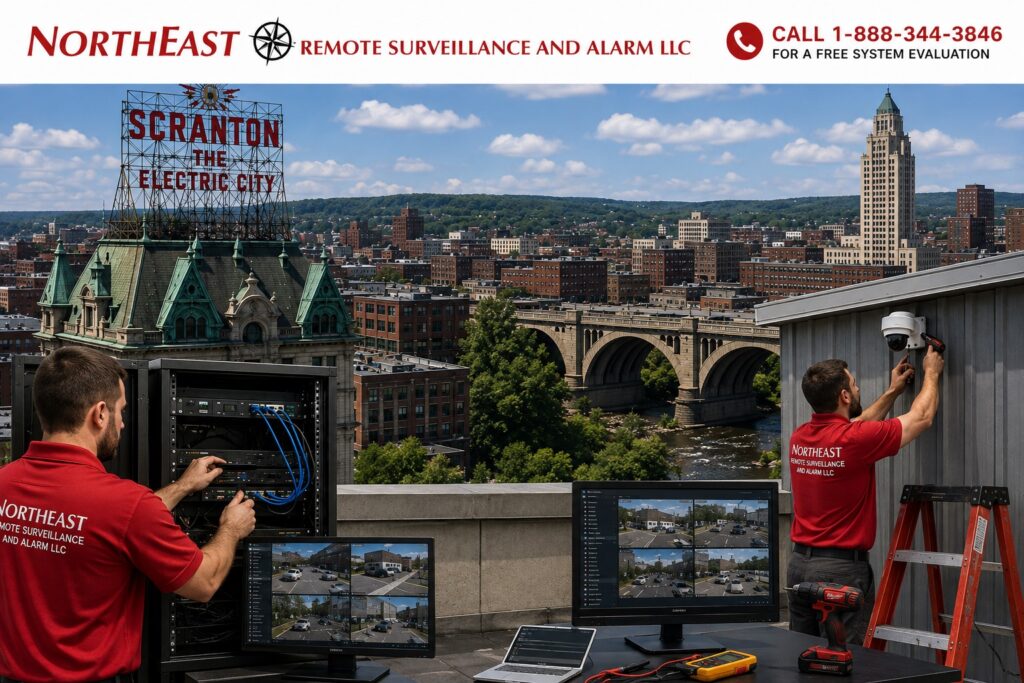
When an Existing Video Surveillance System Needs Attention
A surveillance system may still be recording while no longer meeting the needs of the organization.
Common signs include:
- Cameras frequently going offline
- Blurry or low-resolution video
- Poor nighttime performance
- Missing camera views
- Limited recording retention
- Failed hard drives
- Unsupported NVR hardware
- Outdated software
- Browser compatibility problems
- Difficult mobile access
- Lost administrator credentials
- Unknown passwords
- Unlabeled cameras
- Poor camera naming
- Weak network architecture
- Old PoE switches
- No system-health visibility
- Inconsistent firmware
- Obsolete analog equipment
- Inadequate storage
- Cameras mounted too high
- Cameras aimed too broadly
- No AI analytics
- Separate systems that cannot be centrally managed
A takeover assessment should identify the actual limitations before replacement decisions are made.
Video Surveillance System Takeovers
A system takeover occurs when NERSA evaluates and begins supporting a surveillance system originally installed or maintained by another provider.
The first step should be documentation.
A takeover assessment may identify:
- Camera manufacturer and model
- Recorder manufacturer and model
- Software platform
- Firmware versions
- User accounts
- Administrative access
- Licensing
- Camera IP addresses
- Network topology
- Switch locations
- Fiber connections
- Recording configuration
- Storage capacity
- Retention
- Remote-access configuration
- Existing integrations
- Failed equipment
- Unsupported components
The purpose is to establish ownership and visibility over the system before making changes.
Preserve Compatible Existing Equipment
Not every existing component needs to be replaced.
If equipment remains:
- Functional
- Secure
- Supported
- Compatible
- Properly positioned
- Appropriate for the surveillance objective
it may be practical to retain it.
Possible reusable components can include:
- IP cameras
- Cabling
- Fiber
- Camera mounts
- Poles
- Network switches
- Racks
- UPS equipment
- Storage infrastructure
- Existing VMS servers
Reuse should be based on technical suitability rather than cost alone.
Keeping incompatible or unsupported equipment can create long-term service problems.
Camera Upgrades
Older cameras may no longer provide sufficient image detail or performance.
Camera modernization can address:
- Low resolution
- Poor low-light performance
- Excessive compression
- Weak dynamic range
- Aging infrared
- Limited analytics
- Unsupported firmware
- Coverage gaps
Replacement cameras should be selected according to the scene.
A higher megapixel count alone does not guarantee better surveillance.
The design should consider:
- Field of view
- Lens
- Mounting height
- Distance
- Lighting
- Frame rate
- Required identification detail
Repositioning Existing Cameras
Some surveillance problems are caused by placement rather than camera capability.
A functioning camera may provide poor evidence because it is:
- Mounted too high
- Aimed too broadly
- Obstructed
- Looking into glare
- Positioned behind vegetation
- Too far from the target
- Covering the wrong area
Repositioning can sometimes provide a substantial improvement without replacing the camera.
NERSA evaluates whether each view answers a meaningful operational question.
NVR and Recorder Replacement
Older recorders can become a major limitation even when existing cameras remain usable.
Problems may include:
- Failed hard drives
- Limited camera capacity
- Unsupported operating systems
- Poor remote access
- Storage limitations
- Licensing constraints
- Unreliable hardware
A recorder upgrade may allow a business to retain selected existing cameras while improving:
- Stability
- Recording capacity
- Remote access
- User management
- Search capability
- System administration
VMS Migration
Larger commercial and industrial systems may benefit from migrating to a modern video management system.
A VMS migration can improve:
- Centralized administration
- Multi-site viewing
- User permissions
- Camera organization
- Investigation workflows
- System health
- Integration
- Scalability
Migration planning should confirm existing camera compatibility before the current system is removed.
Analog-to-IP Video Surveillance Migration
Some Scranton commercial facilities still operate older analog surveillance systems.
A migration to IP video can provide:
- Higher image quality
- Better scalability
- Network-based administration
- Improved analytics
- More flexible recording
- Easier multi-site management
Existing coax cabling may sometimes be retained with compatible transmission equipment, while other properties may benefit from new Ethernet or fiber infrastructure.
The correct migration strategy depends on:
- Existing cabling
- Camera locations
- Distance
- Building construction
- Network availability
- Long-term expansion
Storage Upgrades and Retention Expansion
Organizations often discover that their surveillance system retains less video than expected.
Retention may be limited by:
- Increased camera count
- Higher resolution
- Higher frame rates
- Continuous recording
- Failed storage
- Incorrect configuration
NERSA can recalculate storage based on the actual system.
Factors include:
- Number of cameras
- Resolution
- Frame rate
- Compression
- Scene activity
- Recording mode
- Required retention
Storage should be designed around a defined retention objective rather than whatever capacity happened to be installed originally.
AI Analytics Upgrades
Existing surveillance systems may be able to gain improved search and event detection without replacing every camera.
Depending on platform compatibility, upgrades may include:
- Person detection
- Vehicle detection
- Line crossing
- Restricted-zone detection
- Loitering
- Forensic search
- Vehicle classification
- License plate recognition
- Event notifications
Some analytics run on the camera.
Others run through servers or VMS software.
For broader analytics planning:
AI Video Surveillance Systems in Scranton, PA →
Improve Nighttime Surveillance
Nighttime performance is frequently one of the first areas requiring improvement.
Problems can include:
- Dark images
- Headlight glare
- Infrared reflection
- Motion blur
- Poor exposure
- Excessive distance
Improvement may involve:
- Repositioning cameras
- Changing lenses
- Replacing selected cameras
- Adjusting exposure
- Adding lighting
- Improving infrared design
A complete system replacement is not always necessary.
Upgrade Parking Lot Surveillance
Older parking-lot camera systems often provide wide views but limited identification detail.
A modernization project can add:
- Entrance cameras
- Exit cameras
- Targeted vehicle views
- AI analytics
- Pole-mounted cameras
- Better low-light coverage
- Improved recording
For dedicated planning:
Parking Lot Video Surveillance Systems in Scranton, PA →
Upgrade Warehouse Surveillance
Warehouse surveillance systems frequently grow over time without a unified design.
Common problems include:
- Coverage gaps
- Camera overlap
- Poor aisle views
- Missing loading-dock cameras
- Inadequate exterior coverage
- High-mounted cameras with limited detail
Upgrades can add targeted coverage without unnecessarily replacing the entire system.
For warehouse-specific planning:
Warehouse Video Surveillance Systems in Scranton, PA →
Upgrade Manufacturing Surveillance
Industrial systems may include years of mixed equipment installed during separate projects.
A modernization strategy can standardize:
- Camera naming
- Recording
- Network infrastructure
- User permissions
- System administration
- Analytics
- Retention
For manufacturing-specific planning:
Manufacturing Facility Video Surveillance Systems in Scranton, PA →
Network and PoE Upgrades
Video problems are often blamed on cameras when the network is the actual limitation.
A takeover assessment may review:
- Switch capacity
- PoE budget
- Uplink bandwidth
- VLAN configuration
- Fiber
- Cabling
- Outdoor network equipment
- UPS backup
Large surveillance systems should be supported by network infrastructure capable of carrying continuous video traffic.
Fiber Upgrades
Fiber can be especially valuable across:
- Large warehouses
- Manufacturing plants
- Industrial campuses
- Parking areas
- Remote buildings
- Contractor yards
Existing fiber should be documented and tested before additional infrastructure is installed.
In some cases, older fiber can remain a valuable part of the upgraded architecture.
Recovering Administrative Control
A common takeover problem is loss of administrative ownership.
Businesses may inherit systems where:
- The installer owns the admin account
- Passwords are unavailable
- Licensing is unclear
- Remote access uses former employee accounts
- Camera credentials are undocumented
A takeover should attempt to establish clear customer ownership and documented administrative access wherever the platform permits.
Clean Up Camera Names and Documentation
Poor documentation makes a surveillance system difficult to investigate and maintain.
Camera names such as:
Camera 1
Camera 2
Camera 3
provide little operational value.
A stronger naming structure might use:
- Main Entrance Exterior
- Employee Entrance Interior
- Dock 03 Exterior
- Warehouse Aisle 05
- West Gate LPR
- North Parking Overview
Clear naming helps users locate video faster and improves long-term serviceability.
Multi-Site Surveillance Consolidation
Organizations with multiple locations may inherit separate systems from different installers.
A modernization project can evaluate whether sites should remain independent or migrate toward a centralized platform.
Potential benefits include:
- Common user administration
- Remote viewing
- Standard naming
- Site-specific permissions
- Centralized investigation
- System-health monitoring
The appropriate approach depends on existing hardware, network connectivity, and business requirements.
Cybersecurity During a Surveillance Takeover
Older surveillance systems may contain unmanaged network devices or outdated software.
A takeover should consider:
- Password changes
- Firmware status
- User accounts
- Remote-access methods
- Network segmentation
- Unnecessary services
- Administrator permissions
Security cameras and recorders are network-connected devices and should be managed accordingly.
Integration Upgrades
Existing surveillance systems may later need to work with:
- Access control
- Intrusion alarms
- Video intercom
- Vehicle gates
- LPR
- Remote video monitoring
Integration should be added only where it improves operational value.
The objective is not to connect every system simply because a technical integration exists.
Video Surveillance and Access Control Upgrades
An access-control event can become more useful when associated with relevant video.
Potential applications include:
- Employee entry
- Forced doors
- Held-open doors
- Visitor entry
- Vehicle gates
Where compatible platforms are used, a surveillance modernization project can evaluate whether access-control integration is practical.
Remote Video Monitoring Upgrades
Existing exterior camera systems may be candidates for remote video monitoring if they provide sufficient image quality and network reliability.
A monitored design may require:
- Camera repositioning
- AI analytics
- Better lighting
- Reliable connectivity
- Defined response procedures
Remote monitoring should not be added to an unreliable or poorly designed camera system without correcting those deficiencies first.
Phased Surveillance Modernization
Large commercial properties do not always need to upgrade everything at once.
A phased plan might prioritize:
Phase 1
- Failed equipment
- Critical entrances
- Recorder stability
- Storage
- Administrative control
Phase 2
- Parking
- Loading docks
- Exterior coverage
- AI analytics
Phase 3
- Multi-site consolidation
- Integration
- Remote monitoring
- Expansion
This allows the organization to improve the highest-value areas first.
Common Video Surveillance Takeover Mistakes
Replacing Everything Automatically
Existing compatible infrastructure may still provide value.
Keeping Everything Automatically
Unsupported equipment can become a long-term liability.
Ignoring Password Ownership
A system cannot be properly managed if nobody knows who controls it.
Ignoring the Network
Camera reliability depends heavily on the infrastructure carrying the video.
Migrating Without Compatibility Testing
Existing cameras should be tested against the proposed platform.
Increasing Resolution Without Increasing Storage
Higher-resolution video can significantly increase storage requirements.
Adding AI Without Improving Camera Views
Analytics depend on usable imagery.
Expanding Without Documentation
Adding more cameras to an undocumented system increases future complexity.
A Better Video Surveillance Takeover Process
NERSA’s upgrade and takeover approach should answer:
- What equipment exists?
- What still works?
- What is supported?
- What can be securely administered?
- What coverage is missing?
- What footage is currently usable?
- How much video is retained?
- What network infrastructure exists?
- Which components can be reused?
- Which components should be replaced?
- What future expansion is expected?
Only then should the modernization plan be finalized.
Scranton Video Surveillance Upgrade & Takeover Services
NERSA supports existing commercial and industrial surveillance systems throughout Scranton and surrounding Lackawanna County markets.
Services may include:
- Existing-system assessment
- Camera inventory
- Camera replacement
- Camera repositioning
- NVR replacement
- DVR replacement
- VMS migration
- Analog-to-IP migration
- Storage upgrades
- Retention expansion
- AI analytics
- LPR upgrades
- Parking-lot improvements
- Network upgrades
- PoE upgrades
- Fiber integration
- Multi-site consolidation
- Remote-access improvement
- User cleanup
- System documentation
- Integration
- Expansion planning
Video Surveillance Upgrade & Takeover FAQs
Can NERSA take over a camera system installed by another company?
Yes. Existing commercial surveillance systems can be evaluated to determine what equipment, accounts, infrastructure, and documentation are available and what is required to make the system supportable.
Does every existing camera need to be replaced?
No. Compatible cameras that remain functional, secure, supported, and appropriate for their intended view may be retained.
Can old analog cameras be upgraded to IP?
Yes. A migration may involve full replacement, phased replacement, or use of compatible transmission technology depending on the existing infrastructure.
Can an existing NVR be replaced without replacing all the cameras?
Often, yes, depending on camera compatibility and the proposed recorder or VMS.
Can surveillance storage be increased?
Yes. Storage capacity can be recalculated and expanded to support longer retention where the system architecture allows.
Can AI analytics be added to an existing camera system?
Sometimes. Compatibility depends on the cameras, recorder, VMS, server architecture, and analytics platform.
Can existing fiber and network cabling be reused?
Often. Existing cabling and fiber should be tested and evaluated before replacement.
Can NERSA improve poor nighttime camera images?
Yes. Depending on the cause, improvements may involve camera replacement, repositioning, lens changes, configuration, or better lighting.
Can separate locations be consolidated into one surveillance platform?
Potentially. Multi-site consolidation depends on platform compatibility, network connectivity, licensing, and administrative requirements.
What happens if the existing installer controls the passwords?
The available recovery process depends on the manufacturer and current account ownership. Administrative access should be evaluated early during the takeover process.
Upgrade the Scranton Surveillance System Without Starting Over
An effective video surveillance modernization project begins by understanding the system that is already installed.
Some components may remain useful.
Others may be obsolete, poorly positioned, unsupported, or no longer appropriate for the property.
NERSA can evaluate the existing environment and develop a modernization strategy around coverage, image quality, recording, storage, networking, analytics, administration, integration, and future growth.
Continue with the primary Scranton surveillance hub:
Commercial Video Surveillance Systems in Scranton, PA →
For intelligent analytics:
AI Video Surveillance Systems in Scranton, PA →
For warehouse systems:
Warehouse Video Surveillance Systems in Scranton, PA →
For manufacturing facilities:
Manufacturing Facility Video Surveillance Systems in Scranton, PA →
Northeast Remote Surveillance and Alarm, LLC
Commercial & Industrial Security Systems
Call 1-888-344-3846