
Plan Scranton warehouse video surveillance around the entrances, aisles, loading docks, and trailer areas that matter to your operation.

Commercial and Industrial Security and Life Safety Assessment
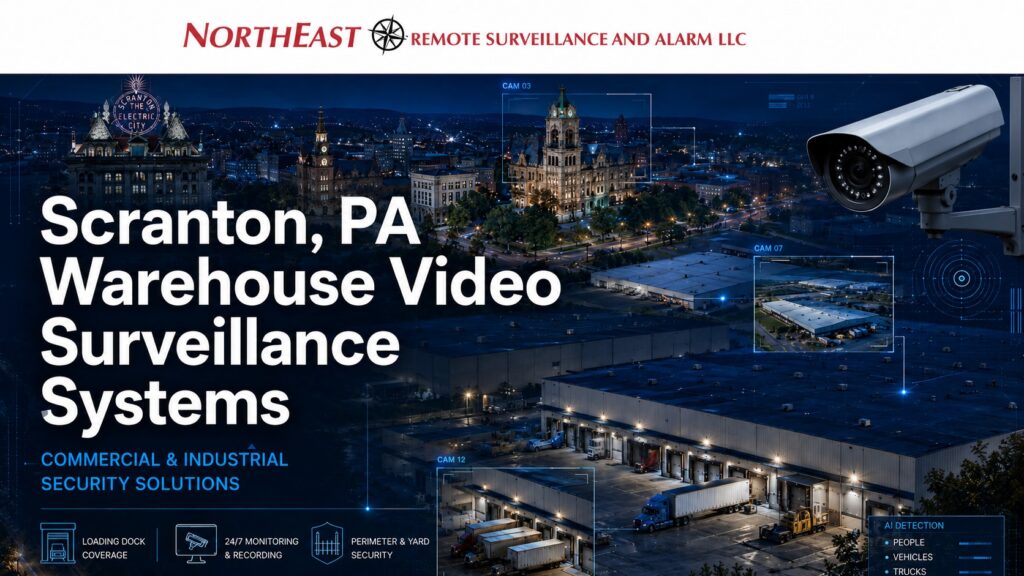
For the broader system plan and related facility applications, visit the Scranton commercial video surveillance guide.
Large buildings, high ceilings, loading docks, trailer yards, employee entrances, shipping areas, inventory aisles, exterior storage, parking lots, and 24-hour operations can create significant gaps when cameras are installed without a facility-specific surveillance plan.
Northeast Remote Surveillance and Alarm, LLC (NERSA) designs, installs, integrates, upgrades, and supports commercial warehouse video surveillance systems in Scranton, Pennsylvania and throughout Lackawanna County and Northeast Pennsylvania.
Our warehouse surveillance systems are designed around actual operating conditions rather than camera count.
A properly engineered system can help provide usable video for:
- Shipping and receiving
- Loading docks
- Trailer yards
- Warehouse entrances
- Employee entrances
- Inventory areas
- Vehicle gates
- Parking lots
- Exterior storage
- Equipment yards
- High-value areas
- Interior aisles
- Perimeter areas
- After-hours activity
- Incident investigation
For the broader Scranton surveillance architecture, visit:
Commercial Video Surveillance Systems in Scranton, PA
Explore this guide: Warehouse Video Surveillance Requires More Than Installing Cameras · Warehouse Surveillance Planning in Scranton · Loading Dock Video Surveillance · Trailer Yard Video Surveillance · Designing Surveillance Around Operational Questions
Warehouse Video Surveillance Requires More Than Installing Cameras
A warehouse may cover tens or hundreds of thousands of square feet while containing dramatically different surveillance environments.
A single facility can include:
- Bright exterior loading docks
- Dark interior storage areas
- High warehouse ceilings
- Narrow aisles
- Open staging areas
- Exterior trailer parking
- Vehicle traffic
- Forklift movement
- Personnel entrances
- Restricted inventory locations
Each area has different image requirements.
An overview camera that works well across a warehouse floor may not provide sufficient detail to identify activity at a loading dock.
A camera positioned to capture general parking activity may not provide the image quality required for vehicle identification.
A camera overlooking an employee entrance may provide excellent facial detail but have little value for monitoring a large exterior perimeter.
NERSA designs warehouse surveillance according to the specific event the camera needs to document.
Warehouse Surveillance Planning in Scranton
A successful warehouse surveillance project begins by defining the facility’s risks and operational priorities.
During planning, NERSA may evaluate:
- Building layout
- Existing camera coverage
- Shipping and receiving flow
- Truck routes
- Employee entrances
- Visitor entrances
- Loading dock positions
- Trailer staging areas
- Inventory locations
- Exterior storage
- Parking lots
- Vehicle gates
- Fence lines
- Lighting conditions
- Existing network infrastructure
- Available fiber
- PoE capacity
- Recording requirements
- Existing NVR or VMS infrastructure
- Remote viewing requirements
- Integration requirements
The objective is to identify where video has operational and security value before selecting cameras.
This reduces unnecessary equipment while helping eliminate blind spots that matter.
Loading Dock Video Surveillance
Loading docks are one of the highest-value surveillance areas in many warehouse and logistics facilities.
These areas may involve:
- Incoming deliveries
- Outbound shipments
- Drivers
- Employees
- Contractors
- Forklifts
- Trailers
- High-value goods
- After-hours activity
A useful loading dock surveillance design may require multiple views.
Exterior Dock Overview
Provides situational awareness around dock positions, trailers, vehicles, and exterior activity.
Dock Door View
Documents activity immediately around the door or opening.
Interior Shipping and Receiving View
Captures movement between the dock and warehouse interior.
Trailer or Vehicle Identification View
Provides a tighter field of view when vehicle identification is required.
Trying to accomplish every objective with one wide-angle camera often creates footage that looks impressive until an incident must actually be investigated.
Warehouse surveillance should be designed for usable evidence, not simply visible coverage.
Trailer Yard Video Surveillance
Trailer yards create unique challenges because they often cover large exterior areas with limited lighting and significant vehicle movement.
Potential surveillance objectives include:
- Monitoring trailer rows
- Documenting truck arrivals
- Monitoring property entrances
- Identifying after-hours activity
- Reviewing trailer movement
- Monitoring stored equipment
- Protecting fuel or material areas
- Detecting activity near restricted zones
Camera placement can involve:
- Building-mounted cameras
- Pole-mounted cameras
- Long-range views
- Dedicated vehicle cameras
- PTZ cameras where appropriate
- Fixed cameras covering defined areas
For larger yards, camera locations should be coordinated with available power, network connectivity, fiber infrastructure, wireless connectivity, and lighting.
Warehouse Interior Video Surveillance
Interior warehouse surveillance requires careful planning because high ceilings and large open spaces can create misleading coverage.
A camera mounted very high may provide excellent situational awareness while producing insufficient detail for identification.
NERSA evaluates areas such as:
- Main warehouse floor
- Rack aisles
- Cross aisles
- Staging areas
- Shipping areas
- Receiving areas
- Packing stations
- High-value storage
- Secure cages
- Inventory control areas
- Employee entrances
- Office-to-warehouse transitions
Different locations may require different lens selections and mounting heights.
The goal is to balance wide situational awareness with the detail required for investigation.
Warehouse Aisle Surveillance
Long warehouse aisles can be difficult to cover properly.
Common problems include:
- Cameras positioned too high
- Excessively wide fields of view
- Racking blocking adjacent areas
- Poor low-light performance
- Cameras aimed across aisles instead of down them
- Insufficient identification detail
Depending on the application, dedicated aisle views can provide better documentation of movement through warehouse storage areas.
For facilities with particularly valuable inventory, surveillance can be concentrated on targeted aisles or storage zones rather than attempting to create identical coverage throughout the entire building.
Employee Entrance Video Surveillance
Employee entrances are important surveillance points because they often generate predictable traffic and offer strong opportunities for identification-quality video.
A properly designed entrance camera may document:
- Employee arrivals
- Departures
- Visitor activity
- Contractors
- Delivery personnel
- Door events
- After-hours entry
These cameras can also become more useful when coordinated with access-control activity.
A system may allow authorized personnel to associate surveillance video with access events, depending on the platforms being used.
Parking Lot Surveillance for Scranton Warehouses
Parking lots present different requirements from interior warehouse spaces.
Surveillance objectives may include:
- General vehicle activity
- Employee safety
- Property incidents
- Unauthorized activity
- Vehicle investigation
- Entrance and exit monitoring
One camera rarely provides both broad parking-lot coverage and reliable identification.
A better design can combine:
Overview cameras for situational awareness
with
targeted cameras at entrances, chokepoints, or other critical areas.
Nighttime lighting, headlights, precipitation, distance, and mounting height must also be considered.
Vehicle Entrance and Gate Surveillance
Warehouse and logistics facilities frequently need video of vehicles entering and leaving the property.
A vehicle entrance may require several different surveillance objectives:
- Vehicle overview
- Driver activity
- Gate activity
- Direction of travel
- License plate capture
- Delivery documentation
License plate capture deserves particular attention.
A standard wide-angle overview camera should not automatically be expected to produce reliable license plate evidence.
Effective plate capture depends on factors including:
- Vehicle speed
- Camera angle
- Mounting position
- Capture distance
- Lens selection
- Exposure
- Headlights
- Nighttime illumination
Where plate identification is operationally important, NERSA can design a dedicated capture view rather than relying on an unrelated overview camera.
AI Video Analytics for Warehouses
Modern warehouse surveillance systems can incorporate AI-based video analytics to help operators identify relevant events and search recorded video more efficiently.
Potential applications include:
- Person detection
- Vehicle detection
- Line crossing
- Restricted-zone intrusion
- Direction-of-travel detection
- Loitering
- Object classification
- Vehicle searching
- Appearance-based forensic search
- Perimeter event detection
Analytics are particularly useful across large facilities where operators would otherwise need to review substantial amounts of recorded video.
AI does not replace correct camera placement.
The quality of analytics depends heavily on the underlying image.
For a deeper discussion of intelligent analytics, see:
AI Video Surveillance Systems in Scranton, PA/scranton-pa-ai-video-surveillance/
Warehouse Perimeter Surveillance
Some warehouse properties require surveillance well beyond the building envelope.
Potential perimeter areas include:
- Fence lines
- Outdoor storage
- Equipment areas
- Trailer lots
- Remote property boundaries
- Rail-side areas
- Utility infrastructure
- Vehicle entrances
Perimeter cameras may combine continuous recording with analytics configured around defined zones.
For example, an analytics rule could prioritize person activity near a restricted exterior area after normal operating hours.
The correct design depends on the physical site, lighting, vegetation, traffic patterns, and required response.
Nighttime Warehouse Surveillance
Warehouse facilities frequently operate after dark, making nighttime image performance a major design factor.
Effective nighttime surveillance can depend on:
- Available site lighting
- Camera low-light capability
- Infrared illumination
- Supplemental lighting
- Vehicle headlights
- Building lighting
- Camera direction
- Mounting height
- Reflective surfaces
A camera specification alone does not guarantee good nighttime video.
Cameras should be evaluated according to the actual scene in which they will operate.
Fixed Cameras vs. PTZ Cameras
Both fixed cameras and pan-tilt-zoom cameras can have roles within warehouse surveillance.
Fixed Cameras
Fixed cameras provide continuous coverage of a defined area.
They are often appropriate for:
- Loading docks
- Entrances
- Warehouse aisles
- Gates
- Inventory areas
- Exterior chokepoints
Because the camera remains aimed at the intended area, the required scene remains recorded.
PTZ Cameras
PTZ cameras can provide powerful situational awareness across large areas when operators need the ability to pan, tilt, and zoom.
They may be useful for:
- Large trailer yards
- Expansive parking areas
- Industrial campuses
- Exterior property monitoring
However, a PTZ camera cannot simultaneously record every direction at full detail.
For critical coverage, fixed cameras commonly provide the primary evidence while PTZ cameras supplement situational awareness.
High-Resolution Cameras and Image Detail
More megapixels do not automatically mean better surveillance.
Useful image quality depends on the relationship between:
- Resolution
- Lens
- Field of view
- Distance
- Camera position
- Lighting
- Compression
- Frame rate
A high-resolution camera covering too broad an area may still provide inadequate identification detail.
Warehouse surveillance should therefore be designed according to the required pixels across the area of interest rather than choosing cameras solely according to their advertised resolution.
Video Recording and Retention
Warehouse facilities can generate significant amounts of video.
Retention planning should consider:
- Number of cameras
- Camera resolution
- Frame rate
- Compression method
- Continuous vs. event-based recording
- Scene activity
- Required retention period
- Redundancy requirements
A large warehouse system should have storage calculated before installation.
Without proper storage engineering, a system may provide fewer days of video than the organization expects.
NERSA designs recording architecture around the actual camera configuration and retention requirement.
NVR, VMS, Cloud, and Hybrid Warehouse Surveillance
Warehouse video surveillance can use several system architectures.
NVR-Based Surveillance
A network video recorder may be appropriate for many single-site commercial facilities.
Video Management System
A VMS can provide greater scalability and management capability for larger or more complex systems.
Cloud-Managed Video
Cloud-managed platforms can simplify remote system access, user administration, and multi-site management depending on the application.
Hybrid Surveillance
Hybrid designs can combine local recording capacity with cloud-based management, analytics, or remote access.
NERSA evaluates:
- Camera count
- Retention requirements
- Internet bandwidth
- Existing server infrastructure
- Remote viewing requirements
- Cybersecurity
- Multi-site growth
- Integration requirements
before recommending the architecture.
Network Infrastructure for Warehouse Cameras
Modern IP cameras depend on reliable network infrastructure.
Warehouse surveillance projects may require evaluation of:
- PoE switches
- Network uplinks
- Fiber backbone
- Ethernet distance
- VLAN configuration
- Bandwidth
- Wireless bridges where appropriate
- UPS backup
- Rack space
- Environmental conditions
- Surge protection
- Network security
Large warehouses frequently contain camera locations beyond normal copper Ethernet distances.
Fiber infrastructure or carefully engineered network extensions may therefore be necessary.
Surveillance design and network design should be coordinated from the beginning.
Fiber for Large Warehouse Surveillance Systems
Fiber is particularly useful across large warehouses, industrial properties, and multi-building sites.
Potential advantages include:
- Long transmission distance
- High bandwidth
- Electrical isolation
- Support for distributed network switches
- Future system expansion
A surveillance system built around a properly designed fiber backbone can often expand more effectively than a system dependent on isolated long cable runs.
Warehouse Video Surveillance and Access Control
Warehouse security becomes stronger when video surveillance and access control are planned together.
Integration may allow authorized personnel to investigate activity associated with:
- Credential use
- Employee entrances
- Forced doors
- Door-held-open conditions
- Gate activity
- Restricted-area access
Potential protected locations include:
- Employee entrances
- Shipping doors
- Offices
- IT rooms
- High-value inventory
- Secure cages
- Exterior gates
The level of integration depends on the selected access-control and video platforms.
NERSA designs these systems around operational requirements rather than forcing unrelated systems together simply because an integration is technically available.
Warehouse Video Surveillance and Intrusion Detection
Video surveillance and intrusion alarm systems serve different functions.
Video documents and provides visual context.
Intrusion systems detect designated alarm conditions.
When coordinated correctly, they can strengthen warehouse security by allowing operators to review video associated with selected alarm events.
Potential applications include:
- After-hours warehouse alarms
- Exterior perimeter activity
- Door alarms
- Restricted areas
- Equipment yards
This can provide useful context before a response decision is made.
Remote Video Monitoring for Warehouse Properties
Facilities with exterior yards, loading docks, or after-hours risk may benefit from event-driven remote video monitoring.
A typical workflow may include:
Detection → Video Event → Operator Review → Defined Response
Depending on the system and monitoring strategy, response procedures may include:
- Reviewing live video
- Contacting authorized personnel
- Audio intervention where installed and appropriate
- Escalation according to predetermined procedures
Remote monitoring is most effective when cameras, analytics, lighting, and response procedures are engineered as one system.
Upgrading Existing Warehouse Camera Systems
Many Scranton-area commercial properties already have surveillance equipment but suffer from incomplete coverage, obsolete technology, or systems that have grown without a consistent design.
Common upgrade issues include:
- Older analog cameras
- Low-resolution IP cameras
- Unsupported NVRs
- Insufficient storage
- Poor nighttime images
- Cameras mounted incorrectly
- Coverage gaps
- Weak remote access
- Aging network switches
- Lack of analytics
- No system health visibility
A modernization project does not necessarily require replacing every component.
NERSA can evaluate what remains usable and develop a phased migration strategy.
Depending on the existing system, an upgrade may involve:
- Camera replacement
- NVR replacement
- VMS migration
- Storage expansion
- Camera repositioning
- New network infrastructure
- Fiber installation
- AI analytics
- Improved exterior coverage
- New loading dock coverage
Multi-Site Warehouse Surveillance
Distribution organizations operating several facilities often need centralized system management.
A scalable platform may allow:
- Centralized users
- Standardized camera naming
- Site-by-site permissions
- Remote viewing
- Common recording policies
- Centralized investigation
- System health monitoring
- Easier expansion
This avoids creating isolated surveillance systems that become increasingly difficult to manage as the organization grows.
NERSA designs commercial surveillance platforms with future expansion in mind.
Common Warehouse Surveillance Design Mistakes
Warehouse systems frequently underperform because cameras were selected before surveillance objectives were defined.
Common problems include:
Mounting Cameras Too High
A high mounting position can create excellent overview images but poor identification detail.
Covering Too Much Area With One Camera
Wide views reduce detail.
Critical locations should have dedicated views.
Ignoring Lighting
A strong daytime image does not guarantee usable nighttime footage.
Assuming PTZ Cameras Replace Fixed Coverage
A PTZ can only look in one direction at a time.
Relying on Overview Cameras for License Plates
Plate capture normally requires a purpose-designed view.
Underestimating Storage
Higher resolutions and longer retention can require substantial recording capacity.
Ignoring Network Infrastructure
Camera performance depends on the network carrying the video.
Installing Analytics Without Testing
Analytics must be configured according to the actual environment and operating conditions.
Designing Surveillance Around Operational Questions
A strong warehouse video surveillance plan should answer specific questions.
Instead of asking:
“How many cameras do we need?”
The better questions are:
- Can we identify who entered this door?
- Can we determine which trailer was at a dock?
- Can we review activity around high-value inventory?
- Can we see vehicles entering the property?
- Can we document shipping and receiving activity?
- Can we verify after-hours perimeter events?
- Can we retrieve relevant footage quickly?
- Can the network support additional cameras later?
- Can the recording system provide the required retention?
Those questions produce a surveillance system that supports real operations.
Warehouse Video Surveillance Installation in Scranton, PA
NERSA provides commercial and industrial warehouse surveillance planning and installation for businesses throughout the Scranton and Lackawanna County market.
System services may include:
- Site surveys
- Camera-system design
- IP camera installation
- Camera replacement
- NVR installation
- VMS deployment
- AI analytics
- Storage design
- Network infrastructure
- Fiber connectivity
- Exterior cameras
- Loading dock surveillance
- Trailer yard surveillance
- Parking-lot surveillance
- Vehicle entrance surveillance
- System integration
- Existing-system upgrades
- Multi-site deployment
- Ongoing system expansion
We focus on commercial and industrial applications rather than single-family home security systems.
Warehouse Video Surveillance FAQs
What cameras are best for a warehouse?
There is no single best warehouse camera. Camera selection depends on the area being monitored, required image detail, lighting, mounting height, distance, environmental conditions, and surveillance objective.
How many cameras does a warehouse need?
Camera quantity depends on the building layout and required coverage. A proper design should identify critical surveillance objectives first rather than determining camera count by square footage alone.
Should warehouse cameras record continuously?
Many commercial facilities use continuous recording for critical areas, although event-based recording may also be appropriate for selected applications. Recording strategy should be coordinated with retention and operational requirements.
Can warehouse cameras identify license plates?
Yes, when a dedicated plate-capture view is engineered for the vehicle approach. A normal wide-angle parking or gate camera may not reliably capture license plates under all conditions.
Can AI cameras detect people in a warehouse or trailer yard?
Many modern commercial platforms can classify people and vehicles and apply analytics to defined zones. Performance depends on the selected equipment, camera placement, lighting, environment, and configuration.
Can video surveillance integrate with warehouse access control?
Depending on the platforms, surveillance video can often be associated with access-control events such as credential use, forced doors, or door-held-open conditions.
Can existing warehouse cameras be reused?
Possibly. NERSA can evaluate existing cameras, cabling, switches, fiber, recording equipment, and network infrastructure to determine which components are appropriate to retain.
How long should warehouse surveillance footage be retained?
Retention requirements vary according to operational needs, company policy, risk, contractual requirements, and other considerations. Storage should be engineered around the organization’s required retention period.
Do large warehouses need fiber for surveillance cameras?
Not always, but fiber is frequently useful when camera locations, network closets, exterior areas, or separate buildings exceed practical copper Ethernet distances.
Can warehouse cameras be monitored remotely?
Yes. Many commercial surveillance platforms support secure remote viewing, and some systems can support event-driven remote video monitoring when designed for that purpose.
Build the Scranton Warehouse Surveillance System Around the Facility
Warehouse video surveillance should provide more than a collection of recorded camera views.
It should help an organization understand what happened, where it happened, when it happened, and—when the system is designed for sufficient image detail—who or what was involved.
For warehouses, logistics facilities, distribution centers, manufacturing properties, and industrial operations in Scranton, the best results come from designing cameras, recording, analytics, networking, lighting, and security integrations as one coordinated system.
Continue with the primary Scranton surveillance resource:
Commercial Video Surveillance Systems in Scranton, PA
For intelligent detection and forensic-search capabilities:
AI Video Surveillance Systems in Scranton, PA
Northeast Remote Surveillance and Alarm, LLC
Commercial & Industrial Security Systems
Call 1-888-344-3846 or request a Commercial and Industrial Security and Life Safety Assessment
Compliance, Codes & Project Standards
NERSA plans commercial and industrial security work with applicable code, documentation, inspection and authority-having-jurisdiction requirements in mind. Requirements vary by system, property and jurisdiction. These resources support project planning; they do not establish legal compliance, certification or AHJ approval.
Related guidance: Regulatory compliance & inspection readiness · Video surveillance compliance · NERSA project standards