
Commercial security should begin with understanding the facility, the operation, the risk conditions, and the people who depend on the system every day.
request a commercial security assessment
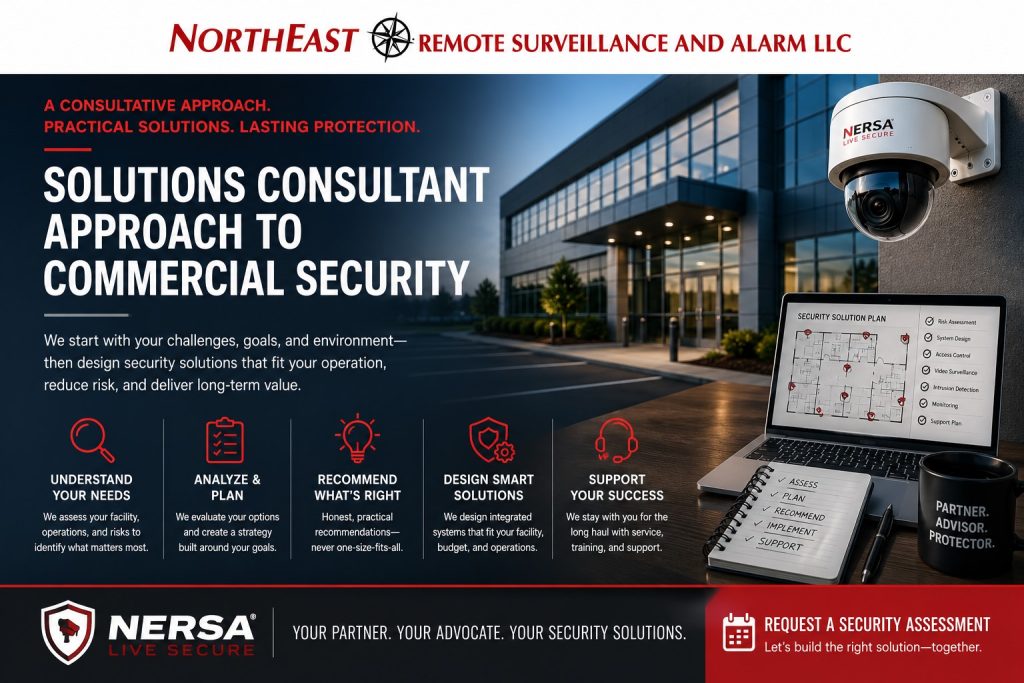
Northeast Remote Surveillance and Alarm, LLC uses a solutions consultant approach instead of forcing commercial and industrial clients into generic equipment packages.
For the broader company trust structure, start with Commercial Security Trust & Project Standards.
Solutions Consultant Approach to Commercial Security
A commercial security project should not start with a camera count, a door count, or a preset alarm package. It should start with a practical conversation about what the business is trying to protect, how the property operates, where risk exists, what systems are already in place, and what problems the client is trying to solve.
NERSA’s solutions consultant approach is built around that process. The goal is to help commercial and industrial clients make better security decisions through assessment, planning, clear communication, responsible recommendations, and long-term support.
This matters because every facility is different. A warehouse with loading docks, trailer parking, employee shift changes, and after-hours activity has different concerns than an office building, manufacturing plant, school, municipal facility, healthcare property, contractor yard, or multi-tenant commercial site. The right system should fit the environment instead of forcing the environment to fit the system.
Recommendations Built Around the Facility
Security equipment is only one part of a successful project. Cameras, access control readers, intrusion devices, alarm communicators, fire/life-safety coordination, intercoms, gate controls, remote monitoring tools, and cloud platforms all need to be selected for a reason.
A sales-only approach often starts with the product. A solutions consultant approach starts with the problem.
That difference matters. A client may ask for more cameras when the real issue is poor lighting, bad camera angles, weak retention, missing signage, lack of after-hours response, or no clear procedure for reviewing incidents. Another client may ask for access control when the real challenge includes door hardware, employee turnover, visitor access, shared credentials, delivery traffic, or unmanaged administrative permissions.
NERSA’s role is to help identify what the system actually needs to accomplish before recommending the equipment.
Facility-First Planning
The facility should guide the security design. That means reviewing how people, vehicles, vendors, employees, visitors, deliveries, contractors, and managers actually move through the property.
In a warehouse or logistics environment, planning may focus on loading docks, overhead doors, shipping and receiving, trailer yards, employee entrances, parking exposure, freight movement, and after-hours activity. In a manufacturing facility, planning may focus on production areas, restricted rooms, contractor entrances, machine areas, tool cribs, perimeter exposure, industrial networks, and operational continuity. In an office, school, healthcare, municipal, or mixed commercial property, the priorities may involve visitor control, employee access, parking visibility, reception areas, interior movement, emergency response, and administrative accountability.
A solutions consultant approach considers those realities before finalizing the system design. The goal is not to sell the largest possible system. The goal is to recommend the right system for the building, the risk, the budget, and the operating environment.
Asking the Right Questions
A good commercial security plan depends on good questions. Before recommending equipment, NERSA looks at what the client is trying to solve and how the system will be used after installation.
Important questions may include:
- What incidents or concerns created the need for the project?
- Who uses the building during business hours and after hours?
- Where do employees, visitors, vendors, and contractors enter?
- Which doors, docks, gates, yards, parking areas, or restricted spaces create the most concern?
- Who will manage user permissions, credentials, mobile apps, and system access?
- Who will review video, receive alerts, respond to alarms, or authorize service changes?
- What existing cameras, alarms, access control systems, wiring, network equipment, or monitoring services are already in place?
- What documentation exists, and what documentation is missing?
- What future expansion, tenant changes, operational changes, or compliance-sensitive conditions should be considered?
These questions help shape the scope before equipment is selected.
Matching Security Design to Business Operations
Commercial security systems should support the way a business operates. A system that looks good on paper can still fail the client if it creates unnecessary disruption, is difficult to manage, misses important activity, or cannot be serviced efficiently.
A solutions consultant approach considers how the client will use the system in real life. That includes who needs access, how alerts should be handled, how incidents will be reviewed, how managers will retrieve video, how credentials will be added or removed, how alarm response should work, and how service issues should be reported.
This is especially important for facilities with multiple managers, shift changes, remote supervisors, IT involvement, tenant spaces, deliveries, public access, or sensitive operational areas. The system should support accountability without creating confusion.
Practical Recommendations Instead of One-Size-Fits-All Packages
Not every client needs the same solution. Some properties need a full security system design. Others need a focused upgrade, better documentation, improved camera placement, access control cleanup, alarm communication updates, remote viewing improvements, or a phased plan that can be completed over time.
NERSA’s broader commercial and industrial security company standards are built around responsible recommendations, not one-size-fits-all selling.
That means explaining when a system should be replaced, when it can be upgraded, when existing infrastructure can be reused, and when a phased approach makes more sense.
The right recommendation should be practical, understandable, and connected to the client’s actual needs. A commercial buyer should know why each major part of the system is being recommended and what role it plays in the overall security plan.
Assessment Before Scope
A stronger scope begins with a stronger assessment. NERSA uses assessment and planning to reduce guesswork before a proposal is built.
The security assessment process helps identify the property conditions, system gaps, infrastructure needs, access concerns, documentation issues, and operational priorities that should shape the project.
This prevents the scope from being based only on assumptions or a quick equipment count.
Assessment-based planning also protects the client. It helps reduce missed details, unclear expectations, unnecessary equipment, weak coverage, poor device placement, and future service problems.
Explaining the “Why” Behind the Recommendation
Commercial buyers should understand the reason behind a security recommendation. A camera should have a purpose. A card reader should have a purpose. An alarm zone should have a purpose. A monitoring workflow should have a purpose. A network or cabling upgrade should have a purpose.
NERSA’s solutions consultant approach is built around explaining that purpose clearly. This helps clients understand the difference between optional upgrades, critical risk areas, infrastructure needs, and long-term support considerations.
When the client understands the “why,” the project becomes easier to approve, install, manage, and support. It also helps owners, facility managers, operations directors, procurement teams, and IT departments make decisions based on risk and operational value instead of guesswork.
Honest Guidance and Client Commitment
A solutions consultant approach depends on trust.
NERSA’s Code of Ethics and Client Commitment reinforces honest recommendations, clear communication, respect for client privacy, responsible system design, documentation, and long-term accountability.
That standard matters because commercial security decisions affect people, property, business continuity, employee accountability, visitor management, incident response, and sensitive operational information. A security provider should not create unnecessary fear, oversell equipment, hide limitations, or leave the client confused after the project is complete.
NERSA’s commitment is to recommend what makes sense for the facility and explain the reasoning in practical terms.
Designing for Long-Term Support
Commercial security systems should be serviceable after installation. That means the design should consider documentation, labeling, user management, network coordination, warranty expectations, support responsibilities, remote access, device placement, and future expansion.
A system that cannot be understood later becomes harder to support. Undocumented cameras, unknown alarm zones, unclear access permissions, unlabeled wiring, unsupported equipment, and unmanaged cloud accounts can create real problems when the client needs service, expansion, or incident review.
NERSA’s solutions consultant approach looks beyond the first installation. The goal is to design systems that can be managed, maintained, and improved as the facility changes.
Supporting Multiple Stakeholders
Commercial security decisions often involve more than one person. A business owner may care about liability and asset protection. A facility manager may care about serviceability and daily operations. An operations director may care about workflow and disruption. An IT department may care about network access and cybersecurity. A property manager may care about tenants, common areas, vendors, and documentation.
A solutions consultant approach helps bring those concerns together. The system should support the people who approve it, manage it, use it, service it, and depend on it during an incident.
This is one reason NERSA avoids generic sales language when planning commercial and industrial systems. The project should be understandable to every stakeholder who has responsibility for the facility.
When a Phased Plan Makes More Sense
Some facilities need immediate correction in one area but long-term planning in others. A phased plan may be appropriate when the property has budget limits, aging infrastructure, multiple buildings, active operations, tenant coordination, network upgrades, or several systems that need improvement over time.
A phased approach can help a client prioritize the most important risks first. For example, a facility may begin with exterior cameras and alarm communication, then move into access control, interior coverage, documentation cleanup, remote monitoring, or infrastructure improvements later.
The key is making sure each phase supports the larger plan. A solutions consultant approach helps prevent disconnected upgrades that solve one problem while creating another.
Commercial Security Without Confusion
Commercial security can become overwhelming when every vendor, platform, camera, recorder, credential, lock, cloud service, monitoring option, and network requirement is presented without context. NERSA’s role is to reduce that confusion.
The client should understand the project in plain language. They should know what the system is intended to do, where it will be installed, how it will be used, what limitations exist, what support is available, and what responsibilities remain with the client after turnover.
That clarity is part of the value of working with a security provider that approaches the project as a consultant, not just an equipment seller.
Request a Commercial Security Assessment
The best way to begin a practical security plan is with a clear review of the property, operations, existing systems, risk areas, infrastructure, documentation, and long-term support expectations.
For the next planning step, request a commercial security assessment with Northeast Remote Surveillance and Alarm, LLC.
Frequently Asked Questions about the Solutions Consultant Approach to Commercial Security
What is a solutions consultant approach to commercial security?
A solutions consultant approach means the security provider starts by understanding the facility, operations, risks, existing systems, infrastructure, and client goals before recommending equipment.
How is this different from selling a security package?
A package approach usually starts with a preset list of equipment, while a solutions consultant approach starts with the problem the client is trying to solve and the way the facility actually operates.
Why should a commercial security project begin with an assessment?
An assessment helps identify risk areas, existing system gaps, infrastructure needs, documentation issues, access concerns, and operational conditions before the project scope is finalized.
Does every commercial facility need the same security system?
No. Warehouses, offices, schools, healthcare facilities, manufacturing plants, municipal buildings, contractor yards, and logistics properties all have different risk conditions and operational needs.
Can a solutions consultant recommend using existing equipment?
Yes. If existing equipment, wiring, infrastructure, or platforms can be used responsibly, a practical recommendation may include reuse, upgrades, cleanup, documentation, or phased replacement.
Why is documentation part of a consultant-style security approach?
Documentation helps the client understand the system, manage future changes, support service calls, review incidents, plan upgrades, and avoid confusion after installation.
Does this approach help with cybersecurity concerns?
Yes. Consultant-style planning considers user permissions, administrator access, remote viewing, account ownership, cloud platforms, mobile apps, network coordination, and responsible handoff.
Solutions Consultant Approach to Commercial Security What is the best first step?
The best first step is to request a commercial security assessment so the facility and project goals can be reviewed before equipment is recommended.