Northeast Remote Surveillance and Alarm, LLC follows a code of ethics and client commitment built around honest recommendations, professional conduct, responsible security planning, client privacy, and long-term accountability.
request a commercial security assessment
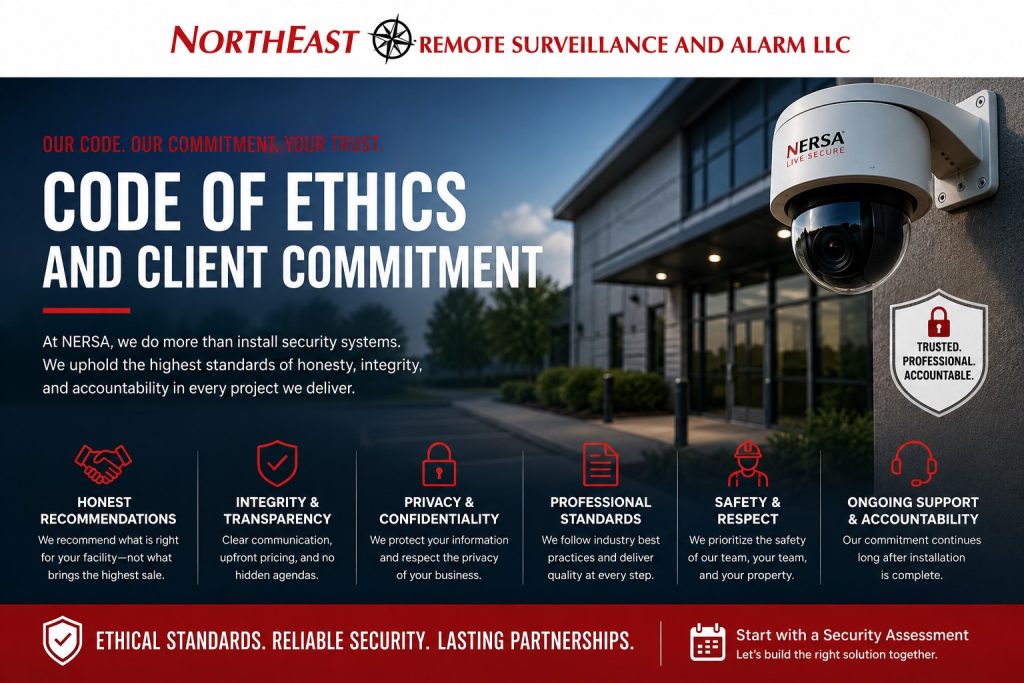
This resource explains the ethical standards NERSA applies when working with commercial and industrial clients before, during, and after a security project.
For the broader company trust structure, start with Commercial Security Trust & Project Standards.
Code of Ethics and Client Commitment
Commercial security work requires trust. Cameras, access control systems, alarm systems, fire/life-safety coordination, monitoring platforms, remote access tools, and security documentation all affect how a business protects people, property, operations, and sensitive information.
NERSA’s code of ethics is built around a simple standard: recommend what makes sense for the facility, communicate clearly, protect the client’s interests, and support the system responsibly after installation. That approach matters because security systems are not just products. They become part of a company’s daily operations, employee accountability, incident response, documentation process, and long-term risk management.
A professional security provider should not rely on pressure, confusion, scare tactics, or one-size-fits-all packages. The client should understand what is being recommended, why it is being recommended, what the system is expected to do, what limitations exist, and how the system will be supported.
Honest Recommendations
NERSA’s first ethical commitment is to provide honest recommendations based on the facility, not on a preset sales package. A warehouse, manufacturing plant, office building, medical office, school, municipal facility, contractor yard, or logistics operation should not be treated like a generic security installation.
A proper recommendation should consider the property layout, access points, operating hours, employee movement, visitor flow, parking areas, loading docks, existing equipment, alarm communication paths, network infrastructure, user responsibility, documentation needs, and long-term support expectations.
Some clients need a full system design. Others need a targeted upgrade, better documentation, improved camera placement, access control cleanup, alarm communication updates, or a phased plan that fits operational priorities. NERSA’s ethical responsibility is to explain those options clearly instead of pushing unnecessary equipment.
No Scare Tactics or Pressure-Based Selling
Security is important, but it should not be sold through fear. NERSA’s standard is to discuss real risk conditions without exaggerating threats or pressuring clients into decisions they do not understand.
A commercial buyer deserves a clear explanation of the risk, the proposed solution, the expected benefit, the limitation of the system, and the reason for the recommendation. That is especially important for owners, facility managers, operations directors, procurement teams, IT departments, and property managers who may need to justify the project internally.
The goal is not to create panic. The goal is to help the client make a practical, informed security decision.
Facility-First Security Planning
NERSA’s client commitment starts with understanding the facility before recommending the system.
The security assessment process is designed to review real operating conditions before equipment is selected.
That means looking at where people enter, where vehicles move, where incidents are most likely to occur, where visibility is weak, where access should be controlled, where alarms should report, where documentation matters, and how the system will be used after installation.
This facility-first approach helps prevent common problems such as cameras that miss critical areas, access control systems that do not fit the door hardware, alarms that do not match the risk, remote access without proper user control, or systems that cannot be serviced easily later.
Clear Communication
Clients should know what they are buying and why. NERSA’s ethical standard is to communicate clearly about project scope, system purpose, limitations, installation expectations, client responsibilities, support expectations, and next steps.
Security proposals should be understandable. They should not hide important assumptions or create confusion about what is included. A professional scope should explain the major components, the reason for the work, the expected outcome, and any known limitations that could affect the project.
Clear communication also matters during installation and turnover. Clients should know when work is expected, what areas may be affected, what training is needed, who will manage users, and how service issues should be reported.
Respect for Client Privacy and Sensitive Information
Commercial security providers may see sensitive areas of a business. That can include camera views, access records, floor plans, alarm zones, employee entrances, office areas, restricted rooms, IT spaces, production areas, medical or administrative areas, and operational routines.
NERSA’s ethical commitment includes respecting client privacy and treating security information responsibly. Security details should be handled with care because they can affect building safety, employee privacy, business operations, and incident response.
This also applies to account access, mobile apps, administrator permissions, remote viewing, monitoring information, and service documentation. A security provider should not be careless with information that helps protect a facility.
Responsible User Access and Account Handling
Modern security systems often include user accounts, mobile access, cloud dashboards, administrator permissions, credential databases, remote viewing, and notification settings. These tools must be handled responsibly.
NERSA’s standard is to help clients understand who should have access, who should hold administrative control, how user changes should be handled, and why shared logins or unmanaged permissions can create problems. Responsible access management supports accountability and helps reduce internal confusion when employees, managers, vendors, or tenants change.
Security systems should protect the business without creating unnecessary access risks.
Documentation as an Ethical Responsibility
Documentation is not just a technical detail. It is part of the client commitment.
Strong security system documentation standards help clients understand what was installed, where devices are located, how systems are organized, what areas are covered, and how the system should be serviced or expanded.
Documentation may include camera schedules, door lists, alarm zone information, network notes, user responsibilities, emergency contacts, monitoring details, and service records.
Without documentation, clients may become dependent on memory, guesswork, or a single person’s knowledge. NERSA treats documentation as part of responsible project delivery because it protects the client long after the installation is complete.
Professional Conduct on Commercial and Industrial Sites
Commercial and industrial properties are active work environments. NERSA’s ethical standards include respect for the client’s facility, employees, workflow, safety expectations, property conditions, and daily operations.
Technicians and project personnel should work professionally, avoid unnecessary disruption, protect finished areas, communicate when access is needed, and respect the operating environment. A security project should improve the facility, not create unnecessary confusion or disorder.
This is especially important in warehouses, manufacturing plants, healthcare facilities, schools, municipalities, offices, and logistics operations where installation work may occur around employees, visitors, vehicles, forklifts, machinery, deliveries, or business-critical operations.
Compliance-Aware Conduct
Security systems can affect doors, egress, fire/life-safety coordination, accessibility, electrical work, alarm communication, documentation, inspections, and owner responsibility. NERSA’s ethical commitment includes recognizing when security decisions may intersect with these issues.
For standards-specific guidance, use NERSA’s Regulatory & Compliance Planning hub.
This ethics page does not replace code review, engineering direction, AHJ requirements, or inspection obligations.
The ethical standard is to avoid careless security recommendations that create problems for the client later. A lock, reader, camera, alarm device, monitoring workflow, or access change should be considered in the context of the facility, the people using it, and the applicable safety environment.
Long-Term Accountability
A security provider’s responsibility does not end when equipment is mounted. Commercial and industrial security systems need support as businesses change employees, operating hours, managers, vendors, tenants, doors, networks, policies, and risk conditions.
NERSA’s client commitment includes long-term accountability through service support, troubleshooting, warranty coordination, documentation review, user changes, system adjustments, and upgrade planning where appropriate.
Long-term accountability also means being clear about what the client controls, what NERSA supports, what the manufacturer covers, and what conditions may require service, maintenance, or future upgrades.
Ethical Security Is Practical Security
Ethical security work is not complicated language or a marketing claim. It is practical behavior applied consistently.
It means telling the truth about what a system can and cannot do. It means designing around the facility instead of forcing a generic package. It means protecting sensitive information. It means documenting the work. It means respecting the property. It means helping the client understand the system after installation.
For NERSA, ethics and client commitment are part of how commercial security projects should be planned, delivered, and supported.
Request a Commercial Security Assessment
The best way to apply these standards to a real facility is to begin with a clear review of the property, risk areas, operations, existing systems, infrastructure, documentation, and long-term support needs.
For the next planning step, request a commercial security assessment with Northeast Remote Surveillance and Alarm, LLC.
Frequently Asked Questions about our Code of Ethics and Client Commitment
What is NERSA’s Code of Ethics and Client Commitment?
NERSA’s code of ethics is built around honest recommendations, clear communication, professional conduct, client privacy, responsible system design, documentation, cybersecurity awareness, and long-term support.
Why does ethics matter in commercial security?
Ethics matters because commercial security providers may affect building access, camera visibility, alarm response, employee privacy, sensitive records, operational routines, and long-term facility protection.
Does NERSA use pressure-based security sales?
No. NERSA’s standard is to discuss real risks and practical options without exaggeration, scare tactics, or unnecessary pressure.
Why is client privacy important in security work?
Client privacy is important because security providers may see camera views, access records, alarm zones, floor plans, restricted areas, account information, and sensitive operational details.
Why is documentation part of ethical security work?
Documentation protects the client by making the system understandable, serviceable, and easier to support after installation, staffing changes, inspections, service calls, or future upgrades.
Does NERSA consider compliance during security planning?
Yes. NERSA takes a compliance-aware approach when security decisions may affect egress, fire/life-safety coordination, accessibility, electrical work, documentation, inspections, or owner responsibility.
What should a client expect from NERSA during a project?
Clients should expect clear communication, practical recommendations, professional conduct, respect for the facility, attention to documentation, responsible access handling, and support after installation.
What is the best first step for a client who wants ethical security planning?
The best first step is to request a commercial security assessment so NERSA can review the facility, understand the risks, and recommend a practical plan.