
Plan warehouse video surveillance around receiving, storage, dispatch, loading docks, exterior yards, and recorded evidence.

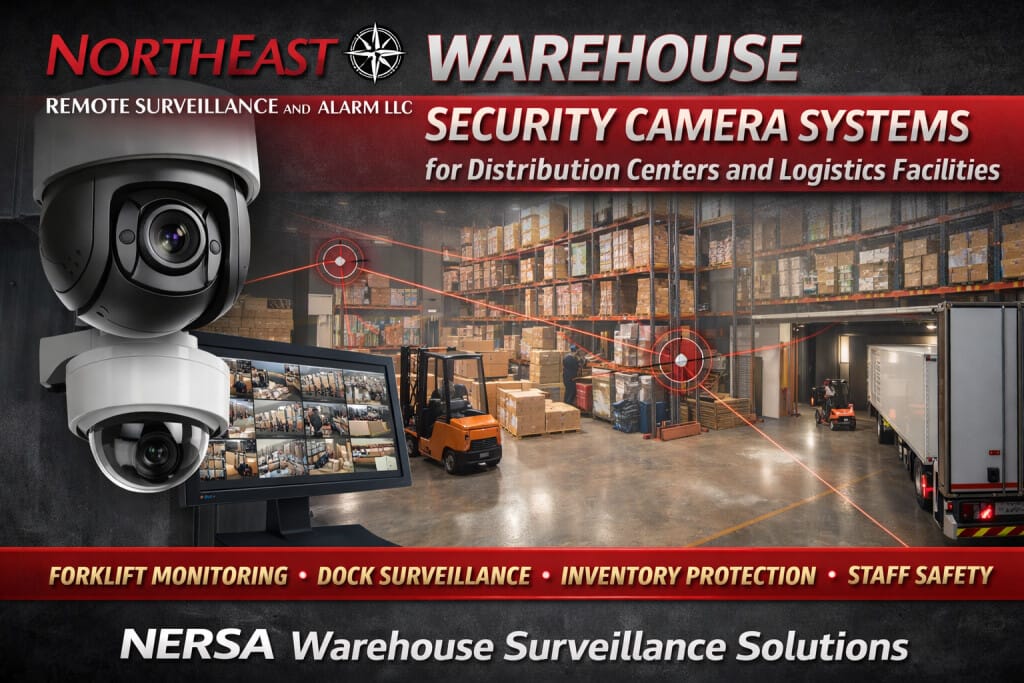
Warehouse Surveillance Designed Around Operations
A warehouse camera system should do more than produce general video. It should provide usable views of the events the facility may need to verify: employee and visitor entry, trailer movement, loading activity, cargo handling, inventory access, vehicle traffic, and after-hours conditions.
Northeast Remote Surveillance and Alarm, LLC designs and installs commercial video surveillance for business and professionally managed facilities. Each project begins with the property, its operating schedule, existing infrastructure, known concerns, and the level of detail required from each camera view.
Coverage Priorities for Warehouses and Distribution Centers
Entrances and Controlled Areas
- Employee and visitor entrances
- Shipping and receiving offices
- Restricted rooms and inventory areas
- Interior transition points
Loading and Cargo Operations
- Dock doors and dock approaches
- Cargo staging and pallet movement
- Forklift lanes and high-activity areas
- Shipping, receiving, and exception review
Exterior and Vehicle Areas
- Truck courts and trailer yards
- Vehicle gates and drive lanes
- Employee and visitor parking
- Perimeters, detached buildings, and storage
Designing for Useful Video
Every camera should have a defined purpose. A wide overview may document activity across a dock or staging area, while a narrower view may be required to identify a person, vehicle, or event at a specific point. Mounting height, lens selection, lighting, obstructions, weather exposure, network capacity, recording settings, and retention requirements all affect the result.
- Image objective: define whether the view is intended for awareness, recognition, identification, or detailed incident review.
- Lighting: account for open dock doors, headlights, reflective surfaces, changing daylight, and dark exterior areas.
- Reliability: plan switching, bandwidth, storage, power, equipment protection, and system health around the facility.
- Administration: establish authorized users, remote access, retention, export procedures, and documentation.
- Scalability: allow for additional doors, cameras, buildings, yards, or locations when expansion is expected.
Existing Systems, Upgrades, and Integration
An existing warehouse system does not automatically require complete replacement. NERSA can evaluate installed cameras, recorders, cabling, fiber, networks, power, software, user access, and documentation to determine what may reasonably be retained, repaired, expanded, reconfigured, migrated, or replaced.
Where compatible and operationally useful, video can also support access control, vehicle-gate security, intrusion detection, intercoms, and remote video monitoring.
Integration should simplify investigation and response without creating unnecessary complexity.
How a Warehouse Surveillance Project Begins
- Facility review: identify operating hours, users, vehicle flow, loading activity, restricted areas, and known concerns.
- Existing-system assessment: document usable equipment, infrastructure, accounts, software, and limitations.
- Coverage plan: assign a practical objective to each proposed camera and confirm the supporting network, power, and storage requirements.
- Installation and commissioning: install, configure, label, test, and document the approved system.
- Training and support: provide authorized personnel with practical system instruction and a clear path for future service.
Confirm Coverage Before Handover
Agree on a representative route through receiving, storage, and dispatch, then review the recorded sequence with the warehouse team. Confirm that the required detail remains usable with normal freight, equipment, and vehicles in place. Include the lighting conditions and operating periods defined in the scope, and record any obstruction or blind spot that remains.
Ask an authorized user to find and export the event using the delivered camera names and timestamps. Check the agreed retention settings, user permissions, and service contacts before accepting the system. When rack layouts, dock assignments, lighting, or operating hours change, review the affected views and records rather than assuming the original coverage plan still applies.
Related Warehouse Security Resources
Use these guides to connect warehouse camera planning with dock coverage, broader facility security, and existing-system upgrades.
- Warehouse and Logistics Security Systems — Coordinate camera planning with the warehouse’s wider security needs.
- Loading Dock Surveillance Systems — Review camera coverage where goods move between trailers and the building.
- Commercial and Industrial Video Surveillance — Explore camera-system planning across the whole property.
- Security System Upgrades, Retrofits, and Takeovers — Assess existing cameras and recording equipment before replacing them.
Frequently Asked Questions
Can NERSA evaluate an existing warehouse camera system?
Yes. The evaluation can include cameras, recorders, cabling, fiber, networks, power, software, remote access, user accounts, retention, and available documentation.
How many cameras does a warehouse need?
The appropriate quantity depends on the required views, facility layout, dock count, aisle arrangement, ceiling height, exterior areas, lighting, and operational objectives. Camera count should follow the coverage plan.
Can warehouse cameras cover loading docks and trailer yards?
Yes. Dock doors, truck courts, trailer staging, gates, drive lanes, and exterior storage can be included when the site conditions and project scope support those views.
Does NERSA work on single-family home systems?
No. NERSA does not provide security installations for individual homes or single-family residences. We serve businesses, industrial and institutional facilities, and professionally managed apartment communities, including shared entrances, common areas, and grounds.
Request a Warehouse Security Assessment
Planning a new warehouse surveillance system, expansion, upgrade, or takeover? NERSA can review the facility and help define the appropriate next step.
Compliance, Codes & Project Standards
NERSA plans commercial and industrial security work with applicable code, documentation, inspection and authority-having-jurisdiction requirements in mind. Requirements vary by system, property and jurisdiction. These resources support project planning; they do not establish legal compliance, certification or AHJ approval.
Related guidance: Regulatory compliance & inspection readiness · Warehouse & logistics compliance · NERSA project standards