
Coordinate truck yard security around vehicle gates, trailers, fence lines, outdoor assets, and connected buildings.
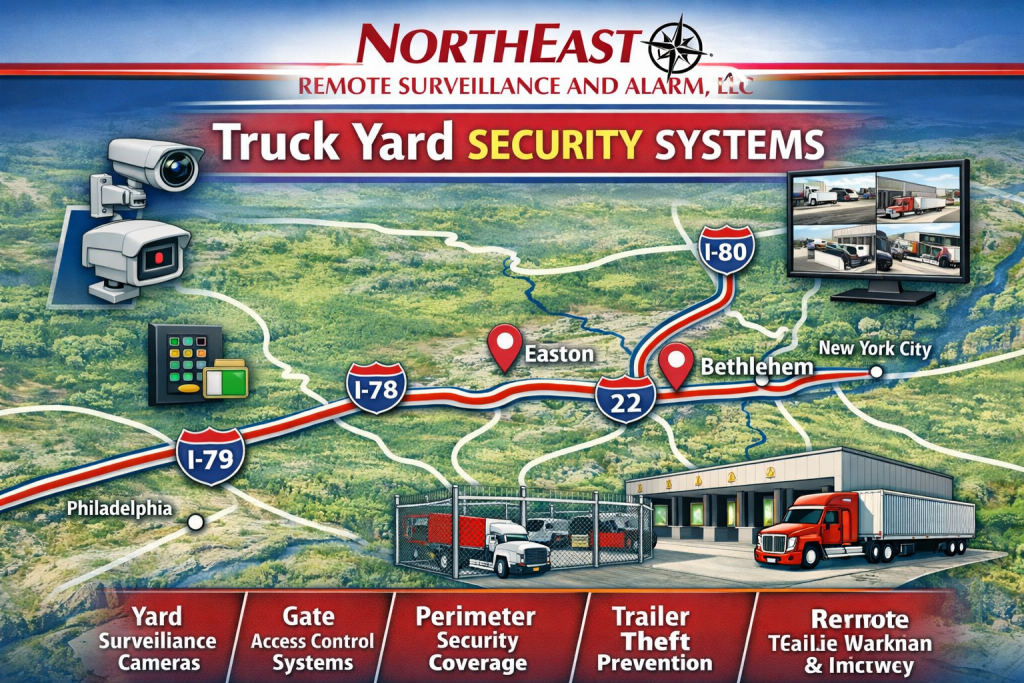
Truck Yard Security Systems in Pennsylvania and the Mid-Atlantic
Truck yards are some of the most exposed commercial properties in the industrial market. Unlike a standard office or retail site, a truck yard has constant vehicle movement, large outdoor areas, trailer activity, multiple entry points, and a much larger perimeter to control.
A truck yard may include vehicle gates, fencing, parked tractors, loaded and empty trailers, containers, laydown areas, employee parking, dispatch offices, fuel zones, maintenance buildings, loading areas, and outdoor storage sections. Each area creates a different security concern, and those concerns cannot be solved with a few basic cameras attached to the building.
A properly designed truck yard security system treats the yard as an operating environment. It helps control entry, document vehicle movement, monitor trailer rows, protect fence lines, reduce trespassing, secure equipment, and give authorized managers clear visibility into important activity across the property.
Northeast Remote Surveillance and Alarm, LLC designs and installs truck yard security systems for commercial and industrial properties that need stronger perimeter protection, better gate control, clearer incident documentation, and more dependable after-hours security.
Whether the property is a logistics terminal, warehouse truck court, contractor yard, trailer storage lot, fleet yard, cross-dock facility, or industrial site, the objective is the same: protect the yard before a gate breach, trailer theft, perimeter intrusion, equipment loss, or liability claim exposes the weak point.
For broader protection covering the warehouse and the surrounding yard, visit Warehouse Security Systems.
What Is a Truck Yard Security System?
A truck yard security system is a layered commercial security solution designed around outdoor industrial yards, vehicle gates, access roads, trailer compounds, truck courts, perimeter lines, equipment areas, and the buildings connected to yard operations.
Depending on the property, the system may include:
- vehicle-gate monitoring and access control
- yard surveillance cameras
- trailer-row coverage
- perimeter and fence-line visibility
- employee, contractor, and vendor access management
- vehicle-entry documentation
- monitoring of remote corners and outdoor storage areas
- protection for dispatch offices, shops, and maintenance buildings
- remote viewing for authorized owners and managers
- after-hours event review
The purpose is not simply to watch an open lot. The purpose is to give the owner or operator practical control over activity that affects the security and operation of the yard.
After an incident, a properly designed system should help answer questions such as:
- Who entered the property?
- When did the vehicle arrive and leave?
- Was the gate opened during an approved period?
- Did an unauthorized vehicle follow another vehicle through the gate?
- Which truck, trailer, container, or piece of equipment moved?
- Was someone near the fence line after hours?
- Did activity continue from the yard into a building or loading area?
- Is the recorded video clear enough to support an investigation?
If the system cannot provide clear answers, the property remains exposed.
Why Truck Yards Need a Dedicated Security Design
Truck yards have a different risk profile than standard commercial properties. They commonly combine large outdoor perimeters, vehicle traffic, trailer storage, contractor access, vendor activity, limited overnight staffing, isolated fence lines, cargo exposure, equipment theft risk, gate tailgating, and inconsistent visibility across wide areas.
A front-door office system does not solve truck-yard problems. The design has to follow how vehicles, trailers, employees, vendors, and visitors actually move through the property.
A complete yard-security plan should account for:
- vehicle entry and exit points
- perimeter exposure
- trailer and container locations
- after-hours movement
- fence-line approaches
- remote corners and blind spots
- public, employee, contractor, and restricted access
- outdoor equipment and material storage
- dispatch, maintenance, and office buildings
- loading areas and truck courts
- practical incident review
For many industrial properties, the yard is the first place a security failure begins. One uncontrolled gate, one dark trailer row, or one exposed fence section can create access to the rest of the site.
Facilities That Need Truck Yard Security Systems
Truck yard security systems are built for commercial and industrial properties where vehicles, trailers, freight, equipment, employees, vendors, and outdoor storage areas need coordinated protection.
Common property types include:
- truck yards
- trailer storage properties
- logistics terminals
- warehouse truck courts
- third-party logistics yards
- contractor equipment yards
- industrial fleet yards
- container storage locations
- maintenance and dispatch facilities
- cross-dock and shipping properties
- fenced commercial storage yards
- manufacturing properties with outdoor fleet or trailer activity
These systems are especially important for sites with gated entry, fenced perimeters, high-value equipment, recurring contractor traffic, unattended trailers, after-hours operations, multiple yard buildings, limited overnight staffing, or a history of theft, trespassing, vandalism, or undocumented vehicle activity.
Layered Protection Across the Truck Yard
A truck yard should not be divided into unrelated security pieces. The gate, trailer rows, perimeter, office, shop, loading areas, and remote sections of the property should work together as one practical security environment.
Vehicle Gates and Entry Lanes
The vehicle gate is one of the most important control points in the yard. If entry is weak or undocumented, the rest of the property becomes harder to protect.
Gate security can help manage:
- authorized employee entry
- contractor and vendor access
- after-hours restrictions
- controlled entry into fenced compounds
- vehicle-entry history
- separation of approved and unauthorized traffic
- investigation of tailgating or unapproved access
- documentation of gate activity during an incident
The objective is to establish who entered, when entry occurred, whether the activity was authorized, and what happened immediately before and after the gate opened.
For vehicle-entry planning, visit Commercial Gate Access Control Systems for Truck Yards and Industrial Facilities.
Trailer Rows and Outdoor Assets
Truck yards may store loaded trailers, empty trailers, containers, fleet vehicles, tools, materials, machinery, fuel, and other commercial assets. These areas require more than broad views of the lot.
A stronger design should help document:
- trailer movement
- vehicles approaching parked trailers
- after-hours activity between trailer rows
- trailer tampering
- movement near containers or outdoor storage areas
- activity around high-value equipment
- vehicles entering or leaving with assets
- the route an intruder used through the property
Trailer protection depends on the relationship between the gate, the yard layout, the perimeter, and the available video. A site that cannot connect those events is much harder to defend after a loss.
For freight and trailer risk planning, visit Cargo Theft Prevention Systems.
Fence Lines, Remote Corners, and Perimeter Approaches
Perimeter exposure is one of the most common truck-yard security problems. Incidents frequently begin away from the main office, where the property is darker, less visible, and less likely to have regular employee activity.
A truck yard security design should evaluate:
- rear and side fence lines
- corner transitions
- isolated outdoor storage sections
- brush lines and undeveloped property edges
- neighboring lots and adjoining access paths
- low-visibility areas near gates
- weak fence sections
- possible climbing, cutting, or walk-in approaches
- routes from the perimeter to trailers, equipment, or buildings
Perimeter coverage is not just about seeing a fence. It is about identifying where someone could enter, where they could hide, what they could reach, and whether the system would provide usable evidence afterward.
Yard Surveillance and Night Visibility
Cameras are a central part of most truck yard security systems, but wide-open space requires deliberate placement. A few high-mounted cameras may show that something happened without showing enough detail to explain what happened.
Coverage may be needed at:
- gate lanes and vehicle approaches
- trailer rows
- fence lines
- remote corners
- dispatch and office entrances
- equipment and maintenance areas
- fuel zones
- truck courts
- employee parking
- staging areas
- outdoor storage sections
- travel routes between the yard and connected buildings
The system should provide useful coverage under the actual conditions of the property. Distance, darkness, glare, vehicle headlights, weather, building placement, trailer height, fencing, and changing yard layouts can all affect image quality.
A strong design balances wide-area awareness with the detail needed to review a vehicle, person, gate event, trailer movement, or perimeter incident.
Dispatch Offices, Shops, and Yard Buildings
Many truck yards include dispatch offices, maintenance buildings, fleet offices, storage rooms, employee entrances, and doors connecting the yard to indoor areas.
Those buildings may need controlled entry, credential history, scheduled access, and alarm protection. The purpose is to keep yard activity from becoming undocumented building access and to protect records, tools, inventory, management areas, and after-hours entry points.
Depending on the facility, authorized users may enter with keycards, fobs, mobile credentials, or other approved methods. Event records can then help management understand whether a door opening was normal employee activity, contractor access, a door-prop issue, or part of a larger yard incident.
Alarm protection may also be appropriate for dispatch offices, storage rooms, shop buildings, side doors, rear doors, and other enclosed spaces connected to the yard. These systems are most useful when they support the broader yard-security strategy rather than operating as an isolated layer.
Loading Areas and Truck Courts
Truck yards often connect directly to loading docks, shipping areas, receiving lanes, warehouse doors, and truck courts. An incident may begin at a fence or gate and continue toward a trailer, dock lane, shipping entrance, or warehouse door.
The design should account for those transitions so that vehicle movement, trailer activity, dock access, and building entry can be reviewed as one event. When yard and loading-area coverage are treated separately, important activity can fall between the systems.
Remote Management and Multi-Site Visibility
Truck yards often operate outside normal business hours. Late arrivals, early departures, weekend activity, contractors, vendors, second shifts, and unattended trailer storage can create security questions when management is not on site.
Authorized users may need to:
- check live yard conditions
- review gate activity
- confirm vehicle movement
- inspect overnight events
- investigate a shipment or trailer issue
- verify activity near a fence line or building
- review multiple yards from one management view
- respond more quickly to a security concern
Remote access is not intended to replace a properly designed physical system. It gives approved managers a practical way to verify important activity and review events without traveling to the property every time a question arises.
Common Truck Yard Security Weak Points
Uncontrolled Vehicle Entry
A gate without reliable control or event documentation makes it difficult to establish who entered, when the entry occurred, and whether the vehicle was authorized.
Fence-Line Gaps
A yard may appear secure from the front while rear or side perimeter areas remain exposed. Remote fence sections often become the easiest path into the property after hours.
Blind Trailer Rows
Trailers can block views and create narrow areas where movement is difficult to document. Coverage has to account for how trailers are actually staged, not just the empty-yard layout.
Poor Night Detail
A camera view that looks acceptable during the day may fail after dark because of distance, insufficient lighting, glare, headlights, or poorly positioned equipment.
Disconnected Yard and Building Systems
When gates, yard cameras, office access, alarms, and loading areas operate without a coordinated plan, management may have pieces of an event without a clear timeline.
Weak Incident Documentation
If authorized personnel cannot quickly locate usable footage of a gate event, trailer movement, perimeter breach, or equipment issue, the system is not providing enough operational value.
Why a Few Cameras Are Not Enough
Truck yard security is not simply a matter of installing several pole-mounted cameras and locking the gate at night.
A complete strategy should consider:
- where vehicles approach the property
- how each gate operates
- whether vehicles can tailgate through entry points
- how trailers and containers are staged
- which fence sections are easiest to approach
- where after-hours activity occurs
- how lighting and headlights affect video
- whether the office, shop, and maintenance areas are protected
- how loading areas connect to the yard
- whether managers can review events quickly
- whether the recorded evidence is usable in real conditions
Without that planning, a property can appear protected while still leaving the most important routes, assets, and entry points exposed.
The strongest truck yard systems connect the perimeter, gate, trailer rows, outdoor assets, yard buildings, loading areas, and management view into one coordinated design.
What We Evaluate During a Truck Yard Security Assessment
Every truck yard has a different layout, traffic pattern, operating schedule, and risk profile. A practical assessment should follow the property rather than forcing the yard into a generic design.
Important considerations include:
- the number and type of vehicle gates
- normal employee, contractor, vendor, and visitor traffic
- trailer and container staging patterns
- high-value equipment and outdoor storage locations
- fence-line conditions and possible approach routes
- remote corners and low-visibility sections
- lighting, glare, and nighttime operating conditions
- dispatch, shop, maintenance, and office entrances
- loading-dock and warehouse connections
- network, power, mounting, and communication requirements
- the people who need live and recorded access
- the way incidents will be reviewed and documented
The final system should match the actual operation of the yard, provide useful evidence, and remain manageable for the people responsible for the property.
Truck Yard Security for Pennsylvania and Mid-Atlantic Facilities
Northeast Remote Surveillance and Alarm, LLC supports commercial and industrial security projects across Pennsylvania and select Mid-Atlantic markets, with experience in warehouse, logistics, truck yard, industrial, contractor yard, and multi-site commercial environments.
Truck yard planning may involve properties near major freight routes and industrial corridors, including I-78, Route 22, Route 33, I-80, distribution centers, warehouse districts, manufacturing areas, industrial parks, and regional logistics markets.
The system should be designed around the individual property rather than a city-swapped template. Gate count, yard size, fencing, trailer layout, lighting, staffing, operating hours, building connections, and existing infrastructure all affect the final design.
Frequently Asked Questions About Truck Yard Security Systems
What areas should a truck yard security system cover?
The design should account for vehicle gates, entry lanes, trailer rows, perimeter fencing, remote corners, outdoor equipment, fuel or maintenance areas, employee parking, dispatch offices, shops, loading areas, and the travel routes connecting those locations.
Can gate activity and recorded video be reviewed together?
Yes. When gate control and video are planned as part of the same yard-security strategy, authorized managers can compare entry activity with recorded footage to understand which vehicle entered, when the gate opened, and what happened in the surrounding area.
How should remote fence lines and yard corners be protected?
Remote sections should be evaluated for approach routes, blind spots, lighting conditions, camera distance, nearby cover, and the assets an intruder could reach after crossing the perimeter. The goal is usable visibility of the approach and the activity that follows.
Can authorized managers review multiple truck yards remotely?
A properly designed system can provide approved users with remote access to live conditions, recorded events, gate activity, and multiple sites from a central management view, depending on the equipment and system configuration selected for the operation.
Do dispatch offices and shop buildings need separate protection?
Often, yes. Buildings connected to the yard may need controlled entry, access history, and alarm protection for offices, storage rooms, maintenance areas, employee entrances, and doors leading directly from the yard.
Secure the Yard Before a Loss Exposes the Weak Point
A truck yard is not simply open space surrounding a building. It is a high-risk operating environment where vehicles, trailers, employees, vendors, gates, fence lines, equipment, loading areas, and buildings meet.
One weak gate, one blind trailer row, one exposed fence section, or one missing overnight event can lead to stolen equipment, unauthorized entry, cargo loss, property damage, operational disruption, and difficult liability questions.
Northeast Remote Surveillance and Alarm, LLC designs truck yard security systems for commercial and industrial properties that need stronger perimeter protection, better gate control, clearer trailer visibility, and more dependable after-hours documentation.
Whether you operate a truck yard, trailer storage property, logistics terminal, contractor yard, warehouse yard, fleet yard, cross-dock facility, or industrial site, NERSA can design a system that protects the perimeter, controls vehicle entry, monitors the yard, and supports the connected property as one coordinated security strategy.
Call 1-888-344-3846 or request a commercial security assessment.