
Plan cargo theft prevention in Allentown around trailer storage, loading docks, freight handoffs, vehicle access, and after-hours response.

Request a Commercial Security Assessment
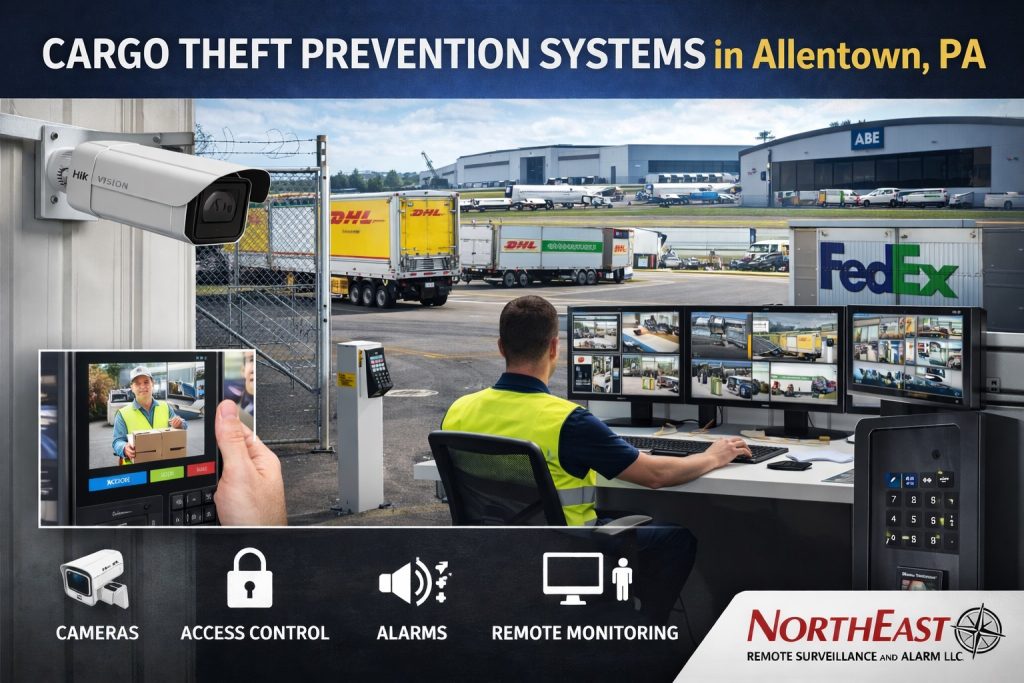
Coordinate this area with the rest of the facility through Allentown warehouse security planning.
Plan cargo theft prevention in Allentown around each stage of freight movement. Review where shipments arrive, wait, transfer and depart, along with areas where cargo remains exposed.
Warehouses and logistics sites handle valuable inventory, outside drivers and several employee shifts. Freight areas may stay busy long after office staff leave. Security coverage needs to account for those hours.
NERSA designs cargo security around daily freight operations. We review docks, trailer parking and shipping areas. We also check vehicle routes and the periods when fewer staff are present.
For broader city-level commercial and industrial security planning, begin with Commercial Security Systems in Allentown, PA.
Commercial & Industrial Properties Only • Warehouses • Distribution Centers • Logistics Facilities • Freight-Handling Properties
Cargo Theft Risk Starts Where Freight Moves
Trace a shipment from gate arrival through staging, loading and departure. Mark where custody changes, where loaded trailers wait and who approves each movement. Check those locations against camera views, access records and dispatch paperwork. A wide view of the yard may not capture enough detail to review a freight handoff.
Trailer Activity and Freight Exposure
Distinguish loaded, empty, sealed, and awaiting-pickup trailers in the operating plan. Record the trailer identifier, assigned location, authorized carrier, and pickup approval in the business’s freight process. Cameras can corroborate movement but cannot establish that a pickup was authorized. Test whether parked trailers obstruct views when the yard is full.
Loading Dock Cargo Theft Prevention
Loading docks are among the most important areas to evaluate because freight, employees, drivers, equipment and vehicles converge in the same operating zone.
Dock activity may involve:
- Incoming shipments
- Outbound freight
- Staged inventory
- Trailer positioning
- Forklift movement
- Driver interaction
- Open overhead doors
- Shipping documentation
- Employee activity
- Temporary exterior storage
Useful security coverage should make it easier to understand what occurred around a dock without interfering with normal shipping and receiving operations.
Before choosing equipment, check camera positions, lighting and mounting heights. Account for trailers that block views and the paths employees and equipment use.
For more detailed dock-wide planning, visit Loading Dock Security Systems in Allentown, PA.
Trailer Yards and Exterior Freight Areas
Many Allentown logistics and industrial properties extend far beyond the warehouse walls.
Trailer rows, truck courts, exterior storage, parking areas and remote gates may account for a substantial portion of the property.
These areas can become more difficult to supervise when:
- Trailers block camera views
- Lighting is inconsistent
- Vehicle lanes are extensive
- Fence lines are remote from the building
- Gates are unattended
- Multiple carriers enter the property
- Drivers arrive outside normal office hours
- Trailers remain parked overnight
Cargo theft prevention should therefore evaluate the exterior property as an operating freight environment rather than simply extending a few building cameras toward the yard.
Coverage should be based on the movement and exposure of freight, not merely the physical size of the property.
Shipping and Receiving Areas
Identify the point where receiving staff verify a delivery and where outgoing freight is released. Aim views at the relevant transfer area without expecting a distant overview to resolve labels or paperwork. Synchronize recorder time with operational records and demonstrate how staff can find and export a shipment event.
Driver, Vendor and Carrier Activity
Define check-in, waiting, assigned docks, permitted pedestrian routes, and departure procedures. Use the business’s established verification process before releasing freight or changing pickup instructions. Access credentials and intercom release should identify the responsible employee; video alone is not a substitute for carrier and shipment authorization.
After-Hours Cargo Theft Exposure
Cargo theft vulnerability can increase when direct supervision is reduced.
Fewer employees may be present at night, on weekends and holidays, during shift changes or between shipments. Review which trailers, docks and outdoor freight areas remain exposed during those periods.
After-hours planning should consider:
- Loaded trailers
- Drop trailers
- Unattended docks
- Yard entrances
- Fence lines
- Side approaches
- Exterior storage
- Remote parking
- Gate activity
- Unexpected vehicle movement
Security measures should reflect which portions of the property remain active and which should normally be quiet.
This can reduce unnecessary alerts and help staff focus on activity outside the site’s normal schedule.
For broader overnight warehouse protection, visit After-Hours Warehouse Monitoring in Allentown, PA.
Where compatible intrusion alarm events need camera context, video verification for commercial intrusion alarms can support review and the response procedures agreed with the customer and monitoring provider.
For a separate example of outdoor-site visibility—not a claim of recovered cargo—see NERSA’s LKQ Parryville recycling-yard project, using wireless-linked cameras and after-hours alerts for management.
Video Surveillance for Cargo Theft Prevention
Write down what each critical view must show: a person at a transfer point, trailer movement, a gate approach, or overall yard activity. Check distance, scene width, mounting angle, obstructions, and night lighting against that purpose. Demonstrate recorded playback and export using representative activity, not only a live camera preview.
Remote Video Monitoring Around Cargo Risk Areas
Define the monitored zones and hours, expected vehicle activity, alert recipients and response steps. Test alerts with the monitoring provider and confirm what the operator can see. Set a clear process for staff to report late pickups or schedule changes. This helps the monitoring team distinguish routine work from unexpected activity.
Gates and Vehicle Movement
Review how drivers request entry, who authorizes release, and how the vehicle reaches its assigned location. Consider tailgating and alternate routes as well as the gate itself. Coordinate any gate-control work with the responsible gate professional; surveillance does not replace the gate’s safety devices or maintenance.
Lighting and Exterior Visibility
Inspect critical views after dark with trucks, headlights, open dock doors, and occupied trailer rows present. Check glare, deep shadows, and motion blur in recorded footage. Resolve lighting and viewing-angle problems before assuming that a higher-resolution camera will produce usable identification.
Cargo Theft Prevention and Warehouse Security
Cargo theft prevention is one part of a complete warehouse security strategy.
The cargo-theft portion focuses specifically on:
- Freight
- Shipments
- Trailer activity
- Dock operations
- Yard exposure
- Shipping and receiving
- Carrier activity
- After-hours cargo vulnerability
Warehouse security is broader and may also address employee entrances, offices, interior restricted areas, intrusion detection, access control, overall facility surveillance and building-wide monitoring.
For complete warehouse-level planning, visit Warehouse Security Systems in Allentown, PA.
Existing Cargo and Yard Security Systems
Inventory camera and recorder models, recording schedules, storage condition, network links, and available administrator access. Test representative footage retrieval before deciding which components to retain. Separate faults that need repair from coverage gaps that need additional views, lighting changes, or revised procedures.
Cargo Theft Prevention System Design in Allentown
An assessment should produce a marked site plan, defined critical views, retention requirements, monitoring responsibilities, and a phased scope where appropriate. At handover, verify the agreed scenes in day and night conditions, retrieve a sample incident, and record remaining limitations such as trailer obstruction or areas outside coverage.
Frequently Asked Questions About Cargo Theft Prevention Systems in Allentown, PA
Is cargo theft prevention the same as warehouse security?
No. Warehouse security addresses the entire facility. Cargo theft prevention is narrower and focuses specifically on freight, trailers, docks, shipping activity, yard movement and shipment exposure.
Can remote video monitoring support cargo theft prevention?
Yes. Remote monitoring may provide additional awareness around selected cargo-risk areas when camera placement, operating schedules and response procedures are properly planned.
Is cargo theft prevention the same as after-hours warehouse monitoring?
No. After-hours monitoring addresses broader overnight warehouse activity. Cargo theft prevention focuses specifically on freight movement, trailers, shipments and cargo-related exposure.
Can an existing surveillance system be improved for cargo protection?
Potentially. Existing cameras, recording equipment, cabling and infrastructure can be evaluated to determine whether repositioning, expansion, upgrades or selective replacement would improve cargo-related coverage.
Request a Cargo Theft Prevention Assessment in Allentown, PA
NERSA can evaluate security around freight, trailers, loading docks, and shipment staging at your Allentown warehouse or logistics property. We review how freight moves through the site and where after-hours exposure calls for additional protection.