
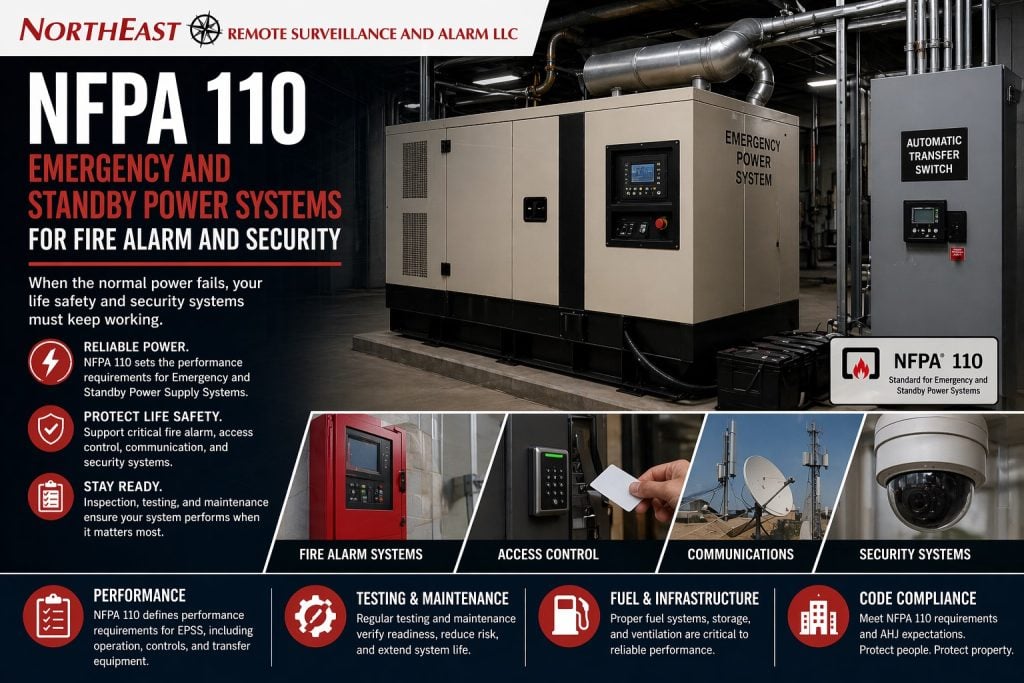
NFPA 110 addresses emergency and standby power-system performance, including generator-based systems that support designated building loads when normal power fails.
Identify the Required Loads
List the equipment the alternate-power system must support and the required behavior during a loss of normal power. Include relevant communications equipment and interfaces, not only the main security or fire alarm panel.
Have the responsible design professionals establish the applicable requirements for the project. The adopted codes, system classification, equipment instructions, and reviewing authority determine the design and verification criteria.
Review the Complete Emergency Power System
NFPA’s overview of NFPA 110 describes a performance standard for emergency power supply systems, most commonly based on generators.
Planning includes the equipment and arrangements needed to deliver alternate power to the intended loads.
Coordinate the power source, transfer equipment, controls, supported loads, and installation conditions. Record the intended sequence from normal operation through power failure, alternate supply, and restoration.
Coordinate Security-System Behavior
Identify which security functions should continue operating and which must change state during a power event. Document the expected behavior of controllers, communications paths, monitoring interfaces, and affected doors.
Fire alarm secondary power and access-control egress each require system-specific review. Generator availability alone does not establish that every supported function meets its applicable requirements.
Verify Transfer and Recovery
Plan the required testing with the responsible electrical and system specialists. Record the conditions tested, expected results, actual results, and any deficiencies that need correction.
Include restoration to normal operation in the verification plan. Confirm that the supported systems recover as intended and that responsible personnel receive the information they need to respond to an abnormal condition.
Keep Maintenance and Load Records Current
Maintain equipment information, inspection and testing records, service history, and a current description of supported loads. Assign responsibility for follow-up so unresolved power-system issues remain visible.
Review the alternate-power arrangement when security equipment is added, the building use changes, or major power components are replaced. Stored-energy backup has a separate guide below for projects that also depend on that form of continuity.
Related Guides
Use these guides to coordinate generator power with stored-energy backup, fire alarms, door egress, and testing records.
- NFPA Standards for Commercial Security, Fire Alarm, Access Control, Wiring & Life Safety — Return to the NFPA standards directory.
- NFPA 111 Stored-Energy Backup Power for Security and Life Safety Systems — Review stored-energy backup under NFPA 111.
- NFPA 72 Fire Alarm Standards for Commercial Buildings — Review commercial fire alarm standards.
- NFPA 101, Door Hardware, and Access Control Egress Compliance — Review access-control egress coordination.
- Security System Documentation, Testing, and Inspection Readiness — Organize testing and maintenance documentation.
Request an Alternate-Power Coordination Review
Request an assessment to review security-system continuity needs and coordination with the facility’s emergency or standby power system.