
Route 22 commercial video surveillance starts with the events a business needs to see and review.

Request a Route 22 camera assessment
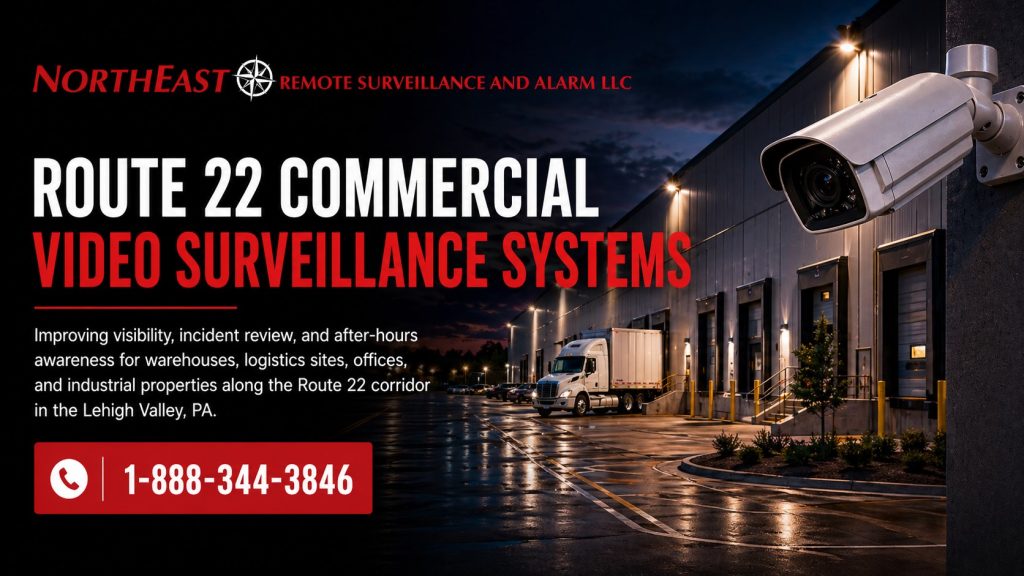
NERSA plans camera coverage for corridor warehouses, manufacturing properties, offices, parking areas, and active loading facilities.
Give Each Camera a Clear Purpose
First, mark employee entrances, visitor approaches, dock doors, drive lanes, and exterior storage on a site plan. Decide whether each view must show general activity, a person’s actions, a freight handoff, or a vehicle passing a defined point. Wide coverage and close detail often require different views.
Next, test lighting, mounting positions, distance, and obstructions. A loading area can look different when trailers are parked, doors are open, or a night shift is operating. Review those conditions before accepting a camera position.
Connect Dock, Parking, and Vehicle Views
Follow the activity from arrival to the part of the property where it needs documentation. A dock overview may show vehicle position, while another view records a handoff or personnel entrance. Parking cameras should distinguish vehicle circulation from pedestrian routes and building approaches.
If a license plate must be captured, evaluate the lane separately. Vehicle speed, angle, headlights, distance, and plate position affect the image. A general parking camera should not be assumed to provide dependable plate detail.
Plan Recording and Incident Review
Define the review period, authorized users, search process, and export procedure. Confirm camera names and timestamps so staff can follow an event between views. Test recorded playback as well as the live image, including representative daytime and nighttime activity.
Where alerts or operator review are needed, specify the event, schedule, permitted activity, and response contact. Recording, remote viewing, and monitored response serve different purposes. The business should choose the functions it can operate and maintain.
Choose the Next Route 22 Planning Guide
Return to Route 22 corridor security for the overall property plan.
Use Route 22 warehouse security for freight operations, Lehigh Valley video surveillance for regional system options, and remote video monitoring for event review and escalation.
Request a Route 22 camera assessment with a site plan, current camera list, operating hours, and examples of incidents that existing views cannot explain.
Compliance, Codes & Project Standards
NERSA plans commercial and industrial security work with applicable code, documentation, inspection and authority-having-jurisdiction requirements in mind. Requirements vary by system, property and jurisdiction. These resources support project planning; they do not establish legal compliance, certification or AHJ approval.
Related guidance: Regulatory compliance & inspection readiness · Video surveillance compliance · NERSA project standards