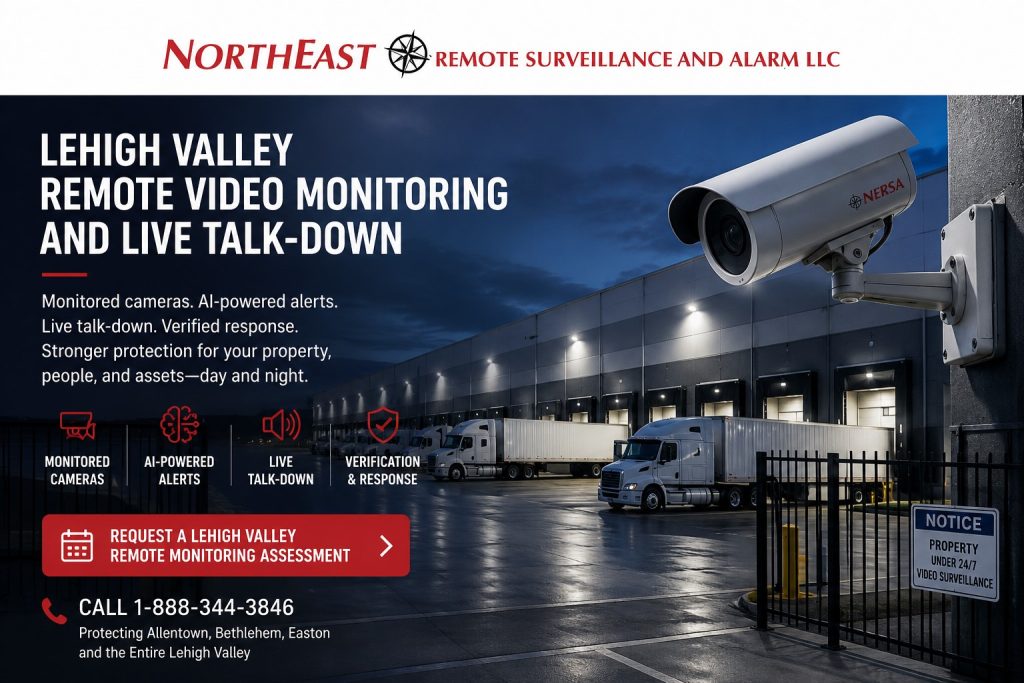
Lehigh Valley remote video monitoring helps businesses identify, verify, and respond to selected activity around loading docks, truck courts, parking lots, gate lanes, contractor yards, warehouse exteriors, fence lines, and other areas exposed after normal business hours.

Request a Lehigh Valley Remote Video Monitoring Assessment
Northeast Remote Surveillance and Alarm, LLC designs, installs, upgrades, integrates, monitors, and supports commercial remote video monitoring systems throughout Allentown, Bethlehem, Easton, Route 22, Route 33, I-78, Lehigh County, and Northampton County.
This guide covers monitored video, AI-supported event alerts, live operator review, audio warnings, and documented response procedures.
For broader regional planning across cameras, access control, intrusion alarms, fire alarm, monitoring, gates, and infrastructure, visit Lehigh Valley Commercial and Industrial Security Systems.
For broader service guidance outside the regional structure, visit Remote Video Monitoring and Live Talk-Down.
Project availability may depend on property location, existing camera compatibility, network connectivity, lighting, monitoring schedules, audio requirements, system condition, and long-term support needs.
How Lehigh Valley Remote Video Monitoring Works
A standard video surveillance system records footage for later review. Remote video monitoring adds a more active layer by using selected cameras, analytics, monitoring schedules, operator review, property instructions, and response procedures.
A monitored system may help:
- Detect selected people or vehicle activity
- Generate alerts in defined areas
- Verify events using live or recorded video
- Distinguish normal activity from possible security concerns
- Issue an audio warning where appropriate
- Notify designated property contacts
- Escalate events according to written instructions
- Document activity for management review
Remote video monitoring is not necessarily continuous observation of every camera. The system should focus on the locations, schedules, and events where active review provides meaningful value.
Remote Monitoring Versus Self-Monitoring
Remote viewing allows an owner or manager to open an application and review live or recorded video.
Self-monitoring still depends on that person noticing the alert, opening the application, understanding what is happening, and deciding how to respond.
Professionally planned remote video monitoring creates a more structured workflow. Depending on the monitoring arrangement:
- An event rule generates an alert.
- Available camera views are reviewed.
- The activity is compared with the property’s schedule and authorized-use instructions.
- A live audio warning may be issued where approved.
- A manager or other designated contact may be notified.
- The event may be escalated according to written procedures.
- Relevant activity may be documented.
Self-monitoring may be appropriate for lower-risk properties with limited alerts. Professional monitoring may provide greater value when a property has extensive exterior exposure, valuable outdoor assets, recurring after-hours activity, or no dependable internal person available to review every event.
Areas Commonly Monitored
Remote video monitoring is often most useful in exterior areas that are difficult to observe when staffing is limited.
Common applications include:
- Loading docks
- Truck courts
- Trailer rows
- Contractor yards
- Parking lots
- Employee entrances
- Gate lanes
- Fence lines
- Exterior storage
- Outdoor equipment
- Side and rear doors
- Warehouse perimeters
- Shipping and receiving approaches
- Detached buildings
- Multi-building commercial properties
The monitored areas should be selected according to actual property risks rather than placing every camera into the same monitoring workflow.
Live Talk-Down and Audio Warnings
Live talk-down allows a monitoring operator to issue an audio warning through speakers installed at the property when suspicious or unauthorized activity has been visually verified.
A warning may advise someone that:
- The property is monitored
- The business is closed
- The area is restricted
- The activity has been observed
- The person should leave the property
- Additional response may follow
Live audio warnings may help discourage trespassing, loitering, vandalism, theft attempts, unauthorized vehicle activity, and entry into restricted exterior areas.
A complete talk-down system may include:
- Properly positioned commercial cameras
- AI-supported event detection
- Outdoor-rated speakers
- Monitoring software
- Reliable power and connectivity
- Approved warning language
- Property-specific response instructions
Live talk-down supports deterrence and event handling. It does not physically intervene or replace gates, locks, access control, intrusion alarms, security personnel, emergency procedures, or law-enforcement response.
AI Analytics and Event Filtering
Analytics can help focus monitoring on selected people, vehicles, and defined activity instead of treating every motion change as a security event.
Available analytics may include:
- Person detection
- Vehicle detection
- Line crossing
- Restricted-area entry
- Loitering
- Direction of travel
- After-hours activity
- Gate-lane events
- Perimeter activity
- Time-based rules
Analytics still depend on proper camera placement and configuration.
Performance may be reduced by:
- Poor lighting
- Excessive viewing distance
- Headlight glare
- Rain, snow, fog, or insects
- Moving vegetation
- Incorrect detection zones
- Cameras mounted too high
- Views blocked by trailers or vehicles
- Normal traffic passing through the scene
- Unrecorded authorized activity
The monitoring design should account for these conditions before alerts are placed into an active review workflow.
Camera Placement and Nighttime Performance
A camera that is suitable for general recording may not provide enough detail for event verification.
Monitoring cameras should help show:
- Where the activity is occurring
- Whether a person or vehicle is present
- The direction of travel
- Whether the activity appears authorized
- Whether another view is needed
- Whether an audio warning is appropriate
Camera planning should account for mounting height, viewing distance, lighting, nighttime image quality, vehicle obstruction, trailer placement, landscaping, network connectivity, recording availability, and speaker coverage.
A wide parking-lot camera may not provide enough detail around one vehicle. A loading-dock camera may become blocked when a trailer is parked. A gate may require both an overview camera and a tighter vehicle-identification view.
For broader regional camera design, recording, image quality, retention, and evidence planning, visit Lehigh Valley Commercial Video Surveillance Systems.
Monitoring Schedules and Authorized Activity
Commercial properties frequently have legitimate activity outside standard office hours.
That activity may include:
- Second- or third-shift employees
- Cleaning crews
- Maintenance personnel
- Truck drivers
- Delivery personnel
- Contractors
- Snow-removal crews
- Managers working late
- Early-morning shipping
- Weekend production
The monitoring plan should define:
- When monitoring begins and ends
- Which areas are monitored
- Which people or vehicles may be present
- Which activities are normal
- Which locations remain restricted
- Who may authorize an exception
- Who should be contacted
- When talk-down may be used
- When escalation may be appropriate
Monitoring instructions should be reviewed whenever shifts, tenants, managers, contractors, delivery schedules, or property operations change.
Remote Monitoring for Lehigh Valley Warehouses and Logistics Properties
Warehouses and logistics facilities often have substantial exterior exposure around loading docks, trailer areas, truck courts, gates, employee entrances, and shipping approaches.
Monitoring may provide additional context around:
- Unknown people near loading docks
- Vehicles entering closed areas
- After-hours trailer activity
- People approaching overhead doors
- Activity around staged freight
- Movement along fence lines
- Loitering near employee entrances
The monitoring schedule should distinguish normal freight activity from suspicious behavior.
For complete regional warehouse planning, use Lehigh Valley Warehouse Security Systems.
Manufacturing, Contractor, and Industrial Properties
Manufacturing facilities may require monitored video around employee entrances, contractor access, industrial parking, loading areas, exterior equipment, maintenance buildings, utility areas, and restricted exterior spaces.
Contractor yards may need stronger awareness around:
- Work trucks
- Trailers
- Tools
- Equipment
- Materials
- Fuel
- Storage containers
- Fenced compounds
- Vehicle gates
Industrial and contractor properties may combine monitored cameras with intrusion alarms, gate access, license plate recognition, lighting improvements, and live talk-down.
The system should account for legitimate shift activity, maintenance work, early arrivals, deliveries, and authorized vehicles rather than treating every nighttime event as suspicious.
Parking Lots, Gates, and Building Approaches
Parking areas and exterior approaches may benefit from monitored video when a property experiences recurring loitering, suspicious vehicles, vandalism, unauthorized parking, or activity near employee vehicles and building entrances.
Useful views may include:
- Parking-lot overviews
- Vehicle entrances and exits
- Employee parking
- Visitor parking
- Building entrances
- Side and rear approaches
- Shared drive lanes
- Pedestrian routes
- Service and dumpster areas
Gate monitoring may also be coordinated with access-control activity, intercom communication, vehicle overview cameras, license plate recognition, and intrusion alarms.
Monitoring and Commercial Alarm Response
Remote video monitoring may operate alongside intrusion alarms and access control.
An intrusion alarm may detect a door opening, interior movement, overhead-door activity, or another protected condition. Monitored video may provide visual information around selected exterior or alarm-related events.
Access-control information may help identify:
- After-hours credential use
- Forced doors
- Held-open doors
- Gate activity
- Contractor access
- Employee entrances
Compatible systems may provide better event context when cameras, alarms, access control, and monitoring procedures are coordinated.
For broader alarm and monitored-event planning, visit Commercial and Industrial Security Monitoring.
Can Existing Cameras Be Used?
Some existing cameras may support remote video monitoring. Others may require repositioning, added lighting, network improvements, upgrades, or replacement.
An assessment should review:
- Camera image quality
- Nighttime performance
- Camera placement
- Viewing distance
- Analytics compatibility
- Network reliability
- Recording availability
- Remote connectivity
- Camera naming
- User permissions
- Speaker compatibility
- Platform support
- Licensing requirements
The best improvement is not always adding more cameras. Better placement, lighting, connectivity, analytics, or response procedures may provide greater value.
Reducing False and Nuisance Alerts
False alerts can overwhelm a monitoring workflow and reduce confidence in the system.
Common causes include:
- Headlights
- Shadows
- Rain or snow
- Animals
- Insects near cameras
- Moving vegetation
- Reflections
- Steam
- Equipment movement
- Normal employee activity
- Public roadway traffic
- Incorrect schedules
- Poorly configured detection zones
False-alert reduction may involve:
- Better camera placement
- Focused detection areas
- Person and vehicle classification
- Exclusion zones
- Schedule adjustments
- Lighting improvements
- Updated property instructions
- Review of recurring nuisance events
The objective is not to eliminate every alert. It is to focus the monitoring process on activity the business considers meaningful.
Privacy and Responsible Monitoring
Remote video monitoring should be used for legitimate commercial and industrial security purposes.
Planning should consider camera placement, audio use, signage, employee expectations, visitor expectations, recording retention, user permissions, internal policies, and applicable legal requirements.
Monitoring should focus on security-relevant locations such as exterior approaches, parking areas, loading docks, yards, gates, entrances, restricted areas, and after-hours exposure.
No security system can guarantee that every theft, trespassing event, act of vandalism, or unauthorized activity will be prevented.
Why Lehigh Valley Businesses Choose Northeast Remote Surveillance and Alarm, LLC
Northeast Remote Surveillance and Alarm, LLC is based in Bethlehem, Pennsylvania, and focuses on commercial and industrial security environments.
NERSA plans remote video monitoring around:
- Property layout
- Exterior exposure
- Camera placement
- Lighting
- Analytics
- Monitoring schedules
- Authorized activity
- Speaker placement
- Network reliability
- Alarm and access-control coordination
- Contact procedures
- Escalation instructions
- Documentation
- Existing system condition
- Long-term serviceability
The objective is to improve after-hours awareness, reduce unnecessary alerts, support appropriate deterrence, and provide useful information when an event occurs.
Request a Lehigh Valley Remote Video Monitoring Assessment
A remote video monitoring assessment may review the property layout, operating hours, loading docks, truck courts, parking areas, gates, fence lines, exterior storage, existing cameras, lighting, detection zones, analytics, speaker locations, network conditions, monitoring schedules, authorized activity, response contacts, and escalation procedures.
Northeast Remote Surveillance and Alarm, LLC can help determine which cameras, analytics, audio devices, monitoring procedures, and infrastructure improvements are appropriate for the property.
Frequently Asked Questions About Lehigh Valley Remote Video Monitoring
What is remote video monitoring?
Remote video monitoring uses cameras, analytics, event rules, monitoring schedules, and a defined review process to help verify and respond to selected activity around a commercial or industrial property.
How is remote video monitoring different from remote viewing?
Remote viewing requires an owner or employee to open an application and review the cameras. Remote video monitoring adds a structured workflow for event alerts, operator review, contact notification, audio warnings where appropriate, escalation, and documentation.
What is live talk-down?
Live talk-down allows a monitoring operator to issue an audio warning through speakers installed at the property after suspicious or unauthorized activity has been visually verified.
What areas are commonly monitored?
Common areas include loading docks, truck courts, parking lots, trailer areas, contractor yards, gates, fence lines, exterior storage, employee entrances, and other after-hours risk areas.
Does remote video monitoring require AI analytics?
Not always. AI analytics may help identify people, vehicles, line crossing, loitering, restricted-area activity, and other selected events while reducing unnecessary motion alerts.
Can existing cameras be used?
Possibly. Existing cameras should be evaluated for image quality, nighttime performance, placement, analytics compatibility, network reliability, recording availability, and platform support.
Can remote monitoring work with intrusion alarms and access control?
Yes, when the platforms and project requirements support coordination. Video may provide additional context around alarm events, gate activity, forced doors, held-open doors, and after-hours credential use.
Does live talk-down replace security guards?
No. Live talk-down can support verification and deterrence but does not physically intervene. Some properties may still require guards, patrols, locks, gates, alarms, or other security measures.
Can remote video monitoring prevent every incident?
No. Remote video monitoring may improve awareness, verification, deterrence, response information, and documentation, but no security system can guarantee prevention.
Can NERSA support both smaller commercial properties and large industrial facilities?
Yes. NERSA can plan targeted monitoring for a smaller commercial property with several exterior cameras or a larger warehouse, manufacturing facility, industrial park, or multi-site organization requiring multiple monitored areas and coordinated response procedures.
What happens during a remote video monitoring assessment?
An assessment may review risk areas, camera views, lighting, operating hours, authorized activity, analytics, speaker coverage, network conditions, monitoring schedules, contacts, escalation instructions, and existing security systems.
How does a business begin a remote video monitoring project?
Begin with Request a Lehigh Valley Remote Video Monitoring Assessment.