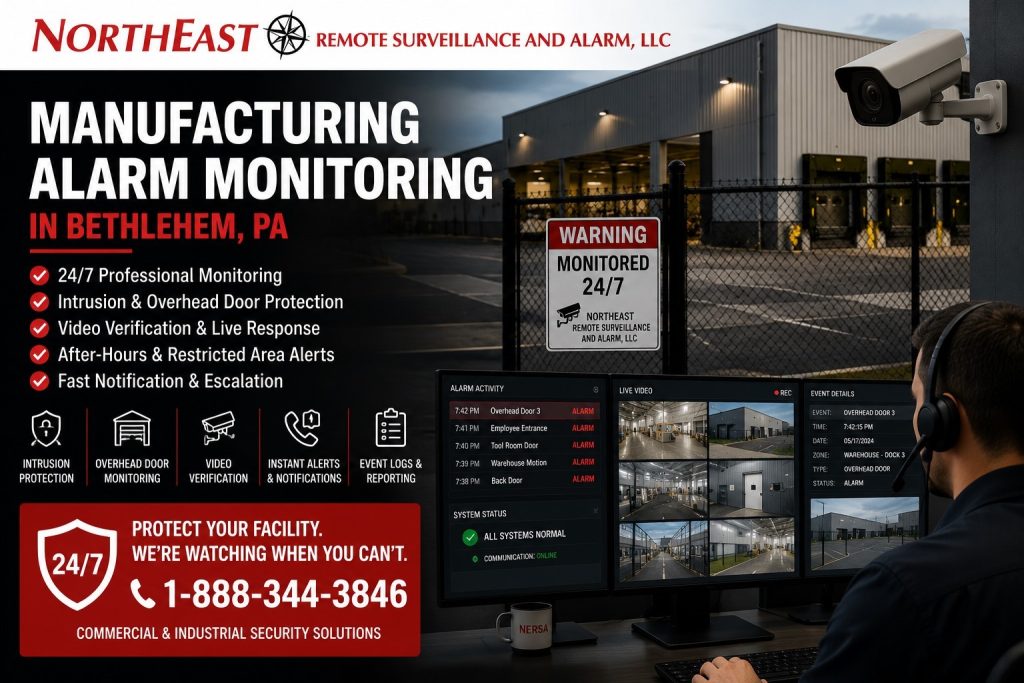
Manufacturing alarm monitoring in Bethlehem, PA should be planned around intrusion detection, after-hours protection, overhead doors, employee entrances, restricted rooms, loading activity, alarm communication paths, video verification, user accountability, and documented response procedures. Northeast Remote Surveillance and Alarm, LLC designs monitoring-ready alarm systems for Bethlehem manufacturing facilities, warehouses, industrial buildings, production spaces, and multi-building commercial properties. For broader Bethlehem manufacturing and industrial security planning, start with Manufacturing & Industrial Security Systems in Bethlehem, PA.
Alarm monitoring is not just about sending a signal when a door opens. Manufacturing facilities have employees, contractors, vendors, drivers, maintenance teams, production schedules, shipping activity, restricted rooms, overhead doors, parking areas, exterior yards, and after-hours conditions that all affect how an alarm should be designed and monitored. NERSA helps Bethlehem businesses plan alarm monitoring systems that support real response needs instead of relying on a generic alarm package.

Manufacturing Alarm Monitoring for Bethlehem Facilities
Manufacturing alarm monitoring should be designed around how the facility actually operates. A production building may have normal daytime shifts, early arrivals, overnight maintenance, weekend work, after-hours deliveries, cleaning crews, service contractors, and areas that need different schedules.
A strong alarm monitoring plan should help management answer practical questions. What area went into alarm? Which door opened? Was the event after hours? Was the user authorized? Was there a camera view available? Did the alarm involve an overhead door, employee entrance, tool room, dock area, office, production zone, or exterior access point? What instructions should the monitoring center follow?
NERSA designs commercial and industrial alarm monitoring systems that help Bethlehem facilities improve after-hours protection, reduce confusion during events, and create better documentation when something happens.
Why Manufacturing Alarm Monitoring Needs Dedicated Planning
Manufacturing facilities are different from small offices or retail spaces. They often include large footprints, multiple entrances, warehouse-connected areas, production floors, overhead doors, shipping offices, maintenance rooms, tool rooms, IT rooms, utility rooms, and exterior property exposure.
A basic alarm design may only protect a few doors and motion areas. That may not be enough for a manufacturing facility with multiple shifts, multiple departments, and multiple access points. Dedicated planning helps determine which areas need alarm protection, which areas need separate schedules, how users should operate the system, and how monitoring should respond.
Alarm monitoring should be simple enough for authorized users to manage and strong enough to protect the property when no one is watching the building directly.
Intrusion Alarm Monitoring and After-Hours Protection
Intrusion alarm monitoring helps protect manufacturing buildings when they are closed, partially occupied, or operating with limited supervision. The system may monitor doors, overhead doors, motion areas, restricted rooms, offices, warehouse spaces, utility areas, and exterior-connected entrances.
Alarm devices may include door contacts, overhead door contacts, motion detectors, glass break sensors where appropriate, sirens, keypads, wireless devices, hardwired devices, partitions, communication modules, and monitoring connections. For Bethlehem alarm design planning, visit Industrial Intrusion Alarm Systems in Bethlehem, PA.
The goal is not only to detect unauthorized entry. The goal is to create a monitored system that gives management and responders better information about what happened, where it happened, and how the event should be handled.
Alarm Zones, Partitions, and Schedules with Manufacturing Alarm Monitoring in Bethlehem, PA
Manufacturing facilities often need more than one alarm schedule. Office areas, production floors, warehouse spaces, loading docks, shipping areas, tool rooms, utility rooms, and exterior buildings may not all operate at the same time.
Partitions and zone planning can help separate different parts of the facility. One area may remain armed while another is occupied. A warehouse may need different protection than the office. A restricted room may need alarm protection even when the larger building is open. A dock area may require special planning because of late deliveries or weekend shipments.
Proper zone and partition planning can reduce nuisance alarms while improving protection. It also helps monitoring personnel, managers, and authorized users understand exactly which area caused the event.
Monitoring for Overhead Doors and Loading Areas
Overhead doors and loading areas are major exposure points in manufacturing facilities. These areas may involve trailers, staged freight, forklifts, drivers, vendors, dock workers, shipping staff, receiving activity, and after-hours movement.
Alarm monitoring for dock and overhead door areas may include door contacts, position monitoring, motion detection, camera verification, schedules, user codes, and escalation instructions. The system should be designed so that normal shipping activity does not create unnecessary alarm problems while after-hours activity is still protected.
Loading dock alarm monitoring is especially useful when dock doors are left unsecured, opened after hours, damaged, forced, or used during a time when the building should be closed.
Employee Entrance Alarm Coordination with Manufacturing Alarm Monitoring in Bethlehem, PA
Employee entrances often need alarm coordination because they are used during shift changes, early arrivals, late departures, weekend work, and maintenance activity. An employee may need to enter before the rest of the building is open. A supervisor may need access to one area but not another. A cleaning crew may need scheduled access without disarming the entire property.
Alarm monitoring should account for valid access, invalid access, after-hours use, forced doors, held-open doors, and user accountability. This helps the business know whether the alarm event was caused by an authorized user, a mistake, an unsecured door, or a potential intrusion.
A properly planned system can help reduce false alarms while still protecting the building when access occurs outside normal conditions.
Restricted Room and Tool Room Monitoring
Restricted rooms and tool rooms may need alarm monitoring even when other parts of the building are open. These rooms may contain tools, parts, maintenance equipment, IT equipment, utility systems, sensitive materials, inventory, production controls, or other assets that should not be accessible to everyone.
Alarm monitoring for restricted areas may include door contacts, motion detection, access activity, video verification, user reporting, and separate schedules. This can help management review unauthorized access, after-hours entry, forced doors, or activity that occurs outside approved times.
Restricted room monitoring is especially valuable when paired with controlled credentials, door status monitoring, and camera coverage.
Video Verification for Alarm Events with Manufacturing Alarm Monitoring in Bethlehem, PA
Video verification can make alarm monitoring more useful by pairing alarm activity with camera footage. When a door opens, motion activates, or an alarm event occurs, nearby camera views may help determine whether the activity appears authorized, accidental, suspicious, or urgent.
Camera coverage can support alarm review at employee entrances, overhead doors, restricted rooms, loading docks, parking areas, exterior doors, gates, and warehouse transition points. For Bethlehem manufacturing camera planning, visit Manufacturing Security Cameras in Bethlehem, PA.
Video does not replace a properly designed alarm system, but it can improve event understanding. It helps management and monitoring personnel see what happened instead of relying only on a signal from a device.
Professional Alarm Monitoring and Escalation Procedures
Professional alarm monitoring supports a facility when no one is onsite, when staff are limited, or when the building has after-hours exposure. Monitoring can support intrusion alarms, video verification, communication path supervision, contact lists, response instructions, and escalation procedures.
A manufacturing alarm monitoring plan should define what happens when specific events occur. A dock door alarm may need different instructions than an office motion alarm. A restricted room opening may need manager notification. A forced door may require a different response than a user error. A repeated trouble signal may need service attention.
For broader monitoring service information, visit Commercial and Industrial Security Monitoring.
Remote Video Monitoring and Alarm Event Review
Some Bethlehem manufacturing facilities benefit from combining alarm monitoring with remote video monitoring. This is especially useful for exterior doors, loading docks, parking lots, truck courts, gates, fenced areas, trailer storage, and other after-hours activity zones.
Remote video monitoring can support event review, AI-supported alerts, live response procedures, speaker warnings where appropriate, and documented escalation instructions. It can help verify whether activity near a protected area appears normal, suspicious, or requiring response.
For Bethlehem-specific monitoring and video review planning, visit Industrial Remote Video Monitoring in Bethlehem, PA.
Alarm Communication Paths and Reliability with Manufacturing Alarm Monitoring in Bethlehem, PA
Alarm monitoring depends on reliable communication. A monitored alarm system needs a communication path that can transmit events, trouble signals, restorals, and system activity to the monitoring center.
Manufacturing buildings may have complex network conditions, metal construction, distance challenges, multiple buildings, older phone lines, cellular signal issues, or IT restrictions that affect communication planning. Alarm communication should be evaluated before installation so the system can be monitored properly.
Communication path planning may include cellular communicators, IP communication, dual-path communication where appropriate, signal testing, backup power, equipment location planning, and service documentation.
User Codes, Permissions, and Accountability
Manufacturing alarm monitoring should include user accountability. Shared codes make it difficult to determine who armed the system, disarmed the system, bypassed a zone, or caused an event. Individual user codes or credentials can help management review activity more clearly.
User permissions may vary by role. Owners, managers, supervisors, maintenance staff, warehouse employees, cleaning crews, contractors, and temporary personnel may not all need the same alarm access. Some users may need access only during certain times. Others may need access only to specific partitions or areas.
A properly planned alarm system helps management remove users, adjust permissions, review history, and maintain cleaner accountability over time.
Reducing False Alarms and Nuisance Events
False alarms can create frustration, wasted time, unnecessary dispatches, and reduced confidence in the system. Many nuisance alarms happen because the system was not designed around the building’s real operations.
Common causes include poorly placed motion detectors, unsecured overhead doors, confusing keypad locations, shared user codes, unclear schedules, untrained users, equipment problems, weak communication paths, and alarm zones that do not match how people move through the facility.
NERSA helps plan alarm monitoring systems that reduce avoidable problems. The goal is to make the system easier to use, easier to understand, and better aligned with the way the facility operates.
Alarm Monitoring for Multi-Building Properties
Some Bethlehem manufacturing and industrial properties include multiple buildings, detached storage areas, exterior utility spaces, separate offices, warehouse additions, guard shacks, fenced yards, or remote equipment areas.
Multi-building alarm monitoring may require partitions, wireless devices, hardwired expansion, cellular communication, network planning, repeaters, separate keypads, exterior-rated devices, and clear response instructions. Each building or area should be planned based on how it is used and how quickly activity needs to be reviewed.
The system should help management understand which building reported the event, what zone activated, whether the event is tied to a user, and what action should be taken.
Environmental and Supervisory Monitoring
Some manufacturing facilities may need monitoring for conditions beyond basic intrusion. Environmental or supervisory alerts can help identify issues involving temperature, water, equipment rooms, utility spaces, freezer or cooler areas, sump conditions, or other facility concerns where appropriate equipment is used.
These alerts should be planned carefully and should not be confused with code-required fire alarm or life-safety systems. Security monitoring can support facility awareness, but life-safety systems must be designed, installed, inspected, and maintained according to applicable requirements.
The best approach depends on the facility, the equipment being protected, the communication method, and the response instructions management wants to follow.
Fire Alarm and Life-Safety Awareness
Manufacturing alarm monitoring should be planned with awareness of fire alarm systems, emergency egress, access-controlled doors, alarm communication, backup power, and inspection-sensitive conditions. Security alarm monitoring does not replace code-required fire alarm design, inspection, testing, or monitoring requirements.
If a security system interacts with door release, access control, communication paths, or building operations, the design should be coordinated carefully. The objective is to protect the property without creating avoidable conflicts with emergency response, egress, inspections, or life-safety requirements.
A security monitoring plan should support the building’s operation and remain serviceable, documented, and understandable for management over time.
Alarm Monitoring Documentation
Documentation helps a monitored alarm system remain usable after installation. A facility should understand what devices are installed, what areas are protected, how zones are named, who has user access, what schedules apply, what communication path is used, and what instructions are followed during events.
Good documentation can help with training, troubleshooting, service, future expansion, staff turnover, and management review. It can also help reduce confusion during alarm events because zones, partitions, users, and response instructions are easier to understand.
NERSA plans alarm systems with long-term serviceability in mind so the system can be supported as the facility changes.
Common Manufacturing Alarm Monitoring Problems We Help Solve
Bethlehem manufacturing facilities often need help when alarm systems are outdated, user codes are shared, doors are not monitored properly, overhead doors create nuisance alarms, motion detectors are poorly placed, monitoring instructions are unclear, communication paths are unreliable, or managers cannot tell who disarmed the system.
Other common problems include missing zone documentation, alarm areas that do not match the operation, contractor access causing false alarms, after-hours activity that is not verified by video, and restricted rooms that are not protected separately.
NERSA can evaluate the current system, building layout, operating schedule, user needs, and monitoring requirements to recommend a practical alarm monitoring plan.
Manufacturing Areas NERSA Can Help Monitor
- Employee entrances
- Office entrances
- Production areas
- Warehouse spaces
- Shipping and receiving areas
- Loading docks
- Overhead doors
- Dock offices
- Tool rooms
- Maintenance rooms
- IT rooms
- Network closets
- Utility rooms
- Electrical rooms
- Mechanical rooms
- Inventory rooms
- Restricted storage areas
- Exterior doors
- Gate entrances
- Detached buildings
- Trailer yards
- Truck courts
- Parking areas
- Multi-building properties
- After-hours access points
Why Bethlehem Manufacturers Choose NERSA
Bethlehem manufacturers choose Northeast Remote Surveillance and Alarm, LLC because NERSA designs commercial and industrial security systems around real facility conditions. Alarm monitoring, cameras, access control, restricted rooms, employee entrances, loading docks, production spaces, warehouse areas, and exterior doors all need planning that matches how the property actually operates.
NERSA focuses on intrusion protection, alarm monitoring, video verification, remote video monitoring, access accountability, communication path planning, low-voltage infrastructure, documentation, and long-term support. Whether the facility needs a monitored intrusion alarm, alarm upgrades, video verification, partition planning, communication improvements, or a complete integrated security system, the design starts with the building and the way it is used.
Request a Manufacturing Alarm Monitoring Assessment in Bethlehem
If your Bethlehem manufacturing facility needs monitored intrusion protection, video verification, alarm communication planning, overhead door monitoring, restricted room alarms, user accountability, remote video monitoring, or a complete alarm system upgrade, Northeast Remote Surveillance and Alarm, LLC can evaluate the property and recommend a system built around your operation.
Call 1-888-344-3846 to request a manufacturing alarm monitoring assessment in Bethlehem, PA.
Manufacturing Alarm Monitoring FAQs
What is manufacturing alarm monitoring?
Manufacturing alarm monitoring is the professional monitoring of alarm events from a manufacturing or industrial facility. It may include intrusion alarms, door contacts, motion detection, overhead door protection, user activity, video verification, communication path supervision, and documented response instructions.
Why do Bethlehem manufacturing facilities need alarm monitoring?
Manufacturing facilities often have after-hours exposure, multiple doors, overhead doors, restricted rooms, loading docks, warehouse areas, contractors, employee shifts, and exterior activity zones. Alarm monitoring helps support response when the building is closed, partially staffed, or not being directly watched.
Can alarm monitoring protect overhead doors?
Yes. Overhead doors can often be protected with alarm contacts, position monitoring, schedules, partitions, and response instructions. This can help identify unauthorized or after-hours door activity.
Can alarm monitoring work with security cameras?
Yes. Alarm monitoring can be paired with camera coverage so events can be reviewed with video. This is useful for employee entrances, dock doors, restricted rooms, parking areas, gates, and other important locations.
What is video verification?
Video verification uses camera footage to help review what is happening during an alarm event. It can help determine whether activity appears authorized, accidental, suspicious, or requiring response.
Can different parts of a manufacturing facility be monitored separately?
Yes. Many manufacturing facilities can use zones, partitions, schedules, and user permissions so different areas of the property are monitored in ways that match the operation.
Can alarm monitoring reduce false alarms?
A properly designed and maintained alarm monitoring system can help reduce avoidable false alarms by using better device placement, clearer schedules, user training, video verification, accurate zone naming, and better response instructions.
Can NERSA monitor restricted rooms and tool rooms?
Yes. Restricted rooms and tool rooms can be protected with door contacts, motion detection, access activity, video verification, and dedicated alarm planning depending on the facility’s needs.
Can NERSA help with old alarm systems?
Yes. NERSA can evaluate older commercial and industrial alarm systems and recommend upgrades, monitoring communication improvements, device replacement, keypad updates, zone cleanup, or system replacement when needed.
Can alarm monitoring support after-hours contractors or cleaning crews?
Yes. Alarm monitoring can be planned around scheduled users, limited access, partitions, entry paths, and response instructions for contractors, cleaning crews, maintenance teams, and other approved after-hours personnel.
Does alarm monitoring replace fire alarm monitoring?
No. Security alarm monitoring does not replace code-required fire alarm systems, fire alarm inspection, fire alarm testing, or fire alarm monitoring requirements. Fire alarm and life-safety systems must be handled according to applicable requirements.
Can manufacturing alarm monitoring be expanded later?
Yes. A properly planned system can expand to additional doors, alarm zones, buildings, cameras, partitions, communication paths, and monitoring procedures as the facility changes.
Does NERSA install residential alarm systems?
No. Northeast Remote Surveillance and Alarm, LLC focuses on commercial and industrial security systems.
Schedule a Manufacturing Alarm Monitoring Assessment
Manufacturing alarm monitoring should be built around the way employees, contractors, shifts, doors, overhead doors, cameras, restricted areas, communication paths, and response procedures actually work at the facility. Northeast Remote Surveillance and Alarm, LLC can help your Bethlehem manufacturing property plan a monitored alarm system that improves after-hours protection, supports video verification, documents activity, reduces confusion, and protects the areas that matter most.
Call 1-888-344-3846 to request a manufacturing alarm monitoring assessment in Bethlehem, PA.