Plan cold storage and food processing alarms around intrusion detection, environmental conditions, notification paths and staff response.
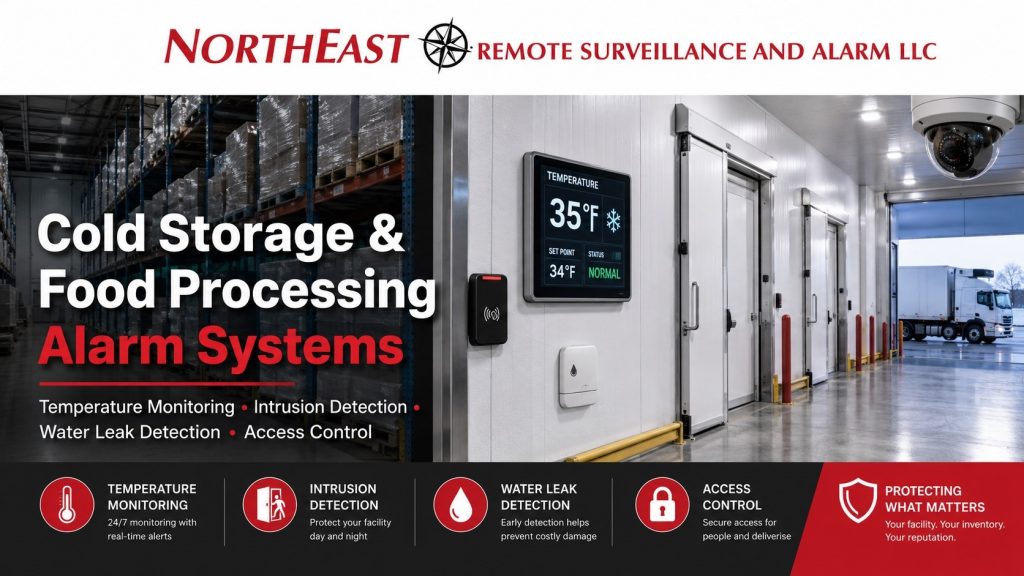
Review temperature changes, freezer or cooler failures, water leaks and unauthorized access.
Include docks, equipment rooms, restricted areas and activity after hours.
NERSA plans these systems within a broader alarm strategy.
See Commercial and Industrial Alarm Installation.
Call 1-888-344-3846 to request a cold storage or food processing alarm assessment.
Alarm Systems for Cold Storage and Food Processing Facilities
Cold storage warehouses, food processing plants, refrigerated distribution centers, freezer rooms, cooler areas, commercial kitchens, packaging facilities, and food logistics operations have different alarm requirements than a standard commercial building.
A basic intrusion alarm may protect the building after hours, but it does not monitor the conditions that directly affect inventory, production, safety, and business continuity.
Cold storage and food processing facilities may need alarms for:
- Freezer temperature changes
- Cooler temperature changes
- Refrigerated storage rooms
- Water leaks
- Sump levels
- Humidity changes
- Power failure
- Equipment status
- Unauthorized entry
- Loading dock doors
- Exterior man doors
- Restricted areas
- Chemical or sanitation rooms
- Packaging rooms
- Maintenance rooms
- Server or controls rooms
- Employee entrances
- Vendor entrances
- After-hours activity
- Alarm events verified by cameras
The goal is to build a system that gives facility managers, owners, maintenance teams, and operators fast awareness when a critical condition changes.
Why Cold Storage Alarm Monitoring Matters
Cold storage environments are time-sensitive. A freezer or cooler that moves outside its acceptable range can create product loss, operational disruption, customer issues, and documentation problems.
An alarm system can help notify the right people before a minor condition becomes a major loss.
Cold storage alarm monitoring can support:
- Faster awareness of freezer or cooler failures
- Reduced product loss from temperature excursions
- Better documentation of temperature-related events
- After-hours notification when staff is not present
- Maintenance response before inventory is damaged
- Protection for temperature-sensitive storage areas
- Improved visibility across multi-room or multi-building facilities
- Integration with video, access control, and commercial monitoring
A well-designed system should not only report that an alarm occurred. It should help identify where the event happened, what type of condition changed, who was notified, and what response path should be followed.
For broader monitoring planning, visit Commercial Security Monitoring.
Food Processing Alarm System Design
Food processing facilities often include production rooms, storage rooms, dock areas, employee entrances, sanitation areas, chemical rooms, packaging areas, mechanical spaces, offices, and refrigerated zones.
Each area has a different risk profile.
A production room may need access control and restricted-area awareness. A freezer may need temperature monitoring. A dock door may need intrusion protection and camera coverage. A sanitation room may need controlled access. A mechanical room may need water detection, power supervision, or equipment-status monitoring.
Northeast Remote Surveillance and Alarm, LLC designs food processing alarm systems around how the facility operates, not around a generic equipment package.
Temperature Monitoring for Freezers, Coolers, and Cold Rooms
Temperature monitoring is one of the most important alarm functions in cold storage and food processing environments.
Temperature alarms may be installed in:
- Walk-in freezers
- Walk-in coolers
- Refrigerated warehouses
- Cold rooms
- Food storage rooms
- Pharmaceutical-style cold storage areas
- Refrigerated staging areas
- Processing rooms
- Temperature-sensitive packaging areas
- Specialty storage rooms
When a monitored area moves above or below the approved range, the system can notify designated contacts by text, email, app notification, phone call, or monitoring procedure depending on the design.
A temperature monitoring system may include:
- Temperature probes
- Wireless or hardwired sensors
- Alarm panel integration
- Cloud-accessible reporting
- Local keypad or panel status
- Event history
- Escalation lists
- Remote alerts
- Cellular communication backup where appropriate
Temperature monitoring should be planned around the actual storage layout. A large freezer, multi-zone cooler, or divided storage area may need multiple sensors to properly monitor different conditions.
Water Leak and High-Water Alarm Monitoring
Water can create serious problems in food processing and cold storage environments.
Leaks may come from refrigeration systems, drains, washdown areas, sump pits, roof issues, plumbing failures, condensate lines, mechanical equipment, or processing areas.
Water detection alarms may be used near:
- Mechanical rooms
- Freezer rooms
- Cooler rooms
- Refrigeration equipment
- Electrical rooms
- Sump pits
- Floor drains
- Washdown areas
- Storage rooms
- Packaging areas
- Maintenance areas
- Server or control rooms
Alarm devices may include spot water sensors, leak detection cable, float switches, sump monitoring devices, and supervised input devices.
These alarms can help notify maintenance staff before water damages inventory, equipment, flooring, electrical systems, or production areas.
Intrusion Alarm Protection for Cold Storage Facilities
Cold storage and food processing facilities still need strong intrusion alarm protection.
Common intrusion alarm points include:
- Exterior man doors
- Employee entrances
- Shipping doors
- Receiving doors
- Overhead doors
- Loading docks
- Office entrances
- Maintenance rooms
- Storage cages
- Chemical rooms
- Packaging rooms
- Restricted production spaces
- Server or controls rooms
Intrusion alarm systems may include door contacts, overhead door contacts, motion detectors, glass break detectors, keypads, sirens, cellular communicators, and monitored alarm reporting.
For facilities with multiple departments or operating schedules, the alarm system may be partitioned so different areas can be armed or disarmed separately.
Loading Dock and Receiving Area Alarm Protection
Loading docks are major risk points for food processing and cold storage sites.
Dock areas may involve vendors, drivers, employees, refrigerated trucks, staged product, pallets, shipping activity, after-hours deliveries, and overhead doors. A dock door left open or accessed after hours can create both security and temperature-control issues.
A dock alarm design may include:
- Overhead door contacts
- Dock door status monitoring
- Door-held-open alerts
- Door-forced-open alerts
- Interior motion detection
- Exterior cameras
- Dock cameras
- Remote video verification
- Access control integration
- Schedules for shipping and receiving areas
Dock alarms should be planned around real operational flow. A facility with early-morning shipping, late-night receiving, or multiple shifts may require different alarm schedules and contact procedures than a standard office building.
Access Control for Food Processing and Cold Storage Areas
Food processing and cold storage facilities often need to control who can access specific areas.
Access control may be used for:
- Employee entrances
- Production areas
- Freezer rooms
- Cooler rooms
- Chemical rooms
- Maintenance rooms
- Shipping offices
- Receiving areas
- Management offices
- IT rooms
- Packaging areas
- Restricted storage rooms
- Vendor entrances
Access control helps reduce unmanaged keys, improve accountability, and document when people entered sensitive areas.
When access control is integrated with alarms, the facility can better understand whether a door event was authorized, after-hours, forced open, or connected to another alarm condition.
Video Verification for Alarm Events
Cold storage and food processing alarm systems are stronger when alarm events can be verified with video.
Video verification helps answer important questions:
- Was the freezer door left open?
- Did an employee enter the room?
- Was a dock door opened by a driver?
- Was there unauthorized activity after hours?
- Was a water alarm caused by a visible leak?
- Did a person enter a restricted area?
- Was the alarm caused by normal operations?
- Was the event false, accidental, or real?
When cameras and alarms are designed together, the facility can review alarm activity with better context.
For video-based alarm review, visit Video Verified Alarm Systems.
Alarm Notifications and Escalation Procedures
Cold storage and food processing alarm notifications should be routed by event type.
A freezer temperature alarm may need to notify maintenance immediately. A water alarm may need to notify a facilities manager. An intrusion alarm may need monitoring center response. A dock door event may need management review. A restricted-area alarm may need supervisor notification.
Notification options may include:
- SMS text alerts
- Email alerts
- App notifications
- Phone call notification
- Central station monitoring
- Remote video verification
- Escalation lists
- Maintenance team alerts
- Management alerts
- After-hours response procedures
The notification design should match the facility’s operating hours, staffing, risk level, and response expectations.
Power Failure and Equipment Status Monitoring
Cold storage and food processing facilities depend on power, refrigeration, mechanical systems, and operating equipment.
Alarm systems may monitor:
- Power failure
- Refrigeration failure
- Generator status
- Battery backup status
- Pump status
- Compressor-related alarm outputs
- Mechanical room conditions
- Control panel signals
- Network or communication failure
- Equipment dry-contact outputs
When equipment provides a usable alarm output, that signal can often be monitored through the alarm system or related monitoring platform.
This helps maintenance teams respond faster when critical systems change status.
Compliance-Aware Alarm Documentation
Food processing and cold storage alarm systems should be designed with documentation in mind.
These systems may help support internal procedures, insurance review, incident documentation, vendor accountability, maintenance response, temperature event review, and restricted-area access history.
A professional alarm installation should include:
- Device location documentation
- Zone lists
- Sensor descriptions
- Notification procedures
- Monitoring account information
- Contact lists
- Panel and keypad locations
- Communication path documentation
- Access control coordination
- Video verification notes
- Serviceable device placement
Alarm systems do not replace food safety programs, internal quality programs, insurance requirements, fire alarm requirements, OSHA programs, or Authority Having Jurisdiction review. They can support visibility, accountability, notification, and documentation when designed correctly.
For compliance-aware security planning, visit Regulatory and Compliance Guide for Commercial Security, Fire Alarm and Life Safety.
Common Alarm Design Mistakes in Cold Storage and Food Processing
Cold storage and food processing facilities can suffer when alarm systems are installed like basic commercial burglar alarms.
Common mistakes include:
- No temperature monitoring
- Too few sensors in large cold rooms
- No freezer or cooler escalation procedure
- No water detection in mechanical areas
- No dock door status monitoring
- No alarm coverage on overhead doors
- No separate partitions for different departments
- Poor keypad placement
- No cellular backup
- No video verification
- No access control integration
- No documentation for maintenance teams
- No after-hours contact routing
- No plan for multi-shift operations
- No restricted-area alarm strategy
- No expansion plan for future storage areas
The system should be designed around the facility’s real operating conditions, not a one-size-fits-all layout.
Cold Storage and Food Processing Alarm Assessment
Northeast Remote Surveillance and Alarm, LLC can assess cold storage and food processing facilities for alarm system design, monitoring needs, sensor placement, video verification, and integration options.
An assessment may review:
- Freezer and cooler locations
- Temperature-sensitive areas
- Loading docks
- Shipping and receiving doors
- Employee entrances
- Restricted rooms
- Mechanical spaces
- Sump or water-risk areas
- Power and equipment monitoring needs
- Existing alarm equipment
- Existing camera systems
- Access control requirements
- Monitoring procedures
- Communication paths
- Contact lists
- Facility schedules
- Multi-shift operations
- Documentation needs
The goal is to create a system that protects the facility, supports operations, and gives management better awareness when critical conditions change.
Why Choose Northeast Remote Surveillance and Alarm, LLC
Northeast Remote Surveillance and Alarm, LLC designs commercial and industrial alarm systems for facilities that need more than a basic keypad and siren.
NERSA supports:
- Cold storage alarm monitoring
- Food processing alarm systems
- Freezer temperature monitoring
- Cooler temperature monitoring
- Water leak detection
- Intrusion alarm systems
- Loading dock alarm protection
- Access control integration
- Video verification
- Commercial security monitoring
- Multi-site alarm design
- Compliance-aware documentation
- Long-term serviceability
NERSA focuses on commercial, industrial, warehouse, logistics, manufacturing, institutional, municipal, healthcare, and enterprise security systems.
Frequently Asked Questions About Cold Storage and Food Processing Alarm Systems
What is a cold storage alarm system?
A cold storage alarm system monitors freezer rooms, cooler rooms, refrigerated areas, storage spaces, doors, water conditions, power status, intrusion points, and other facility conditions that require notification or response.
Can an alarm system monitor freezer and cooler temperatures?
Yes. Temperature sensors can monitor freezers, coolers, cold rooms, refrigerated warehouses, and temperature-sensitive storage areas. The system can send alerts when temperatures move outside the approved range.
Why do food processing facilities need alarm systems?
Food processing facilities need alarm systems to help protect inventory, restricted areas, loading docks, employee entrances, mechanical spaces, cold storage areas, and operational conditions such as temperature, water, and power status.
Can a food processing alarm system monitor water leaks?
Yes. Water sensors, leak detection cable, sump monitoring devices, and float switches can be integrated into a commercial alarm system to notify staff when water is detected.
Can alarms protect loading docks?
Yes. Loading docks can be protected with overhead door contacts, dock door status monitoring, interior motion detection, video verification, and after-hours alarm schedules.
Can alarms be integrated with access control?
Yes. Alarm systems can integrate with access control to document authorized entry, restricted-area access, after-hours activity, forced doors, held-open doors, and employee or vendor access events.
Can alarms be verified with video?
Yes. Alarm events can be connected with camera views so management or monitoring workflows can review what happened and determine whether the event requires action.
Can alarm notifications go to different people based on the event?
Yes. Notifications can be routed by event type. A freezer alarm may notify maintenance, a water alarm may notify facilities, and an intrusion alarm may notify a monitoring center or management contact list.
What happens if internet service fails?
Commercial alarm systems can be designed with cellular backup or dual-path communication so critical alarm signals can still be transmitted when one path fails.
Does NERSA install single-family home alarm systems?
No. Northeast Remote Surveillance and Alarm, LLC focuses on commercial, industrial, warehouse, logistics, manufacturing, municipal, institutional, healthcare, and enterprise security systems.
Protect Cold Storage and Food Processing Operations
Cold storage and food processing facilities need alarm systems that do more than detect break-ins. They need monitoring for temperature, water, power, restricted access, loading docks, intrusion events, and critical operational conditions.
Northeast Remote Surveillance and Alarm, LLC designs cold storage and food processing alarm systems that help protect inventory, support facility operations, improve event documentation, and provide faster awareness when conditions change.
Call 1-888-344-3846 to request a cold storage or food processing alarm assessment.
Coordinate alarm events and environmental monitoring with Food Processing and Cold Storage Security Systems so the facility plan addresses both restricted access and operational conditions.
Plan Your Next Security Improvement
Tell NERSA about your commercial facility, existing systems, and project priorities. We can help you plan an installation, evaluate an upgrade, or coordinate security across multiple locations.
Compliance, Codes & Project Standards
NERSA plans commercial and industrial security work with applicable code, documentation, inspection and authority-having-jurisdiction requirements in mind. Requirements vary by system, property and jurisdiction. These resources support project planning; they do not establish legal compliance, certification or AHJ approval.
Related guidance: NERSA project standards · Documentation, testing & inspection readiness