
Commercial security monitoring connects alarm and video events to a defined review, notification, and response process for your business.

commercial security assessment
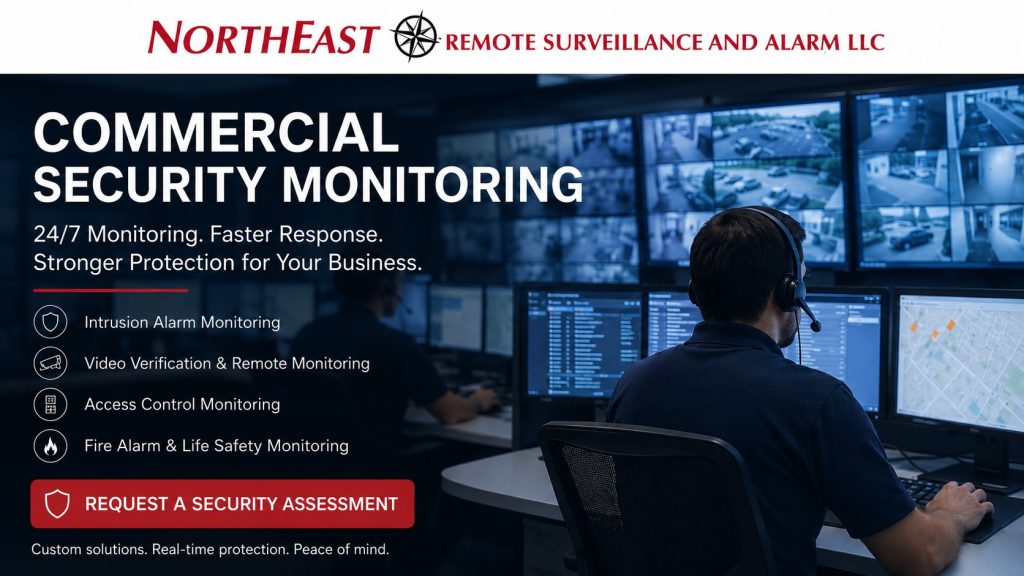
Northeast Remote Surveillance and Alarm, LLC plans monitoring around the property, compatible equipment, operating hours, and responsible contacts.
For the wider installation and integration scope, visit Commercial and Industrial Security Services.
Choose the Monitoring Service Your Property Needs
Begin with the event and the person or service expected to respond.
Ask the proposal to identify the monitored equipment, hours of coverage, review steps, notification recipients, escalation instructions, and exclusions.
Different monitoring functions should have separate responsibilities even when they use a connected platform.
- Alarm signals: define the intrusion events, contact list, communication arrangement, and agreed response instructions. For equipment and detection planning, review commercial intrusion alarm installation.
- Camera events: distinguish recorded evidence and customer notifications from a contracted operator service. For camera-event review and escalation, explore remote video monitoring and live talk-down.
- Industrial operations: account for shifts, authorized after-hours work, equipment areas, and exterior activity. Use the industrial monitoring guide for that operating context.
- Account setup and changes: keep site details, contacts, schedules, and responsible administrators current. Review monitoring setup and account management for the ongoing service arrangements.
Fire and life-safety monitoring require their own system review and coordination with the qualified professionals responsible for the property. Customer app notifications should not be assumed to provide the same service as monitored alarm transmission. Confirm the actual included functions and responsibilities in the site-specific proposal.
Confirm the response before starting service
Walk through a representative event with the responsible provider and property manager. Confirm how the event is identified, what information is available, who is contacted, and how the result is documented. Coordinate testing in advance so test activity is handled appropriately. Record any equipment, communication, or coverage limitation before treating the service as ready.
NERSA supports monitoring for warehouses, manufacturing facilities, logistics sites, offices, industrial parks, contractor yards, schools, municipal buildings, healthcare properties, retail locations, and multi-site commercial organizations. Monitoring should be designed around the facility, the risk, the response plan, and the systems already protecting the property.
What Is Commercial Security Monitoring?
Commercial security monitoring connects a business security system to a response process. Instead of relying only on local alarms, cameras, or staff discovery, monitored systems can send events for review, notification, verification, or escalation.
A commercial monitoring program may include intrusion alarm monitoring, video verification, remote video monitoring, access control event review, fire alarm monitoring, environmental alerts, gate activity, panic or duress signals, and after-hours security response procedures.
The purpose is not just to know that something happened. The purpose is to help the business understand what happened, who needs to be notified, what response is appropriate, and how the event should be documented.
Why Commercial Monitoring Matters
Many commercial properties have risk after employees leave. Warehouses still have dock doors, trailers, freight, tools, vehicles, exterior equipment, and parking areas. Manufacturing buildings may have restricted rooms, production areas, exterior yards, employee entrances, utility rooms, and after-hours maintenance activity. Offices may have sensitive departments, IT rooms, shared entrances, and visitor spaces.
A properly designed monitoring program helps reduce confusion when an event occurs.
Commercial security monitoring can help businesses:
- Respond to after-hours intrusion events
- Verify alarm activity with video when available
- Improve security around docks, yards, gates, and parking lots
- Support employee safety and panic response planning
- Monitor access control events during unusual hours
- Improve communication during security incidents
- Reduce unnecessary response when events can be reviewed
- Document security activity for management review
- Support multi-site oversight and consistent procedures
- Strengthen accountability across the property
Monitoring does not replace good system design. It makes the system more useful when something happens.
Commercial Intrusion Alarm Monitoring
Intrusion alarm monitoring is one of the most common forms of commercial security monitoring. Door contacts, motion detectors, glass break sensors, overhead door contacts, panic devices, and other alarm points can send signals when activity occurs during armed periods.
For commercial properties, intrusion alarm monitoring should be planned around the actual building layout. A warehouse may need separate protection for offices, docks, employee entrances, shipping areas, and exterior overhead doors. A manufacturing facility may need partitions for offices, production areas, maintenance rooms, tool storage, and restricted spaces.
For intrusion alarm system planning, visit Commercial and Industrial Intrusion Alarm Systems.
Video Verification and Remote Video Monitoring
Video verification can help confirm what is happening during an alarm or monitored event. Instead of treating every signal the same way, camera views can provide more context.
A monitored video event may show whether a person is on-site, whether a vehicle is entering a restricted area, whether a door was forced, whether an employee is still working late, or whether an alarm was caused by non-threatening activity.
For exposed exterior areas, remote video monitoring can be especially useful. This may include parking lots, gates, truck yards, loading docks, trailer rows, contractor yards, industrial yards, and building approaches.
For video system planning, visit Commercial and Industrial Video Surveillance Systems.
For setup, provider transitions, and account administration, review monitoring setup and account management.
Live Talk-Down Monitoring
Live talk-down monitoring adds an active response layer to commercial monitoring. When suspicious activity is detected and reviewed, a monitoring operator can speak through an on-site speaker and issue a live voice warning.
This can help deter trespassing, loitering, vandalism, illegal dumping, theft from yards, unauthorized activity around docks, and after-hours movement around exposed property areas.
Live talk-down monitoring is most useful when cameras, speakers, lighting, analytics, and response procedures are designed together. The system should be clear enough for the operator to understand the event and loud enough for the person on-site to hear the warning.
For audio and speaker system planning, visit Two-Way Communication & IP Speaker Systems.
Access Control Monitoring
Access control monitoring helps businesses review door activity, user activity, gate activity, and after-hours access events. This is especially important for facilities with many employees, vendors, contractors, drivers, tenants, or restricted areas.
Access control monitoring can help identify unusual entry times, repeated denied access attempts, doors held open, forced doors, gate activity, and access events that do not match normal operating schedules.
When access control is paired with video surveillance, a business can review not only which credential was used, but also what happened at the door or gate.
For access control planning, visit Commercial and Industrial Access Control Systems.
Fire Alarm and Life Safety Monitoring
Fire alarm monitoring is different from standard security monitoring because fire alarm systems are life-safety systems. They must be planned, installed, monitored, tested, and maintained according to applicable code requirements, authority expectations, and the needs of the building.
Commercial and industrial facilities may need fire alarm monitoring for sprinkler systems, waterflow, supervisory signals, trouble signals, manual pull stations, smoke detection, duct detection, elevator recall, notification appliances, and emergency response.
For dedicated fire alarm and life-safety planning, visit Commercial and Industrial Fire Alarm Installation.
Warehouse Security Monitoring
Warehouses and distribution centers are among the strongest candidates for commercial security monitoring because they often have large footprints, many doors, heavy vehicle movement, exterior exposure, and after-hours activity.
Warehouse monitoring may include intrusion alarm events, dock door alarms, employee entrance activity, trailer yard cameras, gate events, video verification, fire alarm monitoring, remote video review, and live talk-down response.
A monitored warehouse security system can help protect loading docks, truck courts, trailer areas, employee entrances, shipping and receiving, restricted inventory, office-to-warehouse transitions, and exterior approaches.
For warehouse-specific security planning, visit Warehouse Security Systems for Pennsylvania and the Mid-Atlantic.
Monitoring for Manufacturing and Industrial Facilities
Manufacturing and industrial properties often have production areas, restricted rooms, tool storage, maintenance spaces, employee entrances, service doors, yards, parking areas, and utility spaces that require coordinated monitoring.
Monitoring should account for shift schedules, contractor access, after-hours maintenance, production downtime risk, safety-sensitive areas, and restricted operational zones.
A manufacturing facility may need intrusion alarm monitoring for offices and production areas, video monitoring for yards and entrances, access control monitoring for restricted rooms, and fire alarm monitoring for life-safety protection.
For manufacturing security planning, visit Manufacturing Plant Security Systems.
Monitoring for Truck Yards, Parking Lots, and Exterior Areas
Exterior areas can be difficult to protect with alarms alone. Truck yards, fleet lots, parking areas, storage yards, fenced lots, and contractor yards may need cameras, lighting, license plate recognition, gate monitoring, remote video review, and talk-down capability.
A monitoring plan should consider how vehicles enter, where people approach, what lighting is available, where cameras can see clearly, and what response should happen if unauthorized activity is confirmed.
For vehicle documentation and gate visibility, visit License Plate Recognition Camera Systems.
For contractor yard planning, visit Contractor Yard Security Systems in Easton, PA.
What Commercial Security Monitoring Can Include
A commercial monitoring program may include:
- Intrusion alarm monitoring
- Video verification
- Remote video monitoring
- Live talk-down monitoring
- Fire alarm monitoring
- Access control event review
- Forced-door alerts
- Door-held-open alerts
- Gate activity alerts
- Panic and duress monitoring
- Environmental alerts
- After-hours activity review
- Designated contact notification
- Event escalation procedures
- Incident documentation support
The right combination depends on the property type, operating schedule, security risks, existing systems, and response expectations.
Monitoring Is Only as Strong as the System Design
Monitoring cannot fix poor camera placement, weak alarm design, bad lighting, missing door contacts, unreliable internet, unclear response procedures, or poorly managed user permissions.
A strong monitoring plan starts with the property.
Important design factors include:
- Which areas are monitored
- When monitoring is active
- Which events require review
- Who should be notified
- When events should be escalated
- Which cameras verify which alarm points
- Which doors need access control alerts
- Which areas need live talk-down capability
- How video is retained and exported
- How users are added and removed
- How the system will scale over time
For a full site review, visit Physical Plant Security Assessment.
What Commercial Security Monitoring Does Not Replace
Commercial security monitoring is an important layer, but it does not replace a complete security plan.
Monitoring does not replace:
- Proper locks and door hardware
- Fencing and gates
- Good exterior lighting
- Access control
- Video surveillance
- Intrusion alarm design
- Fire alarm and life-safety compliance
- Employee procedures
- Security policies
- Incident reporting
- On-site response when needed
Monitoring works best when it supports a complete security system and a clear response procedure.
Related Planning
For account setup, provider transitions, and ongoing administration, review NERSA monitoring account services.
- Use Commercial and Industrial Video Surveillance Systems to review the camera systems that can support event review.
- Use Commercial and Industrial Access Control Systems to review controlled entry and user administration alongside monitoring needs.
- Use Commercial and Industrial Intrusion Alarm Systems to review intrusion-alarm equipment and reporting options.
- Use Commercial and Industrial Fire Alarm Installation to review the separate installation scope for commercial fire-alarm systems.
Industries That Benefit From Commercial Monitoring
Commercial monitoring can support many types of properties, including warehouses, manufacturing facilities, distribution centers, logistics buildings, truck yards, contractor yards, schools, municipal buildings, healthcare offices, retail properties, corporate offices, industrial parks, utility sites, and multi-site commercial organizations.
For a broader overview of industries NERSA serves, visit Industries Served by Northeast Remote Surveillance and Alarm, LLC.
Commercial Security Monitoring Across Pennsylvania and the Mid-Atlantic
Northeast Remote Surveillance and Alarm, LLC supports commercial and industrial monitoring needs across Pennsylvania and the Mid-Atlantic. NERSA works with organizations that need systems designed around real facilities, real risks, and long-term operational support.
For regional service planning, visit Commercial and Industrial Security Systems in Pennsylvania and the Mid-Atlantic.
Request a Commercial Security Monitoring Assessment
If your property needs intrusion alarm monitoring, video verification, remote video monitoring, fire alarm monitoring, access control event review, live talk-down response, or a stronger after-hours security plan, Northeast Remote Surveillance and Alarm, LLC can help.
A properly designed monitoring program should improve visibility, support response, document activity, and help your organization understand what is happening when an event occurs.
Call 1-888-344-3846 or request a commercial security assessment.
Frequently Asked Questions About Commercial Security Monitoring
What is commercial security monitoring?
Commercial security monitoring connects business security systems to a response process. It may include intrusion alarm monitoring, video verification, remote video monitoring, access control alerts, fire alarm monitoring, panic signals, and after-hours event response.
What types of businesses need commercial monitoring?
Warehouses, manufacturing facilities, logistics sites, offices, schools, municipal buildings, healthcare properties, retail locations, contractor yards, truck yards, industrial sites, and multi-site organizations can all benefit from commercial security monitoring.
Is commercial monitoring the same as video surveillance?
No. Video surveillance records and displays activity. Monitoring adds a response process so certain events can be reviewed, verified, reported, or escalated.
Can cameras be used to verify alarm events?
Yes. When cameras are properly placed and integrated into the monitoring workflow, video can help verify alarm events and provide better context before escalation.
Does commercial monitoring work after hours only?
It can. Many businesses use monitoring after hours, on weekends, during holidays, or during specific risk windows. Some facilities may need monitoring during operating hours for panic, gate, access control, or high-risk areas.
Can commercial monitoring include live talk-down?
Yes. Live talk-down monitoring can allow a trained operator to issue a voice warning through on-site speakers when suspicious or unauthorized activity is observed.
Can access control events be monitored?
Yes. Access control events such as forced doors, doors held open, denied access attempts, unusual entry times, and gate activity can be included in a monitoring plan when the system supports it.
Does monitoring replace fire alarm service?
No. Fire alarm monitoring is part of a regulated life-safety system and must be handled separately from standard security monitoring. Fire alarm systems require proper design, installation, testing, inspection, monitoring, and documentation.
Can NERSA monitor existing systems?
In some cases, existing systems may be usable if they support the required communication, signal reporting, video quality, integration, and response workflow. A site assessment is needed to determine what can be reused.
What is the first step?
The first step is a commercial security assessment that reviews the property layout, existing systems, operating schedule, risk areas, monitoring needs, response procedures, and long-term security goals.