Truck yard remote video monitoring helps logistics facilities, trailer yards, fleet operations, distribution centers, contractor yards, industrial properties, and warehouse sites improve visibility around parked trailers, gate activity, perimeter movement, after-hours access, and exterior security events. This anonymous case study shows how Northeast Remote Surveillance and Alarm, LLC approaches remote video monitoring when a commercial property needs stronger exterior awareness, real-time event review, live talk-down capability, and better documentation around truck yard activity. For the full proof section, visit Commercial and Industrial Security Case Studies.
Call 1-888-344-3846 to request a truck yard remote video monitoring assessment.
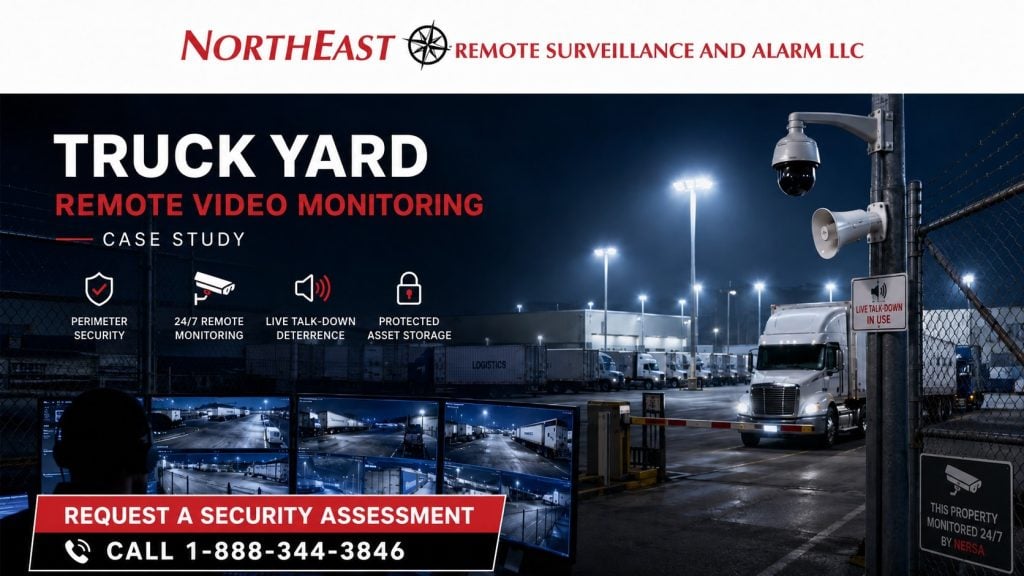
Case Study Overview
This case study is based on a common truck yard and logistics security problem: the property had exterior camera coverage, but the business needed a more active way to address after-hours activity around trailers, gates, yard lanes, perimeter edges, and parked vehicles.
The site did not need a basic camera package. It needed a monitored exterior security layout built around how trucks, trailers, employees, drivers, vendors, and unauthorized vehicles could move through the property.
The goal was to improve visibility and response around:
- Trailer rows
- Truck courts
- Gate lanes
- Fence lines
- Yard entrances
- Exterior storage areas
- Parked commercial vehicles
- After-hours vehicle movement
- Perimeter approach points
- Exterior traffic patterns
- Unauthorized access
- Real-time event review
- Incident documentation
This page focuses only on the truck yard remote video monitoring case study. For broader yard protection, visit Truck Yard Security Systems. For monitored response and live deterrence planning, visit Remote Video Monitoring and Live Talk-Down.
Property Type
The property was an anonymous commercial truck yard and logistics-style site with parked trailers, truck movement, vehicle staging, gate access, perimeter exposure, and after-hours security concerns.
The site included:
- Parked trailers
- Truck lanes
- Vehicle entry points
- Fence-line exposure
- Exterior storage areas
- Yard lighting
- Trailer parking rows
- A nearby warehouse or dispatch building
- Periods of low staffing
- After-hours activity concerns
- Existing exterior cameras that needed a stronger monitoring strategy
Like many logistics and industrial properties, most of the exposure was outside the building.
The Security Challenge
The main challenge was not whether cameras existed. The issue was that recorded video alone did not provide enough real-time awareness when suspicious activity occurred after hours.
Common concerns included:
- Unauthorized vehicles approaching the yard
- People walking near parked trailers after hours
- Unverified movement near fence lines
- Limited awareness around remote yard corners
- Gate activity without immediate review
- Trailer rows that were difficult to supervise at night
- Delayed response when suspicious activity occurred
- Management discovering issues only after reviewing footage later
- Exterior incidents that needed stronger documentation
This is a common weakness in truck yard security. A site may have cameras, but if the right areas are not being actively reviewed during vulnerable hours, the system may only show what happened after the loss has already occurred.
For broader logistics protection planning, visit Warehouse Security Systems.
Why Truck Yards Need a Different Monitoring Strategy
A truck yard is not just open space around a building. It is an operating environment where trailers, vehicles, drivers, employees, vendors, gates, fence lines, equipment, and exterior exposure all intersect.
Truck yards may include:
- Trailer parking
- Fleet vehicles
- Drop trailers
- Driver access
- Gate lanes
- Yard lanes
- Exterior storage
- Dispatch offices
- Maintenance areas
- Dock-side vehicle movement
- Side and rear property exposure
- Low-visibility areas
- Long fence lines
- Multiple vehicle paths
A standard building alarm does not fully protect that type of exterior environment. A basic camera system may record it, but recording alone may not create a live response when suspicious activity is happening.
Remote video monitoring adds a more active layer by focusing operator review around the highest-risk exterior zones during the hours when direct supervision is limited.
Site Conditions Reviewed
Before recommending a monitoring layout, Northeast Remote Surveillance and Alarm, LLC reviewed how the truck yard actually operated.
The review focused on:
- How vehicles entered the site
- Where trailers were parked
- Which areas had the most after-hours exposure
- How the gate was used
- Where unauthorized vehicles could approach
- Which fence lines were most vulnerable
- How lighting affected camera performance
- Whether existing cameras provided usable views
- Which views should be monitored
- Which views should primarily be recorded
- Whether live talk-down speakers were appropriate
- How management wanted alerts handled
- Whether contact notification or escalation was needed
- Whether monitoring should run continuously or during selected hours
The monitoring design started with the property layout and operating conditions, not a generic equipment package.
Monitoring Strategy
The recommended approach focused remote monitoring on the areas where after-hours activity mattered most.
The goal was not to monitor every camera equally. The goal was to identify the highest-risk exterior views and build a practical monitoring workflow around them.
Gate and Vehicle Entry Monitoring
The gate area was treated as a priority because it controlled one of the main vehicle paths into the yard.
Monitoring around the gate can help review:
- Unauthorized vehicle approach
- After-hours entry attempts
- Tailgating
- Vehicles stopping near the gate
- Driver activity
- Vendor or contractor activity
- Gate-left-open conditions
- Suspicious loitering near the entrance
If a gate is not documented well, the business may not know when the event started or how the vehicle or individual first approached the property.
For gate-specific planning, visit Commercial Gate Access Control Systems.
Trailer Row Monitoring
Trailer rows were reviewed because parked trailers often represent one of the highest-value and highest-exposure parts of the property.
Monitoring around trailer rows can help identify:
- People walking between trailers
- Vehicles stopping near parked trailers
- Suspicious after-hours activity
- Trailer tampering
- Repeated movement in the same area
- Activity near high-value trailer locations
- Unusual vehicle positioning
- Overnight movement that does not match normal operations
Trailer rows require careful camera planning because long parking rows, poor lighting, parked equipment, and blind corners can make review difficult if the views are not designed properly.
Fence Line and Perimeter Monitoring
Fence lines and perimeter edges were reviewed because unauthorized activity often begins at the property boundary.
Perimeter monitoring may focus on:
- Side fence approaches
- Rear fence lines
- Remote corners
- Cut-through areas
- Adjacent lot exposure
- Pedestrian approach paths
- Dark exterior areas
- Exterior storage edges
A perimeter fence is more useful when the business can see and document activity near it.
Exterior Storage and Equipment Areas
Some truck yards also store equipment, materials, attachments, or vehicles outside.
Monitoring these areas can improve awareness around:
- Unauthorized movement
- Equipment tampering
- Vehicle damage
- After-hours access
- Suspicious loitering
- Theft attempts
- Unusual activity near stored assets
These areas should be reviewed based on actual exposure and value, not treated as unimportant background views.
Live Talk-Down and Real-Time Deterrence
Remote video monitoring can be paired with live talk-down when appropriate.
Live talk-down allows an operator to issue a real-time audio warning when suspicious activity is verified. This can help deter trespassing, loitering, unauthorized vehicle activity, vandalism, theft attempts, and after-hours movement in restricted areas.
In a truck yard environment, live talk-down may be useful near:
- Gates
- Trailer rows
- Perimeter edges
- Outdoor storage areas
- Equipment parking areas
- Building approaches
- After-hours access points
The goal is not to create unnecessary audio events. The goal is to verify suspicious activity first, then issue a targeted warning when the event appears real and actionable.
For active deterrence planning, visit Remote Video Monitoring and Live Talk-Down.
Why Recorded Video Alone Was Not Enough
Recorded video is important, but it is reactive.
It helps answer what happened after the event.
Remote video monitoring adds a more active review layer while the activity is occurring.
For this truck yard scenario, recorded video alone could help document an incident, but it did not provide:
- Real-time operator review
- Live talk-down capability
- Faster notification to contacts
- Event escalation procedures
- Stronger after-hours awareness
- A practical deterrence layer
- A documented monitoring workflow
That distinction matters for truck yards, trailer lots, contractor yards, industrial yards, and other exterior commercial sites where losses often happen outside the building.
For cargo-risk planning, visit Cargo Theft Prevention Systems.
Camera Coverage Strategy for Monitoring
Remote video monitoring depends on usable camera views.
A monitored camera should not be aimed randomly. It should provide a clear view of the area where the operator needs to verify activity and make a decision.
Camera planning considered:
- Gate lane visibility
- Trailer row visibility
- Yard corner visibility
- Fence-line visibility
- Vehicle approach angles
- Lighting conditions
- Camera height
- Camera field of view
- Night performance
- Weather exposure
- Potential obstructions
- Remote viewing quality
- Whether analytics could support detection
- Whether speakers could cover the same area
The strongest monitoring design uses camera views that help operators confirm suspicious activity quickly.
If a view is too wide, too dark, too distant, blocked by trailers, or poorly angled, the monitoring team may not be able to determine what is happening.
For broader camera planning, visit Commercial Video Surveillance Systems.
Alarm and Monitoring Coordination
Remote video monitoring can also support alarm activity when the site includes building alarms, gate devices, door contacts, motion detection, or other intrusion points.
Depending on the property, monitored video may support:
- Gate activity review
- Door alarm verification
- Yard motion alerts
- Building perimeter review
- Dispatch office alarm review
- Shop building alarm review
- After-hours contact notification
- Escalation procedures
- Event documentation
A truck yard may not be protected well enough by a building alarm alone, but cameras and monitoring can support the exterior areas where traditional alarm devices do not cover the full exposure.
For alarm system planning, visit Commercial and Industrial Alarm Installation.
Operational Result
The remote video monitoring design helped the property move from passive recording toward a more active after-hours security process.
The system supported:
- Better awareness of after-hours yard activity
- Better review of vehicle movement near the gate
- Better monitoring of trailer rows
- Better perimeter visibility
- Better exterior event documentation
- Live talk-down potential for suspicious activity
- Faster notification procedures
- Stronger management confidence around yard exposure
- Better support for incident review
No sensitive customer information, exact camera maps, passwords, alarm zones, monitoring schedules, or security weaknesses are published in this case study.
The value of the project was the monitoring strategy, not just the equipment.
What This Case Study Does Not Cover
This page is focused specifically on remote video monitoring for a truck yard.
It is not the main truck yard security page. It is not the main remote video monitoring page. It is not the main commercial video surveillance page. It is not the main gate access control page. It is not the main alarm page. It is not the main cargo theft prevention page.
For broader truck yard protection, visit Truck Yard Security Systems.
For monitored response, visit Remote Video Monitoring and Live Talk-Down.
For commercial video planning, visit Commercial Video Surveillance Systems.
For cargo and freight exposure planning, visit Cargo Theft Prevention Systems.
For the full case-study hub, visit Commercial and Industrial Security Case Studies.
Lessons From This Truck Yard Remote Video Monitoring Case Study
This case study highlights several practical lessons for exterior commercial and industrial security.
Truck Yard Security Starts Outside the Building
The most important exposure may not be inside the warehouse or office. It may be in the yard where trailers, vehicles, equipment, and perimeter edges remain vulnerable.
Monitoring Should Focus on High-Risk Views
Not every camera needs the same monitoring priority. The strongest approach focuses remote review on gates, trailer rows, fence lines, yard corners, and after-hours approach points.
Live Talk-Down Works Best With Usable Camera Views
A live warning is only useful when the operator can verify suspicious activity. Camera placement and monitoring workflows must support each other.
Lighting Affects Monitoring Performance
Poor lighting can make remote review more difficult. Camera performance, lighting coordination, infrared behavior, and mounting angles should all be reviewed before monitoring begins.
Recorded Video and Live Monitoring Serve Different Purposes
Recorded video helps investigate after the fact. Remote monitoring can help detect, verify, warn, notify, and document while activity is happening.
Recommended Truck Yard Monitoring Assessment
A truck yard remote video monitoring assessment should review the full exterior operation before final recommendations are made.
Northeast Remote Surveillance and Alarm, LLC may review:
- Gate entrances
- Trailer rows
- Truck courts
- Yard lanes
- Fence lines
- Remote corners
- Exterior storage areas
- Lighting conditions
- Existing cameras
- Existing network infrastructure
- Camera mounting locations
- Speaker locations
- Vehicle movement patterns
- After-hours schedules
- Contact notification procedures
- Escalation expectations
- Monitoring hours
- Recording retention
- Gate control needs
- Alarm integration needs
- Future expansion
The goal is to design a monitored yard security plan that matches how the property actually operates.
Frequently Asked Questions About Truck Yard Remote Video Monitoring
What is truck yard remote video monitoring?
Truck yard remote video monitoring uses cameras, monitoring workflows, and event review procedures to help supervise exterior truck yard areas such as gates, trailer rows, fence lines, vehicle lanes, and equipment areas during selected monitoring periods.
Why do truck yards need remote video monitoring?
Truck yards often have trailers, vehicles, equipment, exterior storage, gate activity, and perimeter exposure that remain vulnerable after hours. Remote video monitoring adds a more active review layer than recorded video alone.
What areas should be monitored in a truck yard?
Common monitoring areas include gate lanes, trailer rows, fence lines, truck courts, yard corners, exterior storage areas, dispatch building approaches, equipment zones, and after-hours vehicle paths.
Can remote monitoring help deter trespassing?
Yes. Remote video monitoring can help identify suspicious activity, verify the event, issue live talk-down warnings where speakers are installed, notify contacts, and support documentation.
What is live talk-down?
Live talk-down allows an operator to issue a real-time audio warning through speakers when suspicious activity is verified. It is often used for trespassing, loitering, unauthorized vehicle activity, vandalism, or after-hours movement in restricted areas.
Is remote video monitoring the same as recorded video?
No. Recorded video helps with after-the-fact investigation. Remote video monitoring adds a live or event-based review layer so suspicious activity can be evaluated while it is happening.
Can truck yard monitoring work with gate access control?
Yes. Gate access control and remote video monitoring can support each other. Gate access control manages entry, while cameras and monitoring can provide visual context around gate activity.
Can truck yard monitoring support cargo theft prevention?
Yes. Truck yard monitoring can support cargo theft prevention by improving visibility around trailers, gates, yard movement, dock approaches, and after-hours vehicle activity.
Can existing cameras be used for remote monitoring?
Sometimes. Existing cameras may be used if they provide clear, reliable, properly angled views of the areas that need monitoring. If the views are too dark, too wide, blocked, or poorly positioned, camera upgrades may be needed.
Do all truck yard cameras need to be monitored?
No. Monitoring should focus on priority views such as gates, trailer rows, fence lines, high-risk yard corners, exterior storage areas, and after-hours approach points. Other cameras may be recorded for later review.
Can remote monitoring reduce false alarms?
Remote video review can help determine whether activity appears suspicious, authorized, weather-related, animal-related, or false. This can help improve response decisions when monitoring procedures are planned correctly.
Does truck yard monitoring require speakers?
Speakers are not always required, but they are useful when live talk-down is part of the deterrence plan. Speaker placement should match the monitored camera views and the areas where warnings may need to be issued.
Does NERSA publish exact customer monitoring layouts?
No. Northeast Remote Surveillance and Alarm, LLC does not publish sensitive customer camera maps, monitoring schedules, alarm zones, passwords, or security weaknesses in public case studies.
Does NERSA install residential monitoring systems?
No. Northeast Remote Surveillance and Alarm, LLC focuses on commercial, industrial, warehouse, logistics, manufacturing, institutional, municipal, healthcare, and enterprise security systems.
How do I request a truck yard remote video monitoring assessment?
Call 1-888-344-3846 or request a security assessment at Northeast Remote Surveillance and Alarm, LLC can review your yard layout, gate activity, trailer rows, camera coverage, lighting, monitoring needs, and after-hours exposure.
Request a Truck Yard Remote Video Monitoring Assessment
Truck yard remote video monitoring should be designed around the real exterior risk areas of the property. Gates, trailer rows, fence lines, yard lanes, exterior storage areas, parked vehicles, dock-side approaches, and after-hours movement all require specific visibility and response planning.
If your logistics facility, truck yard, trailer lot, contractor yard, warehouse, distribution center, fleet operation, or industrial property needs better after-hours visibility and live monitoring support, Northeast Remote Surveillance and Alarm, LLC can evaluate the site and recommend a practical monitoring layout.
Call 1-888-344-3846 or request a security assessment