Restaurant security systems should protect entrances, dining areas, registers, employee spaces, kitchens, rear doors, deliveries, restricted storage, parking areas, staff, customers and after-hours operations without turning the property into an unnecessarily complicated security environment.
Request a Restaurant Security Assessment
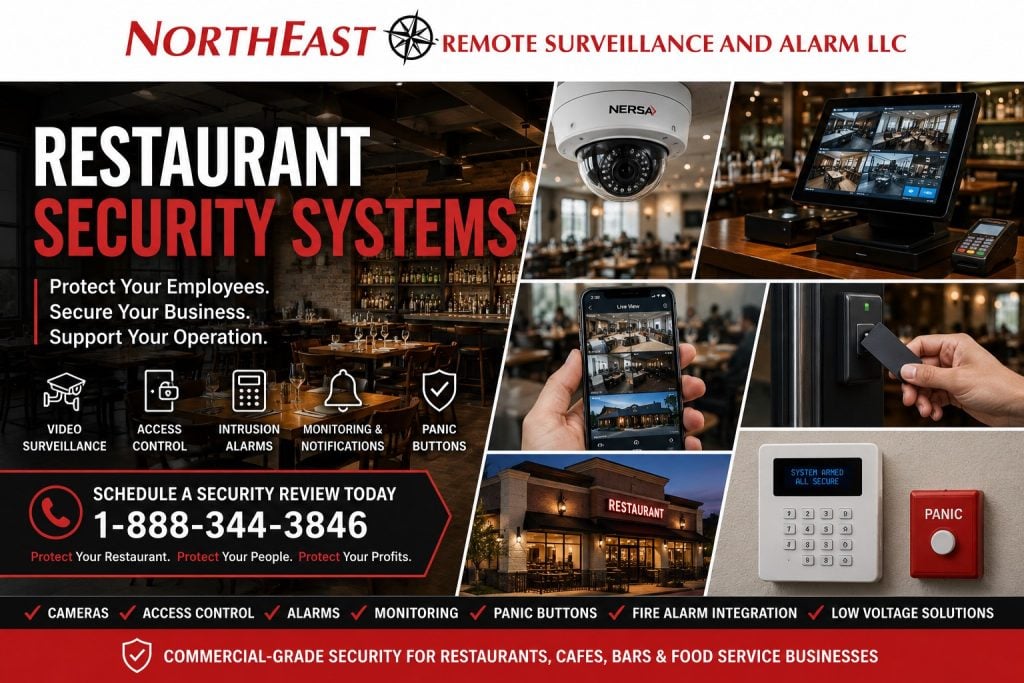
NERSA designs, installs, integrates, monitors, upgrades, takes over and supports commercial-grade security systems. Qualifying sites include restaurants, cafés, bars, quick-service and franchise locations, catering businesses, commercial kitchens and other food-service operations.
Restaurants have a distinct security profile because they combine:
- Public access
- Employee movement
- Cash and card transactions
- Food and supply storage
- Deliveries
- Rear-door activity
- Late operating hours
- Parking exposure
- After-hours risk
The correct system should be built around how the restaurant actually operates rather than around a predetermined equipment package.
For broader small-business security planning, visit Small Business Security Systems.
Commercial Systems Only • Restaurants • Cafés • Bars • Quick-Service Locations • Franchises • New Installations • Upgrades • Takeovers • Monitoring
Commercial Security Planning for Restaurants
A restaurant security system should support daily business operations while providing useful visibility and dependable protection.
Planning may need to consider:
- Customer entrances
- Employee entrances
- Registers
- Bars
- Takeout counters
- Dining areas
- Kitchen transitions
- Rear doors
- Delivery entrances
- Storage rooms
- Manager offices
- Restricted areas
- Employee-only spaces
- Parking areas
- Exterior approaches
- After-hours activity
The objective is not to install the greatest possible number of cameras, alarm devices or controlled doors.
The objective is to provide useful visibility, dependable intrusion protection, controlled access where appropriate, practical staff-safety tools and a system that ownership and management can operate effectively.
Restaurant Security Risks
Restaurants may face:
- Break-ins after hours
- Cash-handling concerns
- Register disputes
- Employee theft
- Customer incidents
- Rear-door exposure
- Delivery-access problems
- Unauthorized restricted-area access
- Storage loss
- Vandalism
- Parking-lot incidents
- Late-night activity
- False alarms
- Limited owner visibility
A properly planned system should help ownership understand what happened and provide useful information when an incident requires review.
Video Surveillance for Restaurants
Restaurant camera systems should be designed around areas where useful evidence matters most.
Common camera locations may include:
- Front entrances
- Host stands
- Registers
- Takeout counters
- Dining areas
- Bars where appropriate
- Kitchen entrances
- Rear doors
- Delivery entrances
- Storage-room approaches
- Manager-office approaches
- Employee entrances
- Parking areas
- Exterior approaches
Camera placement should reflect the intended result.
A wide dining-room view may provide general context, while a focused camera may be needed at a register, rear door, delivery point or other location where identification or transaction detail matters.
For broader small-business camera planning, visit Small Business Security Camera Systems.
Employee, Delivery and Restricted-Area Access
Restaurants often contain areas that should not be accessible to every customer, vendor or employee.
These may include:
- Employee entrances
- Rear doors
- Manager offices
- Cash-handling areas
- Storage rooms
- Liquor storage where applicable
- IT rooms
- Shared tenant spaces
Access control can help reduce key-management problems and provide individually managed permissions for selected doors.
For employee credentials, restricted areas, schedules and commercial door management, visit Small Business Access Control Systems.
Intrusion and After-Hours Protection
Restaurants are often most exposed after closing.
A commercial intrusion system may protect:
- Front doors
- Rear doors
- Side entrances
- Storefront glass
- Interior movement areas
- Offices
- Storage rooms
- Restricted areas
The system should be easy for authorized employees to operate and dependable when the property is closed or lightly staffed.
For broader commercial after-hours protection, visit Small Business Alarm Systems.
Panic and Staff-Safety Protection
Some restaurants may benefit from panic or duress protection where employees handle cash, work late, close alone, operate bars or regularly interact with the public.
Potential locations may include:
- Registers
- Bars
- Host stands
- Manager offices
- Cash-handling areas
- Takeout counters
- Back offices
Panic protection should be paired with clear procedures and appropriate monitoring instructions.
Rear Doors and Delivery Areas
Rear doors are often one of the most important restaurant security points.
Employees, vendors, delivery drivers, waste-removal personnel and contractors may all use the rear of the building.
Security planning may need to consider:
- Door status
- Delivery activity
- Employee access
- After-hours openings
- Exterior lighting
- Camera coverage
- Alarm protection
- Visitor communication
The goal is to maintain an efficient delivery workflow without creating an uncontrolled entrance.
Parking and Exterior Security
Restaurant security does not end at the building entrance.
Exterior planning may need to consider:
- Customer parking
- Employee parking
- Patios
- Rear alleys
- Delivery areas
- Dumpster areas
- Drive lanes
- Exterior doors
- Building approaches
- After-hours loitering
Remote Visibility and After-Hours Monitoring
Restaurant owners and managers may need secure remote visibility for:
- Openings and closings
- Deliveries
- Register activity
- Employee entrances
- Customer incidents
- Alarm events
- Parking activity
- Multi-location oversight
Remote access should use appropriate permissions so managers receive only the views and administrative capabilities required for their role.
Existing Restaurant Security Systems
Many restaurants inherit cameras, alarms, access control, cabling, administrator accounts or monitoring arrangements from a prior owner, tenant, franchisee, installer or property manager.
For restaurants operating within broader lodging or hospitality properties, see Poconos hospitality and commercial-property security.
Existing equipment should be evaluated before complete replacement is recommended.
Potential issues may include:
- Poor camera placement
- Weak nighttime video
- Short recording retention
- Shared alarm codes
- Former employees retaining access
- Old alarm communicators
- Unclear administrator ownership
- Poor rear-door protection
- Weak parking coverage
- Inadequate documentation
- Unreliable network equipment
- Limited expansion capability
The appropriate path may involve repair, reconfiguration, selective replacement, takeover or phased modernization.
Fire Alarm and Life-Safety Coordination
Restaurant properties may also require coordination with commercial fire alarm and life-safety systems.
Security planning should not interfere with emergency egress, fire alarm operation or required door behavior.
Multi-Location Restaurant Security
Restaurant groups operating several locations may benefit from consistent standards for:
- Cameras
- Alarm users
- Access permissions
- Monitoring contacts
- Naming conventions
- Administrator ownership
- Documentation
The individual properties may still require different camera views, alarm zones or access requirements based on layout and operating hours.
Why Restaurants Choose NERSA
Northeast Remote Surveillance and Alarm, LLC focuses on commercial and industrial security systems rather than residential-style alarm packages.
NERSA evaluates restaurant properties around:
- Customer flow
- Employee movement
- Register and cash areas
- Rear-door activity
- Deliveries
- Restricted spaces
- Parking
- After-hours exposure
- Existing equipment
- Monitoring
- Network infrastructure
- Future growth
The objective is to provide a restaurant security system that remains useful, manageable, supportable and appropriate for the operation of the business.
Request a Restaurant Security Assessment
NERSA can help improve security at restaurants, cafés, bars, quick-service locations, franchises and other food-service properties. We review camera coverage, after-hours protection, staff access and rear doors. Plans can also address parking visibility, panic protection and upgrades to existing systems.
Request a Restaurant Security Assessment.
Frequently Asked Questions About Restaurant Security Systems
What should a restaurant security system include?
The exact system depends on the property, but common components may include video surveillance, intrusion alarms, rear-door protection, controlled access to restricted areas, parking coverage, panic protection, remote viewing and professional monitoring.
Where should restaurant cameras be installed?
Common locations include front entrances, registers, dining areas, bars where appropriate, kitchen entrances, rear doors, delivery areas, storage-area approaches, employee entrances, parking areas and exterior approaches.
Do restaurants need access control?
Some do. Access control can be useful for employee entrances, rear doors, manager offices, storage rooms, cash areas, IT rooms and other restricted locations.
Can restaurant alarms be professionally monitored?
Yes. Compatible commercial alarm systems can transmit qualifying events for professional monitoring.
Are panic buttons useful in restaurants?
They can be, especially where employees handle cash, work late, close alone, operate bars or regularly interact with the public.
Can restaurant owners view cameras remotely?
Yes. Compatible commercial systems can provide secure remote viewing for approved owners and managers.
Can an existing restaurant security system be upgraded?
Yes. Existing cameras, alarms, access control, cabling, monitoring and administrator ownership can be evaluated to determine what should be retained, corrected, upgraded or replaced.
Can one security structure support several restaurant locations?
Yes. Restaurant groups can use consistent standards for cameras, alarms, access control, monitoring, user management and documentation while accounting for differences between individual properties.
How does a restaurant security project begin?
The project begins with a property-specific assessment of customer entrances, employee areas, registers, rear doors, deliveries, parking, existing systems, after-hours exposure and future requirements.
Compliance, Codes & Project Standards
NERSA plans commercial and industrial security work with applicable code, documentation, inspection and authority-having-jurisdiction requirements in mind. Requirements vary by system, property and jurisdiction. These resources support project planning; they do not establish legal compliance, certification or AHJ approval.
Related guidance: Regulatory compliance & inspection readiness · NERSA project standards · Documentation, testing & inspection readiness