
Small business access control helps you decide who can enter each controlled door and at what times.

Request a Small Business Access Control Assessment
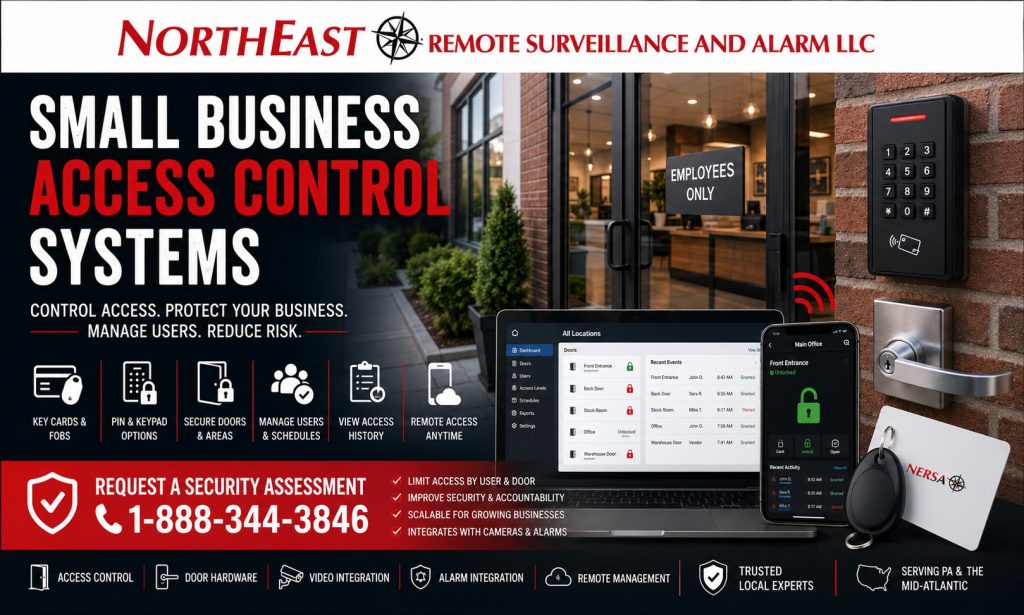
Set permissions for restricted areas and reduce reliance on physical keys or shared codes.
NERSA designs, installs, upgrades, integrates, takes over and supports commercial-grade access control. Qualifying sites include offices, retail stores, restaurants, gyms, salons, medical offices and warehouses. We also serve contractor shops, nonprofits, multi-tenant properties and growing multi-location businesses.
A properly designed system should begin with the business, the doors, the users, the operating schedule, and the areas that need stronger control—not with a predetermined number of readers or a generic equipment package.
For broader small-business security planning involving cameras, alarms, monitoring, intercoms, parking security, and scalable system growth, visit Small Business Security Systems.
Complete Hardware Installation and Door Adjustments Included
NERSA installs all access-control hardware specified for your system and fine-tunes the complete door opening as part of the installation. This includes door, hinge, latch and closer adjustments so the door closes, latches and operates reliably with the access-control system.
Before handover, we test credential operation, authorized entry, door closing, latching and required exit operation. Hardware installation and these door adjustments are part of our installation work.
Commercial-Grade Access Control for Small Businesses
Small businesses can outgrow traditional key control quickly.
Keys can be copied, lost, shared, or remain in circulation after an employee, contractor, cleaner, vendor, or tenant no longer needs access.
Electronic access control can provide individually managed credentials that can be changed or removed without rekeying the entire property.
Depending on the business, access may be controlled by:
- Employee
- Manager
- Department
- Door
- Restricted area
- Schedule
- Shift
- Temporary assignment
- Contractor status
- Business location
The objective is not to electrify every door.
The objective is to secure the openings and restricted areas where stronger accountability and more manageable access provide real value.
Doors and Areas That May Need Access Control
A small-business access-control plan may consider:
- Employee entrances
- Rear doors
- Office doors
- Stockrooms
- Inventory rooms
- IT rooms
- Manager offices
- Cash-handling areas
- Medical or controlled storage
- Staff-only spaces
- Utility rooms
- Warehouse entrances
- Multi-tenant suite doors
- After-hours entrances
The correct doors depend on how the business operates and which areas should remain public, employee-only, or restricted.
Credentials and User Management
Small-business access control may use several credential types depending on the platform and property.
For a regional view of staff access and other day-to-day business needs, see Northeastern Pennsylvania small-business security.
These can include:
- Keycards
- Key fobs
- PIN credentials
- Mobile credentials
- Cloud-managed users
- Scheduled permissions
- Temporary credentials
A smaller office may need one or two controlled doors, while a growing organization may need consistent credential management across several locations.
The system should remain simple enough to administer while still providing the level of accountability the business requires.
Door Hardware and Complete Opening Planning
Access control is not only a reader mounted beside a door.
The complete opening may include:
- Reader
- Controller
- Electric strike
- Electrified lockset
- Electrified trim
- Exit hardware
- Door-position contact
- Request-to-exit device
- Power supply
- Power transfer
- Door closer
- Frame
- Mechanical override
- Associated wiring
The door should close, latch, secure, release, and report status properly.
Electronic access control cannot correct a damaged frame, failing closer, poorly adjusted door, or unsuitable locking arrangement.
Life Safety and Egress
Commercial access control must be planned around safe building operation.
Door hardware, emergency egress, accessibility, fire-rated openings, request-to-exit equipment, emergency release, and fire-alarm interfaces may affect how a controlled opening should be designed.
The objective is to improve security without interfering with required exit or emergency operation.
Existing Small Business Access Control Systems
An older or inherited access-control system does not automatically require complete replacement.
Existing readers, panels, door hardware, wiring, power supplies, credentials, software, and network infrastructure may sometimes remain useful when they are compatible, dependable, secure, supportable, and appropriate for the finished system.
Common existing-system concerns may include:
- Former employees with active credentials
- Shared codes
- Unknown administrator accounts
- Unsupported software
- Failed readers
- Unreliable door hardware
- Poorly operating doors
- Missing documentation
- Inadequate power supplies
- Limited expansion capacity
- Different platforms at different locations
The appropriate project may involve repair, reprogramming, selective replacement, takeover, or phased modernization.
Small Business Access Control Resources
For small-business camera systems that can provide visual context around entrances, restricted areas, parking, and access events, visit Small Business Security Camera Systems.
For after-hours perimeter protection, interior detection, individual alarm users, communication, and professional response, visit Small Business Alarm Systems.
For businesses operating several properties that need consistent users, permissions, credentials, and administration, visit Multi-Location Small Business Security Systems.
For broader commercial access-control planning beyond the small-business environment, visit Commercial & Industrial Access Control Installation.
For aging, inherited, unreliable, or poorly documented security systems requiring modernization, visit Commercial Security System Upgrades, Retrofits, and Takeovers.
For visitor communication and controlled entry before a door or gate is released, visit Commercial Intercom Systems Installation.
Small Business Access Control by Business Type
For employee entrances, stockrooms, offices, inventory areas, and after-hours retail access, visit Retail Store Security Systems.
For employee doors, storage areas, management access, deliveries, and after-hours restaurant security, visit Restaurant Security Systems.
For employee entrances, offices, records, IT rooms, tenant spaces, and after-hours access, visit Office Security Systems.
For staff entrances, restricted storage, records, controlled rooms, and privacy-aware healthcare security, visit Medical Office Security Systems.
For offices, workshops, tool rooms, exterior yards, gates, and controlled contractor access, visit Contractor Shop Security Systems.
For member access, staff credentials, after-hours entry, and commercial door management, visit Gym and Fitness Studio Security Systems.
For smaller warehouse and flex-commercial properties requiring employee entry, stock-area control, and scalable commercial access management, visit Small Warehouse Security Systems.
Why Small Businesses Choose Northeast Remote Surveillance and Alarm
Northeast Remote Surveillance and Alarm, LLC focuses on commercial and industrial security systems rather than consumer access-control products.
NERSA has supported business and professionally managed properties since 2008 and evaluates the complete opening, user workflow, property, infrastructure, and future growth requirements before recommending an access-control system.
A properly planned small-business access-control system should provide:
- Better key control
- Individual credentials
- Manageable permissions
- Schedule-based access
- Restricted-area protection
- Practical user administration
- Secure account ownership
- Expansion capability
- Proper door operation
- Long-term serviceability
The objective is to provide a system that gives the business better control over its doors without making the system unnecessarily difficult to operate.
Frequently Asked Questions About Small Business Access Control Systems
What is a small-business access-control system?
It is a commercial system that manages who may enter selected doors or restricted areas using individually controlled credentials.
What doors should a small business control?
Common examples include employee entrances, rear doors, offices, stockrooms, IT rooms, manager offices, warehouse entrances, and other staff-only or restricted areas.
Can access control reduce reliance on physical keys?
Yes. Managed credentials can reduce the need to distribute traditional keys to employees and contractors.
Can employee access be removed when someone leaves?
Yes. Individual credentials can generally be disabled or changed without rekeying every controlled door.
Can a small business use mobile credentials?
Yes. Many commercial platforms support mobile credentials depending on the selected system and hardware.
Can cameras support controlled doors?
Yes. Compatible video systems can provide additional context around credential use, door events, and restricted-area activity.
Can a business start with only one controlled door?
Yes. A single employee entrance can be a practical starting point if that is the business’s primary access-control need.
Can an existing access-control system be upgraded?
Often, yes. Existing readers, controllers, door hardware, wiring, software, and user management should first be evaluated for condition and compatibility.
Request a Small Business Access Control Assessment
NERSA can assess access control for staff entrances, rear doors, stockrooms, offices and restricted areas. We also review after-hours access and existing systems before recommending improvements.
Request a Small Business Access Control Assessment.
Compliance, Codes & Project Standards
NERSA plans commercial and industrial security work with applicable code, documentation, inspection and authority-having-jurisdiction requirements in mind. Requirements vary by system, property and jurisdiction. These resources support project planning; they do not establish legal compliance, certification or AHJ approval.
Related guidance: Regulatory compliance & inspection readiness · Access control & door hardware standards · NFPA 101 & egress planning · ADA access-control planning