
Electrified door hardware should be planned as part of the full life cycle of a commercial access control system, not treated as a one-time parts swap.

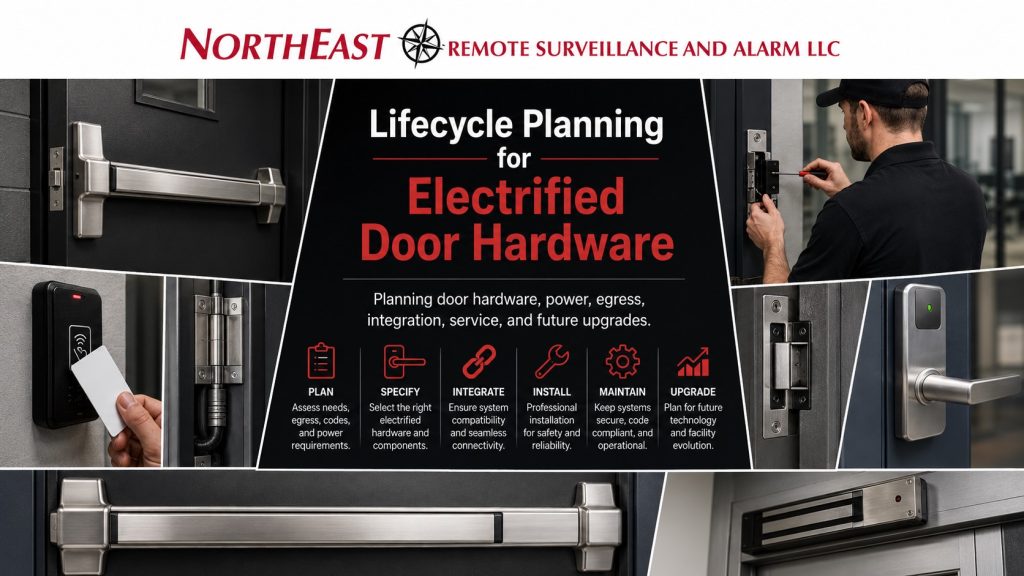
Exit devices, electrified trim, electric strikes, power transfers, readers, door contacts, request-to-exit devices, controllers, and power supplies all need to work together safely, reliably, and serviceably over time.
For full access control system planning, start with Commercial & Industrial Access Control Installation.
Why Lifecycle Planning Matters for Electrified Door Hardware
Electrified door hardware is one of the most important parts of a commercial access control system because it is where security, daily operation, code compliance, and user experience all meet. A door may look simple from the outside, but a controlled opening can include mechanical hardware, electronic locking hardware, low-voltage wiring, access control readers, door monitoring, request-to-exit devices, emergency egress considerations, power supplies, battery backup, programming, and long-term maintenance requirements.
When electrified door hardware is planned correctly, the system is easier to use, easier to service, and easier to expand. When it is planned poorly, a facility may deal with nuisance lock failures, doors not reporting properly, users being locked out, staff propping doors open, access control faults, premature hardware replacement, or code-related concerns.
Lifecycle planning helps prevent those problems by looking beyond the first installation. It asks how the door will perform today, how it will be maintained, how it will be documented, and how it can be upgraded as the building changes.
Electrified Door Hardware Is Not Just a Lock
A controlled door is a system. The lock, trim, exit device, strike, hinge, reader, controller, power supply, door contact, REX device, fire alarm interface, and access control software all affect the final result.
Common electrified door hardware components include:
- Electrified exit devices
- Motorized latch retraction kits
- Electrified trim
- Electric strikes
- Electrified locksets
- Magnetic locks where appropriate
- Power transfer hinges
- Door loops
- Request-to-exit devices
- Door position switches
- Card readers and mobile credential readers
- Access control panels and door controllers
- Low-voltage power supplies
- Battery backup
- Fire alarm release interfaces where required
- Door closers, latching hardware, and mechanical accessories
The best lifecycle plan considers the full opening, not just the electronic part being added.
For a deeper look at the hardware layer, see Access Control Trim & Strike Hardware.
Phase 1: Door and Opening Assessment
Every electrified hardware project should begin with the physical door opening. Before selecting a kit, strike, trim, reader, or controller, the existing door should be evaluated for condition, alignment, usage, and mechanical suitability.
Important questions include:
- Is the door wood, hollow metal, aluminum storefront, glass, or another construction type?
- Is the frame in good condition?
- Does the door close and latch properly without electronic hardware?
- Is the existing exit device compatible with electrification?
- Is the existing lockset or trim worth upgrading, or should it be replaced?
- Is the opening fire-rated?
- Is the door part of a required means of egress?
- Is the door exposed to weather, forklifts, dock traffic, impact, vibration, or heavy employee use?
- Is there an existing access control system, or is this part of a new system?
- Is conduit, cabling, or power already available?
- Does the door need to be monitored for held-open or forced-open events?
This phase is critical because electrified hardware cannot compensate for a door that does not close correctly, latch correctly, or support the hardware being installed. If the opening is worn, misaligned, damaged, or poorly maintained, the access control upgrade may appear to be the problem even though the real issue is the door condition.
Phase 2: Selecting the Right Electrified Hardware
Not every door should receive the same type of electrified hardware. The right choice depends on the door type, security level, egress requirements, traffic level, fire rating, building use, and how the access control system will be operated.
An office suite entrance may require a different solution than a warehouse employee entrance. A healthcare corridor door may require different planning than an industrial exterior door. A storefront door may require a different approach than a hollow metal warehouse door with a panic device.
Common planning options include:
Electric strikes
Electric strikes are often used when the existing locking hardware remains in place and the strike releases electronically. They can be a good fit for certain doors, but the opening, latch type, frame condition, and egress requirements must be reviewed carefully.
Electrified trim
Electrified trim allows the exterior trim of an exit device to be controlled electronically while preserving egress from the inside. This can be a strong option for commercial and industrial doors where proper exit function must remain intact.
Motorized latch retraction
Motorized latch retraction kits can allow an exit device to electronically retract the latch for access control, scheduled unlocking, or integration with a reader. These systems require careful planning for power, wiring, compatibility, and long-term service.
Electrified locksets
Electrified locksets may be used on certain commercial doors where the lock body itself is electronically controlled. The application should be reviewed based on traffic level, credential control, fire rating, and mechanical durability.
Magnetic locks
Maglocks require careful code, egress, fire alarm, and AHJ review. They may be appropriate in some applications, but they should never be treated as a simple shortcut for controlling a door.
Phase 3: Egress, Life Safety, and Code Coordination
Electrified door hardware must be planned around safe egress. A door that is part of an exit path must allow people to leave in accordance with applicable code, local requirements, and AHJ expectations. This is especially important for panic hardware, delayed egress, maglocks, fire-rated openings, assembly areas, schools, healthcare spaces, warehouses, industrial buildings, and multi-tenant commercial properties.
Lifecycle planning should include review of:
- Free egress requirements
- Panic hardware requirements
- Fire-rated door requirements
- Fire alarm interface requirements
- Door release requirements
- Fail safe versus fail secure operation
- Emergency override planning
- ADA and accessibility considerations
- AHJ and fire marshal expectations
- Labeling and documentation
- Testing procedures after installation
Code planning is not just an installation concern. As buildings change, door use can change. A door that was acceptable for one occupancy, tenant layout, or operational pattern may require review when the facility expands, changes use, adds access control, or modifies the flow of people.
For related compliance planning, see NFPA 101, Door Hardware & Access Control Egress Compliance.
Phase 4: Power and Wiring Planning
Electrified door hardware depends on stable power and properly planned wiring. Undersized power supplies, long voltage-drop runs, poor cable routing, weak terminations, and undocumented wiring can create service issues that show up later as intermittent failures.
Lifecycle planning should account for:
- Voltage requirements
- Current draw
- Inrush current
- Wire gauge
- Cable distance
- Power supply capacity
- Battery backup requirements
- Fire alarm interface needs
- Relay control
- Lock monitoring
- REX wiring
- Door contact wiring
- Future expansion
- Service access
- Labeling and as-built documentation
Motorized latch retraction and certain electrified exit devices can require more power than basic low-current devices. Planning should account for real operating conditions, not just the minimum listed on a part sheet.
A good lifecycle plan also considers where power supplies are mounted, how they are labeled, how they are protected, and how a technician will service them later. This matters in warehouses, industrial facilities, schools, healthcare properties, and multi-door commercial buildings where future service calls need to be efficient.
Phase 5: Integration With Access Control Systems
Electrified hardware should be selected with the access control platform in mind. The door hardware, reader, controller, credentials, monitoring points, and software rules all need to support the intended operation of the facility.
Planning questions include:
- Will the door use cards, fobs, PINs, mobile credentials, or a combination?
- Does the door need schedules?
- Does the door need lockdown functions?
- Does the door need remote unlock capability?
- Should the door report forced-open events?
- Should the door report held-open events?
- Does the opening need a door contact?
- Does the opening need request-to-exit monitoring?
- Should the door integrate with intrusion alarms or video surveillance?
- Should events be connected to camera footage?
- Will the customer need audit reports?
- Will this be one door now and many doors later?
A lifecycle plan should avoid painting the facility into a corner. Even if only one door is being upgraded today, the system should be planned so that more doors, readers, schedules, credentials, and reporting features can be added later.
For broader system planning, see Commercial & Industrial Access Control Guide.
Phase 6: Installation Quality and Commissioning
Electrified door hardware needs to be installed, wired, programmed, and tested as a complete operating system. Good installation includes more than mounting the part and powering it up.
Commissioning should verify:
- The door closes and latches properly
- The electrified hardware releases correctly
- The reader grants access correctly
- Unauthorized access is denied
- The door reports open and closed status correctly
- Held-open events work as intended
- Forced-open events work as intended
- Request-to-exit devices function correctly
- Egress works properly
- Fire alarm release functions are tested where applicable
- Schedules work properly
- Power supplies are labeled
- Door names match the software
- Credentials and permissions are tested
- Customer staff understand basic operation
Many future service problems come from incomplete commissioning. A door may appear to work during a quick test but fail under real traffic, changing weather, heavy use, or repeated daily operation. Lifecycle planning makes final testing a formal part of the project, not an afterthought.
Phase 7: Documentation and Service Records
Documentation is one of the most overlooked parts of access control lifecycle planning. Without clear records, every future service call becomes harder and more expensive.
A strong documentation package may include:
- Door names and locations
- Hardware models
- Power supply locations
- Controller locations
- Reader types
- Wiring paths
- Lock voltage and current requirements
- Relay assignments
- REX device locations
- Door contact locations
- Fire alarm interface notes
- Credential groups
- Schedules
- Testing notes
- Photos of completed work
- As-built drawings where appropriate
For larger commercial and industrial facilities, documentation is not just helpful. It becomes part of long-term operational control. When a company adds employees, changes tenants, modifies shifts, expands a warehouse, or replaces doors, accurate documentation helps keep the access control system organized.
Phase 8: Maintenance and Periodic Review
Electrified door hardware is used every day. Some doors may cycle hundreds or thousands of times per week. Over time, screws loosen, doors shift, closers weaken, hinges wear, weather changes alignment, and staff may modify how the door is used.
A lifecycle plan should include periodic review of:
- Door alignment
- Latch engagement
- Reader operation
- REX operation
- Door contact operation
- Power supply health
- Battery backup
- Locking hardware performance
- Access events and alarms
- Credential lists
- Employee access groups
- Schedules and unlock periods
- Forced-open and held-open activity
- Physical damage
- Weather exposure
- Changes in building use
A door that worked properly when installed may need adjustment later. Preventive review can help reduce emergency service calls, false access control events, door abuse, and user frustration.
Phase 9: Replacement and Modernization Planning
Electrified hardware should not be viewed as permanent. Like any building system, it has a service life. Lifecycle planning should identify when hardware should be repaired, when it should be upgraded, and when it should be replaced.
Replacement may be needed when:
- Exit devices are worn or obsolete
- Parts are difficult to source
- Power transfer components fail repeatedly
- A door has become a high-traffic opening
- The facility is moving to mobile credentials
- The access control platform is being upgraded
- Wiring is undocumented or unreliable
- Hardware no longer meets operational needs
- Doors are being replaced or renovated
- A facility needs better reporting, lockdown, or integration
Modernization is often best handled in phases. A facility may begin by upgrading critical doors, then move into employee entrances, warehouse doors, office doors, restricted areas, IT rooms, mechanical rooms, and exterior gates. Planning this path ahead of time helps avoid wasted labor and mismatched hardware.
For budget planning, see Commercial & Industrial Access Control Cost.
Common Mistakes in Electrified Door Hardware Planning
Many access control problems begin before the first device is installed. The most common mistakes include choosing hardware before inspecting the door, failing to verify code requirements, using the wrong electric strike, ignoring door alignment, undersizing power supplies, skipping door contacts, failing to document wiring, and selecting hardware that cannot support future expansion.
Another major mistake is treating access control as only a security project. In reality, electrified door hardware affects employees, visitors, vendors, emergency responders, maintenance staff, IT, management, and life safety planning. A door that is secure but difficult to use will often be bypassed. A door that works electronically but fails mechanically will still become a problem.
The best approach is to plan the opening as a long-term controlled access point.
Best Applications for Lifecycle-Based Planning
Lifecycle planning is especially important for:
- Warehouses
- Distribution centers
- Manufacturing facilities
- Industrial buildings
- Corporate offices
- Healthcare properties
- Schools and education facilities
- Municipal buildings
- Contractor yards
- Truck yards
- Multi-tenant commercial buildings
- Multi-site businesses
- Facilities with shift changes
- Facilities with restricted areas
- Facilities upgrading from keys to credentials
Any facility that depends on reliable daily access should treat electrified door hardware as part of a larger security and operations plan.
NERSA’s Approach to Electrified Door Hardware Lifecycle Planning
Northeast Remote Surveillance and Alarm, LLC plans electrified door hardware around the door, the building, the access control system, the user workflow, and the long-term service needs of the facility. We help commercial and industrial customers evaluate existing openings, select appropriate hardware, plan wiring and power, coordinate access control integration, document the installation, and support future upgrades.
Our work may include electrified trim, electric strikes, motorized exit device kits, request-to-exit devices, door position monitoring, reader installation, controller wiring, power supply installation, access control programming, and integration with broader commercial security systems.
The goal is not only to make the door unlock electronically. The goal is to create a controlled opening that is safe, reliable, serviceable, documented, and ready to support the facility as it grows.
Lifecycle Planning for Electrified Door Hardware FAQs
What is electrified door hardware?
Electrified door hardware refers to door locking or releasing hardware that is controlled electronically. This may include electric strikes, electrified trim, electrified locksets, magnetic locks, electrified exit devices, motorized latch retraction kits, request-to-exit devices, and related access control hardware.
Why does electrified door hardware need lifecycle planning?
Lifecycle planning helps make sure the door works properly at installation and remains reliable over time. It accounts for door condition, hardware compatibility, power requirements, code considerations, future expansion, documentation, and maintenance.
Can an existing exit push bar be upgraded for access control?
In many cases, yes. Some existing exit devices can be upgraded with electrified trim or motorization kits, depending on the model, condition, door type, power requirements, and egress requirements. The opening should be inspected before selecting the final hardware.
Is an electric strike always the best access control option?
No. Electric strikes can be useful in the right application, but they are not the correct choice for every door. Some openings are better served by electrified trim, electrified locksets, motorized latch retraction, or other hardware depending on the door and code requirements.
What is the difference between fail safe and fail secure hardware?
Fail safe hardware unlocks when power is removed. Fail secure hardware remains locked from the secure side when power is removed while still allowing required egress where applicable. The correct choice depends on the door, occupancy, code requirements, fire alarm interface, and operational needs.
Do electrified doors need door contacts?
Door contacts are strongly recommended for many access control doors because they allow the system to report whether the door is open or closed. They can support forced-open alerts, held-open alerts, audit trails, and better system monitoring.
Should electrified door hardware connect to the fire alarm system?
Some openings and hardware types may require fire alarm interface or emergency release coordination. This depends on the door type, locking method, occupancy, code requirements, and AHJ expectations. These details should be reviewed during planning.
How often should electrified door hardware be inspected?
High-use doors should be reviewed periodically to confirm that the door closes, latches, locks, unlocks, reports status, and supports proper egress. The review frequency depends on usage, facility type, environment, and system criticality.
Can electrified door hardware be added one door at a time?
Yes. Many facilities start with one or two priority doors and expand later. Lifecycle planning helps make sure the first phase does not limit future doors, credentials, schedules, reporting, or system integration.
Who should plan electrified door hardware for a commercial facility?
Electrified door hardware should be planned by professionals who understand commercial access control, door hardware, low-voltage wiring, egress requirements, and long-term service needs. For code-sensitive openings, coordination with the AHJ, fire marshal, architect, engineer, or door hardware professional may also be required.
Plan Electrified Door Hardware the Right Way
Electrified door hardware is a long-term building system. The right plan can improve security, reduce key control problems, support employee access, improve documentation, simplify service, and create a stronger foundation for future access control expansion.
Northeast Remote Surveillance and Alarm, LLC designs, installs, upgrades, and supports commercial and industrial access control systems for real facilities with real operational requirements.
Request a Security Assessment or call NERSA at 1-888-344-3846 to discuss electrified door hardware, access control upgrades, door hardware coordination, and long-term lifecycle planning for your facility.
Plan Your Next Security Improvement
Tell NERSA about your commercial facility, existing systems, and project priorities. We can help you plan an installation, evaluate an upgrade, or coordinate security across multiple locations.