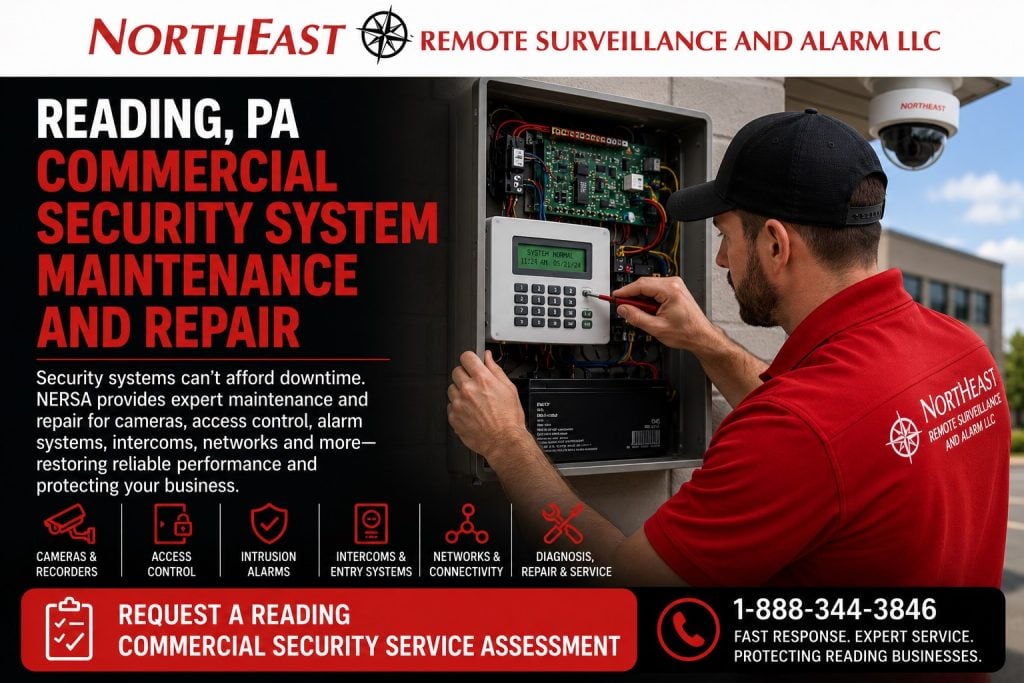
NERSA provides commercial security system maintenance and repair in Reading, PA.
NERSA security assessment request
Request a service assessment for offline cameras, missing recordings, access-control faults, recurring intrusion-alarm trouble or failed intercoms. We check the equipment and its supporting connections to identify a practical repair, reconfiguration or upgrade path. Service eligibility depends on system ownership, authorized access, manufacturer support and parts availability.
Diagnose, maintain and repair existing commercial security systems at warehouses, manufacturing facilities, offices, institutional properties, multi-tenant buildings and other business locations in Reading, Pennsylvania.
Security equipment can develop problems even when the overall system remains suitable for continued use.
Cameras may stop recording, controlled doors may fail to report correctly, intrusion alarm zones may generate recurring trouble conditions, intercoms may lose communication and remote users may lose access after network or software changes.
On this page: Service assessment · Repair or replace · Service limitations
Northeast Remote Surveillance and Alarm, LLC checks the full path behind a reported fault. That may include the device, cable, power supply, controller and recorder. Software, networks, communication accounts, user permissions and programming may also need review.
The objective is to identify the actual cause, restore dependable operation where practical and determine whether the affected equipment should be repaired, reconfigured, upgraded or replaced. For a Reading commercial security service assessment, useful intake details include the equipment make and model, affected camera or door identifiers, when the problem began, recent power or network changes, administrator access, and available fault logs. Those details help narrow the diagnosis before replacement parts are ordered.
This service supports existing commercial and industrial properties covered by NERSA’s Reading Commercial Security System Upgrades, Retrofits and Takeovers services.
Commercial and industrial systems only • Existing-system diagnosis • Camera and recorder repair • Access-control troubleshooting • Intrusion alarm service • Intercom repair • Network and cabling corrections • Monitoring-path troubleshooting • Small businesses through enterprise facilities
Project availability may depend on property location, installed equipment, system ownership, administrator access, manufacturer support, software licensing, monitoring agreements, network access, customer IT policies, available documentation, replacement-part availability, building conditions and the project’s long-term support requirements.
Repair the Cause, Not Just the Visible Symptom
A commercial security failure is not always caused by the device that appears to be malfunctioning.
An offline camera may be affected by:
- Damaged cabling
- A failed PoE port
- Insufficient switch power
- A network-address conflict
- A recorder configuration problem
- Failed surge protection
- Moisture exposure
- A defective camera
- An undocumented network change
A controlled door may not secure because of:
- Strike alignment
- Damaged electrified hardware
- A failing power supply
- Door or frame movement
- Incorrect programming
- A door-position switch problem
- A reader communication fault
- Controller or network failure
An alarm trouble condition may involve:
- A low backup battery
- Failed communication
- Damaged sensor wiring
- Wireless supervision
- Expander failure
- Programming errors
- Power problems
- A defective field device
Replacing the visible device without testing the complete operating path can leave the original problem unresolved.
NERSA approaches commercial security repair by tracing the reported symptom through the equipment, wiring, power, programming and communication path that support it.
When a Reading Business Should Request Security-System Service
Cameras Are Offline or Intermittent
A camera that repeatedly disconnects may have a device problem, but it may also be affected by cabling, network switching, power, environmental exposure or recorder configuration.
Service may be appropriate when:
- One or more cameras are offline
- Cameras restart repeatedly
- Live video freezes
- Images appear only intermittently
- The recorder reports network errors
- Video disappears during certain conditions
- Outdoor cameras fail after rain or storms
- Several devices connected to one switch fail together
- A camera returns after the switch is restarted
- The same problem continues after prior service
The affected camera, cable, PoE source, network path and recorder connection should be evaluated together.
Recorded Video Is Missing
A camera may display live video while recorded evidence remains incomplete or unavailable.
Potential causes include:
- Failed hard drives
- Incorrect recording schedules
- Storage configuration problems
- Recorder faults
- Time and date errors
- Camera disconnections
- Database corruption
- Insufficient storage
- Overwritten footage
- Network interruptions
- User-permission limitations
- Incorrect playback procedures
Service should determine whether the problem involves recording, storage, retrieval, user access or an unsupported recorder.
Remote Viewing No Longer Works
Remote viewing may stop working after:
- A router replacement
- An internet-provider change
- A firewall change
- A public IP address change
- A mobile application update
- A software update
- An account-password change
- A cloud-service interruption
- A recorder replacement
- Expired licensing
- A provider-controlled account becoming unavailable
Remote-access restoration should preserve appropriate account ownership and customer authorization.
Unsafe or undocumented remote-access methods should not be restored merely because they were used previously.
Controlled Doors Do Not Lock or Release Properly
Access-control problems can involve electronic, electrical and mechanical components.
Common symptoms include:
- Reader accepts the card but the door does not unlock
- Door unlocks but does not relock
- Electric strike buzzes or binds
- Electrified trim operates intermittently
- Magnetic lock does not release
- Door remains open after entry
- Door-position status is inaccurate
- Request-to-exit equipment does not report
- Controller shows the door offline
- Mobile or card credentials stop working
- Events are missing from the software
The complete controlled opening should be inspected before the problem is assigned to the reader, controller or lock.
The Alarm Panel Shows Trouble
Commercial intrusion systems may continue to arm while displaying a recurring condition.
Possible causes include:
- Low batteries
- Communication failure
- Telephone-line failure
- Cellular trouble
- Network interruption
- Device tamper
- Wireless supervision
- Expansion-module failure
- Missing sensors
- Wiring damage
- Power failure
- Programming conflicts
A persistent trouble condition should be diagnosed rather than repeatedly acknowledged or cleared.
False Alarms Are Occurring
Repeated unwanted alarms reduce confidence in the system and may affect how employees respond to future events.
Possible causes include:
- Misaligned contacts
- Loose overhead-door devices
- Damaged wiring
- Poorly positioned motion detectors
- Environmental conditions
- Weak wireless devices
- Incorrect entry delays
- User errors
- Partition confusion
- Building movement
- Doors that do not close properly
- Outdated zone descriptions
Service should identify why the event occurred and whether the correction involves equipment, programming, building conditions or employee procedures.
The Intercom or Entry Station Has Failed
An entry system may experience:
- No audio
- One-way audio
- Poor video
- Failed call buttons
- Mobile-app problems
- Door-release failure
- Network disconnection
- Power problems
- Damaged exterior equipment
- Cloud-account issues
- Incorrect user permissions
The repair should examine the entry station, network, power, software, account ownership and associated door equipment.
The System Failed After a Power Outage or Storm
Power events may affect:
- Cameras
- Recorders
- Network switches
- Access-control panels
- Lock power supplies
- Alarm panels
- Communicators
- Wireless bridges
- Intercoms
- UPS equipment
- Surge-protection devices
The equipment should be inspected before repeatedly restoring power or replacing random components.
A failed surge device, damaged power supply or compromised network switch may cause continuing instability after the original event.
The Original Installer Is No Longer Available
A business may need a new service provider because:
- The original installer closed
- The provider no longer serves the area
- The company stopped supporting the manufacturer
- Service response is inadequate
- Documentation was never delivered
- Administrator access is unavailable
- Monitoring ownership is unclear
- The provider controls important accounts
- The system was inherited from a prior tenant
NERSA can evaluate qualifying customer-authorized systems to determine whether a practical service path exists.
What NERSA Reviews During a Service Assessment
A commercial security service assessment may examine:
- Reported symptoms
- Affected devices
- Equipment manufacturers and models
- System ownership
- Administrator and programming access
- Software licensing
- Cloud-account ownership
- Device health
- Cabling and terminations
- Network switches
- PoE power
- Power supplies
- Backup batteries
- Surge protection
- Equipment enclosures
- Environmental conditions
- Recorders and storage
- Controllers and expansion modules
- Communication equipment
- Monitoring status
- System programming
- User permissions
- Event history
- Available documentation
- Replacement-part availability
- Future support requirements
The assessment should distinguish among:
- Repairable equipment
- Configuration problems
- Network or power problems
- Mechanical dependencies
- Unsupported components
- Customer-account issues
- Conditions requiring another qualified trade
- Equipment that should be upgraded or replaced
For a broader inspection of several existing systems or an inherited property, review Commercial Security System Inspection and Assessment.
Video Surveillance Maintenance and Repair
Commercial video systems may include:
- IP cameras
- Analog cameras
- Encoders
- Network video recorders
- Digital video recorders
- Video servers
- Hard drives
- PoE switches
- Fiber links
- Wireless bridges
- Video-management software
- Mobile applications
- Cloud services
- Remote monitoring connections
Camera Image Problems
Image problems may include:
- Blurry video
- Dirty or obstructed lenses
- Poor nighttime visibility
- Excessive glare
- Incorrect focus
- Condensation
- Water intrusion
- Infrared reflection
- Image flicker
- Incorrect exposure
- Changed camera position
- Physical damage
Some image problems can be corrected through cleaning, adjustment or configuration. Others may indicate a failed sensor, damaged housing, unsuitable camera location or equipment that no longer meets the property’s requirements.
Camera Connectivity Problems
An offline camera may require testing of:
- Camera power
- PoE port
- Cable continuity
- Cable termination
- Network address
- Switch configuration
- Fiber or wireless uplink
- Recorder connection
- Camera firmware
- Camera hardware
Several cameras failing simultaneously may indicate a shared switch, uplink or power problem rather than several independent camera failures.
Recorder and Storage Problems
Recorder service may involve:
- Failed hard drives
- Missing channels
- Recording-schedule errors
- Incorrect storage allocation
- Network disconnections
- Time and date problems
- User-access issues
- Software faults
- Database problems
- Overheating
- Power-supply failure
- Unsupported firmware
- Aging recorder hardware
The assessment should determine whether the recorder can be repaired or whether continued investment in unsupported equipment is impractical.
Playback and Export Problems
Users may report that video exists but cannot be found, played or exported.
The review may examine:
- User permissions
- Search procedures
- Time synchronization
- Camera names
- Recording schedules
- Export formats
- Media-player requirements
- Storage health
- Software compatibility
- Available retention
Successful export should be confirmed before the business depends on the system for incident documentation.
Access-Control Maintenance and Repair
Access control combines credentials, readers, controllers, wiring, power supplies, software and electrified door hardware.
Reader and Credential Problems
Service may be needed when:
- Cards or fobs stop working
- Mobile credentials fail
- Reader lights or sounds change
- Some users work while others do not
- The reader is physically damaged
- The reader disconnects
- A credential works at the wrong doors
- Access schedules are incorrect
- Lost credentials remain active
The problem may involve the credential, reader, controller, access level, schedule, communication path or software.
Controller and Software Problems
Controller-related symptoms may include:
- Doors showing offline
- Missing events
- Delayed door commands
- Failed remote unlock
- Communication trouble
- Software unable to connect
- Expired licensing
- Controller reboots
- Incorrect time
- Lost programming
- Cloud-account problems
The assessment should determine whether the controller remains supported and whether customer-authorized administrator access is available.
Electrified Door-Hardware Problems
A door may fail even when the access-control electronics operate correctly.
Potential issues include:
- Strike misalignment
- Binding latches
- Failed electrified trim
- Worn exit hardware
- Damaged power transfer
- Loose hardware
- Door-closer problems
- Frame movement
- Magnetic-lock alignment
- Broken request-to-exit devices
- Incorrect door-position reporting
Electronic-security work may require coordination with a qualified door, hardware, locksmith, electrical or life-safety professional when the condition extends beyond the approved scope.
Power-Supply and Battery Problems
Controlled doors may become unreliable because of:
- Failed power supplies
- Low batteries
- Incorrect voltage
- Insufficient current
- Excessive voltage drop
- Loose wiring
- Failed relays
- Overloaded enclosures
- Damaged fuses
- Heat or environmental conditions
Power requirements should be evaluated against the actual connected equipment.
Commercial Intrusion Alarm Maintenance and Repair
An intrusion alarm service call may involve:
- Alarm panels
- Keypads
- Door contacts
- Overhead-door contacts
- Motion detectors
- Glass-break detectors
- Wireless devices
- Panic buttons
- Sirens
- Expanders
- Repeaters
- Communicators
- Power supplies
- Backup batteries
Door-Contact Problems
A contact may fail because of:
- Misalignment
- Physical damage
- Loose wiring
- Excessive gap
- Building movement
- Corrosion
- Door changes
- Repeated impact
- Improper mounting
Overhead-door contacts require particular attention because ordinary door movement, vibration, weather and vehicle activity may affect the device.
Motion-Detector Problems
Unwanted motion alarms may be associated with:
- Changed room layouts
- Storage racks
- Heating or cooling airflow
- Direct sunlight
- Birds or animals
- Machinery
- Detector movement
- Incorrect sensitivity
- Device failure
- Poor original placement
Detector placement should be evaluated against the environment as it exists now.
Communicator Problems
An alarm communicator may experience:
- Cellular failure
- Weak signal
- Network disconnection
- Telephone-line trouble
- Account errors
- Incompatible receiver settings
- Power loss
- Antenna problems
- Unsupported communication technology
The panel may continue operating locally even when alarm events are no longer being transmitted correctly.
User and Code Problems
Service may also involve:
- Former employees
- Shared codes
- Unknown users
- Incorrect authority
- Partition mistakes
- Missing administrator access
- Unclear opening and closing records
- Temporary users that never expired
User cleanup can improve accountability without replacing the alarm equipment.
Intercom and Visitor-Entry Repair
Commercial intercom systems may combine:
- Exterior call stations
- Interior master stations
- Mobile applications
- Video cameras
- Speakers and microphones
- Door-release relays
- Network connections
- Cloud services
- Access-control integrations
Service may address:
- Failed audio
- Poor audio quality
- Failed video
- Inoperative buttons
- Mobile-call problems
- Door-release failure
- Network disconnection
- Power loss
- Account-access problems
- Damaged exterior stations
- Integration problems
The assessment should determine whether the issue originates with the intercom, the network or the associated controlled door.
Network and Low-Voltage Infrastructure Repair
Security systems increasingly depend on customer-owned or dedicated network infrastructure.
Service may require evaluation of:
- Copper cabling
- Fiber links
- Patch panels
- PoE switches
- Network uplinks
- Wireless bridges
- Equipment racks
- Cabinets
- UPS equipment
- Surge protection
- Routers or firewalls affecting approved connectivity
- Cellular communication
- Cable labels and port assignments
Common infrastructure symptoms include:
- Multiple devices dropping offline
- Slow or unstable video
- Switches restarting
- Wireless links disconnecting
- Fiber links failing
- Remote access becoming unavailable
- Equipment failing after network changes
- Insufficient PoE power
- Overheated or disorganized cabinets
NERSA coordinates security-network requirements with authorized customer IT personnel when the affected infrastructure is customer-managed.
Preventive Commercial Security Maintenance
Waiting for a complete failure can increase downtime and make the cause more difficult to identify.
A preventive maintenance visit may include an approved review of:
- Camera operation
- Camera views
- Camera cleanliness
- Recording status
- Hard-drive health
- System time
- User access
- Controlled-door operation
- Door-position reporting
- Reader operation
- Alarm-panel trouble conditions
- Sensor status
- Communicator status
- Batteries
- Power supplies
- Switch health
- UPS condition
- Equipment enclosures
- Documentation
- Known recurring problems
Preventive maintenance does not guarantee that equipment will never fail. It can identify visible deterioration, active troubles, documentation gaps and support limitations before they become larger operational problems.
One-Time Repair or Ongoing Service?
One-Time Diagnostic Service
A focused service visit may be appropriate when:
- One camera is offline
- A door does not release
- A keypad displays trouble
- An intercom station has failed
- Remote viewing stopped after a network change
- The business needs a specific problem diagnosed
The service scope should identify the reported problem and any limitations on testing unrelated systems.
Multi-System Assessment
A broader assessment may be appropriate when:
- Several systems are failing
- The property was inherited
- Documentation is missing
- The original installer is unavailable
- Multiple manufacturers are present
- Several providers have worked on the system
- Administrator access is unclear
- The business is considering a provider change
Planned Maintenance
Scheduled service may be appropriate for properties with:
- Large camera counts
- Numerous controlled doors
- Several alarm partitions
- Multiple buildings
- Industrial operating conditions
- Critical monitoring requirements
- High employee turnover
- Frequent system changes
- Limited internal technical staff
The appropriate service arrangement depends on the installed systems, property operations and support requirements.
Repair, Upgrade or Replace?
The correct recommendation depends on equipment condition, compatibility, support and repair cost.
Repair May Be Appropriate When
- The equipment remains supported
- Replacement parts are available
- The failure is isolated
- The infrastructure remains suitable
- The repair restores dependable operation
- Administrator access is available
- Continued service is practical
An Upgrade May Be Appropriate When
- The system operates but has recurring limitations
- Communication technology is aging
- Additional capacity is needed
- User administration is difficult
- Better reporting is required
- Selected equipment is unsupported
- Existing infrastructure can support modernization
Replacement May Be Appropriate When
- The system is unsupported
- Parts are unavailable
- Failures are recurring
- Programming access is unavailable
- Equipment is provider-locked
- Software cannot run on supported platforms
- The system cannot meet current operational needs
- Repair costs are approaching replacement value
- No practical long-term support path exists
For broader planning when repair is no longer the best path, review Commercial Security System Upgrades, Retrofits and Takeovers.
What Existing Equipment May Be Repaired or Retained?
Equipment may remain when it is:
- Customer-owned
- Accessible
- Supported
- Compatible
- Properly installed
- Testable
- Repairable
- Adequately powered
- Suitable for the environment
- Practical to maintain
Potentially serviceable equipment may include:
- Cameras
- Recorders
- Hard drives
- Network switches
- Access-control readers
- Controllers
- Electric strikes
- Electrified trim
- Door-position switches
- Alarm panels
- Keypads
- Intrusion sensors
- Communicators
- Intercom stations
- Cabling
- Fiber
- Power supplies
- UPS equipment
- Equipment enclosures
Retention should be based on inspection and testing rather than age alone.
Service Limitations
A repair project may be limited by:
- Missing customer authorization
- Unknown equipment ownership
- Provider-controlled accounts
- Locked programming
- Unsupported hardware
- Expired software licensing
- Missing administrator credentials
- Unavailable replacement parts
- Failed or inaccessible cabling
- Customer IT restrictions
- Network changes outside NERSA’s control
- Hidden building conditions
- Mechanical door problems
- Electrical problems outside the low-voltage scope
- Water damage
- Lightning or surge damage
- Fire alarm requirements
- Manufacturer restrictions
- No practical long-term support path
These conditions should be identified before the customer depends on the proposed repair.
Reading Properties That May Need Security-System Repair
Warehouses and Distribution Centers
Warehouse service may involve:
- Dock cameras
- Overhead-door contacts
- Employee entrances
- Shipping offices
- Yard cameras
- Fiber links
- Wireless bridges
- PoE switches
- Alarm partitions
- Access-controlled inventory rooms
- Multi-shift user administration
Manufacturing and Industrial Facilities
Industrial service may require planning around:
- Production schedules
- Controlled shutdown periods
- Dust
- Heat
- Vibration
- Electrical interference
- High ceilings
- Multiple buildings
- Restricted areas
- Industrial network policies
- Maintenance departments
Offices and Multi-Tenant Buildings
Office and multi-tenant service may involve:
- Common entrances
- Tenant-suite access
- Shared camera systems
- Visitor intercoms
- Separate alarm areas
- Property-management accounts
- Tenant turnover
- Shared equipment rooms
- Remote administration
Account ownership and tenant permissions should be confirmed before programming is changed.
Healthcare, Educational and Institutional Properties
These properties may require coordination around:
- Occupied areas
- Restricted rooms
- Staff safety
- Emergency procedures
- Privacy requirements
- Visitor access
- Approved service periods
- IT policies
- Life-safety interfaces
- Multiple departments
Small Commercial Properties
A smaller Reading office, medical practice, contractor facility, shop or warehouse may have fewer devices but still needs accurate diagnosis, dependable repair and clear system ownership.
NERSA supports qualifying projects ranging from focused small-business service calls to complex multi-building commercial and industrial system assessments.
The NERSA Reading Security-Service Process
1. Document the Reported Problem
NERSA begins with the symptoms observed by the customer.
Useful details may include:
- When the failure began
- Whether the problem is constant or intermittent
- Which devices are affected
- What changed before the failure
- Whether power or internet service was interrupted
- What prior service was attempted
- Whether messages or trouble codes are displayed
2. Identify the Installed System
The assessment may document:
- Manufacturer
- Model
- Equipment location
- Connected devices
- Software
- Account ownership
- Network dependencies
- Power source
- Available administrator access
3. Test the Affected Operating Path
Testing may include the relevant:
- Device
- Cabling
- Power
- Network connection
- Controller
- Recorder
- Software
- Communication path
- User permissions
- Mechanical opening
4. Identify the Cause and Available Correction
The condition may be classified as:
- Configuration error
- Account or permission issue
- Device failure
- Cabling failure
- Power problem
- Network problem
- Mechanical dependency
- Environmental problem
- Unsupported equipment
- Broader system limitation
5. Repair or Stabilize the System
Approved work may include:
- Device replacement
- Cable repair
- Re-termination
- Programming correction
- User cleanup
- Battery replacement
- Power-supply replacement
- Switch-port correction
- Software configuration
- Recorder repair
- Door-hardware adjustment within scope
- Communicator correction
- Account reconfiguration
6. Test Normal Operation
Testing may confirm applicable:
- Live video
- Video recording
- Playback
- Door release
- Door securing
- Reader response
- Door-position status
- Alarm-zone operation
- Communication signals
- Intercom audio and video
- Remote access
- User permissions
- Power behavior
7. Document Remaining Limitations
The customer should be informed when:
- Equipment remains unsupported
- Other failures are likely
- Parts are unavailable
- Administrator access remains limited
- Network dependencies are outside NERSA’s control
- A temporary repair was completed
- Further modernization is recommended
- Another qualified trade is required
Why Reading Businesses Use NERSA for Security-System Repair
Commercial security repair requires more than replacing the first device that appears to have failed.
It requires an understanding of:
- Cameras and recording
- Access control
- Intrusion alarms
- Intercoms
- Monitoring paths
- Cabling
- Fiber
- PoE power
- Network switching
- Equipment accounts
- Software licensing
- Door hardware
- Backup power
- System documentation
- Long-term supportability
Northeast Remote Surveillance and Alarm, LLC focuses on commercial, industrial, institutional, municipal, healthcare, educational, warehouse, manufacturing, logistics and multi-site environments.
NERSA evaluates the reported failure in relation to the complete system that supports it. The objective is to restore dependable operation where practical and give the customer a clear recommendation when repair is no longer the most supportable path.
Request a Reading Commercial Security Service Assessment
A Reading commercial security service assessment can help determine whether the appropriate path is repair, reconfiguration, account recovery, cabling correction, power replacement, network troubleshooting, preventive maintenance, selective modernization or complete replacement.
The assessment may review:
- Cameras
- Recorders
- Storage
- Remote viewing
- Access-control readers
- Controllers
- Credentials
- Electrified door hardware
- Intrusion alarm panels
- Keypads
- Sensors
- Communicators
- Intercoms
- Cabling
- Fiber
- PoE switches
- Power supplies
- Backup batteries
- UPS equipment
- Networks
- Software
- User accounts
- Documentation
- Known recurring failures
Frequently Asked Questions About Reading Commercial Security Repair
Can NERSA repair a commercial security system installed by another company?
NERSA can evaluate qualifying customer-authorized commercial systems to determine whether the equipment is accessible, supported, repairable and suitable for continued service.
Does the entire system need to be replaced when one device fails?
No. An isolated device, cable, power or configuration problem may be repairable without replacing the complete system.
Can NERSA repair an older camera system?
Possibly. Repair depends on the camera, recorder, wiring, power, manufacturer support, available parts and compatibility with the remaining system.
Why are several cameras offline at the same time?
Several cameras may share a failed switch, uplink, fiber connection, wireless bridge, power source or recorder connection.
Can missing recorded video be recovered?
That depends on whether the footage was recorded, retained and remains accessible. Overwritten, unrecorded or physically damaged data may not be recoverable.
Can remote viewing be restored?
Possibly. The recorder, application, account ownership, network, firewall, internet service and remote-access method must be evaluated.
Can NERSA repair access-controlled doors?
NERSA can evaluate qualifying readers, controllers, power supplies, electric strikes, electrified trim, magnetic locks, request-to-exit devices and door-position switches. Mechanical door or frame problems may require another qualified professional.
Why does the reader accept a card but the door stay locked?
The problem may involve the controller output, relay, power supply, wiring, lock hardware, strike alignment or mechanical door condition.
Can former employee credentials and alarm codes be removed?
Yes, when the customer has appropriate authorization and the installed platform provides accessible user administration.
Can recurring intrusion alarm troubles be repaired?
NERSA can evaluate trouble conditions involving batteries, communication, wireless supervision, sensors, wiring, expanders, power and programming.
Can a security system be repaired after lightning or a power surge?
Qualifying equipment can be assessed for power, surge, network and device damage. The extent of damage may not be visible until connected components are tested.
Can NERSA repair a commercial intercom?
NERSA can evaluate qualifying intercom stations, network connections, power, software, mobile accounts and door-release integrations.
Does NERSA provide general IT support?
No. NERSA’s work is focused on the infrastructure and network requirements supporting commercial security, monitoring and related low-voltage systems.
Can NERSA maintain systems at several Reading-area locations?
Yes. Qualifying multi-site properties may benefit from standardized equipment records, service procedures, user administration and prioritized maintenance planning.
Can repairs be completed in phases?
Yes. Critical failures may be addressed first while unsupported or lower-priority equipment is scheduled for later modernization.
What happens when replacement parts are unavailable?
NERSA can determine whether a compatible repair, limited upgrade or equipment replacement provides the most practical path.
Does this service include fire alarm work?
Routine fire alarm inspection, testing, and repair require a separate service scope. Fire alarm concerns require a separate review based on the installed life-safety system, applicable requirements and approved scope.
Does NERSA support small businesses and large industrial properties?
Yes. NERSA evaluates qualifying commercial projects ranging from smaller offices, shops and contractor facilities to warehouses, manufacturing plants, institutions and multi-building enterprise environments.
What information should be gathered before requesting service?
Useful information includes the manufacturer and model, device locations, administrator credentials, recent changes, displayed trouble messages, prior service records, network contacts and available drawings.
How does a Reading business request security-system repair?
Call 1-888-344-3846 or submit the NERSA security assessment request.
Describe the affected equipment, current symptoms, when the problem began and any recent power, network or building changes.
For installation, upgrades, and broader facility planning, review Commercial Security System Installation in Reading, PA.
Compliance, Codes & Project Standards
NERSA plans commercial and industrial security work with applicable code, documentation, inspection and authority-having-jurisdiction requirements in mind. Requirements vary by system, property and jurisdiction. These resources support project planning; they do not establish legal compliance, certification or AHJ approval.
Related guidance: Regulatory compliance & inspection readiness · NERSA project standards · Documentation, testing & inspection readiness