
A commercial security system should be inspected before it is upgraded, taken over, expanded, or relied on for serious protection.
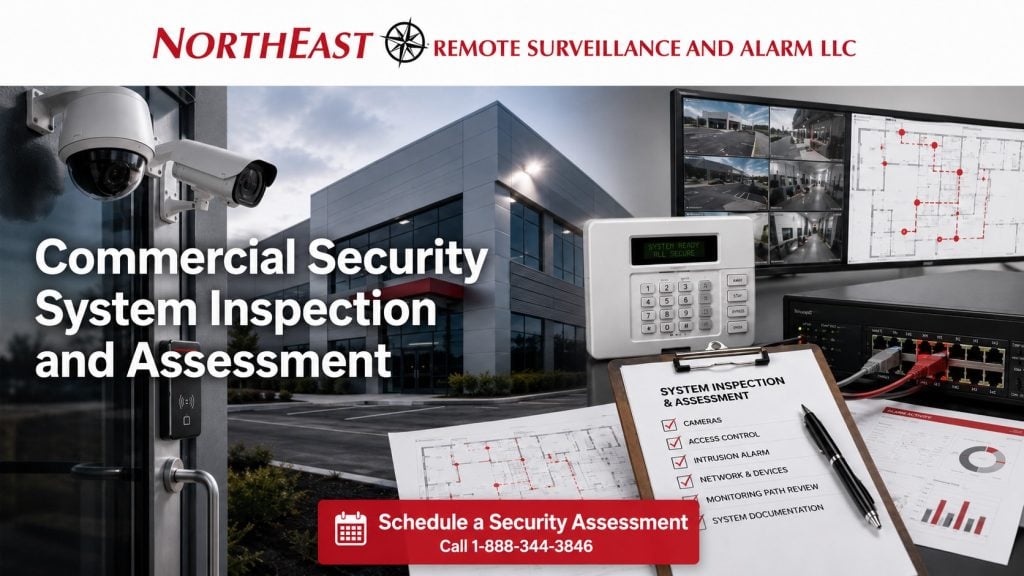
Northeast Remote Surveillance and Alarm, LLC helps commercial and industrial facilities assess existing cameras, access control, intrusion alarms, monitoring paths, user permissions, network equipment, cabling, documentation, and long-term service needs.
This resource supports our broader Commercial Security System Upgrades, Retrofits & Takeovers service for businesses that need to understand what they already have, what still works, what needs attention, and what should be upgraded next.
Commercial Security System Inspection for Existing Buildings
Many businesses have security equipment installed, but they do not know whether the system is actually protecting the property the way it should.
The cameras may record, but the footage may not be useful. The alarm keypad may arm, but signals may not be reporting correctly. The access control system may unlock doors, but old users may still have credentials. The monitoring account may exist, but the contact list may be outdated. The network equipment may power devices, but nothing may be labeled. The system may look active while still having serious gaps.
A commercial security system assessment helps answer the most important questions:
- What equipment is installed?
- What still works?
- What is outdated?
- What is not documented?
- Who has access?
- Are alarm signals reporting?
- Are camera views useful?
- Are doors controlled correctly?
- Is remote access secure and organized?
- What should be fixed first?
- What can be reused?
- What needs to be upgraded?
The goal is to give the business a clear plan before spending money on unnecessary replacement or scattered repairs.
When a Security System Assessment Is Needed
A commercial facility should request a security system inspection and assessment when the system is difficult to trust, difficult to manage, or difficult to support.
Common reasons include:
- The system was inherited from a previous owner or tenant.
- Cameras are installed, but video is unclear or hard to search.
- Remote viewing is unreliable.
- Access control users are disorganized.
- Former employees may still have access.
- Alarm codes have not been cleaned up.
- The alarm panel shows trouble conditions.
- Monitoring account information is unclear.
- Emergency contacts are outdated.
- Camera names and alarm zones are confusing.
- Network equipment is unlabeled.
- Documentation is missing.
- The current provider is unresponsive.
- The business is preparing for an upgrade or takeover.
- The building layout, staff, tenants, or operating hours have changed.
- Ownership wants a professional condition report before making decisions.
If no one can clearly explain how the system is built, how it reports, who has access, and what needs attention, the system should be assessed.
What a Commercial Security Assessment Reviews
Northeast Remote Surveillance and Alarm, LLC reviews the complete security environment, not just one device.
A security system inspection may include:
- Security cameras
- DVRs, NVRs, or video management platforms
- Remote viewing access
- Access control readers
- Door controllers
- Door hardware
- Door contacts
- Request-to-exit devices
- Intrusion alarm panels
- Keypads
- Motion detectors
- Overhead door contacts
- Sirens and sounders
- Alarm communicators
- Monitoring account information
- Emergency contact lists
- User codes and permissions
- Network switches
- PoE equipment
- Cabling and pathways
- Power supplies
- Backup batteries
- UPS backup
- Device labeling
- Documentation
- Future upgrade needs
This assessment helps determine whether the system needs cleanup, repair, retrofit, takeover, upgrade, replacement, or phased improvement.
Camera System Inspection
Security cameras should be judged by whether they provide useful video, not whether they simply exist.
NERSA reviews camera systems for:
- Camera locations
- Camera image quality
- Field of view
- Night performance
- Parking lot coverage
- Loading dock coverage
- Entrance and exit views
- Blind spots
- Recorder condition
- Storage capacity
- Recording retention
- Playback speed
- Clip export ability
- Remote viewing reliability
- Camera naming
- User access
- Offline cameras
- Future camera needs
A camera view that cannot help identify what happened is not providing enough value. The assessment identifies which views are useful, which views are weak, and where upgrades would create the biggest improvement.
For broader camera planning, see Commercial Video Surveillance Systems.
Access Control Inspection
Access control should make it easier to manage who enters the building, when they enter, and which doors they can use.
NERSA reviews access control systems for:
- Controlled doors
- Reader locations
- Door controller condition
- Door hardware
- Electric strikes or electrified locks
- Request-to-exit operation
- Door position monitoring
- Door schedules
- Access levels
- Active users
- Former users
- Vendor access
- Mobile credentials where applicable
- Administrator permissions
- Access logs
- Door-held and forced-door reporting
- Emergency egress considerations
- Documentation
A business should know who has access and how fast that access can be removed when someone leaves.
For related access control planning, see Commercial & Industrial Access Control Systems.
Intrusion Alarm Inspection
A commercial intrusion alarm should match the building as it operates today.
Buildings change over time. Walls move. Offices expand. Warehouses add racking. Tenants change. Employees change. Doors are added. Old alarm coverage may not match the current risk.
NERSA reviews intrusion alarm systems for:
- Alarm panel condition
- Keypad locations
- Door contacts
- Overhead door contacts
- Motion detectors
- Glassbreak detectors where applicable
- Sirens and sounders
- Alarm zones
- Partitions or areas
- User codes
- Communicator condition
- Monitoring path
- Backup battery condition
- Trouble conditions
- Zone descriptions
- Opening and closing procedures where applicable
- Documentation
The assessment helps determine whether the alarm system can remain in service, needs cleanup, needs a communicator upgrade, or should be replaced.
For related alarm planning, see Commercial Burglar Alarm and Intrusion Detection Systems.
Monitoring Path Review
A monitored alarm system should be tested and documented.
NERSA reviews the monitoring path to help determine whether signals are being transmitted correctly and whether account information is current.
Monitoring review may include:
- Alarm communicator type
- Phone-line, cellular, or IP communication path
- Communication trouble conditions
- Monitoring account information
- Site name and address
- Emergency contact list
- Call list order
- Zone descriptions
- Signal testing history
- Alarm signal testing where applicable
- Trouble signal testing where applicable
- Opening and closing reports where applicable
- Monitoring center receipt confirmation
The business should know where signals are going, who is being called, and whether the system is reporting properly.
For related monitoring planning, see Security System Monitoring Upgrades.
User Permission Review
Old users are one of the most common security risks in existing systems.
A business may have former employees, vendors, cleaning crews, managers, previous tenants, or old provider accounts still tied to cameras, access control, alarm codes, remote apps, or monitoring contacts.
NERSA reviews user permissions across:
- Camera systems
- Remote viewing apps
- Access control platforms
- Alarm panels
- Monitoring accounts
- Mobile credential platforms
- Multi-site dashboards
- Vendor support accounts
- Administrator roles
The goal is to identify who has access, who should keep access, who should be removed, and where permissions need to be reorganized.
Documentation Review
A security system is harder to support when documentation is missing.
NERSA reviews available records and identifies documentation gaps for:
- Camera lists
- Camera names and views
- Recorder locations
- Access-controlled doors
- Reader locations
- Alarm zones
- Keypad locations
- Communicators
- Monitoring accounts
- Emergency contacts
- Network equipment
- Power supplies
- Cable labels
- Device records
- Service history
- User permissions
- Future upgrade notes
If documentation is incomplete, NERSA can help organize the system through Commercial Security System Documentation Cleanup.
Network and Infrastructure Assessment
Modern security systems depend on network and low-voltage infrastructure.
Cameras, access control panels, alarm communicators, remote viewing platforms, and monitoring paths all depend on stable power, cabling, network equipment, and backup support.
NERSA reviews:
- Network switches
- PoE switch capacity
- Patch panels
- Cable pathways
- Cable condition
- Equipment cabinets
- NVR or server locations
- UPS backup
- Power supplies
- Surge protection where applicable
- Wireless bridges where applicable
- Internet connection requirements
- Device labeling
- Future expansion capacity
Poor infrastructure can cause camera dropouts, failed recordings, access control problems, alarm communication issues, and remote viewing failures.
For related infrastructure planning, see Commercial Low Voltage and Network Infrastructure Services.
Security System Takeover Assessment
Many inspections are performed before a takeover.
If a business wants to switch providers, NERSA can inspect the current equipment and determine what can be supported, what needs correction, and what may need replacement.
A takeover assessment may review:
- Existing provider status
- Admin access availability
- Camera platform condition
- Access control platform condition
- Alarm panel condition
- Monitoring account condition
- User permission concerns
- Locked or proprietary equipment
- Documentation gaps
- Priority service issues
- Upgrade recommendations
For related takeover planning, see Commercial Security System Takeovers.
Security System Retrofit Assessment
An assessment is also valuable before a retrofit.
A retrofit should be based on actual system condition, not guessing. NERSA identifies which parts of the system can be reused, corrected, upgraded, or replaced.
A retrofit assessment may evaluate:
- Existing camera cable
- Existing coax or network cabling
- Existing reader wiring
- Door hardware condition
- Alarm wire
- Existing sensors
- Recorder condition
- Power supplies
- Communicators
- Network equipment
- Device locations
- Serviceability
- Future expansion needs
For related retrofit planning, see Commercial Security System Retrofits.
Upgrade Priority Planning
A good assessment should help the business decide what to do first.
Not every issue has the same urgency. Some items affect immediate security. Some affect usability. Some affect documentation. Some can wait for a future phase.
NERSA helps identify priority areas such as:
- Failed or offline cameras
- Poor entrance coverage
- Weak parking lot coverage
- Old users with access
- Alarm trouble conditions
- Outdated communicators
- Monitoring contact problems
- Broken access control doors
- Missing door contacts
- Unsupported recorders
- Inadequate storage
- Unlabeled network equipment
- Missing documentation
- Expansion limitations
The result is a practical improvement path instead of a random equipment list.
Assessment Before Budgeting
A security system assessment helps prevent wasted budget.
Without an assessment, a business may replace equipment that could have been reused or keep equipment that should have been replaced. The assessment gives ownership a clearer understanding of what is serviceable, what is weak, and what will create long-term value.
The assessment can support decisions about:
- Camera upgrades
- Access control upgrades
- Alarm takeovers
- Monitoring upgrades
- Documentation cleanup
- Network improvements
- Communicator upgrades
- Multi-site standardization
- Full system replacement
- Phased implementation
Before and After
| Before Assessment | After Assessment |
|---|---|
| System condition was unclear | Equipment and system condition reviewed |
| Camera views were assumed | Camera coverage and review value assessed |
| Access users were uncertain | User permissions and access levels reviewed |
| Alarm zones were unclear | Alarm zones and devices reviewed |
| Monitoring path was uncertain | Communication and monitoring information reviewed |
| Documentation was missing | Documentation gaps identified |
| Network equipment was unlabeled | Infrastructure support needs reviewed |
| Upgrade planning was guesswork | Priorities organized into a practical plan |
Commercial Facilities That Need Security Assessments
Commercial security system inspections and assessments are useful for:
- Warehouses
- Distribution centers
- Manufacturing facilities
- Office buildings
- Healthcare offices
- Schools and education facilities
- Retail stores
- Contractor shops
- Auto repair shops
- Laundromats
- Industrial parks
- Multi-tenant buildings
- Logistics facilities
- Truck yards
- Professional offices
- Municipal and institutional properties
- Multi-site businesses
Each assessment should be based on the building layout, operating hours, access points, users, security risks, and long-term support needs.
Related Planning
An assessment identifies system condition and practical next steps. Some proprietary or unsupported systems require equipment changes.
Why Businesses Choose NERSA for Security Assessments
Northeast Remote Surveillance and Alarm, LLC focuses on commercial, industrial, institutional, and non-residential security systems.
A meaningful assessment requires more than looking at one keypad or one camera. It requires understanding video surveillance, access control, intrusion alarms, monitoring paths, low-voltage infrastructure, user permissions, documentation, and long-term service.
NERSA helps businesses understand what they already have before recommending what comes next.
When to Request a Commercial Security System Assessment
A business should request a security assessment if:
- The system is outdated.
- The system was inherited.
- Cameras are unclear.
- Remote viewing is unreliable.
- Access control users are disorganized.
- Alarm zones are confusing.
- Monitoring information is outdated.
- Former employees may still have access.
- Documentation is missing.
- Service calls take too long.
- The business wants to switch providers.
- The building is preparing for upgrades.
- Multiple locations need standardization.
- Ownership wants a practical improvement plan.
Commercial Security System Assessment Checklist
Before assessing a commercial security system, review:
- Existing cameras
- Camera views
- Recorder or VMS platform
- Remote viewing users
- Access-controlled doors
- Door hardware
- Access levels
- Credential holders
- Alarm panel
- Alarm keypads
- Alarm zones
- Door contacts
- Motion detectors
- Communicator
- Monitoring account
- Emergency contacts
- Network equipment
- PoE switches
- Cabling
- Power supplies
- Backup batteries
- UPS backup
- Device labels
- Documentation
- Service history
- Future expansion needs
Request a Commercial Security System Inspection
If your commercial building, warehouse, office, healthcare facility, school, industrial property, logistics facility, retail site, contractor yard, multi-tenant building, or multi-site business needs a clear review of its existing security system, Northeast Remote Surveillance and Alarm, LLC can help.
Frequently Asked Questions About Commercial Security System Inspection and Assessment
What is a commercial security system inspection and assessment?
A commercial security system inspection and assessment reviews the condition, performance, documentation, users, monitoring path, and upgrade needs of an existing business security system. It may include cameras, access control, intrusion alarms, monitoring, network equipment, and documentation.
Is this the same as a fire alarm inspection?
No. This resource is about commercial security systems, including cameras, access control, intrusion alarms, monitoring, and security infrastructure. Fire alarm inspections, testing, and life-safety compliance are separate services.
Can NERSA inspect a system installed by another company?
Yes. NERSA can review existing commercial security systems installed by another provider and determine whether the system can be supported, cleaned up, retrofitted, upgraded, or replaced.
Can an assessment help before switching security providers?
Yes. A takeover assessment helps identify what equipment is installed, what is locked or unsupported, what can be reused, what needs correction, and what documentation is missing.
Can cameras be evaluated during the assessment?
Yes. NERSA can review camera locations, image quality, recording, remote viewing, storage, camera names, blind spots, night performance, and upgrade needs.
Can access control users be reviewed?
Yes. User permission review is an important part of the assessment. Active users, former users, vendor access, access levels, door schedules, and administrator permissions can all be reviewed where system access allows.
Can alarm monitoring be tested?
Yes, where appropriate and authorized. Alarm signal testing can help confirm whether the monitoring center receives the correct signals from the correct account.
Can NERSA identify what should be upgraded first?
Yes. The assessment can help prioritize urgent repairs, security gaps, documentation cleanup, monitoring issues, camera upgrades, access control improvements, and long-term retrofit planning.
Does the assessment include documentation cleanup?
The assessment identifies documentation gaps. Documentation cleanup can also be performed as a follow-up service when the business needs camera lists, door schedules, alarm zones, monitoring contacts, user permissions, and network equipment organized.
How do we schedule a commercial security system assessment?
Call 1-888-344-3846 or use Request a Security Assessment.
NERSA can review the existing system and recommend the right path for cleanup, takeover, retrofit, upgrade, or replacement.