
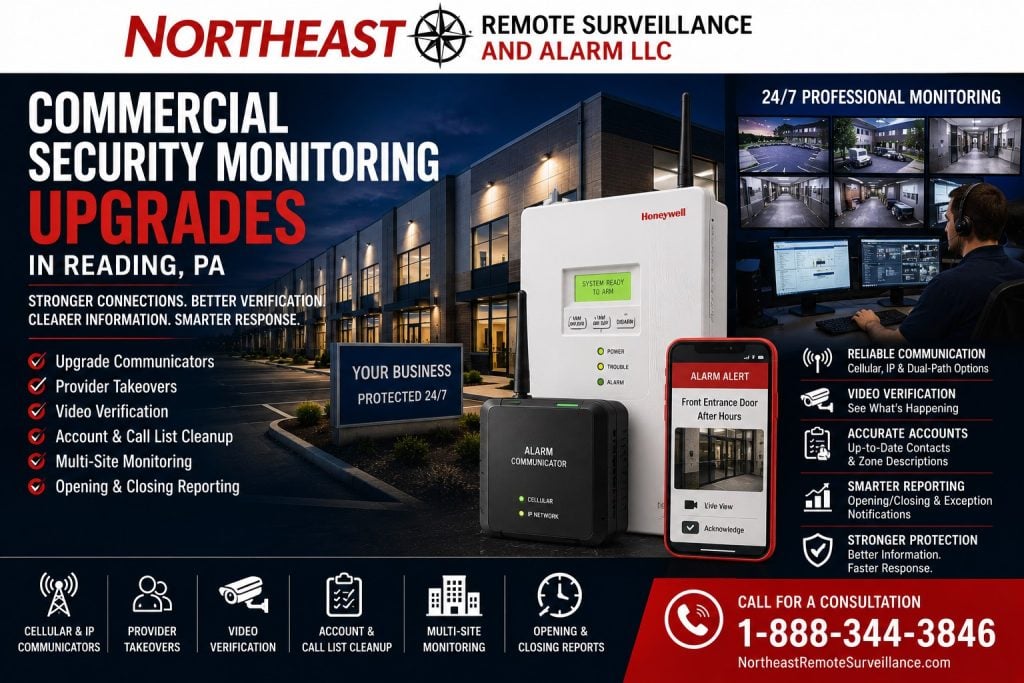
Commercial security monitoring upgrades in Reading, PA help businesses modernize outdated alarm communication, change monitoring providers, correct monitoring-account information, improve event reporting, add verification capabilities, and regain better control over an existing monitored security system.
An older alarm system does not automatically need to be replaced simply because the monitoring arrangement behind it is outdated.
A serviceable commercial alarm panel, door contacts, motion detectors, overhead-door contacts, panic devices, keypads, wiring, power supplies, and other field equipment may still have years of useful service remaining.
The real problem may be the communication path, monitoring provider, outdated account information, poor zone descriptions, unmanaged user access, incomplete reporting, or a monitoring arrangement that no longer reflects how the facility operates.
Northeast Remote Surveillance and Alarm, LLC evaluates existing commercial monitoring systems for warehouses, manufacturing plants, distribution facilities, offices, institutional properties, healthcare facilities, municipal buildings, and multi-location organizations throughout Reading and Berks County.
For currently available monitoring services and supported alarm-event functions, visit commercial security monitoring in Reading, PA.
Call 1-888-344-3846 to schedule a commercial security monitoring upgrade assessment.
Upgrade the Monitoring System Without Replacing Everything
A monitoring upgrade begins by determining what is actually wrong with the existing system.
In some properties, the alarm panel and sensors remain dependable but the communicator relies on technology that is no longer appropriate.
Other businesses have reliable alarm equipment but outdated emergency contacts, unclear zone descriptions, shared passcodes, inconsistent opening and closing procedures, or a monitoring provider that no longer provides the reporting or administrative control management requires.
A focused upgrade may preserve compatible equipment while improving the way alarm information leaves the property, reaches the monitoring center, is interpreted by operators, and is communicated back to the customer.
Depending on the existing system, the project may involve:
- Replacing an outdated communicator
- Moving from telephone-line communication to a supported modern communication path
- Adding cellular or IP communication
- Establishing dual-path communication where appropriate
- Changing monitoring providers
- Rebuilding an outdated monitoring account
- Correcting zone and partition descriptions
- Updating emergency contact lists
- Removing former employees
- Updating account passcodes
- Improving opening-and-closing reporting
- Adding mobile or management notifications
- Adding compatible video verification
- Consolidating multiple commercial locations
- Testing alarm, trouble, restoration, and communication signals
- Documenting the completed monitoring arrangement
The purpose is to improve the monitoring layer while retaining existing equipment when that equipment remains compatible, supportable, and dependable.
When Commercial Security Monitoring Needs an Upgrade
Monitoring arrangements tend to become outdated gradually.
A business may replace its telephone provider, change internet service, expand the building, add another warehouse section, change managers, acquire another property, change employee schedules, or continue using a monitoring account originally programmed many years earlier.
Eventually the alarm system may no longer reflect the way the business operates.
Common signs that an upgrade should be considered include:
- The alarm still relies on a traditional telephone line.
- A VoIP conversion has created communication problems.
- Managers are unsure how the alarm communicates.
- Zone descriptions no longer match the building.
- Former employees remain on emergency contact lists.
- Shared account passcodes are still being used.
- Opening-and-closing reports are unavailable or no longer useful.
- Several company locations use different monitoring arrangements.
- Communication failures are not being reported clearly.
- Management cannot easily place the system on test.
- Alarm events identify only a generic area instead of the actual door, department, or building.
- The existing provider no longer meets the organization’s administrative or reporting needs.
- There is no practical backup reporting path.
- Existing alarm events cannot be associated with supporting video where verification is desired.
These conditions warrant a monitoring review, but they do not automatically require replacement of every alarm component.
Commercial Monitoring Provider Takeovers
Changing monitoring companies should be treated as a controlled system transition rather than simply changing a phone number or receiver destination.
Before moving an existing Reading commercial alarm system, NERSA can evaluate the alarm panel, communicator, programming access, active zones, partitions, user information, existing monitoring agreement, and the condition of the reporting arrangement.
A provider takeover may include:
- Confirming authorized account ownership
- Identifying the existing alarm panel and communicator
- Reviewing programming access
- Testing active alarm points
- Reviewing partitions
- Updating emergency contacts
- Correcting site and zone descriptions
- Rebuilding dispatch instructions
- Replacing incompatible communication equipment
- Testing restorations and trouble events
- Confirming customer notifications
- Documenting the completed account
- Training authorized customer representatives
NERSA does not bypass ownership protections or make unauthorized changes to another provider’s monitoring account.
Where existing administrative access cannot legitimately be recovered, the customer may need to obtain records from the existing provider, complete required account-transfer procedures, replace incompatible communication equipment, or rebuild the monitoring account through an authorized migration.
Modernizing Alarm Communication
One of the most common reasons to upgrade monitoring is an outdated communication path.
Many older commercial alarm systems were designed around analog telephone lines. Over time, businesses may replace those lines with VoIP, change carriers, eliminate traditional copper service, modify network infrastructure, or add cellular communication.
The correct replacement depends on the existing panel, communicator compatibility, network environment, cellular coverage, backup power, supervision requirements, and the type of signals that need to be reported.
Cellular Communication
A compatible cellular communicator can provide commercial alarm reporting without relying entirely on the building’s traditional telephone service.
The upgrade should verify actual cellular performance at the equipment location and test alarm, trouble, restoration, and communication functions after installation.
Internet or IP Communication
Compatible commercial systems may use an approved network connection for alarm communication or remote-management functions.
When business-network infrastructure is involved, responsibility for internet service, firewall changes, network equipment, backup power, and future IT modifications should be clearly understood.
Dual-Path Communication
Some compatible systems can use two supported communication methods to provide greater reporting resiliency.
A meaningful dual-path design should be evaluated as a complete communication arrangement rather than assuming that the presence of two interfaces automatically creates redundancy.
The final configuration should reflect the equipment, property, network environment, available cellular service, and customer requirements.
Monitoring Account Cleanup
Upgrading the communicator without correcting the monitoring account can leave many of the original problems in place.
The monitoring account should accurately identify the property, reporting areas, responsible parties, and expected response to important events.
A commercial monitoring account review may address:
- Correct business name
- Protected address
- Building or suite identification
- Alarm-zone descriptions
- Partition names
- Responsible-party lists
- Contact order
- Account passcodes
- Dispatch instructions
- Opening and closing schedules
- Gate or building-access information
- After-hours procedures
- Panic and duress events
- Communication failures
- Environmental signals
- Testing instructions
- Escalation requirements
A technically functional alarm system can still produce poor results when the account information behind it is incomplete or outdated.
Clear Alarm Zone Descriptions
Commercial properties need zone descriptions that tell operators and managers where an event occurred.
For a larger facility, descriptions such as Zone 4, Back Door, or Motion 2 may provide very little useful information.
More useful descriptions might identify an actual location such as:
- Main Office West Employee Door
- Warehouse Overhead Door 12
- East Shipping Office Motion
- Building Two North Roof Hatch
- Tool Crib Panic Button
- Rear Vehicle Gate
- Server Room High Temperature
Where practical, the terminology used by the monitoring account should match the terminology used by facility personnel, security documentation, alarm keypads, access-control systems, and other property records.
That makes alarm information easier to understand during an actual event.
Opening, Closing and Failure-to-Arm Reporting
Many Reading-area commercial properties operate on schedules that are more complicated than simply opening in the morning and closing at night.
Warehouses may have second or third shifts.
Manufacturers may operate production departments on different schedules.
Cleaning crews may enter after the office closes.
Employees may work overtime.
Drivers and shipping personnel may arrive before administrative staff.
Where supported by the existing system and monitoring platform, a monitoring upgrade may provide management with useful schedule and exception information such as:
- Late-to-close alerts
- Failure-to-arm notifications
- Early-opening reports
- User-specific opening records
- Partition-specific status
- Holiday schedules
- After-hours disarming notifications
- Multi-location exception reporting
- Manager notifications
These functions should be configured around the actual operating schedule so normal business activity does not generate unnecessary exceptions.
Video Verification for Existing Alarm Systems
Some existing monitored alarm systems can be upgraded so supported alarm events are associated with related video or images.
Video verification may provide additional information when a monitored event occurs at an exterior door, loading dock, warehouse area, gate, equipment yard, trailer area, or other protected location.
A verification upgrade should confirm that the associated camera actually provides a useful view.
That may require reviewing:
- Alarm-zone identification
- Camera coverage
- Lighting
- Time synchronization
- Network connectivity
- Event delivery
- Video availability
- Customer response instructions
- Privacy requirements
Video verification is different from proactive remote video monitoring.
This resource addresses verification added to an existing monitored security system rather than continuous camera analytics, live operator intervention, or active video guarding.
Panic and Duress Monitoring
Commercial panic and duress devices require particularly clear reporting and response instructions.
A monitoring upgrade may include reviewing existing panic devices, correcting their descriptions, confirming whether they operate silently or audibly, testing signal transmission, updating responsible parties, and documenting the approved response procedure.
Employees who are authorized to use these devices should understand how they operate and how testing is coordinated.
Panic signals should not simply be grouped into generic intrusion descriptions when the system and monitoring arrangement support more specific identification.
Multi-Site Monitoring Consolidation
Businesses with several commercial properties may inherit different monitoring providers, communication methods, account names, user procedures, and reporting formats as the organization grows.
A monitoring consolidation can help create a more consistent structure while retaining site-specific response information.
A multi-location program may standardize:
- Account naming
- Zone-description conventions
- Communication technologies
- Corporate contacts
- Local responsible parties
- Testing procedures
- Opening-and-closing reporting
- Administrator access
- Passcode management
- Reporting practices
- Account documentation
The objective is not to make every location identical.
Each property should retain the contacts, schedules, zones, partitions, and response instructions appropriate to that site while management gains better control over the portfolio.
Reusing Existing Alarm Equipment
An existing commercial alarm system may contain equipment that remains completely serviceable.
Depending on compatibility and condition, an upgrade may retain:
- Alarm control panels
- Keypads
- Door contacts
- Motion detectors
- Glass-break detectors
- Overhead-door contacts
- Panic devices
- Expansion equipment
- Existing wiring
- Sirens
- Power supplies
- Environmental sensors
Before reuse, the equipment should be identified and tested.
NERSA may review panel model, programming access, communicator compatibility, reporting capability, active zones, bypassed devices, battery condition, available expansion, documentation, manufacturer support, and existing trouble conditions.
For projects where the panel, sensors, zones, partitions, or overall intrusion design itself is the primary concern, visit commercial intrusion alarm systems in Reading, PA.
Controlled Monitoring Cutovers
A monitoring-provider change should be planned to reduce the possibility of an unintended monitoring gap.
The existing service should not simply be canceled because replacement equipment has been installed.
A controlled transition may involve:
- Confirming account ownership and transfer requirements.
- Identifying the existing panel and communicator.
- Testing active alarm points.
- Creating the replacement monitoring account.
- Updating contacts and response instructions.
- Installing or configuring the approved communicator.
- Placing affected systems on test.
- Transmitting required alarm and trouble signals.
- Confirming signals at the monitoring center.
- Verifying customer notifications.
- Confirming the replacement account is operational.
- Completing authorized closure or transfer of the former monitoring arrangement.
- Providing customer documentation.
The exact procedure depends on the equipment, existing provider, monitoring arrangement, and scope of work.
Signal Testing and Commissioning
Every monitoring upgrade should finish with actual signal testing.
A normal-looking keypad does not prove that every required event is reaching the monitoring center correctly.
Testing may include, where applicable:
- Intrusion alarms
- Separate partition alarms
- Panic or duress signals
- Opening and closing events
- Communication failures
- AC power trouble
- Battery trouble
- Device trouble
- Environmental alarms
- Verification events
- Restorations
- Customer notifications
- Responsible-party calls
The customer should understand what was tested and which existing devices or conditions remain outside the upgrade scope.
Warehouse and Distribution Monitoring Upgrades
Reading and Berks County contain warehouses, distribution facilities, trucking operations, and industrial properties where monitoring must account for loading docks, overhead doors, employee entrances, shipping offices, truck activity, inventory areas, and changing work schedules.
Monitoring upgrades for these properties may improve identification of individual dock doors, separate office and warehouse areas, provide failure-to-arm reporting, modernize communication paths, or improve after-hours alarm information.
The monitoring arrangement should distinguish normal shipping and receiving activity from events that occur after approved operating hours.
Manufacturing and Industrial Monitoring Upgrades
Manufacturing facilities may have production areas, maintenance departments, tool rooms, utility spaces, shipping operations, contractors, and employees working different shifts.
A monitoring upgrade should reflect those operating conditions.
A facility that operates continuously should not be programmed around the same opening and closing expectations as a building that becomes completely vacant every evening.
Account structure, partitions, reporting, and notifications should match actual plant operations.
Office and Multi-Tenant Monitoring Upgrades
Office and multi-tenant buildings may require separate consideration for shared entrances, individual suites, property management, cleaning personnel, restricted rooms, and after-hours users.
Monitoring responsibilities should be clearly divided.
One tenant should not receive another tenant’s alarm information or have administrative authority over unrelated protected areas.
A monitoring upgrade can help clean up those boundaries when the existing account structure has become unclear through years of tenant changes or building modifications.
Reading and Berks County Commercial Monitoring Upgrades
NERSA supports qualifying commercial monitoring upgrades throughout Reading and surrounding Berks County business and industrial markets, including:
- Reading
- West Reading
- Wyomissing
- Shillington
- Sinking Spring
- Muhlenberg Township
- Exeter Township
- Spring Township
- Bern Township
- Fleetwood
- Kutztown
- Hamburg
- Birdsboro
- Douglassville
- Boyertown
- Surrounding Berks County communities
Projects are focused on commercial, industrial, institutional, healthcare, municipal, educational, warehouse, manufacturing, and multi-location properties.
Commercial Security Monitoring Upgrade Process
NERSA approaches an existing monitoring upgrade as a complete communication and account project.
1. Existing System Review
The current alarm panel, communicator, monitoring arrangement, account information, known problems, and existing reporting functions are reviewed.
2. Communication Assessment
The existing telephone, cellular, IP, or dual-path arrangement is evaluated for compatibility, reliability, supervision, coverage, network dependency, and supportability.
3. Upgrade Plan
NERSA identifies which equipment can remain, which communication components require replacement, and which monitoring information needs correction.
4. Account Configuration
Zone descriptions, contacts, passcodes, partitions, schedules, escalation procedures, and approved response instructions are established or corrected.
5. Communicator and Monitoring Work
The approved communication and monitoring changes are installed and configured.
6. Controlled Transition
The replacement monitoring arrangement is activated through a planned cutover process.
7. Signal Testing
Applicable alarm, trouble, restoration, communication, reporting, and notification functions are tested.
8. Customer Turnover
Authorized customer representatives receive operating information, testing procedures, support contacts, and relevant project documentation.
Frequently Asked Questions
What is a commercial security monitoring upgrade?
A commercial security monitoring upgrade improves the communication equipment, monitoring-provider arrangement, account information, reporting, verification, notifications, or administration behind an existing monitored security system.
Do we have to replace the entire alarm system?
Not necessarily. Existing panels, sensors, keypads, wiring, and other devices may remain usable when they are compatible, dependable, supportable, and appropriate for the required monitoring arrangement.
Can NERSA take over monitoring from another provider?
NERSA can evaluate the existing system, account ownership, communicator, programming access, equipment compatibility, and contractual considerations to determine whether an authorized monitoring takeover is practical.
Can an older telephone-line alarm be upgraded to cellular communication?
Many compatible commercial alarm systems can use a supported modern communicator, but the existing panel, signaling method, power, cellular coverage, supervision requirements, and monitoring configuration must be confirmed.
Can cellular and internet communication be used together?
Some compatible systems support cellular and IP communication. The actual configuration depends on the alarm equipment, network, available communication services, backup power, and monitoring requirements.
Can existing alarm sensors remain in place?
Compatible and dependable existing sensors may be retained after identification, testing, and evaluation.
Can inaccurate alarm-zone descriptions be corrected?
Yes. Zone and partition descriptions can be reviewed and updated so operators and facility managers receive clearer information about where an event occurred.
Can former employees be removed from the monitoring account?
Responsible parties, account passcodes, administrators, notification recipients, and other authorized users should be reviewed as part of an account upgrade.
Can video verification be added?
Compatible alarm, video, network, software, and monitoring systems may support adding video or image information to defined alarm events.
Is video verification the same as remote video monitoring?
No. Video verification provides visual information associated with a defined alarm event. Remote video monitoring may use camera analytics, operator review, and other proactive monitoring functions.
Can opening and closing reports be added?
Compatible systems and monitoring services may support opening activity, closing activity, failure-to-arm, late-to-close, early-opening, and similar management reporting.
Can multiple locations use one standardized monitoring program?
Qualifying multi-location organizations can often standardize monitoring administration, communication methods, account naming, reporting, contacts, and procedures while retaining location-specific requirements.
Does changing the monitoring provider repair failed alarm equipment?
No. Monitoring upgrades do not automatically repair damaged contacts, detectors, batteries, wiring, keypads, locks, or other physical equipment.
Does this guide include commercial fire-alarm monitoring upgrades?
No. Commercial fire-alarm monitoring and communicator work is handled separately as a life-safety scope with its own equipment, testing, documentation, and authority requirements.
Schedule a Commercial Security Monitoring Upgrade Assessment
An existing alarm system may not need complete replacement to become easier to manage and more dependable to monitor.
A focused assessment can determine whether the current panel and field devices remain usable, whether the communication method should be modernized, which account information requires correction, whether additional reporting or verification is appropriate, and how a provider transition can be completed through a controlled process.
Northeast Remote Surveillance and Alarm, LLC provides commercial security monitoring upgrades for Reading and qualifying properties throughout Berks County.
Request a commercial security assessment.
Northeast Remote Surveillance and Alarm, LLC
Commercial & Industrial Security Systems
Reading and Berks County, Pennsylvania