
Commercial intrusion alarm systems in Reading, PA should be designed around the doors, loading docks, windows, roof openings, restricted areas, operating schedules, employee responsibilities, after-hours activity and response procedures that make each commercial property different.
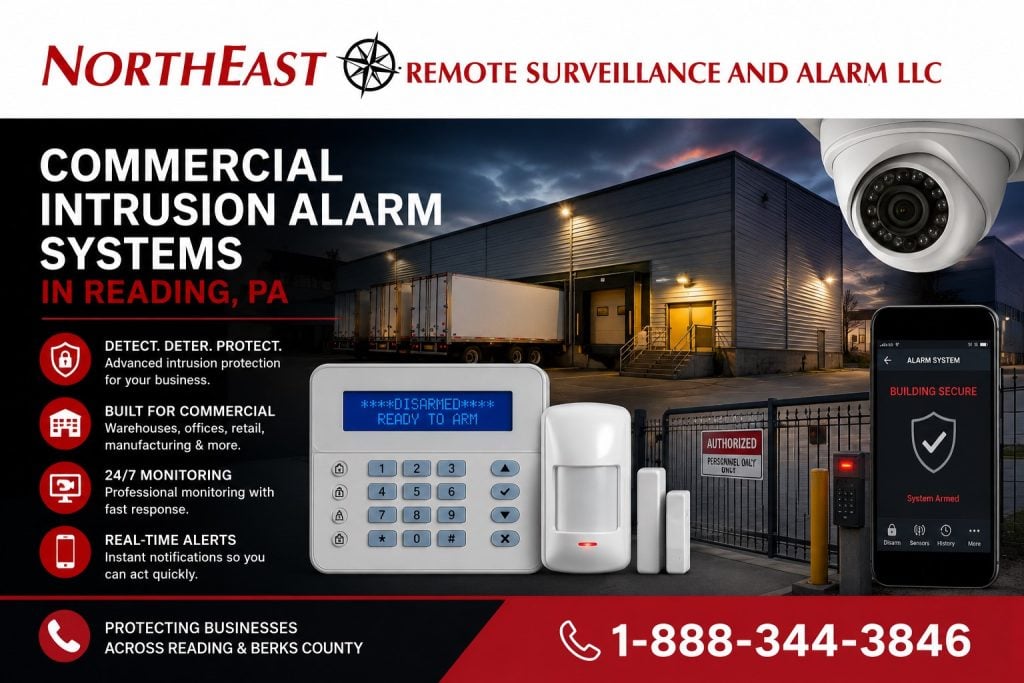
Northeast Remote Surveillance and Alarm, LLC (NERSA) designs, installs, monitors, expands, upgrades and takes over commercial intrusion detection systems for warehouses, manufacturing plants, distribution centers, offices, schools, healthcare properties, municipal buildings, retail facilities, contractor properties and multi-site organizations throughout Reading.
The right intrusion system should be designed around the property rather than assembled from a standard collection of door contacts and motion detectors.
For broader commercial-security planning within Reading, visit Commercial Security System Installation in Reading, PA.
Commercial and Industrial Systems Only • Reading, PA • New Installations • Expansions • Monitoring • Communicator Upgrades • Takeovers
Intrusion Protection Designed Around Reading Facilities
Commercial properties throughout Reading may operate very differently from one another.
An alarm design should consider:
- Exterior entrances
- Employee doors
- Loading docks
- Overhead doors
- Ground-level windows
- Roof access
- Restricted rooms
- Warehouses
- Production areas
- Shipping and receiving
- Offices
- Inventory areas
- Equipment rooms
- After-hours activity
- Multiple shifts
- Contractor access
- Existing alarm equipment
- Communication paths
- Monitoring procedures
- Future expansion
The objective is to provide dependable intrusion detection without creating unnecessary alarm activity or making daily system operation difficult for authorized personnel.
What a Commercial Intrusion Alarm Can Protect
A properly designed intrusion system may protect the building perimeter, selected interior spaces and areas containing valuable or sensitive equipment.
Potential locations include:
- Main entrances
- Secondary exterior doors
- Emergency exits
- Shipping entrances
- Loading-dock doors
- Overhead doors
- Storefront glass
- Roof hatches
- Utility entrances
- Warehouse areas
- Production spaces
- Inventory cages
- Tool rooms
- Server rooms
- Records rooms
- Cash-handling areas
- Medical or controlled storage
- Detached buildings
Not every opening or interior space requires the same detection device.
The selected protection should match the physical condition, environment and actual operating risk.
Commercial Intrusion Detection Devices
Commercial alarm systems may use several types of detection.
These can include:
- Door and window contacts
- Heavy-duty overhead-door contacts
- Motion detectors
- Glass-break detection
- Photoelectric beams
- Outdoor-rated detection
- Specialized sensors
- Panic or duress devices where appropriate
Device selection should account for the environment.
Warehouse doors, industrial production spaces and outdoor areas may require different equipment and mounting methods than offices or storefronts.
The goal is not to use every available sensor technology.
The goal is to select reliable devices appropriate for the property.
Loading-Dock and Overhead-Door Protection
Loading docks require special consideration because large moving doors, trucks, employee activity and changing schedules can create recurring alarm problems when ordinary devices are applied incorrectly.
Planning may involve:
- Heavy-duty overhead-door contacts
- Personnel-door contacts
- Dock-office protection
- Interior detection
- Separate dock alarm areas
- After-hours schedules
- Camera verification
- Gate or yard awareness
Mounting, wiring and device selection should reflect door movement, vibration, alignment, weather exposure and normal dock operations.
For broader warehouse planning, visit Warehouse Security Systems in Reading, PA.
Alarm Zones and Partitions
Commercial intrusion systems should reflect the way different departments, tenants, buildings and shifts operate.
Partitions may allow:
- Offices and warehouses to operate independently
- Tenants to control separate areas
- Production areas to remain occupied while offices are armed
- Shipping areas to follow different schedules
- Detached buildings to be controlled separately
- Restricted rooms to remain protected independently
Clear zone naming is important.
A description such as “Shipping Office East Door” is much more useful than “Zone 17.”
User Codes and Arming Permissions
Each authorized user should generally receive an individually managed code or credential where accountability matters.
Individual users can help management:
- Identify who armed or disarmed an area
- Remove former employees
- Limit access to selected partitions
- Establish temporary permissions
- Review opening and closing activity
- Reduce sharing of master codes
A documented procedure should identify who may add, remove and modify users and who is responsible for maintaining current monitoring information.
Opening, Closing and Schedule Management
Commercial alarm systems may support schedules and exception reporting for organizations with multiple shifts or varying operating hours.
Functions may include:
- Arming reminders
- Late-to-close notifications
- Early-opening notifications
- Failure-to-arm reporting
- Holiday schedules
- Temporary schedule changes
- Area-specific schedules
These functions should reflect actual operations rather than force employees into unrealistic schedules.
Professional Commercial Alarm Monitoring
A professionally monitored commercial intrusion system can transmit qualifying alarm events when the property is closed or unattended.
The monitoring plan should establish:
- Which signals require notification
- Which conditions may require dispatch
- Who should be contacted
- Contact order
- Site instructions
- Authorized passcodes
- Test procedures
- Temporary construction procedures
- Escalation instructions
Monitoring information should be reviewed when employees, responsible parties or facility procedures change.
For broader monitoring planning, visit Professional Commercial Security Monitoring.
Video Verification
Compatible cameras and intrusion systems may provide additional information around an alarm event.
Verification may help authorized personnel review:
- Activity around a protected door
- Movement associated with an alarm
- Exterior events
- Loading-dock alarms
- Gate or yard activity
- Multiple alarms occurring in sequence
Video adds context but does not replace properly designed intrusion detection.
For broader camera planning, visit Commercial & Industrial Video Surveillance Systems.
For active operator review of selected camera events, visit Remote Video Monitoring and Live Talk-Down.
Cellular, IP and Dual-Path Alarm Communication
Modern commercial alarm systems do not always need to depend on legacy analog telephone lines.
Depending on the panel and monitoring environment, communication may use:
- Cellular
- Internet/IP
- Dual-path cellular and IP
- Other supported supervised communication
Communication planning should account for:
- Panel compatibility
- Cellular signal
- Network availability
- Backup power
- Supervision
- IT policies
- Monitoring compatibility
- Recurring service requirements
A communication upgrade may allow a serviceable existing system to remain in operation without replacing every detector and device.
Panic and Duress Protection
Some Reading commercial properties may require separate panic, duress or emergency-alert functions for employees in higher-risk positions.
These signals require different response procedures from ordinary intrusion alarms.
For dedicated planning, visit Panic, Duress and Emergency Alert Systems.
Intrusion Alarms for Different Reading Properties
Warehouses and Distribution Facilities
Warehouse alarm systems may require overhead-door protection, loading-dock coverage, multiple partitions, roof-hatch protection and shift-based administration.
Manufacturing and Industrial Facilities
Manufacturing properties may require alarm protection around production areas, tool rooms, restricted spaces, shipping departments, maintenance areas and off-shift operations.
Offices and Multi-Tenant Buildings
Office alarm systems may need independent tenant areas, shared entrances, server-room protection and different operating schedules.
Retail and Cash-Handling Properties
Retail properties may require storefront protection, rear-door security, interior detection, opening and closing management and panic protection.
Schools, Healthcare and Municipal Properties
Institutional properties may need alarm systems that accommodate evening use, public entrances, restricted departments and multiple buildings.
Facility-specific alarm designs should reflect the building’s operations and coordinate with its broader security plan.
Contractor Yards and Detached Buildings
Contractor and fleet properties may require intrusion protection beyond the primary building.
Planning may include:
- Detached-building alarms
- Yard-gate monitoring
- Exterior detection
- Equipment-area protection
- Cellular communication
- Camera verification
Outdoor detection should be selected carefully because animals, vegetation, weather, headlights and normal neighboring activity can cause poorly designed systems to become unreliable.
Multi-Site Commercial Alarm Management
Organizations with several properties may benefit from consistent:
- Zone naming
- User roles
- Administrator permissions
- Communication paths
- Monitoring procedures
- Escalation instructions
- Testing standards
- Documentation
The physical systems do not need to be identical at every property, but administration should remain understandable.
For broader multi-site security planning, visit Multi-Site Commercial Security Systems in Reading, PA.
Existing Alarm System Takeovers and Upgrades
Many Reading properties already have commercial alarm systems installed by another provider.
Existing equipment should be evaluated before complete replacement is recommended.
NERSA may review:
- Alarm panel
- Keypads
- Expansion modules
- Door contacts
- Motion detectors
- Glass-break devices
- Panic devices
- Power supplies
- Batteries
- Communicators
- Zone programming
- User codes
- Monitoring signals
- Documentation
- Expansion capacity
A takeover should involve more than changing the monitoring destination.
The existing system should be tested so management understands what is working, what is bypassed, what needs repair and whether the account information reflects the current property.
For broader existing-system evaluation, visit Commercial Security System Inspection and Assessment.
For Reading-specific modernization, visit Reading Security System Upgrades, Retrofits and Takeovers.
Reducing Avoidable False Alarms
False-alarm reduction begins with good design, reliable equipment, realistic schedules and clear user procedures.
Common causes may include:
- Misaligned contacts
- Damaged overhead-door devices
- Poor detector placement
- Employees entering through the wrong door
- Shared or outdated user codes
- Forgotten schedule changes
- Cleaning crews without proper instructions
- Low batteries
- Poorly planned outdoor detection
- Incomplete responsible-party lists
- Construction activity without test procedures
The system should be reviewed when facility conditions or operating procedures change.
Access Control and Video Coordination
Compatible intrusion alarms may exchange selected information with access control and video surveillance systems.
Examples may include:
- Video associated with an alarm event
- Authorized entry coordinated with alarm partitions
- Door events associated with camera views
- Forced-door reporting
- Gate activity review
Integration should be confirmed before equipment is selected.
For broader access-control planning, visit Commercial & Industrial Access Control Systems.
For multi-system coordination, visit Unified Commercial Security Systems in Reading, PA.
Commercial Alarm Project Planning
A commercial intrusion project generally includes:
- Facility assessment
- Alarm and response planning
- System design
- Installation
- Programming and testing
- User training
- Documentation and ongoing support
The completed system should have understandable zone names, appropriate users and schedules, tested communication paths and clear operating procedures.
Why Reading Businesses Choose NERSA
Northeast Remote Surveillance and Alarm, LLC focuses on commercial and industrial security rather than residential alarm packages.
NERSA approaches commercial intrusion alarms around:
- Facility-specific planning
- Commercial-grade detection
- Loading-dock and overhead-door protection
- Alarm zoning and partitions
- Individual users
- Schedule management
- Cellular and IP communication
- Professional monitoring
- Video verification
- Existing-system takeovers
- Multi-building scalability
- Documentation
- Long-term service
NERSA has supported non-residential properties since 2008.
Reading Commercial Intrusion Alarm Service Area
This resource is specifically for qualifying commercial and industrial intrusion-alarm projects within Reading, Pennsylvania.
For surrounding Berks County communities and regional planning, visit Greater Reading Area Commercial & Industrial Security Systems.
Request a Reading Commercial Intrusion Alarm Assessment
A site assessment can identify:
- Openings requiring protection
- Interior areas requiring detection
- Alarm partitions
- Users and schedules
- Existing equipment
- Monitoring procedures
- Communication paths
- Verification options
- Integration requirements
- Future expansion
Request a Reading Commercial Intrusion Alarm Assessment.
Commercial and Industrial Systems Only • Reading, PA • New Installations • Expansions • Monitoring • Communicator Upgrades • Takeovers
Frequently Asked Questions About Commercial Intrusion Alarms in Reading, PA
What is a commercial intrusion alarm system?
A commercial intrusion alarm system uses perimeter and interior detection, user controls, schedules, communications and professional monitoring to identify unauthorized activity when protected areas are armed.
Can NERSA install intrusion alarms in warehouses?
Yes. Warehouse systems may protect personnel doors, overhead doors, loading docks, shipping offices, inventory areas, roof hatches and large interior spaces.
Can different departments arm their areas separately?
Yes. Compatible systems may use partitions so departments, tenants, buildings or work areas operate independently.
Can an alarm system show who armed or disarmed it?
Yes. Individually managed users can provide supported records showing which user performed an arming or disarming function.
Can NERSA take over an existing alarm?
Many systems can be evaluated for takeover depending on panel condition, compatibility, programming access, communicator support and device condition.
Do all devices need to be replaced during a takeover?
Not necessarily. Compatible and serviceable equipment may remain when it is identified, tested and appropriate for the completed system.
Can an older telephone-line communicator be upgraded?
Many systems can be upgraded to supported cellular, IP or dual-path communication when panel compatibility allows.
Can cameras help verify an alarm?
Yes. Compatible video systems may provide additional context around an intrusion event.
Can overhead warehouse doors be protected?
Yes. Overhead and rolling doors can use appropriately selected commercial contacts and mounting methods.
Can one part of a building remain armed while another is occupied?
Yes. Properly partitioned systems may allow selected areas to remain protected while authorized personnel occupy another part of the facility.
Does access control replace an intrusion alarm?
No. Access control manages authorized entry, while intrusion detection protects assigned areas when armed.
Can panic buttons be added?
Yes. Appropriate panic or duress devices may be incorporated into a commercial alarm system with their own defined response procedures.
How can false alarms be reduced?
Proper detector selection, realistic schedules, individual users, good door hardware, employee training, regular testing and current monitoring information can reduce avoidable alarms.
Can alarm systems be standardized across several properties?
Yes. Multi-site organizations can standardize naming, users, communications, monitoring procedures and documentation while allowing each property to retain the detection layout it requires.
Does NERSA install residential alarm systems in Reading?
No. Northeast Remote Surveillance and Alarm, LLC focuses on commercial and industrial systems.
How much does a commercial intrusion alarm cost?
Cost depends on the building, number of protected openings, detectors, partitions, communications, monitoring, existing equipment, cabling and installation conditions.
How does a Reading commercial intrusion project begin?
The project begins with a property-specific assessment of entrances, operating schedules, users, existing alarm equipment, monitoring procedures and after-hours security requirements.