Industrial park video surveillance in the Lehigh Valley should be designed around shared roads, tenant entrances, parking areas, loading zones, service drives, vehicle gates, exterior storage, warehouse activity, manufacturing operations, and after-hours exposure—not around a generic commercial camera package.
An industrial park in Allentown, a multi-building manufacturing campus in Bethlehem, a Route 33 warehouse complex near Easton, a Route 22 business park, or a distribution property connected to I-78 may each require different camera locations, recording capacity, network infrastructure, user permissions, retention, remote access, and monitoring procedures.
Northeast Remote Surveillance and Alarm, LLC designs, installs, upgrades, integrates, monitors, and supports industrial park video surveillance systems throughout:
- Allentown
- Bethlehem
- Easton
- Lehigh County
- Northampton County
- Route 22
- Route 33
- I-78
- Surrounding Lehigh Valley industrial and commercial markets
NERSA plans industrial park camera systems around:
- Shared vehicle entrances
- Internal roads and drive lanes
- Tenant and employee entrances
- Parking areas
- Loading docks
- Shipping and receiving zones
- Warehouse and manufacturing buildings
- Contractor and vendor access
- Common exterior areas
- Vehicle gates
- Trailer and fleet parking
- Exterior storage
- Fence lines
- Utility and equipment areas
- Recording quality and retention
- AI-supported video search
- Remote video monitoring
- Camera and recorder health
- Fiber, wireless, and network infrastructure
- Multi-building administration
- Long-term service and lifecycle planning
The objective is not to install the greatest possible number of cameras. The objective is to create dependable, searchable video that helps property owners, facility managers, tenants, and authorized security personnel understand what occurred during a vehicle incident, theft, vandalism event, access concern, loading-dock dispute, property-damage claim, contractor issue, or after-hours alarm.
Call 1-888-344-3846 to schedule a Lehigh Valley industrial park video-surveillance assessment.
For regional camera planning across all commercial and industrial property types, visit Lehigh Valley Commercial Video Surveillance Systems.
For broader industrial park planning involving access control, intrusion alarms, monitoring, gates, fire alarm coordination, intercoms, and infrastructure, continue to Lehigh Valley Industrial Park Security Systems.
For NERSA’s principal sitewide camera-system resource, visit Commercial and Industrial Video Surveillance Systems.
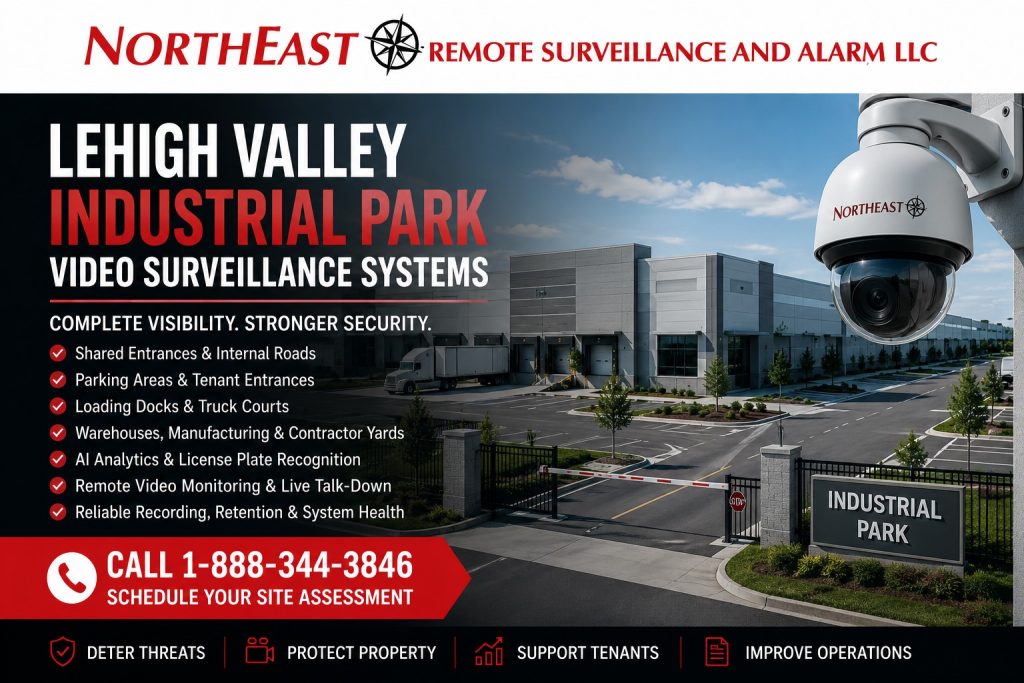
Industrial Park Cameras Should Follow the Property
An industrial park may contain several buildings, tenants, parking areas, truck lanes, shared roads, loading docks, exterior storage areas, utility spaces, and controlled entrances.
Before cameras are selected, the property owner or facility manager should identify:
- Which entrances serve the entire park
- Which roads and drive lanes are shared
- Where employees and visitors park
- Which tenants operate after hours
- Where delivery drivers report
- Which buildings have loading docks
- Where trailers or fleet vehicles are stored
- Which areas contain outdoor equipment or materials
- Where contractors and service providers enter
- Which locations have limited natural visibility
- Which incidents require identification-level detail
- How long video should remain available
- Who may view footage
- Which tenants require separate permissions
- Whether multiple buildings need centralized management
- Which areas require active monitoring
A camera that provides a useful overview of a shared drive may not capture enough detail to identify a person, vehicle, license plate, tenant entrance, dock position, or transfer of materials.
A stronger industrial park system may combine:
- Wide-area overview cameras
- Focused vehicle-entrance cameras
- Tenant-building entrance views
- Parking-lot cameras
- Loading-dock cameras
- Shared-road coverage
- Gate and lane cameras
- Trailer-area surveillance
- Exterior-storage cameras
- Utility-area views
- License plate recognition
- AI-supported perimeter detection
- Remote-monitoring cameras
Each camera should have a clear operational purpose.
Shared Entrances and Internal Roads
Industrial parks often have one or more shared entrances serving multiple buildings or tenants.
Camera planning may include:
- Primary vehicle entrances
- Secondary service entrances
- Shared internal roads
- Intersections
- Delivery approaches
- Visitor lanes
- Contractor entrances
- Emergency-access routes
- Gate lanes
- Exit lanes
A shared entrance camera may help document:
- Vehicles entering or leaving
- Direction of travel
- Delivery activity
- Contractor access
- After-hours vehicle movement
- Property-damage incidents
- Gate events
- Traffic disputes
General overview cameras may show traffic flow, but dedicated lane cameras may be required when the property needs reliable vehicle or license plate detail.
Camera design should account for:
- Vehicle speed
- Lane width
- Direction of travel
- Sun glare
- Headlights
- Mounting height
- Nighttime lighting
- Landscape growth
- Weather
- Communication pathways
Tenant and Employee Entrances
Industrial park buildings may contain separate entrances for:
- Office employees
- Warehouse employees
- Manufacturing personnel
- Drivers
- Contractors
- Vendors
- Temporary labor
- Visitors
- Maintenance staff
Camera coverage may provide context for:
- Access granted
- Access denied
- Forced-door events
- Doors held open
- Visitor entry
- Contractor activity
- After-hours access
- Employee arrival and departure
- Reported incidents near an entrance
An electronic access record shows what the access-control system recorded, but it does not independently establish who physically entered or what occurred around the opening.
Compatible video and access-control platforms may help authorized users associate selected door events with nearby footage.
For complete controlled-door, credential, locking-hardware, and user-permission planning, visit Commercial and Industrial Access Control Systems.
For ongoing credential administration, controller-health awareness, door-status oversight, and lifecycle support, visit Managed Access Control Systems and System Health Monitoring.
Parking Lot Video Surveillance
Industrial parks may contain several parking areas serving different tenants, shifts, visitors, contractors, and fleet vehicles.
Parking-lot planning may include:
- Employee parking
- Visitor parking
- Accessible parking
- Shift-change activity
- Building approaches
- Rear and side lots
- Shared pedestrian routes
- Drive lanes
- Tenant entrances
- Loading-area transitions
- Fleet parking
- After-hours activity
Video may help authorized personnel review:
- Vehicle-damage claims
- Theft
- Vandalism
- Suspicious activity
- Employee arrival and departure
- Contractor movement
- Visitor incidents
- After-hours traffic
- Activity near parked fleet vehicles
A single wide camera may show that an event occurred without providing enough detail to identify a person, vehicle, or direction of travel.
Some properties benefit from:
- Wide parking overviews
- Focused building-entrance cameras
- Drive-lane views
- Pedestrian-approach cameras
- Dedicated LPR at selected entrances
For dedicated exterior-camera planning, visit Lehigh Valley Parking Lot Security Cameras.
Loading Docks and Shipping Areas
Industrial parks often contain warehouses, manufacturing buildings, service properties, and distribution tenants with active loading areas.
Dock environments may involve:
- Tractor-trailers
- Delivery vehicles
- Drivers
- Employees
- Vendors
- Forklifts
- Staged freight
- Overhead doors
- Shipping offices
- Receiving offices
- Adjacent personnel entrances
- After-hours deliveries
Camera planning may need to document:
- Vehicle arrival
- Trailer positioning
- Dock-door activity
- Material transfers
- Freight condition
- Driver and employee interaction
- Loading and unloading
- Damage claims
- Access through nearby doors
One camera rarely provides every useful view.
A stronger design may combine:
- Truck-court overview
- Exterior dock camera
- Interior dock-door camera
- Freight-transfer view
- Shipping-office entrance camera
- Driver check-in camera
Planning should consider dock numbering, trailer angles, lighting transitions, nighttime conditions, weather exposure, mounting height, recording retention, and required identification detail.
For complete loading-dock planning involving cameras, controlled doors, alarms, and monitoring, visit Lehigh Valley Loading Dock Security Systems.
Warehouse and Distribution Buildings
Industrial parks may contain warehouses and distribution centers requiring video coverage for:
- Loading docks
- Shipping and receiving
- Employee entrances
- Warehouse aisles
- Inventory rooms
- Secured cages
- Truck courts
- Trailer storage
- Parking areas
- Exterior doors
- Gate lanes
- Building approaches
Useful warehouse video may support:
- Freight verification
- Inventory investigations
- Delivery disputes
- Employee incidents
- Vehicle claims
- Access-event review
- Alarm verification
- After-hours response
For focused warehouse camera planning, visit Lehigh Valley Warehouse Video Surveillance Systems.
For complete warehouse protection involving multiple systems, continue to Warehouse Security Systems in the Lehigh Valley.
Manufacturing and Production Facilities
Manufacturing tenants may require cameras around:
- Employee entrances
- Production-support areas
- Restricted processes
- Tool rooms
- Maintenance departments
- Raw-material storage
- Finished-goods storage
- Quality-control areas
- Shipping operations
- Exterior equipment
- Industrial parking
Manufacturing environments may involve dust, heat, vibration, changing layouts, tall machinery, reflective surfaces, strong lighting differences, and limited service access.
Camera placement should support legitimate security and incident-review needs without interfering with production, maintenance, employee policies, or required safety procedures.
For focused plant-camera planning, visit Lehigh Valley Manufacturing Video Surveillance Systems.
For complete manufacturing-security planning, continue to Lehigh Valley Manufacturing Security Systems.
Contractor Facilities and Exterior Storage
Industrial parks may include contractor facilities, fleet operations, equipment yards, material storage, and service properties.
Camera priorities may include:
- Vehicle gates
- Fence lines
- Fleet parking
- Trailers
- Tools
- Equipment
- Materials
- Fueling areas
- Detached buildings
- Service entrances
- Exterior storage
- After-hours activity
These properties may require:
- Wide-area yard cameras
- Focused gate views
- Long-range cameras
- Wireless or fiber-connected cameras
- License plate recognition
- AI-supported perimeter detection
- Remote video monitoring
- Live audio talk-down
A building-mounted camera may provide a general overview while failing to produce useful detail at the far side of a large yard.
For broader contractor and fleet planning, visit Lehigh Valley Contractor Yard Security Systems.
Common Areas and Shared Property Responsibilities
Multi-tenant industrial parks may need clear separation between common-area security and tenant-controlled systems.
Common areas may include:
- Shared roads
- Parking lots
- Vehicle entrances
- Monument signs
- Service drives
- Shared loading zones
- Common walkways
- Exterior utility areas
- Property-management offices
- Dumpster and compactor locations
- Unoccupied spaces
The management structure should establish:
- Who owns the cameras
- Who owns the recorder or cloud account
- Which users may view each camera
- Whether tenants receive limited access
- Who may export video
- How requests for footage are handled
- How long recordings are retained
- Who authorizes service
- Who controls administrator accounts
- How former users are removed
A shared system should not rely on one generic administrator account used by property management, tenants, contractors, and service providers.
Individual permissions improve accountability and reduce unnecessary access.
License Plate Recognition for Industrial Parks
License plate recognition may help document vehicles at selected entrances or lanes.
Potential applications include:
- Main industrial park entrances
- Employee parking gates
- Truck entrances
- Contractor access
- Visitor lanes
- Delivery lanes
- Fleet yards
- Restricted vehicle areas
Reliable plate capture depends on:
- Camera angle
- Vehicle speed
- Lane width
- Mounting height
- Lighting
- Direction of travel
- Plate size in the image
- Dedicated capture settings
A standard overview camera should not automatically be expected to provide reliable plate capture.
The property should define whether the objective is:
- General vehicle documentation
- Searchable plate records
- Alerts for selected plates
- Gate support
- Delivery verification
- Incident investigation
For dedicated plate-capture planning, visit License Plate Recognition Camera Systems.
AI Video Analytics and Smart Search
AI-supported video may help authorized users locate or classify selected activity more efficiently.
Depending on the platform and configuration, analytics may assist with:
- People detection
- Vehicle classification
- Line crossing
- Perimeter activity
- Loitering
- Direction of travel
- Restricted-area activity
- After-hours movement
- Object appearance or removal
- Faster recorded-video search
AI should not replace proper camera placement.
Analytics perform best when:
- Camera views are stable
- Lighting is suitable
- Subjects are large enough in the image
- Detection zones are configured correctly
- The network is reliable
- Recording is functioning
- The selected analytic matches the property’s objective
Shadows, glare, headlights, weather, vegetation, vibration, blocked views, and changing site conditions may affect performance.
The property should begin by defining what it needs to detect or find rather than enabling every available analytic feature.
For deeper planning, visit AI Video Surveillance Systems.
Remote Video Monitoring and Live Talk-Down
Some industrial parks require more than passive recording.
Remote video monitoring may be appropriate for:
- Shared entrances
- Truck courts
- Trailer areas
- Parking lots
- Loading docks
- Exterior storage
- Equipment yards
- Fence lines
- Vacant buildings
- Utility areas
- Repeat trespassing locations
A defined monitored-video program may include:
- Analytics-generated events
- Monitoring-operator review
- Video verification
- Live audio warnings
- Customer notification
- Escalation under approved procedures
Remote video monitoring is different from simply giving users mobile access to cameras.
A monitored service requires:
- Selected cameras
- Defined schedules
- Appropriate analytics
- Current response contacts
- Written escalation instructions
- Suitable speaker placement when talk-down is used
- Clear responsibility between property management and tenants
For active after-hours deterrence, visit Remote Video Monitoring and Live Talk-Down.
Recording and Video Retention
Industrial park video provides limited value if the required footage was not recorded correctly or has already been overwritten.
Actual retention depends on:
- Number of cameras
- Resolution
- Frame rate
- Compression
- Scene activity
- Recording schedules
- Continuous or event-based recording
- Storage capacity
- Audio recording
- Analytic metadata
- Added cameras
- Failed or degraded drives
A recorder initially designed for a specific retention period may no longer provide that retention after additional buildings or cameras are added.
Retention planning should consider:
- Tenant incident-reporting delays
- Vehicle claims
- Property-damage investigations
- Delivery disputes
- Contractor issues
- Insurance requirements
- Legal or records procedures
- Evidence exports
- Management expectations
The oldest available footage should be verified rather than estimated only from a storage setting.
On-Premises, Cloud-Managed, and Hybrid Video
Industrial park camera systems may use local, cloud-managed, or hybrid architectures.
On-Premises Recording
On-premises systems may be appropriate for:
- Larger camera counts
- Longer retention
- High recording bandwidth
- Local storage control
- Specialized integrations
- Customer-managed infrastructure
These systems still require:
- Recorder or server maintenance
- Hard-drive monitoring
- Software support
- User administration
- Secure remote access
- Cybersecurity
- Backup planning
- Lifecycle management
Cloud-Managed Video
Cloud-managed systems may provide:
- Remote administration
- Centralized users
- Multi-building visibility
- Mobile access
- Device-health information
- Easier expansion
- Subscription-based services
The customer should understand:
- Recurring costs
- Internet requirements
- Retention limitations
- Primary account ownership
- Data export
- Outage behavior
- Local recording capabilities
- Long-term platform support
Hybrid Video Surveillance
Hybrid systems may combine local recording with cloud-based:
- Administration
- Remote viewing
- Health alerts
- Event management
- Analytics
- Selected backup functions
- Multi-site dashboards
The correct architecture depends on camera count, retention, bandwidth, cybersecurity, user requirements, tenant access, subscription preferences, and future expansion.
For the detailed comparison, visit Cloud vs. On-Premises vs. Hybrid Video Surveillance.
Managed Camera and Recorder Health Monitoring
Industrial park camera systems can fail quietly.
A camera may remain powered but stop recording. A recorder may appear online while a storage drive is degraded. A wireless link may become unstable. A remote building may stop reporting while daily operations continue normally.
Compatible health-monitoring services may help identify:
- Offline cameras
- Repeated disconnections
- Recording interruptions
- Recorder failures
- Storage trouble
- Degraded drives
- Reduced retention
- Network communication loss
- Wireless-link failures
- Cloud gateway trouble
- Licensing issues
- Time-synchronization problems
- Buildings or sites that stop reporting
Health monitoring does not guarantee uninterrupted operation and does not replace physical inspection.
It improves awareness of technical conditions that may otherwise remain unnoticed until footage is needed.
For camera-specific oversight, visit Managed Video Surveillance and Camera System Health Monitoring.
For broader health monitoring across cameras, access control, alarms, networks, power systems, and multiple buildings, visit Commercial Security System Health Monitoring.
For complete managed-security planning, continue to Managed Security Systems and System Health Monitoring.
Preventive Maintenance and Physical Camera Inspection
Remote system-health information cannot identify every physical problem.
Scheduled maintenance may include:
- Cleaning camera lenses
- Removing insects and spiderwebs
- Verifying camera views
- Checking focus
- Inspecting mounting stability
- Reviewing nighttime image quality
- Inspecting enclosures
- Testing recording
- Confirming system time
- Reviewing retention
- Testing remote access
- Reviewing user accounts
- Inspecting recorder condition
- Checking UPS and backup power
- Updating camera documentation
Industrial parks change over time.
New tenants, fences, signs, trailers, landscaping, storage containers, machinery, and temporary construction can obstruct views that were useful when installed.
Critical cameras should be reviewed periodically against their original purpose.
Fiber, Wireless, and Network Infrastructure
Industrial park cameras may span several buildings and large exterior areas.
Supporting infrastructure may include:
- Cat6 or Cat6A cabling
- Fiber-optic backbones
- PoE switches
- Wireless building links
- Point-to-point bridges
- Equipment racks
- UPS systems
- Backup batteries
- Surge protection
- VLANs
- Network segmentation
- Secure remote access
- Cable labeling
- Closeout documentation
Many apparent camera failures are infrastructure problems caused by:
- Damaged cabling
- Failed PoE ports
- Insufficient bandwidth
- Fiber-link trouble
- Wireless-bridge interruption
- Power outages
- Weak backup power
- Incorrect network addressing
- Firewall or VLAN changes
- Poor equipment enclosures
- Undocumented network changes
The network and power architecture should be designed as part of the video-surveillance system rather than treated as a separate afterthought.
For broader infrastructure planning, visit the appropriate cabling, fiber, wireless, and network resources within Lehigh Valley Commercial and Industrial Security Systems.
Video Integration With Access Control and Intrusion Alarms
Industrial park cameras may provide context for:
- Access granted
- Access denied
- Forced doors
- Held-open doors
- Visitor releases
- Gate activity
- Intrusion alarms
- After-hours entry
- Restricted-room access
- Contractor activity
- Tenant incidents
Compatible integration may allow authorized users to move from a door or alarm event to relevant video more efficiently.
Integration should solve a defined operating need. It should not introduce unnecessary complexity or interfere with required egress, fire alarm functions, emergency procedures, or other life-safety systems.
For broader coordination among cameras, access control, intrusion alarms, intercoms, gates, monitoring, and reporting, visit Unified and Integrated Commercial Security Systems.
Multi-Building and Multi-Tenant Video Management
Industrial park owners may inherit:
- Different camera manufacturers
- Separate recorder systems
- Inconsistent camera names
- Different retention periods
- Shared passwords
- Unclear account ownership
- Unsupported software
- Separate mobile applications
- Missing documentation
- Different tenant systems
- Multiple service providers
A coordinated management program may establish:
- Centralized user administration
- Tenant-specific permissions
- Property-management permissions
- Standard camera naming
- Camera and recorder inventories
- Retention standards
- Health reporting
- Service-ticket tracking
- Preventive maintenance
- Recurring-failure analysis
- Migration planning
- Lifecycle priorities
Every building does not need immediate replacement.
Supportable systems may remain in operation while the owner develops a phased standardization and modernization plan.
For ongoing multi-location administration, documentation, service coordination, and lifecycle support, visit Multi-Site Security System Management.
For larger enterprise video environments, visit Enterprise Video Surveillance Systems.
Industrial Park Video Surveillance Upgrades and Takeovers
An industrial park may require modernization because of:
- Poor image quality
- Weak nighttime performance
- Offline cameras
- Failed recorders
- Inadequate storage
- Short retention
- Difficult footage retrieval
- Insecure remote access
- Installer-owned accounts
- Unsupported software
- Poor camera placement
- Weak network infrastructure
- Inconsistent systems across buildings
- Limited expansion capacity
An assessment may determine which components can be:
- Retained
- Repositioned
- Reconfigured
- Repaired
- Expanded
- Integrated
- Migrated
- Replaced in phases
A successful takeover should provide:
- Customer-controlled accounts
- Documented camera locations
- Clear camera names
- Verified recording
- Known retention
- Secure user access
- Tenant-specific permissions where appropriate
- Supportable infrastructure
- Defined service procedures
- A practical modernization plan
Existing equipment does not need to be replaced merely because another provider installed it.
It may remain when it is compatible, dependable, secure, accessible, serviceable, and appropriate for the completed system.
For broader modernization involving cameras, access control, intrusion alarms, infrastructure, and inherited systems, visit Commercial Security System Upgrades, Retrofits and Takeovers.
Industrial Park Video Surveillance From Small Parks to Enterprise Portfolios
A smaller industrial park may require:
- Shared entrance cameras
- Parking-lot coverage
- Tenant entrance views
- Loading-area visibility
- Local recording
- Secure remote access
- Basic user permissions
A larger multi-building property may require:
- Several shared road cameras
- Multiple parking areas
- Loading-dock coverage
- Truck and trailer surveillance
- Fiber or wireless links
- License plate recognition
- Longer retention
- Remote monitoring
- Managed system health
- Tenant-specific permissions
An enterprise property portfolio may require:
- Centralized users
- Regional administrators
- Standard camera naming
- Consistent retention
- Multi-site dashboards
- Health reporting
- Service coordination
- Documented platform standards
- Lifecycle planning
The system should solve current property requirements without preventing future buildings, tenants, cameras, users, or locations from being added.
The NERSA Industrial Park Video Surveillance Process
Property and Operations Review
NERSA reviews:
- Property layout
- Shared roads
- Vehicle entrances
- Tenant buildings
- Parking areas
- Loading docks
- Truck courts
- Exterior storage
- Utility areas
- Employee and visitor movement
- Existing systems
- Known incidents
Camera-Purpose Planning
Each proposed camera receives a defined purpose, such as:
- Shared-road overview
- Vehicle-entrance documentation
- Building-entrance identification
- Parking-area awareness
- Dock documentation
- Trailer-area coverage
- Exterior-storage review
- Perimeter monitoring
- Alarm verification
- License plate capture
Recording and Retention Planning
The design may evaluate:
- Camera count
- Resolution
- Frame rate
- Compression
- Recording architecture
- Storage
- Actual retention
- Expansion requirements
- Evidence-export needs
Infrastructure Review
Planning may include:
- Cabling
- Fiber
- Wireless links
- PoE switching
- Bandwidth
- Power
- Backup power
- Network security
- Equipment locations
- Building-to-building communication
Installation and Configuration
Approved systems are configured around:
- Camera views
- Camera names
- Recording requirements
- User permissions
- Tenant permissions
- Remote access
- Analytics
- Monitoring
- Included integrations
Testing and Commissioning
Testing may include:
- Live image verification
- Recording checks
- Playback
- Search
- Video export
- Retention verification
- Remote access
- User permissions
- Tenant permission separation
- Analytic events
- Health-monitoring functions
- Included integrations
Training and Documentation
Authorized personnel may receive instruction on:
- Live viewing
- Recorded-video search
- Video export
- Mobile access
- User administration
- Incident review
- Tenant access management
- Requesting service
Project documentation may identify:
- Camera names
- Camera locations
- Recorder information
- Storage
- Expected retention
- User roles
- Tenant permissions
- Network requirements
- Primary accounts
- Service information
Why Lehigh Valley Industrial Parks Choose NERSA
Northeast Remote Surveillance and Alarm, LLC focuses on commercial and industrial physical-security systems.
NERSA approaches industrial park video surveillance as a complete visibility, evidence, infrastructure, management, and support system—not as a collection of unrelated cameras.
Planning may account for:
- Shared property operations
- Multi-building environments
- Tenant and property-management responsibilities
- Vehicle movement
- Parking
- Loading docks
- Truck and trailer activity
- Employee and contractor entrances
- Exterior storage
- Recording and retention
- Secure remote access
- AI-supported search
- Alarm verification
- Remote monitoring
- Camera health
- Fiber and network infrastructure
- Customer account ownership
- Documentation
- Long-term support
NERSA supports industrial parks, warehouse complexes, manufacturing campuses, contractor properties, logistics facilities, and multi-building commercial sites throughout Allentown, Bethlehem, Easton, Route 22, Route 33, I-78, and the surrounding Lehigh Valley.
Frequently Asked Questions About Industrial Park Video Surveillance
What is an industrial park video-surveillance system?
It is a commercial camera, recording, storage, viewing, analytics, and management system designed for shared roads, entrances, parking lots, tenant buildings, loading areas, exterior storage, gates, and common areas across an industrial park.
Where should industrial park cameras be installed?
Common priorities include vehicle entrances, internal roads, tenant entrances, employee parking, visitor parking, loading docks, truck courts, trailer areas, exterior storage, service drives, utility locations, fence lines, and property approaches.
Should every tenant have access to every camera?
No. User permissions should reflect legitimate operational responsibilities. Property management may control shared cameras while tenants receive limited access only to approved views.
Can several buildings share one recording platform?
Possibly. Compatible systems may support centralized recording, cloud administration, shared infrastructure, or multi-site management. The correct architecture depends on bandwidth, retention, tenant requirements, cybersecurity, and account ownership.
Can industrial park cameras capture license plates?
Dedicated LPR cameras may capture plates at selected lanes when the angle, distance, lighting, mounting position, and vehicle speed are properly controlled.
Can cameras help document loading-dock disputes?
Cameras may provide useful context around vehicle arrival, trailer positioning, freight movement, driver activity, and dock operations when the relevant areas are visible and footage remains available.
Can cameras integrate with tenant access control?
Compatible platforms may associate selected credential and door events with nearby footage. Permissions should be structured carefully so tenants do not receive unnecessary control over common or neighboring areas.
Can NERSA monitor camera and recorder health?
Compatible systems may provide technical health information for cameras, recorders, storage, networks, cloud gateways, wireless links, licensing, and other supported conditions.
Is remote viewing the same as active remote monitoring?
No. Remote viewing allows authorized users to access live or recorded cameras. Remote video monitoring is a separate service involving selected cameras, event triggers, monitoring personnel, schedules, and response procedures.
Should an industrial park use local or cloud recording?
The correct approach depends on camera count, retention, bandwidth, tenant access, cybersecurity, remote administration, recurring costs, and future expansion.
Can existing cameras and cabling be reused?
Possibly. NERSA can evaluate cameras, cabling, switches, fiber, wireless links, recorders, storage, software, accounts, and views to determine what may be retained, repaired, expanded, migrated, or replaced.
Can several industrial parks be managed from one platform?
Compatible systems may support centralized users, location-specific permissions, standard camera naming, retention standards, health reporting, service coordination, and portfolio-wide administration.
Does NERSA install residential camera systems?
No. Northeast Remote Surveillance and Alarm, LLC focuses on commercial, industrial, warehouse, manufacturing, logistics, institutional, municipal, healthcare, educational, contractor, and multi-site properties.
Request a Lehigh Valley Industrial Park Video Surveillance Assessment
NERSA can evaluate:
- Shared vehicle entrances
- Internal roads
- Tenant buildings
- Employee entrances
- Visitor entrances
- Parking areas
- Loading docks
- Truck courts
- Trailer areas
- Exterior storage
- Service drives
- Vehicle gates
- Utility areas
- Fence lines
- Existing cameras
- Lighting
- Required image detail
- Recording
- Storage
- Retention
- Remote access
- Property-management permissions
- Tenant permissions
- Account ownership
- AI analytics
- Fiber and network infrastructure
- Remote monitoring
- Camera-health capabilities
- Future expansion
Call Northeast Remote Surveillance and Alarm at 1-888-344-3846 to schedule a Lehigh Valley industrial park video-surveillance assessment.
For regional camera planning, return to Lehigh Valley Commercial Video Surveillance Systems.
For complete industrial park security planning, continue to Lehigh Valley Industrial Park Security Systems.