
For the broader system plan, see Lehigh Valley commercial security systems and installation.

Request an industrial park assessment
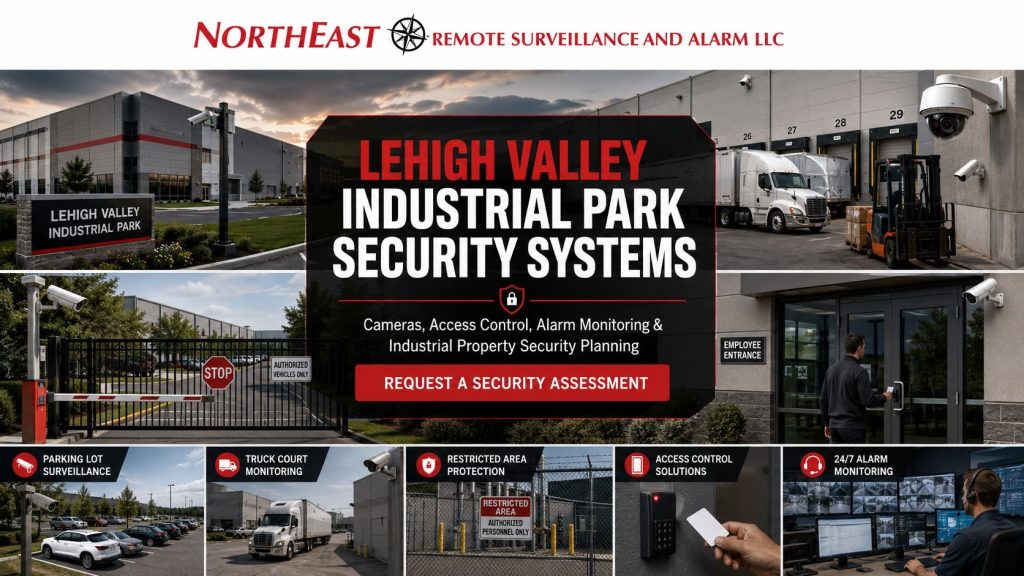
Industrial park security systems in the Lehigh Valley, PA must separate shared roads, gates, parking and exterior approaches from cameras and access equipment controlled by individual tenants.
NERSA plans commercial surveillance, gate access control, visitor communication, monitored events and supporting fiber or wireless connections for multi-building industrial and business parks.
Facility owners and managers should identify which cameras, doors, networks and alert procedures belong to the landlord versus each tenant before equipment is installed or integrated.
Plan Lehigh Valley Industrial Park Security Responsibilities
Begin with a site plan that distinguishes landlord-managed areas from leased premises. Record who owns each camera, reader, gate, network connection, and equipment cabinet. Then identify who approves changes, pays for service, and receives alerts when a shared system fails.
A common entrance can serve several businesses with different hours. Therefore, its schedule should account for approved deliveries and tenant access without giving every tenant control of the entire property. Document an exception process for temporary work, special deliveries, and changes in occupancy.
Separate Shared Views and Tenant Records
Common-area cameras can document vehicle approaches, intersections, shared parking, and building entrances. Tenant cameras may cover inventory or private work areas. Define viewing permissions separately so a tenant receives the access needed for its premises and approved common areas.
For incident requests, name the person who reviews and exports recordings. Agree on how staff identify the location, time period, and relevant cameras. Test retrieval before an incident, and keep system clocks consistent across buildings.
Coordinate Gates, Visitors, and After-Hours Response
At shared gates, define how employees, carriers, maintenance teams, and visitors request entry.
An intercom call should reach someone who can make an informed decision.
Likewise, alarm and monitoring contacts should identify the responsible tenant or property representative for each area.
For an agreed alarm-response workflow using camera evidence, see Lehigh Valley alarm monitoring and video verification.
When a tenant leaves, remove its credentials and administrator permissions while preserving access for occupied buildings.
Check gate schedules, visitor directories, contact lists, and service accounts as part of the handover.
For equipment shared among tenants, the Lehigh Valley security maintenance guide explains how to document faults and ongoing support responsibility.
This avoids carrying old permissions into the next tenancy.
Choose Systems for Common Property
Use these services to plan shared camera coverage, controlled entry, visitor communication, monitoring, and supporting infrastructure.
Where shared buildings or tenant spaces require new intrusion detection, review commercial intrusion alarm installation in the Lehigh Valley for protected openings, separate arming areas, testing, and handover.
- Video surveillance for shared approaches and incident review.
- Access control for separately managed user groups and openings.
- Gate access and visitor intercoms for common entrances.
- Remote video monitoring for defined events, schedules, and response procedures.
- Security infrastructure for shared pathways, power, and network connections.
Review Individual Facilities and Nearby Parks
Inside a tenant’s premises, review the separate requirements for manufacturing facilities warehouses or office buildings and multi-tenant workplaces.
Use the Lehigh Valley industrial park directory to find local park and corridor information.
For production sites within these parks, the LVIP manufacturing plant security guide explains how production floors, restricted rooms, shipping areas and employee entrances fit into a coordinated plan.
For broader regional coordination, review Lehigh Valley commercial security.
Request an industrial park assessment with a property plan, tenant list, equipment records, and current service responsibilities.
Compliance, Codes & Project Standards
NERSA plans commercial and industrial security work with applicable code, documentation, inspection and authority-having-jurisdiction requirements in mind. Requirements vary by system, property and jurisdiction. These resources support project planning; they do not establish legal compliance, certification or AHJ approval.
Related guidance: Regulatory compliance & inspection readiness · NERSA project standards · Documentation, testing & inspection readiness