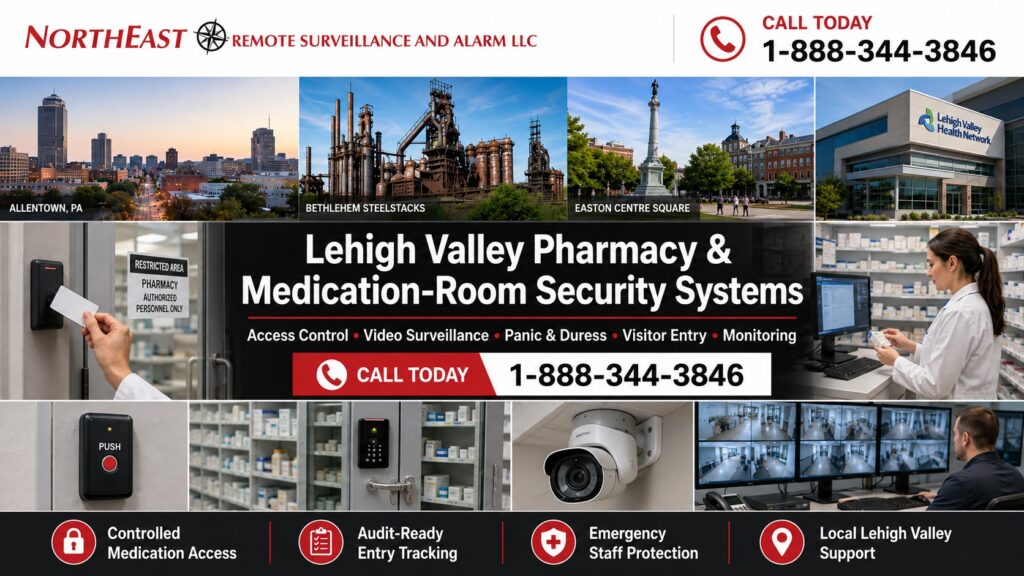
Lehigh Valley Pharmacy & Medication-Room Security Systems


Pharmacies and medication-storage areas require tighter security controls than ordinary office or administrative spaces because access may need to be limited to specific employees, departments, schedules, or authorized clinical personnel.

Northeast Remote Surveillance and Alarm, LLC (NERSA) designs, installs, upgrades, integrates and supports commercial security systems for pharmacy and medication-storage environments throughout Allentown, Bethlehem, Easton, Lehigh County, Northampton County and the surrounding Lehigh Valley.

Depending on the facility, pharmacy and medication-room security may incorporate:

  • electronic access control;
  • individually assigned credentials;
  • card and key-fob access;
  • mobile credentials;
  • PIN credentials;
  • door-position monitoring;
  • forced-door alerts;
  • held-open-door alerts;
  • intrusion detection;
  • panic and duress devices;
  • video surveillance of appropriate approaches;
  • alarm monitoring;
  • dual-path alarm communication;
  • intercom and controlled visitor entry;
  • event reporting;
  • multi-site administration.

For broader healthcare-security planning, visit Lehigh Valley Healthcare Security Systems.

For regional commercial access-control planning, visit Lehigh Valley Commercial Access Control Systems.

Commercial and institutional systems only.

Call NERSA: 1-888-344-3846

Lehigh Valley pharmacy and medication-room security systems collage featuring Allentown, Bethlehem SteelStacks, Easton Centre Square, a Lehigh Valley healthcare facility, restricted pharmacy access control, panic and duress protection, medication storage, video surveillance, monitoring, and Northeast Remote Surveillance and Alarm branding.

Pharmacy Security Starts with Controlled Access

The first question in pharmacy and medication-room security is not which reader or camera should be installed.

The first question is:

Who requires access to this space, when should that access be permitted, and how should the facility respond when something unusual occurs?

A pharmacy or medication-storage area may be accessed by:

  • pharmacists;
  • pharmacy technicians;
  • nursing personnel;
  • physicians or authorized clinical staff;
  • administrators;
  • inventory personnel;
  • approved vendors;
  • authorized contractors.

Not every employee who can enter the healthcare facility should automatically be able to enter the pharmacy or medication room.

NERSA designs access around the operating requirements of the specific facility.


Electronic Access Control for Pharmacy and Medication Rooms

Electronic access control can help organizations replace broad mechanical-key access with individually managed credentials.

A properly designed system can establish access according to:

  • individual employee;
  • department;
  • job responsibility;
  • schedule;
  • location;
  • specific controlled opening.

Credentials may include:

  • keycards;
  • key fobs;
  • mobile credentials;
  • PIN codes;
  • supported multi-factor combinations.

If an employee leaves the organization or changes responsibility, access can be adjusted without necessarily rekeying the entire facility.

For detailed regional system architecture, visit Lehigh Valley Commercial Access Control Systems.

This pharmacy spindle should focus specifically on the restricted medication-area application, not duplicate the broader access-control technology page.


Individually Assigned Credentials

Shared credentials reduce accountability.

Where practical, pharmacy and medication-room access should be based on individually assigned users rather than:

  • shared cards;
  • shared PINs;
  • unattended keys;
  • generic department credentials.

Individual credentials can help provide a clearer record of access events.

The organization can define:

  • which doors a user may access;
  • the times that access is permitted;
  • when credentials expire;
  • when temporary permissions begin and end.

Credential administration should be incorporated into employee onboarding, role changes and offboarding.


Pharmacy Door-Position Monitoring

Knowing that access was granted does not necessarily mean the opening returned to a secure condition.

Door-position monitoring can identify conditions such as:

  • door forced open;
  • door held open;
  • door remaining open longer than expected;
  • door failing to fully close.

A medication-room door may have a functioning reader while still providing poor security because the:

  • closer is improperly adjusted;
  • latch does not engage;
  • strike is misaligned;
  • door is routinely propped open;
  • door-position sensor is incorrectly installed.

NERSA evaluates the entire controlled opening rather than treating the reader as a standalone device.


Forced-Door and Held-Open Alerts

Pharmacy and medication areas can benefit from notifications when the door behaves outside the expected access process.

Door Forced Open

A forced-door event generally occurs when a monitored opening changes to an open condition without a valid authorized access event.

Door Held Open

A held-open event may occur when an authorized entry takes place but the door remains open beyond a defined period.

These events can provide useful operational information.

However, alert thresholds must be configured carefully.

A system that generates constant nuisance events can train staff to ignore meaningful alarms.


Pharmacy Access Schedules

Not every authorized employee necessarily requires continuous access.

Permissions can sometimes be organized around:

  • normal pharmacy hours;
  • employee shifts;
  • weekend operation;
  • after-hours procedures;
  • temporary assignment;
  • emergency access requirements.

Schedules can reduce unnecessary access while preserving normal workflow.

System design should not create restrictions that interfere with legitimate healthcare operations or defined emergency procedures.


Pharmacy Panic and Duress Systems

Pharmacy personnel may work in environments where a discreet method of signaling an emergency is appropriate.

Potential devices may include:

  • fixed under-counter panic buttons;
  • desk-mounted panic buttons;
  • wireless panic devices;
  • supported wearable devices;
  • defined duress functions.

Device placement should be based on:

  • employee work locations;
  • accessibility;
  • accidental-activation risk;
  • response procedures;
  • monitoring;
  • staff training.

For detailed emergency-signaling planning, visit Lehigh Valley Healthcare Panic & Duress Systems.

The panic and duress page should own the emergency-signaling topic.

This page should explain how that protection applies specifically to pharmacy and medication areas.


Silent and Audible Emergency Signaling

Pharmacy emergency signaling may be configured differently depending on the facility’s response plan.

A defined event could involve:

  • silent monitoring-center transmission;
  • local audible notification;
  • internal staff notification;
  • designated responsible-party notification;
  • associated video review.

NERSA establishes the intended response before programming the system.

An emergency device should never be installed without defining what should happen when it is activated.


Pharmacy Video Surveillance

Video surveillance may provide useful context around pharmacy and medication-room security where camera placement is appropriate.

Potential coverage may include:

  • pharmacy entrances;
  • medication-room approaches;
  • receiving areas;
  • public service counters;
  • controlled hallways;
  • loading or delivery approaches.

Video planning should consider:

  • privacy;
  • facility policy;
  • camera angle;
  • image quality;
  • retention requirements;
  • authorized access;
  • cybersecurity.

For the regional video-surveillance architecture, visit Lehigh Valley Commercial Video Surveillance Systems.

This page should not become another regional camera page.

Video is discussed here only as one layer of medication-area security.


Access Events and Associated Video

Where systems support appropriate integration, access-control events may be associated with nearby cameras.

Potential applications include:

  • reviewing video associated with a door event;
  • displaying a nearby camera during a forced-door condition;
  • associating a held-open event with video;
  • reviewing activity around an after-hours access event.

This can provide operational context beyond a simple access log.

Integration should be implemented only where it improves investigation or response.


Intrusion Detection for Pharmacy and Medication Areas

Some medication-storage areas may require protection when the surrounding facility or department is closed.

Intrusion detection may incorporate:

  • door contacts;
  • motion detectors;
  • glass-break detection where appropriate;
  • other supported sensors.

The protected area may be configured independently from other portions of the healthcare facility where system architecture allows.

For broader regional alarm-system planning: Lehigh Valley Commercial Intrusion larm Systems


Professional Alarm Monitoring

Supported pharmacy security events may be transmitted to a professional monitoring center according to the system design and facility procedures.

Monitoring records should clearly describe:

  • facility;
  • protected area;
  • event type;
  • device or zone;
  • responsible parties;
  • escalation procedures.

Descriptions should be meaningful.

For example:

Pharmacy Rear Door

is more useful operationally than:

Zone 17

Monitoring instructions should be reviewed after:

  • personnel changes;
  • renovations;
  • area-name changes;
  • new devices;
  • procedural changes.

Dual-Path Alarm Communication

Depending on the alarm platform and facility requirements, communication may use:

  • internet;
  • cellular;
  • multiple supported communication paths.

Where appropriate, dual-path communication can reduce dependence on a single connection.

System planning should consider:

  • network availability;
  • cellular coverage;
  • power backup;
  • network policies;
  • equipment compatibility;
  • communication supervision.

Medication-Room Visitor and Vendor Entry

Pharmacies and medication areas may receive:

  • pharmaceutical deliveries;
  • inventory shipments;
  • service technicians;
  • equipment vendors;
  • authorized contractors.

Visitors and vendors should not automatically receive the same access privileges as permanent employees.

A controlled workflow may include:

  • intercom communication;
  • staff verification;
  • receptionist or pharmacy-controlled release;
  • scheduled access;
  • temporary credentials;
  • supervised entry.

For broader healthcare visitor-entry planning, visit Lehigh Valley Healthcare Visitor Entry Systems.


Pharmacy Delivery and Receiving Security

Medication security often begins before products reach the medication room itself.

The delivery path may include:

  • loading dock;
  • receiving area;
  • secured hallway;
  • elevator;
  • pharmacy entrance;
  • medication-storage room.

Security planning can examine whether the delivery process creates uncontrolled access to other portions of the building.

Potential controls may include:

  • cameras;
  • intercoms;
  • access-controlled receiving doors;
  • restricted interior doors;
  • scheduled vendor access;
  • door-position monitoring.

Behavioral Healthcare Medication Security

Behavioral healthcare facilities may have medication areas with additional operational considerations.

These can include:

  • controlled staff access;
  • patient separation;
  • panic and duress protection;
  • controlled visitor movement;
  • medication storage;
  • staff-only corridors;
  • after-hours protection.

For the broader behavioral-health environment, visit Lehigh Valley Behavioral Healthcare Security Systems.

This pharmacy spindle should continue to own only the medication and pharmacy security intent.


Medical Office Pharmacy and Medication Storage

Medical office buildings may contain:

  • medication closets;
  • controlled storage rooms;
  • specialty pharmacies;
  • medical inventory;
  • refrigerated medication storage;
  • restricted clinical supply areas.

Security needs can differ substantially from those of a larger healthcare campus.

For the broader property-security architecture:

Learn more about Lehigh Valley Medical Office Building Security Systems


Multi-Site Pharmacy Security

Healthcare organizations operating multiple facilities may benefit from a standardized approach to medication-area security.

Standardization may include:

  • credential formats;
  • access groups;
  • naming conventions;
  • event descriptions;
  • panic-device standards;
  • monitoring procedures;
  • door hardware standards;
  • reporting;
  • administrative policies.

Centralized access control may allow an authorized administrator to manage users across several healthcare properties while maintaining location-specific permissions.

For broader multi-site planning:

Recommended NERSA supporting URL — BUILD IMMEDIATELY

https://northeastremotesurveillance.com/lehigh-valley-healthcare-campus-security-systems

Removing Access When Employees Leave

Credential removal should be a defined part of employee offboarding.

When employment or authorization ends, the organization should consider:

  • disabling access credentials;
  • removing mobile credentials;
  • changing shared codes where unavoidable;
  • reviewing mechanical-key possession;
  • updating access groups;
  • updating monitoring contacts where relevant.

Electronic access control can make credential revocation easier than recovering every mechanical key that may have been issued.

However, the technology only works if administration procedures are followed.


Pharmacy Security Event Reporting

Access-control systems may provide reports showing:

  • valid entries;
  • denied access attempts;
  • forced-door events;
  • held-open events;
  • user activity;
  • door activity;
  • selected administrative changes.

Reporting should have a defined operational purpose.

Generating large volumes of unused event data does not automatically improve security.

NERSA helps organizations identify which events are meaningful enough to review or act upon.


Security System Integration

Pharmacy security may benefit from coordination between:

  • access control;
  • video surveillance;
  • intrusion detection;
  • panic and duress;
  • visitor entry;
  • alarm monitoring.

Possible examples include:

  • forced-door event associated with nearby video;
  • panic event associated with a pharmacy camera;
  • controlled vendor entry;
  • alarm event associated with a specific protected opening.

Integration should solve a practical problem.

It should not be added merely because systems can communicate with one another.


Fire and Life-Safety Coordination

Electrically controlled doors must maintain required emergency egress and comply with applicable life-safety requirements.

Planning may involve coordination among:

  • electric locking hardware;
  • exit devices;
  • magnetic locks where appropriate;
  • fire-alarm interfaces;
  • request-to-exit devices;
  • emergency release;
  • automatic operators.

Security cannot compromise required egress.

Door hardware and electronic controls should be evaluated together.


Network and Cybersecurity Considerations

Modern access-control and video platforms may depend on the organization’s network.

Healthcare security planning may require coordination with IT regarding:

  • IP addressing;
  • VLANs;
  • firewall policies;
  • PoE;
  • internet access;
  • remote administration;
  • server requirements;
  • cloud connectivity;
  • cybersecurity;
  • user permissions.

Physical-security equipment should not be placed on the healthcare network without considering the organization’s network and cybersecurity requirements.


Existing Pharmacy Security System Upgrades

Healthcare facilities may already have older:

  • readers;
  • cards;
  • controllers;
  • electric locks;
  • alarm panels;
  • panic buttons;
  • cameras;
  • recorders;
  • cabling;
  • power supplies.

NERSA can evaluate whether these components should be:

  • retained;
  • repaired;
  • reprogrammed;
  • integrated;
  • expanded;
  • upgraded;
  • replaced.

The decision should consider:

  • condition;
  • compatibility;
  • supportability;
  • cybersecurity;
  • reliability;
  • expansion capability.

For broader healthcare upgrade planning:

Recommended NERSA URL — BUILD IMMEDIATELY

https://northeastremotesurveillance.com/lehigh-valley-healthcare-security-upgrades-retrofits

Recommended title

Lehigh Valley Healthcare Security Upgrades, Retrofits & Takeovers


Pharmacy Security System Takeovers

A takeover should involve more than changing monitoring providers or administrator credentials.

NERSA can review:

  1. controlled openings;
  2. existing access credentials;
  3. readers and controllers;
  4. locking hardware;
  5. panic devices;
  6. cameras;
  7. alarm devices;
  8. communication paths;
  9. monitoring instructions;
  10. documentation;
  11. user administration;
  12. network requirements.

The objective is to identify what can remain and what creates unacceptable reliability, security or support limitations.


New Construction and Medication-Room Planning

Pharmacy security should be considered early in new construction or renovation.

Early planning can determine:

  • controlled-door locations;
  • locking hardware;
  • reader locations;
  • panic-device locations;
  • camera positions;
  • cable pathways;
  • conduit;
  • controller locations;
  • network connections;
  • power supplies;
  • backup power;
  • future expansion.

Planning before walls and ceilings are complete can prevent expensive retrofits later.


Pharmacy and Medication-Room Security Assessment

NERSA evaluates the facility before recommending equipment.

A typical assessment may review:

Authorized Users

Who actually requires access to the medication area?

Access Schedules

When should those users be allowed entry?

Door and Hardware

Does the opening reliably close, latch and secure?

Existing Security Systems

What access control, alarms, cameras and panic devices are already installed?

Emergency Procedures

What should happen during a panic, forced-door or other defined event?

Monitoring

Which events require off-site monitoring or escalation?

Vendor Access

How are deliveries, contractors and service personnel handled?

Network Infrastructure

What connectivity and cybersecurity requirements apply?

Expansion

Will additional doors, pharmacies, buildings or locations need to be supported?


Lehigh Valley Pharmacy Security Service Area

NERSA supports qualifying commercial and institutional pharmacy and medication-room security projects throughout:

  • Allentown;
  • Bethlehem;
  • Easton;
  • Whitehall;
  • South Whitehall;
  • Upper Macungie;
  • Lower Macungie;
  • Emmaus;
  • Hanover Township;
  • Hellertown;
  • Nazareth;
  • Northampton;
  • Lehigh County;
  • Northampton County;
  • Route 22;
  • Route 33;
  • I-78;
  • surrounding Lehigh Valley communities.

Do not create city-swapped pharmacy pages merely by replacing Lehigh Valley with Allentown, Bethlehem or Easton.

Only create a city-level page if it has meaningful independent search intent and genuinely local content.


Where This Page Fits in the NERSA Architecture

Regional Commercial Security Parent

Lehigh Valley Commercial and Industrial Security Systems

Healthcare Industry Hub

Lehigh Valley Healthcare Security Systems

Pharmacy & Medication-Room Spindle

Lehigh Valley Pharmacy & Medication-Room Security Systems

This page owns:

Lehigh Valley + Pharmacy / Medication Room + Physical Security Systems

It does not own:

  • general healthcare security;
  • generic commercial access control;
  • healthcare panic and duress overall;
  • healthcare visitor entry;
  • behavioral healthcare overall;
  • generic video surveillance;
  • generic intrusion alarms.

That intent boundary must remain intact.


Closely Related Healthcare Pages

Healthcare Parent

Lehigh Valley Healthcare Security Systems

Panic & Duress

Lehigh Valley Healthcare Panic & Duress Systems

Behavioral Healthcare

Lehigh Valley Behavioral Healthcare Security Systems

Visitor Entry

Lehigh Valley Healthcare Visitor Entry Systems

BUILD IMMEDIATELY

Medical Office Building Security

https://northeastremotesurveillance.com/lehigh-valley-medical-office-building-security-systems

Healthcare Campus & Multi-Site Security

https://northeastremotesurveillance.com/lehigh-valley-healthcare-campus-security-systems

Healthcare Security Upgrades, Retrofits & Takeovers

https://northeastremotesurveillance.com/lehigh-valley-healthcare-security-upgrades-retrofits

Internal-Link Lock

Keep the published page disciplined.

Primary parent:

Lehigh Valley Healthcare Security Systems

Primary technology support:

Lehigh Valley Commercial Access Control Systems

Primary emergency-signaling support:

Lehigh Valley Healthcare Panic & Duress Systems

Primary visitor-entry support:

Lehigh Valley Healthcare Visitor Entry Systems

Primary video support:

Lehigh Valley Commercial Video Surveillance Systems

Use these links where contextually appropriate.

Do not link every repetition of the same term.

Do not use feeder links where a NERSA page exists.


Plan Pharmacy and Medication-Room Security in the Lehigh Valley

Whether your healthcare organization needs to secure one medication room, modernize an existing pharmacy access-control system, add panic protection, improve door monitoring, control vendor access, integrate appropriate video, or standardize medication-area security across multiple facilities, NERSA can evaluate the property and develop a system around the actual operating requirements.

Northeast Remote Surveillance and Alarm, LLC

Commercial & Institutional Security Systems

Allentown • Bethlehem • Easton • Lehigh County • Northampton County

Call 1-888-344-3846

Request a Lehigh Valley Pharmacy & Medication-Room Security Assessment

Scroll to Top
1-888-344-3846