
Add useful video analytics to the cameras that still perform—and replace only the parts of a legacy system that limit the result.

Request a commercial security assessment
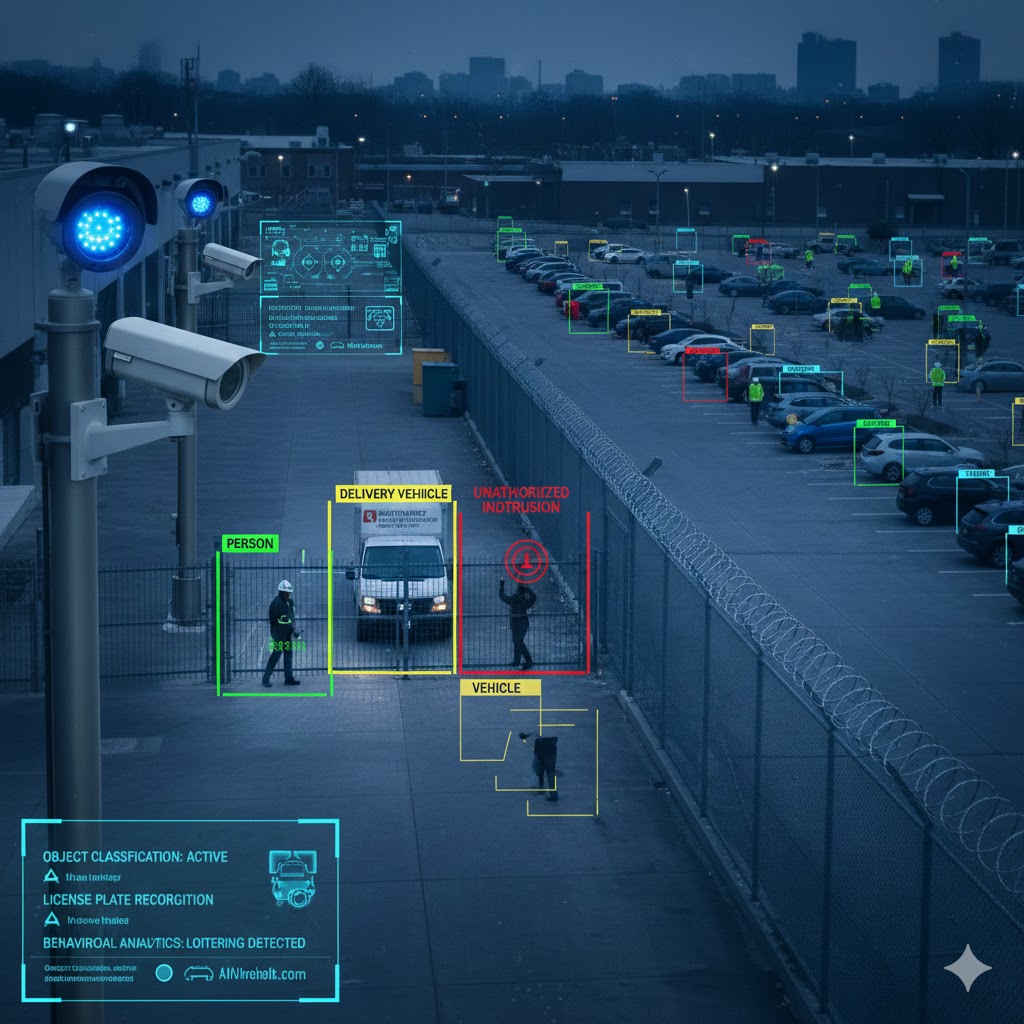
Start With the Event You Need to Detect
AI video surveillance is most useful when the operating question is clear. A business may need to distinguish people from vehicles, detect activity inside a defined area, identify a line crossing, flag extended presence, count movement, or find recorded events faster. Capabilities vary by camera, recorder, analytics platform, licensing, and scene.
Northeast Remote Surveillance and Alarm, LLC evaluates the property, camera views, network, recording system, response plan, and existing equipment before recommending an AI upgrade. The goal is a practical improvement—not an “AI” label added to an unsuitable system.
Common Commercial Analytics Uses
- Person or vehicle activity in a defined yard, entrance, dock, parking, or perimeter area
- Virtual-line crossing at gates, fence lines, driveways, restricted approaches, or after-hours zones
- Time-in-area or loitering events where supported and appropriate
- Vehicle or people counting for selected operational questions
- Faster recorded-video search using object type, time, location, or other supported attributes
- Events that trigger recording, notifications, audio messages, or operator review when the platform supports the workflow
Current manufacturer guidance confirms that analytics performance depends on mounting, scene, image quality, object visibility, distance, and configuration. Every event rule should be tested in the real environment.
Four Ways to Modernize a Legacy Camera System
- Keep compatible cameras and upgrade the recorder or server. Suitable existing streams may gain centralized analytics, search, alerts, and better administration.
- Add analytics-ready cameras only at critical views. Entrances, gates, docks, yards, or restricted approaches can be upgraded while usable general-coverage cameras remain.
- Use a phased hybrid design. Analog or older IP devices may be retained temporarily through compatible encoders, hybrid recorders, or bridges while priority areas move to modern equipment.
- Use cloud or hybrid management where it fits. This can support remote administration and multi-site access when bandwidth, cybersecurity, retention, ownership, licensing, and privacy requirements are suitable.
Decide Which Cameras Are Worth Keeping
An existing camera should be retained only when it supports the required view and remains manageable. We review image detail, lens and placement, low-light performance, resolution, frame rate, codec, stream stability, firmware status, credentials, ownership, mounting condition, network capacity, power, recording compatibility, and manufacturer support.
A recorder upgrade cannot recover detail the camera never captured. Poor angle, backlighting, distance, obstructions, unstable connectivity, or weak nighttime performance may require camera repositioning or replacement.
Plan Alerts Around a Real Response
An alert has value only when the right person receives it and knows what to do.
Each rule should identify the protected area, active schedule, target object or behavior, verification method, recipient, escalation path, recording action, and expected response.
For selected exterior events, remote video monitoring and live talk-down may provide operator review and defined escalation.
Understand Analytics Limitations
Video analytics can miss events or create unwanted alerts. Rain, snow, shadows, glare, insects, vegetation, headlights, crowding, occlusion, camera movement, low contrast, and poor configuration can affect performance. Analytics should supplement appropriate lighting, physical security, alarms, access control, staff procedures, and human judgment.
Privacy, audio recording, retention, user access, cybersecurity, workplace policy, and regulatory requirements should be reviewed before deployment.
For safety-related applications, see AI video analytics and workplace safety.
Build the Infrastructure for Reliable Video
Analytics increase the importance of stable video streams, accurate time, predictable bandwidth, sufficient storage, secure accounts, documented licenses, resilient power, and serviceable networks. A modernization plan may include PoE switching, structured cabling, fiber, wireless links, recorder or server changes, storage expansion, network segmentation, backup power, and remote-access controls.
Learn more about commercial security infrastructure planning and commercial security system upgrades.
Frequently Asked Questions
Can AI be added without replacing every camera?
Often. Compatible existing cameras may work with an upgraded recorder, server, appliance, or hybrid platform. Each stream and use case must be evaluated.
Will AI eliminate false alarms?
No. Object classification and well-designed rules can reduce some unwanted events, but scene conditions, configuration, and system limitations still matter.
Does every camera need analytics?
No. Analytics should be used where a defined event, search, count, or response creates operational value. General recording may be sufficient elsewhere.
Can an AI upgrade be completed in phases?
Yes. Critical views, failing recorders, account ownership, network gaps, or urgent alerting needs can be addressed first while preserving an expansion plan.
Request an AI Video Upgrade Assessment
NERSA can evaluate existing cameras, recording, network capacity, coverage, ownership, analytics opportunities, and replacement priorities for commercial and industrial properties across our service area.
Request a commercial security assessment.
Compliance, Codes & Project Standards
NERSA plans commercial and industrial security work with applicable code, documentation, inspection and authority-having-jurisdiction requirements in mind. Requirements vary by system, property and jurisdiction. These resources support project planning; they do not establish legal compliance, certification or AHJ approval.
Related guidance: Regulatory compliance & inspection readiness · Video surveillance compliance · NERSA project standards