Use AI video analytics to identify defined workplace conditions and support incident review within a broader facility safety program.
Request a Commercial Security Assessment
AI video tools can help staff spot selected safety conditions at work. They can also make events easier to review across factories, warehouses, loading docks, and maintenance areas.
Northeast Remote Surveillance and Alarm, LLC (NERSA) designs and installs commercial video systems. Supported AI tools can flag defined events and send alerts. Staff do not have to watch every live camera view to receive those alerts.
NERSA supports projects from one safety-focused camera at a small business to systems across several buildings. We also work with large industrial sites and enterprise teams.
For complete camera-system planning involving coverage, recording, retention, image quality and broader surveillance requirements, visit Commercial & Industrial Video Surveillance Systems.
AI Video Analytics for Workplace Safety
Traditional video surveillance records activity within a facility.
AI tools can review selected camera views for objects, movement, or conditions you have chosen to detect. They add another source of information for staff.
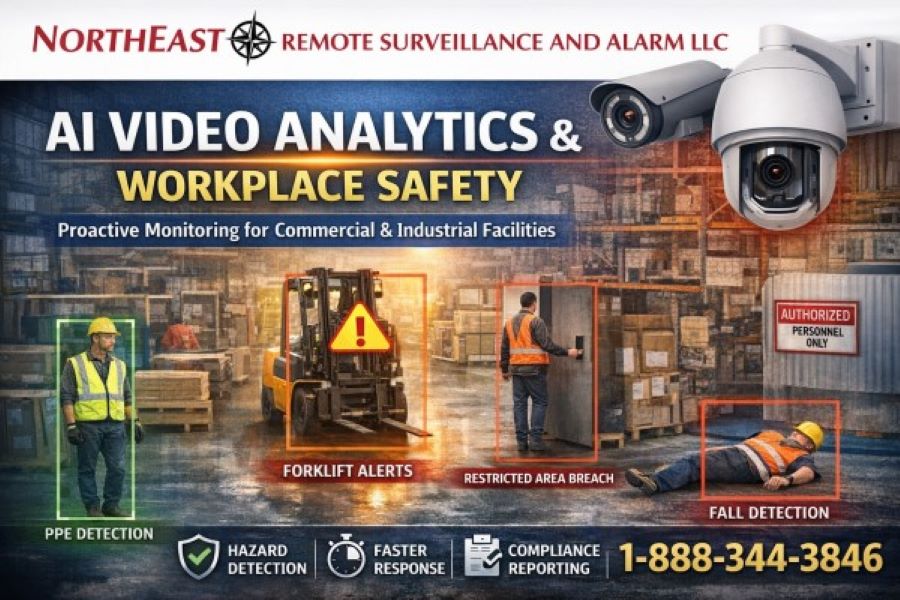
Depending on the platform, camera position and environment, safety-focused analytics may help identify:
- Missing visible personal protective equipment
- Forklift and pedestrian proximity
- Entry into restricted or hazardous zones
- Falls or possible man-down conditions
- Blocked pathways
- Recurring congestion
- Vehicle and pedestrian traffic conflicts
- Events requiring faster supervisor review
The purpose is not to replace employees, supervisors, safety personnel or established workplace-safety procedures.
These tools give staff another way to spot, review, and investigate selected conditions.
PPE Detection
It can be hard for staff to check protective equipment use across a large industrial site.
Some AI tools can help detect visible protective equipment as people enter a work area. This depends on the tool and a camera view that shows enough detail.
Applications may involve items such as:
- Hard hats
- High-visibility garments
- Protective eyewear
- Other visually distinguishable protective equipment supported by the analytic platform
Potential locations may include:
- Production-area entrances
- Warehouse transitions
- Manufacturing cells
- Maintenance corridors
- Loading areas
- Other defined operational zones
Camera placement matters significantly.
A distant overview camera may provide excellent general surveillance while being poorly suited for identifying PPE.
Plan the camera around the protective equipment you need to see. An existing wide view may not show enough detail for the AI tool.
Forklift and Pedestrian Safety Analytics
Forklifts and pedestrians frequently share space in warehouses, manufacturing facilities, distribution centers and loading areas.
Video tools may help staff review areas where forklifts and people often cross paths.
Potential applications include:
- Warehouse aisle intersections
- Pedestrian crossings
- Loading-dock approaches
- Shipping and receiving areas
- Staging zones
- Material-handling areas
- Blind corners
- Production traffic lanes
Supported tools may flag close approaches between vehicles and people. They can also help staff find areas where these events happen often.
The greatest value may come from recognizing patterns over time.
Repeated close approaches at one crossing may point to an area worth reviewing. Recorded events can help facility staff assess traffic routes, barriers, signs, and work procedures.
The video system provides visibility and evidence. Safety decisions remain with the appropriate facility personnel.
Restricted-Area and Hazard-Zone Detection
Commercial and industrial facilities often contain areas where pedestrian activity should be limited or unexpected.
AI video analytics can be configured around defined zones where person detection may warrant attention.
Applications may include:
- Robotic work cells
- Machinery operating zones
- Equipment yards
- Maintenance areas
- Chemical storage locations
- Loading-dock vehicle lanes
- Roof-access points
- Elevated-access areas
- Other restricted operational zones
Detection areas should be intentionally defined around actual facility conditions.
Extremely broad zones can generate unnecessary alerts and make meaningful events harder to recognize.
A stronger design begins with a specific operational question:
What event does the facility need greater visibility into?
The camera view, analytic rule and notification process can then be designed around that condition.
Fall and Possible Man-Down Detection
Some video analytics platforms can identify visual conditions that may be consistent with a person falling or remaining prone.
This capability may be useful in selected environments such as:
- Isolated work areas
- Maintenance spaces
- Warehouses
- Utility areas
- Production environments
- Low-traffic interior areas
- Selected exterior locations
Performance depends heavily on the scene.
Camera angle, distance, lighting, obstructions, machinery movement and normal employee activity can all affect analytic performance.
Treat fall and man-down alerts as an added source of information. They do not replace required emergency procedures, staff supervision, emergency communications, or dedicated life-safety systems.
Camera Engineering Determines Analytic Performance
AI analytics begins with the camera image.
An analytic engine cannot reliably evaluate information the camera cannot clearly see.
Important design factors may include:
- Camera height
- Viewing angle
- Lens selection
- Subject size within the image
- Lighting
- Shadows
- Glare
- Backlighting
- Camera stability
- Environmental conditions
- Obstructions
- Overlapping people or equipment
A camera mounted high above a warehouse may be excellent for broad situational awareness while being unsuitable for detailed PPE identification.
A camera monitoring a defined pedestrian crossing may require a very different field of view.
Analytics should therefore be engineered around the specific event being detected, not simply enabled across every available camera.
Turning Detection Into a Useful Alert
An analytic event has limited value if nobody knows what should happen after it occurs.
The notification and response workflow should be considered with the analytic design.
Depending on the application, a supported event may generate:
- Mobile notification
- Desktop alert
- Video-management-system event
- Automatic display of the associated camera
- Recorded event bookmark
- Local audible or visual notification
- Escalation to designated personnel
Not every event requires the same response.
A recurring informational event should not necessarily create the same notification as entry into a defined hazardous area.
Thoughtful alert design can reduce unnecessary notifications while making important events easier to recognize.
Testing and Tuning Safety Analytics
Commercial and industrial environments change.
Lighting varies throughout the day. Equipment moves. Production layouts change. Stored materials can obstruct views. Exterior conditions shift with the seasons. Employees use spaces differently over time.
Analytics should therefore be reviewed and adjusted when operating conditions change.
Evaluation may include:
- False alerts
- Missed events
- Detection-zone placement
- Sensitivity
- Object size
- Schedules
- Notification rules
- Changes in the physical environment
A rule aimed at one useful event is often better than a broad rule that sends too many alerts.
Incident and Near-Miss Review
Safety-focused analytics can also make relevant recorded video easier to locate.
Instead of manually reviewing long periods of footage, authorized personnel may be able to locate events associated with defined analytic conditions.
Recorded video can support:
- Incident investigation
- Near-miss review
- Safety training
- Operational evaluation
- Review of recurring hazards
- Traffic-pattern analysis
- Verification of event sequences
Video can provide context around what occurred before, during and after an event.
That information may help facility personnel better understand actual conditions surrounding an incident or recurring operational concern.
For broader information about workplace safety and electronic security planning, visit OSHA and Electronic Security Systems.
Understanding the Limits of AI Video Analytics
AI video analytics can improve awareness, but no analytic should be represented as infallible.
Performance can be affected by:
- Poor lighting
- Severe glare
- Backlighting
- Weather
- Shadows
- Camera vibration
- Heavy congestion
- Blocked views
- Small subject size
- Changing scene conditions
- Poorly defined detection zones
- Improper sensitivity settings
Analytics should be deployed with realistic expectations.
The strongest implementations combine appropriate camera selection, useful image quality, carefully defined detection rules, testing and a clear response process.
Small Business Through Enterprise Safety Analytics
Workplace-safety analytics can be useful at very different scales.
A small industrial business may need one camera focused on a PPE transition point or restricted workspace.
A warehouse may use analytics at a forklift intersection and loading area.
A manufacturing facility may require several defined safety zones across production and material-handling spaces.
A multi-building campus may use different analytics based on the operating conditions within each facility.
A large organization may use the same types of AI tools at several sites. Each site still needs rules and response steps that fit its work.
The scale changes, but the design principle remains the same:
Identify the workplace condition that needs greater visibility, then engineer the camera, analytic and response workflow around that objective.
NERSA supports small-business applications through multi-camera, multi-building, campus and enterprise environments.
Practical Applications for Commercial and Industrial Facilities
AI workplace-safety analytics may be appropriate when a facility has a clearly defined visual condition that is difficult to observe consistently.
Examples can include:
- PPE transition points
- Forklift and pedestrian intersections
- Restricted work zones
- High-risk operational areas
- Isolated employee locations
- Recurring congestion points
- Areas associated with previous near misses
Not every facility needs every available analytic.
The strongest project usually begins with one clearly defined operational concern rather than a list of AI features.
Camera position, image quality, detection rules, notification methods and response procedures can then be selected around the actual requirement.
Frequently Asked Questions
What are AI workplace-safety video analytics?
They are video analytics configured to identify selected visual conditions such as PPE presence, person entry into defined zones, forklift and pedestrian proximity or other supported safety-related events.
Can cameras detect missing PPE?
Some supported analytic platforms can identify visually distinguishable PPE under appropriate conditions. Performance depends on camera position, image quality, lighting and the specific analytic.
Can video analytics detect forklift and pedestrian conflicts?
Analytics may help identify proximity events or recurring traffic conflicts in selected areas where forklifts and pedestrians share space.
Can AI cameras monitor restricted areas?
Yes. Supported systems can use defined detection zones to identify people entering locations where pedestrian activity is restricted or unexpected.
Can AI video detect a person who has fallen?
Some platforms provide fall or possible man-down analytics. These functions should be evaluated carefully for the specific environment and should not replace required emergency or safety procedures.
Does every camera need workplace-safety analytics?
No. Analytics should be applied where there is a clearly defined condition worth detecting. Unnecessary analytics can create excessive alerts without providing useful information.
Do analytics need ongoing adjustment?
Often, yes. Lighting, layouts, equipment and activity patterns can change, so detection zones and rules may require periodic review.
Can AI video analytics replace workplace-safety personnel?
No. Analytics provide an additional layer of visual awareness. They do not replace supervisors, safety personnel, established procedures or required life-safety systems.
Request an AI Workplace Safety Analytics Assessment
NERSA can assess whether safety-focused video analytics are practical for your facility. Applications may include protective-equipment detection, forklift and pedestrian alerts, restricted-area detection, or fall and man-down alerts, depending on site conditions and system capabilities.
Start with the event your team needs to see more clearly. That goal should guide a single-camera project as well as a system used across many buildings.
Request a Commercial Security Assessment.
Small Business – Enterprise Scalable Solutions
Commercial & Industrial Systems Only • AI Video Analytics • Workplace Safety Visibility • Event Detection