
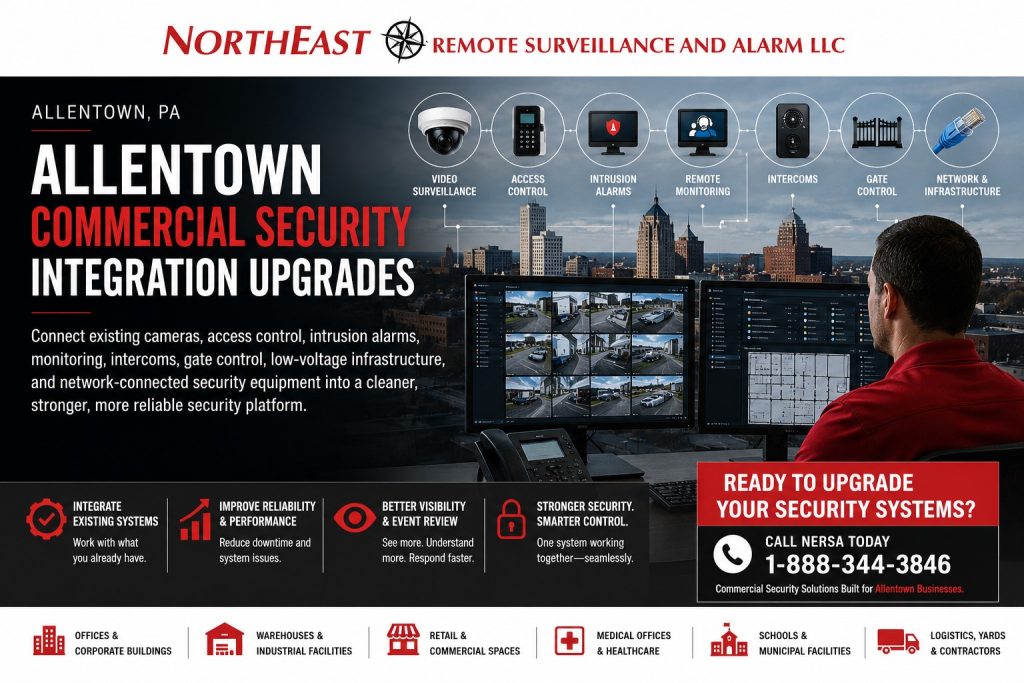
Allentown commercial security systems integration upgrades connect compatible cameras, access control, alarms, monitoring, intercoms, gates, and network tools around a defined operating need.

For broader project planning, start with our commercial security installation in Allentown, PA guide.
Place this decision within the wider integration plan using Allentown unified security systems.
Northeast Remote Surveillance and Alarm, LLC evaluates existing equipment and improves how supported systems share events, video, user actions, and alerts.
For equipment replacement and complete modernization, review Allentown Commercial Security System Upgrades and Retrofits.
For the cabling, fiber, power, and switching behind those integrations, review Allentown low-voltage infrastructure upgrades.
Projects can scale from one coordinated door and camera at a small business to common event workflows across an enterprise portfolio.
What a Security Integration Upgrade Does
Businesses often add security equipment over time. For example, a site may install cameras first, then add an alarm, access control, an intercom, or a gate system. Each system may work, yet staff may still use separate apps, accounts, event logs, and response steps.
An integration upgrade coordinates selected systems where the connection adds value. As a result, an access event may open the matching camera view. An alarm may also link to video from the affected area.
Signs Integration May Help
- Staff switch between several security apps
- Door events and camera footage are hard to match
- Alarm alerts lack useful location or video context
- User accounts and permissions differ across systems
- Device names are unclear or inconsistent
- Older equipment limits new workflows
- Staff repeat the same task in several platforms
However, not every system should connect. An added link should improve review, response, or administration. Otherwise, it can create needless complexity.
Event and Video Coordination
Useful integration starts with a specific event. For instance, a valid credential can call up the related entrance camera. A forced-door event can mark video for review. Likewise, an intrusion signal can link to a nearby camera or notify an approved contact.
Clear device names make these workflows easier to understand. Therefore, NERSA aligns door, zone, camera, and location labels before testing the connection. The final result should tell staff what happened and where it occurred.
Access Control, Alarms, Intercoms, and Gates
Access control may share door status, cardholder events, schedules, or alarms with a supported video platform. Intrusion systems may send selected events to video or monitoring tools. In addition, an intercom may connect a visitor call with a camera and a controlled door.
Gate systems may combine credentials, visitor entry, vehicle video, and position monitoring. However, each opening must still meet its safety, exit, and operating requirements. Integration should support those functions without hiding how the gate or door works.
Reuse and Compatibility
Existing cameras, panels, readers, recorders, sensors, and network devices may remain when they are reliable and supported. First, NERSA checks models, software versions, licenses, network paths, power, and available interfaces. We also confirm that the proposed workflow works with the installed equipment.
Some older products cannot share the required data. In that case, a limited gateway, recorder, controller, or software change may solve the problem. By contrast, unsupported or failing equipment may require replacement before integration.
Network Reliability and Secure Access
Connected security systems depend on stable power, networks, time settings, and account control. Therefore, the plan should define ports, addresses, remote access, backups, and technology ownership. Strong passwords and current software also reduce avoidable risk.
NERSA works with authorized customer technology contacts when coordination is required. In addition, we document device names, system links, approved users, and service responsibilities. Clear records support future testing and troubleshooting.
Phased Integration Upgrades
Integration can often proceed in stages. For example, a first phase may connect high-risk doors with video. A later phase may add alarm events, visitor entry, gates, or more locations.
Each phase should deliver a useful result and preserve a clear path forward. Meanwhile, testing should confirm event timing, camera selection, notifications, permissions, and failure behavior. Staff should also understand how to use the new workflow.
Integration Upgrade or Unified Platform?
An integration upgrade improves coordination among compatible systems already in place.
A unified platform may place several security functions under one administration and interface.
To compare a full-platform approach, review Unified Security Systems in Allentown, PA.
For citywide cameras, access control, alarms, monitoring, and related services, review Commercial Security Systems in Allentown, PA.
Security Integration FAQs
Does integration require replacing every system?
No. Compatible and reliable equipment may remain. However, unsupported parts may limit the available workflow.
Can camera and access events work together?
Often, yes. A supported setup can link a door event with the related live or recorded camera view.
Can integration be phased?
Yes. A business can begin with the highest-value event and add other systems or sites later.
Should every security system connect?
No. Each connection should solve a defined problem and remain clear enough for staff to operate and support.
Request an Integration Upgrade Assessment
Northeast Remote Surveillance and Alarm, LLC will map the installed systems, identify the coordination problem, and test practical options. Afterward, the recommendation will explain what to reuse, connect, replace, or leave independent.
Request a security assessment for commercial security integration upgrades in Allentown.
Compliance, Codes & Project Standards
NERSA plans commercial and industrial security work with applicable code, documentation, inspection and authority-having-jurisdiction requirements in mind. Requirements vary by system, property and jurisdiction. These resources support project planning; they do not establish legal compliance, certification or AHJ approval.
Related guidance: Regulatory compliance & inspection readiness · NERSA project standards · Documentation, testing & inspection readiness