Bethlehem Healthcare Security Systems

Integrated Protection for Patients, Staff, Visitors, Property, and Daily Operations

Healthcare facilities must remain welcoming and accessible while maintaining control over employee entrances, restricted rooms, medication and supply areas, records, technology spaces, parking areas, and after-hours activity.

Northeast Remote Surveillance and Alarm, LLC designs, installs, monitors, upgrades, integrates, and supports commercial security systems for medical offices, outpatient facilities, healthcare buildings, laboratories, pharmacies, administrative properties, and multi-location healthcare organizations throughout Bethlehem, Pennsylvania and the surrounding Lehigh Valley.

NERSA works exclusively in non-residential environments and plans each system around the facility, its users, operating hours, existing infrastructure, security concerns, and long-term requirements. (Northeast Remote Surveillance)

REQUEST A COMMERCIAL SECURITY ASSESSMENT

Call 1-888-344-3846

Commercial systems only • New installations • Upgrades • Retrofits • Takeovers

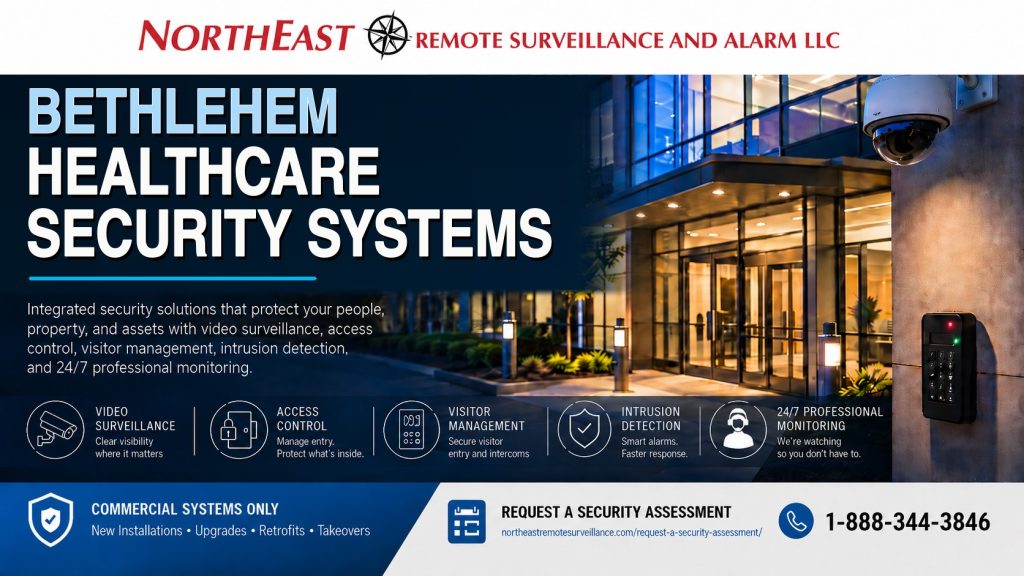
Modern Bethlehem healthcare facility protected by NERSA video surveillance, access control, intrusion detection, and 24/7 monitoring.

Healthcare Security Designed Around Your Facility

A healthcare property should not be secured with a generic camera-and-alarm package.

Medical facilities may include public entrances, employee-only doors, waiting areas, reception desks, clinical departments, administrative offices, records rooms, laboratories, medication storage, supply areas, delivery entrances, parking lots, and restricted technology spaces. Each area can have different visibility, access, alarm, privacy, and response requirements.

NERSA uses an assessment-first security planning process to review:

  • Patient, visitor, employee, vendor, and contractor movement
  • Public, employee-only, and after-hours entrances
  • Restricted clinical, administrative, medication, records, and technology areas
  • Parking lots, sidewalks, building exteriors, and delivery approaches
  • Existing cameras, alarms, controlled doors, networks, and cabling
  • Panic, duress, notification, and monitoring requirements
  • Privacy-sensitive conditions and user permissions
  • Emergency egress and life-safety coordination
  • Documentation, future expansion, and multi-location management

The objective is to create a practical security environment that improves visibility, controls access, documents important activity, and remains understandable and manageable after installation. (Northeast Remote Surveillance)


Commercial Video Surveillance for Healthcare Facilities

Properly designed commercial video surveillance systems can improve visibility around entrances, reception approaches, employee doors, corridors, parking areas, delivery points, building exteriors, and other appropriate operational areas.

A healthcare video-surveillance system may provide:

  • Live and recorded video
  • Entrance and exit documentation
  • Parking-area and exterior visibility
  • Remote access for authorized users
  • Searchable event and incident review
  • Video verification of alarm activity
  • Role-based user permissions
  • Local, cloud-managed, or hybrid recording
  • Centralized management for multiple locations
  • Integration with access control, alarms, and intercoms

Camera placement should be based on what the organization needs to see and document. An entrance identification view, parking-area overview, hallway camera, and exterior approach camera require different lenses, angles, mounting heights, lighting, and recording settings.

Healthcare properties also require privacy-aware planning. Camera placement should be limited to appropriate security and operational areas and reviewed against the organization’s policies, privacy responsibilities, and qualified legal or compliance guidance where necessary. (Northeast Remote Surveillance)


Access Control for Employees and Restricted Areas

Commercial access control systems help healthcare organizations determine who may enter a controlled area, when access is permitted, and how entry activity is documented.

Access control may be used for:

  • Employee entrances
  • Administrative departments
  • Records rooms
  • Medication and supply storage
  • Laboratories
  • Technology and network rooms
  • Equipment areas
  • Building-management spaces
  • Restricted interior departments
  • After-hours entrances
  • Multi-tenant healthcare suites

Employees may use keycards, key fobs, mobile credentials, PINs, or other approved credentials. Permissions can be assigned according to job responsibility, department, location, and schedule.

When an employee leaves the organization or changes responsibilities, access can be updated without rekeying every affected door. Authorized administrators may also review access history, identify forced or held-open doors, and investigate relevant entry events.

A complete access-control design includes more than a reader. Door hardware, controllers, locking devices, request-to-exit equipment, door contacts, power supplies, network connections, accessibility, emergency egress, and administrator permissions must work together as one dependable opening. (Northeast Remote Surveillance)


Visitor Management and Controlled Entry

Healthcare facilities regularly receive patients, family members, vendors, contractors, delivery personnel, inspectors, and service providers. A structured entry process can improve awareness without creating unnecessary difficulty for authorized visitors.

Visitor management systems may support:

  • Visitor pre-registration
  • Digital check-in and check-out
  • Temporary badges or credentials
  • Host and employee notification
  • Visitor and contractor classification
  • Time-stamped entry records
  • Access-control integration
  • Location or department restrictions
  • Automatic credential expiration
  • Documented visitor policies and acknowledgements

A smaller medical office may need controlled front-door entry and staff notification. A larger healthcare property may require registration kiosks, temporary credentials, contractor tracking, department-specific permissions, and centralized administration.

Visitor information should be managed according to the healthcare organization’s approved privacy, retention, and administrative policies. (Northeast Remote Surveillance)


Video Intercom and Entry Communication

A commercial video intercom system can help employees see and communicate with a visitor before granting access through a controlled door.

Intercoms may be installed at:

  • Main public entrances
  • Employee entrances
  • After-hours doors
  • Delivery and service entrances
  • Administrative entrances
  • Controlled lobbies
  • Parking garages
  • Gates or separate support buildings
  • Restricted departments

Depending on the selected platform, authorized employees may see the visitor, speak with the visitor, confirm the reason for entry, and release the door from a reception desk, security station, approved mobile device, or remote office.

Intercom activity may also be coordinated with cameras and access control so visitor communication, door activity, entry decisions, and recorded video support the same security workflow. (Northeast Remote Surveillance)


Intrusion Detection and After-Hours Protection

Healthcare buildings still require dependable protection when they are closed, lightly staffed, or operating with a reduced overnight workforce.

Commercial intrusion alarm systems may protect:

  • Exterior entrances
  • Rear and service doors
  • Windows and vulnerable openings
  • Interior corridors
  • Administrative offices
  • Records and storage rooms
  • Medication or supply areas
  • Technology rooms
  • Detached support spaces
  • Other designated after-hours zones

A system may include door contacts, motion detectors, glass-break detection, alarm partitions, individual user codes, remote notifications, communication-path supervision, and professionally monitored response.

Alarm zones and schedules should reflect how the facility operates. A department that closes during the afternoon may require different protection from an area that remains occupied into the evening. Proper planning allows designated areas to be protected without unnecessarily disrupting authorized activity. (Northeast Remote Surveillance)


Panic and Duress Devices

Panic or duress devices can give employees a direct way to initiate an alert during a threatening or urgent situation.

Potential locations may include:

  • Reception and check-in desks
  • Administrative offices
  • Consultation areas
  • Cash-handling locations
  • Pharmacy or medication areas
  • Staff workstations
  • Other employee-designated locations

Panic and duress systems should be designed around a documented response plan. The plan should establish who receives the alert, how the event location is identified, whether the activation is silent or audible, how monitoring personnel respond, and what employees are expected to do.

Technology should support employee training and emergency procedures rather than replace them.


24/7 Professional Security Monitoring

Commercial security monitoring adds a structured response layer when a healthcare building is closed, lightly staffed, or operating outside regular hours.

Depending on the system and approved monitoring plan, monitored events may include:

  • Intrusion alarm signals
  • Panic or duress alerts
  • Communication-path failures
  • Environmental conditions
  • Water-leak or temperature-related alerts
  • Video verification
  • Forced-door or held-open-door events
  • Defined responsible-party notifications
  • Customized escalation procedures

When an approved signal is received, trained monitoring personnel can follow the response instructions established for the facility.

Healthcare support areas containing temperature-sensitive materials, technology equipment, mechanical systems, or other critical assets may also benefit from environmental monitoring when appropriate. Monitoring requirements should be determined during the facility assessment rather than added as a generic package. (Northeast Remote Surveillance)


Remote Video Monitoring and Event Verification

Some healthcare properties require more than recorded surveillance.

Remote video monitoring and live talk-down may be considered for parking areas, building exteriors, delivery entrances, equipment areas, separate buildings, or locations experiencing repeated after-hours activity.

A monitored-video system may combine cameras, analytics, event-based alerts, operator review, video verification, responsible-party notification, documented escalation, and live speaker warnings where appropriate.

Remote monitoring is different from basic remote viewing. Remote viewing allows an authorized user to open an application and look at cameras. Monitored video is organized around alerts, event review, verification, escalation, and response.

Not every healthcare property requires live monitored video. Its suitability depends on exterior exposure, lighting, camera placement, network reliability, after-hours activity, response expectations, and facility policies. (Northeast Remote Surveillance)


Integrated Healthcare Security Systems

Security systems are more useful when they support the same operating objective.

NERSA can design unified and integrated security systems that coordinate compatible cameras, access control, alarms, intercoms, monitoring, analytics, and event reporting.

Integration may allow:

  • A door-access event to be reviewed with recorded video
  • A forced-door alert to display the nearest camera
  • An intrusion event to receive video verification
  • An intercom call to support authorized remote door release
  • A visitor credential to expire automatically
  • A panic event to be associated with nearby video
  • Several healthcare properties to use a more consistent management platform
  • Authorized administrators to investigate events without switching among disconnected systems

The purpose is not to connect every device simply because integration is technically possible. Each connection should improve visibility, administration, documentation, communication, or response. (Northeast Remote Surveillance)


Fire Alarm and Life-Safety Coordination

Healthcare security planning may also intersect with fire alarm operation, emergency egress, access-controlled door release, notification systems, monitoring communication, and other life-safety functions.

NERSA provides commercial fire alarm and life-safety installation for qualifying non-residential properties.

Fire alarm and security systems can be coordinated, but they are not interchangeable. Fire alarm equipment is regulated life-safety infrastructure and must retain priority over security functions. Access-controlled doors, emergency releases, monitoring paths, and system interfaces should be planned around applicable requirements and the responsible Authority Having Jurisdiction. (Northeast Remote Surveillance)


Security-System Upgrades, Retrofits, and Takeovers

An aging or inherited healthcare security system does not always need to be removed completely.

NERSA provides commercial security-system upgrades, retrofits, and takeovers for facilities with unsupported, poorly documented, outdated, or underperforming systems.

An existing-system assessment may determine:

  • What equipment is installed
  • Which components remain usable
  • Whether recorded video provides sufficient detail
  • Whether users and credentials require cleanup
  • Whether controlled doors and locking hardware operate properly
  • Whether alarm zones are clearly labeled
  • Whether monitoring paths and account contacts are current
  • Whether cabling and network equipment can support expansion
  • Which equipment is obsolete or unsupported
  • Which improvements should be completed first
  • Whether modernization can be completed in phases

Where practical, compatible and serviceable components may be retained. Outdated, unreliable, insecure, or unsupported equipment can then be replaced according to priority instead of assuming the entire system must be discarded. (Northeast Remote Surveillance)


Bethlehem Healthcare Properties NERSA Can Support

Healthcare security systems may be designed for:

  • Medical and physician offices
  • Dental and orthodontic practices
  • Urgent-care facilities
  • Outpatient clinics
  • Specialty medical practices
  • Pharmacies
  • Diagnostic and medical laboratories
  • Rehabilitation and therapy centers
  • Healthcare administration buildings
  • Medical office complexes
  • Equipment and supply facilities
  • Multi-tenant healthcare properties
  • Multi-location medical organizations

The correct security plan depends on the property, services provided, number of employees and visitors, operating hours, restricted areas, existing equipment, and long-term administration requirements. NERSA’s broader Industries We Serve resource explains its commercial, healthcare, institutional, office, industrial, warehouse, and multi-site focus. (Northeast Remote Surveillance)


Why Bethlehem Healthcare Organizations Choose NERSA

Commercial and Non-Residential Focus

NERSA works exclusively with commercial, industrial, institutional, municipal, healthcare, educational, warehouse, manufacturing, and other non-residential properties.

Local Bethlehem Presence

Northeast Remote Surveillance and Alarm, LLC is based in Bethlehem and supports commercial facilities throughout the Lehigh Valley and selected Pennsylvania and Mid-Atlantic markets.

Assessment-First Planning

Recommendations begin with the facility, its users, operating conditions, existing systems, infrastructure, and actual security requirements—not a predetermined equipment package.

Integrated Capabilities

Video surveillance, access control, intrusion alarms, visitor management, intercoms, monitoring, fire alarm coordination, and supporting infrastructure can be considered under one planning approach.

New and Existing Systems

NERSA supports new installations, expansions, equipment upgrades, retrofits, phased modernization, and qualifying system takeovers.

Long-Term Administration

System planning considers employee turnover, credential management, camera naming, alarm-zone documentation, remote access, user permissions, future expansion, customer control, and ongoing serviceability. (Northeast Remote Surveillance)


Frequently Asked Questions

What security systems do Bethlehem healthcare facilities commonly need?

The appropriate system depends on the building, patient and visitor traffic, employee schedules, restricted areas, existing equipment, and after-hours exposure. Common components include video surveillance, access control, visitor entry, intercoms, intrusion detection, panic or duress devices, and professional monitoring.

Can NERSA upgrade an existing healthcare security system?

Yes. NERSA can evaluate existing cameras, recording equipment, access control, alarm devices, monitoring paths, network infrastructure, credentials, users, and documentation to determine what can be retained, repaired, upgraded, integrated, or replaced.

Can access control manage different departments and schedules?

Yes. Access permissions may be organized according to employee role, department, location, and schedule. Available options depend on the selected platform, door hardware, system configuration, and administrative requirements.

Can authorized employees view cameras remotely?

Remote access may be included when appropriate. Access should be restricted to approved users and devices and configured according to the organization’s policies, cybersecurity expectations, and system design.

Can visitor management work with access control?

Compatible visitor-management and access-control platforms may be integrated so approved visitors receive temporary credentials, scheduled access, restricted permissions, and automatic expiration.

Does NERSA install systems in operating healthcare facilities?

Retrofit and upgrade work can be planned around operating conditions. Scheduling, work areas, access requirements, noise, patient traffic, and other site conditions should be reviewed before installation begins.

Does NERSA provide residential security systems?

No. Northeast Remote Surveillance and Alarm, LLC focuses on commercial and other non-residential security environments.

Does installing a security system guarantee regulatory compliance?

No. Cameras, access control, alarms, visitor-management systems, and monitoring services do not independently establish or guarantee regulatory compliance. They can support physical security, access management, documentation, incident review, and response procedures.

Healthcare organizations should evaluate legal, privacy, regulatory, life-safety, and organizational requirements with their qualified advisers and responsible authorities. NERSA’s Regulatory and Compliance Hub provides additional commercial security and life-safety planning information. (Northeast Remote Surveillance)


Request a Bethlehem Healthcare Security Assessment

Online information can explain cameras, access control, alarms, visitor management, intercoms, and monitoring, but it cannot determine the complete requirements of a specific healthcare property.

A NERSA assessment may review the facility layout, public and employee entrances, visitor procedures, parking areas, restricted rooms, camera visibility, controlled doors, alarm protection, panic-device requirements, monitoring procedures, network infrastructure, life-safety interfaces, documentation, and future expansion plans.

After reviewing the property, NERSA can recommend a practical path for a new installation, system upgrade, retrofit, phased modernization, or qualifying takeover.

REQUEST A COMMERCIAL SECURITY ASSESSMENT

CONTACT NORTHEAST REMOTE SURVEILLANCE AND ALARM, LLC

Call 1-888-344-3846


Scroll to Top
1-888-344-3846