
Plan commercial intercoms around who calls, who answers, and how authorized staff communicate before releasing a visitor entrance, loading-area door, or vehicle gate.

Request a Commercial Intercom System Assessment
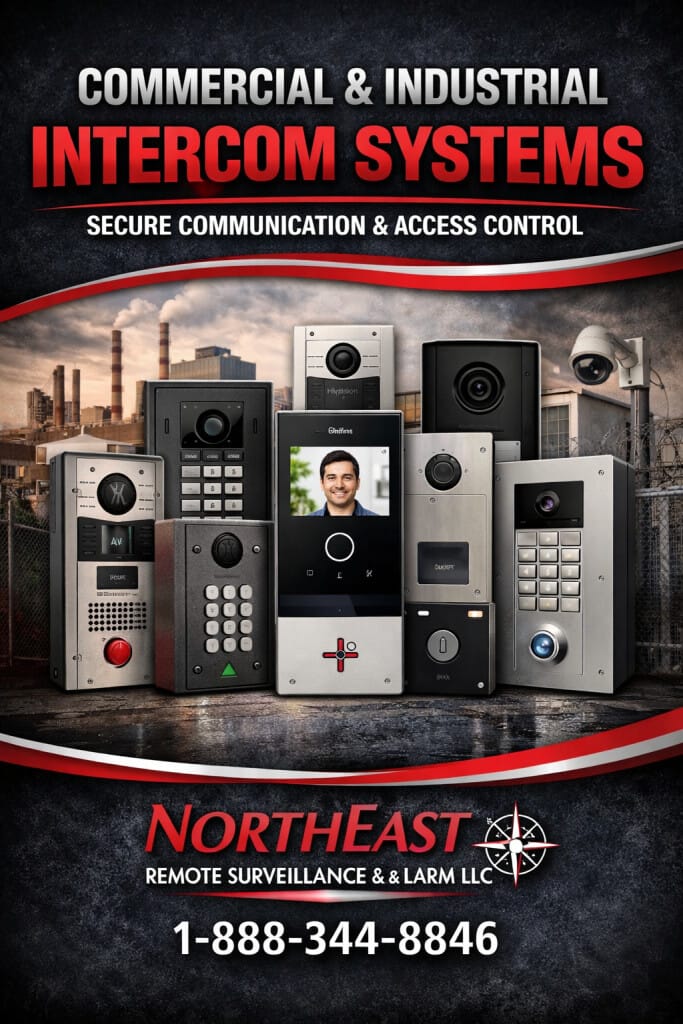
Intercom Services by Location and Application
Choose a local service guide or review how visitor entry connects intercoms and access control.
- Lehigh Valley intercom and visitor-entry systems — coordinate communication across regional properties.
- Allentown commercial intercom and paging — plan staff, visitor, and facility communication.
- Easton intercom and paging systems — explore local entry and communication options.
- Visitor entry, intercom, and access-control planning — define who answers, verifies visitors, and authorizes entry.
Northeast Remote Surveillance and Alarm, LLC (NERSA) designs and installs commercial intercoms for qualifying properties. These include warehouses, manufacturers, logistics sites, industrial parks, contractor facilities and offices. We also serve municipal buildings, schools, healthcare facilities, business parks and multi-tenant commercial properties.
A properly designed intercom system should begin with:
- Who needs to communicate
- Where the call originates
- Who should answer it
- Whether access may be released
- Which users are authorized to release the opening
- What should happen when the normal answering position is unavailable
The system should support the property’s operating procedure rather than forcing employees to work around the technology.
For broader commercial-security planning, visit Commercial & Industrial Security Services.
Commercial and Industrial Systems Only • Visitor Entry • Loading Docks • Vehicle Gates • Multi-Tenant Properties • Remote Answering • New Installations • Upgrades
Commercial Intercom Systems for Controlled Entry
A commercial intercom is more than a doorbell or wall-mounted speaker.
It creates a communication point between the person requesting entry and the employees, reception personnel, security staff, facility managers or other authorized users responsible for deciding what should happen next.
Common applications may include:
- Main visitor entrances
- Employee entrances
- Reception areas
- Security vestibules
- Warehouse entrances
- Loading docks
- Shipping and receiving
- Dispatch entrances
- Vehicle gates
- Parking-garage entrances
- Tenant entrances
- Restricted areas
- Remote buildings
The intercom should support a clearly defined entry procedure.
Visitor Verification
For properties with several entry points, use the visitor, intercom, and access-workflow integration guide to define answering and release responsibilities.
Local planning resources cover Wilkes-Barre visitor entry and Pittston visitor entry.
Many commercial intercom systems include video so authorized personnel can see and communicate with the person requesting access.
Depending on the system, visitor interaction may include:
- Two-way audio
- Video verification
- Call history
- Time stamps
- Remote answering
- Approved door release
- Approved gate release
- Event documentation
The intercom should support the organization’s visitor procedures rather than replace them.
Employees should still determine whether a visitor, vendor, contractor, delivery driver or other caller is authorized to enter.
For facilities that need digital check-in, visitor records, temporary credentials or more formal visitor workflows, visit Enterprise Visitor Management Systems.
Commercial Door Communication
Intercoms can be used where staff need to communicate with a person before releasing a controlled entrance.
Applications may include:
- Main entrances
- Employee doors
- Shipping entrances
- Warehouse doors
- Tenant entrances
- Service entrances
- Restricted-area doors
Door release should only be available to properly authorized users.
For credential management, permissions, schedules and controlled entry, visit Commercial & Industrial Access Control Systems.
Vehicle Gate Communication
Vehicle gates often require communication before entry is granted to drivers, visitors, vendors or contractors.
Gate intercom planning may need to consider:
- Driver positioning
- Call-station location
- Vehicle approach
- Audio quality
- Camera visibility
- Gate release
- Emergency access
- Remote answering
- Network connectivity
- Environmental exposure
Intercom communication is only one part of a complete vehicle-entry system.
For dedicated gate planning, visit Commercial Gate Access Control Systems.
Loading Dock and Warehouse Communication
Warehouses and industrial properties may require communication between drivers, receiving personnel, dispatch offices, supervisors and facility staff before a delivery entrance or controlled area is accessed.
Intercom locations may include:
- Dock offices
- Receiving doors
- Shipping areas
- Employee entrances
- Dispatch points
- Driver entrances
- Controlled warehouse doors
The system should support the facility’s workflow without weakening control over restricted entrances.
Remote Answering
Commercial properties do not always have one receptionist or guard continuously positioned at a desk.
Compatible intercom systems may allow calls to be routed to:
- Reception personnel
- Security offices
- Facility managers
- Desktop applications
- Mobile users
- Remote staff
- Other approved answering positions
Remote answering should use appropriate authentication and permissions.
The organization should also define what happens when:
- The primary recipient does not answer
- A call occurs after hours
- The responsible employee is unavailable
- The caller is not expected
- The entrance should remain secured
Multi-Tenant Commercial Properties
Multi-tenant properties may need intercom systems that route callers to the correct tenant, department, property manager or security personnel.
Planning should establish:
- Who receives each call
- Which tenant controls which entrance
- Who may release common doors
- How tenant changes are managed
- Which users receive administrator access
- What happens after normal business hours
- How property management retains control of common infrastructure
One tenant should not automatically receive unnecessary control over another tenant’s entrances, users, calls or security functions.
Industrial Environment Considerations
Industrial intercom equipment may be exposed to conditions that do not exist at a typical office entrance.
These may include:
- Weather
- Dust
- Moisture
- Temperature changes
- Vibration
- Vehicle traffic
- Forklift traffic
- Impact
- Electrical interference
- Heavy daily use
- Remote outdoor locations
Equipment selection, mounting, power, cabling, network design and enclosure protection should reflect the actual environment.
IP and Network Infrastructure
Modern commercial intercom systems may rely on IP networking, PoE, software, mobile applications, cloud services or local servers.
Infrastructure planning may need to consider:
- Structured cabling
- PoE capacity
- Network switching
- Network segmentation
- Bandwidth
- Firewalls
- Remote connectivity
- Equipment locations
- Backup power
- Device security
- Administrator ownership
An intercom should not simply be connected to whatever network port happens to be available.
The supporting network should be appropriate for dependable commercial operation and long-term service.
For broader infrastructure planning, visit Commercial & Industrial Infrastructure and Cabling.
Intercoms and Video Surveillance
Video can provide additional context around entrances, gates, docks and visitor interactions.
Compatible systems may provide:
- Built-in intercom video
- Nearby camera views
- Recorded entrance activity
- Additional gate or loading-area context
For broader camera-system planning, visit Commercial & Industrial Video Surveillance Systems.
Intercoms and Access Control
Intercoms provide communication and verification.
Access control manages credentials, permissions, schedules and controlled-entry rules.
Compatible systems may coordinate an approved door or gate release after communication with the visitor or driver.
For broader planning, visit Commercial & Industrial Access Control Systems.
Intercoms and Intrusion Alarms
Intercom communication and intrusion detection perform different functions.
An intercom may support entry communication, while an intrusion alarm protects selected areas when armed.
For broader after-hours intrusion planning, visit Commercial & Industrial Intrusion Alarm Systems.
Intercoms and Remote Monitoring
Selected camera events may require professional review or approved live audio response beyond ordinary visitor intercom communication.
For dedicated planning, visit Remote Video Monitoring and Live Talk-Down.
Unified Security Integration
Intercoms may also operate as part of a broader coordinated security environment involving video surveillance, access control, alarms, monitoring and gates.
Integration should provide a practical operational benefit rather than unnecessary complexity.
For broader multi-system planning, visit Unified Commercial and Enterprise Security Systems.
Existing Commercial Intercom Systems
Commercial properties may inherit intercom stations, call boxes, door-release controls, gate communication equipment, cabling, software or administrator accounts from a previous owner, tenant or provider.
Existing equipment should be evaluated before complete replacement is recommended.
Potential concerns may include:
- Poor audio quality
- Failed call stations
- Unreliable door release
- Unsupported equipment
- Outdated software
- Weak network connectivity
- Unknown administrator access
- Poor camera views
- Missing documentation
- Limited remote-answering capability
The appropriate path may involve repair, reconfiguration, selective replacement or phased modernization.
For existing-system evaluation, visit Commercial Security System Inspection and Assessment.
For broader modernization planning, visit Commercial Security System Upgrades, Retrofits and Takeovers.
Commercial Intercom Applications
NERSA supports qualifying intercom projects for:
- Warehouses
- Manufacturing facilities
- Logistics properties
- Industrial parks
- Contractor operations
- Office buildings
- Municipal facilities
- Schools
- Healthcare properties
- Business parks
- Multi-tenant buildings
- Multi-building commercial properties
The correct intercom design depends on the entrance, workflow, users, environment, network and entry procedure rather than the property type alone.
Why Businesses Choose NERSA
Northeast Remote Surveillance and Alarm, LLC focuses on commercial and industrial security systems rather than single-family home intercom packages.
NERSA evaluates intercom projects around:
- Entry procedures
- Visitor workflow
- Employee responsibilities
- Door or gate operation
- Call routing
- Video requirements
- Remote answering
- Network infrastructure
- User permissions
- Existing systems
- Expansion requirements
- Long-term serviceability
The objective is to provide dependable communication at the point where someone needs to speak with authorized personnel before entry, direction or another controlled action occurs.
Test the Complete Call and Entry Workflow
During handover, place calls from the actual visitor and driver positions in representative noise and lighting. Have the intended staff answer from each approved desk, mobile device, or remote position. Check the camera view, two-way speech, scheduled routing, unanswered calls, after-hours handling, and which users can authorize release.
Verify the approved door or gate sequence after release and during a communication or power interruption with the responsible project team. Record the tested configuration, remaining limitations, support contacts, and who maintains call directories and permissions. Where conversations or video are recorded, document the approved access and retention rules before enabling that function.
Request a Commercial Intercom System Assessment
A commercial intercom assessment may review:
- Entrance locations
- Visitor procedures
- Loading-dock communication
- Vehicle gates
- Tenant routing
- Door-release requirements
- Video requirements
- Remote answering
- Network connectivity
- Existing equipment
- Administrator ownership
- Future expansion
If your commercial or industrial property needs better communication at visitor entrances, employee doors, loading docks, warehouse entrances, vehicle gates, tenant entrances or other controlled locations, Northeast Remote Surveillance and Alarm, LLC can help.
Request a Commercial Intercom System Assessment.
Frequently Asked Questions About Commercial & Industrial Intercom Systems
What is a commercial intercom system?
A commercial intercom allows employees, visitors, drivers, vendors, contractors, tenants or security personnel to communicate at an entrance, gate, dock or other controlled location.
Can commercial intercom systems include video?
Yes. Many commercial systems provide video so authorized personnel can see the caller while communicating with them.
Can an intercom release a door or gate?
Yes, when it is properly coordinated with compatible door or gate equipment and the user is authorized to release the opening.
Where are commercial intercoms commonly installed?
Typical locations include main entrances, employee doors, loading docks, warehouse offices, visitor lobbies, dispatch doors, vehicle gates, tenant entrances and restricted areas.
Can intercom calls be answered remotely?
Many modern systems support remote, mobile, desktop or multi-position answering depending on the platform and configuration.
Can one intercom system support several tenants?
Yes. Compatible systems can route calls to different tenants, departments, property managers or other approved answering positions.
Can intercoms work with video surveillance?
Yes. Compatible video systems may provide additional visual context around an intercom interaction.
Do commercial intercom systems require network planning?
IP-based systems may require structured cabling, PoE, switching, segmentation, secure remote connectivity and administrator management.
Do intercoms replace access control?
No. Intercoms provide communication and visitor verification, while access control manages credentials, permissions and controlled-entry rules.
Can an existing intercom system be upgraded?
Sometimes. Existing call stations, cabling, door-release equipment, network infrastructure and software can be evaluated before replacement is recommended.
How does a commercial intercom project begin?
The project begins with a review of the entrances, users, call-routing requirements, door or gate release, network conditions and visitor procedures.
Customer Project: The Howard Apartments
The Howard Apartments case study in Orwigsburg, PA covers a 144-apartment community with fire alarm systems, Akuvox door entry, and video surveillance for outdoor spaces and indoor common areas.
Browse additional customer projects in the Case Studies.
Compliance, Codes & Project Standards
NERSA plans commercial and industrial security work with applicable code, documentation, inspection and authority-having-jurisdiction requirements in mind. Requirements vary by system, property and jurisdiction. These resources support project planning; they do not establish legal compliance, certification or AHJ approval.
Related guidance: Regulatory compliance & inspection readiness · Access control & door hardware standards · NFPA 101 & egress planning · ADA access-control planning