
Plan electronic locks so security works with safe exit routes, fire doors, accessibility, and daily use.

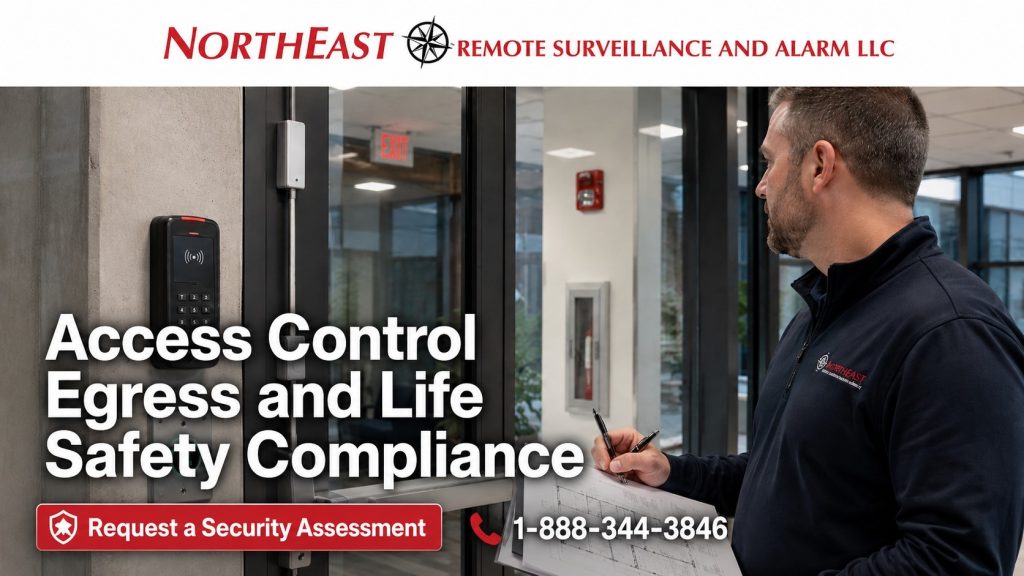
This guide covers strikes, electrified trim, locks, readers, door contacts, and request-to-exit devices.
It also addresses fire alarm connections and coordination with the reviewing authority where needed.
NERSA includes this work in commercial security compliance and inspection planning.
Plan the Complete Door Opening
Access control is only as reliable as the door hardware behind it. A card reader may look simple from the outside, but the opening may include a lock, strike, latch, exit device, door closer, hinge, power transfer, door contact, request-to-exit device, reader, controller, power supply, and release sequence.
NERSA helps commercial clients plan access control hardware around the actual door, not just the desired credential. This helps avoid the common problem of selecting electronic security equipment before confirming whether the door, frame, hardware, fire rating, egress path, and user workflow can support it.
Commercial door hardware planning may involve:
- Electric strikes
- Electrified locksets
- Electrified trim
- Electrified exit devices
- Magnetic locks
- Mechanical exit devices
- Door position switches
- Request-to-exit devices
- Door release buttons
- Emergency release devices
- Power transfer hinges
- Door loops
- Access control readers
- Intercom door release
- Door closers
- Power supplies
- Fire alarm interface relays
- Door-held-open alerts
- Door-forced-open alerts
The goal is a controlled opening that is secure, usable, serviceable, and inspection-ready.
Coordinate Security, Egress, and Door Function
Electronic locking hardware affects how a door locks, unlocks, releases, reports status, and supports emergency exit. If the wrong hardware is selected or installed without coordination, the door may create nuisance alarms, user complaints, service issues, inspection concerns, or unsafe operating conditions.
Electronic locking coordination is especially important for:
- Public entrances
- Employee entrances
- Stair doors
- Fire-rated openings
- Corridor doors
- Exterior exit doors
- School entrances
- Healthcare doors
- Municipal building entrances
- Warehouse employee doors
- Manufacturing plant entrances
- Restricted interior rooms
- IT rooms
- Electrical rooms
- Records rooms
- Loading dock offices
- Guard shack doors
- Pedestrian gates
Each door should be reviewed based on how it is used, who uses it, how people exit, whether it is part of an egress path, whether it is fire-rated, and whether emergency release or AHJ review may be needed.
Electric Strikes
Electric strikes are commonly used in commercial access control because they allow an existing latch or lockset to remain in place while the strike releases electronically. They can be useful for office doors, employee entrances, tenant doors, interior controlled rooms, and some exterior openings.
Electric strike planning should consider:
- Door frame type
- Lockset compatibility
- Latch engagement
- Fail-secure or fail-safe operation
- Fire-rated opening concerns
- Request-to-exit needs
- Door position monitoring
- Power supply location
- Wiring path
- Weather exposure
- Door closer condition
- AHJ expectations when applicable
An electric strike should not be selected only because it is convenient. It must match the door, the lock, the frame, the life-safety requirements, and the way the opening is used.
Electrified Locksets and Electrified Trim
Electrified locksets and electrified trim can be useful when the door hardware itself needs to control access. These options are often used where a cleaner hardware solution is preferred or where the opening requires coordination with exit devices, latches, or commercial-grade door hardware.
Electrified trim and lockset planning may involve:
- Lock function
- Lever operation
- Exit device compatibility
- Fail-safe or fail-secure operation
- Power transfer method
- Door rating
- Frame condition
- Reader location
- Access schedule
- Emergency release operation
- Service access
- Long-term hardware support
These openings often require coordination between the security contractor, locksmith, door hardware provider, facility manager, and sometimes the AHJ or design professional.
Electrified Exit Devices
Electrified exit devices are often used on commercial doors where people must be able to exit using panic hardware or fire exit hardware while entry is controlled electronically. These are common in schools, municipal buildings, healthcare spaces, warehouses, offices, and public-facing commercial facilities.
Electrified exit device planning should consider:
- Door use
- Panic hardware requirements
- Fire exit hardware concerns
- Trim function
- Power transfer
- Request-to-exit monitoring
- Door position monitoring
- Fire alarm release requirements
- Access control programming
- Door-held-open reporting
- Final testing and documentation
A door with an exit device must remain practical for daily use and emergency exit. Access control should enhance security without defeating the purpose of the exit hardware.
Magnetic Locks
Magnetic locks require careful planning because they can directly affect how a door releases. A maglock may be appropriate in some applications, but it should never be treated as a simple add-on.
Maglock planning may involve:
- Emergency release method
- Request-to-exit device placement
- Manual release device placement
- Fire alarm interface
- Power loss operation
- Door type
- Egress path review
- AHJ coordination
- Inspection documentation
- Final function testing
For many commercial projects, maglocks require more coordination than other locking methods. The door must be reviewed carefully so the locking arrangement supports safe egress, emergency release, and inspection expectations.
For broader egress planning, visit Access Control Egress and Life Safety Compliance.
Door Position Switches and Door Monitoring
Door position switches help the access control system know whether a door is open or closed. This is important for security, event reporting, alarm integration, and facility management.
Door monitoring can support:
- Door-forced-open alerts
- Door-held-open alerts
- Door-propped-open alerts
- After-hours entry reporting
- Restricted room monitoring
- Perimeter door status
- Gate status
- Video verification
- Alarm integration
- Access control event history
A locked door that does not report its status may still create a security gap. Door contacts help facility managers know whether a door is actually closed, not just whether the lock was commanded.
Request-to-Exit Devices and Release Sequences
Request-to-exit devices help the system understand when someone is leaving through a controlled door. They may also support lock release, alarm shunting, event logging, and proper door operation.
Request-to-exit planning may include:
- Motion request-to-exit sensors
- Push-to-exit buttons
- Touchless exit buttons
- Exit device monitoring
- Door contact integration
- Alarm shunt timing
- Unlock duration
- Door-held-open timing
- Fire alarm release coordination
- Emergency release planning
Poor request-to-exit placement can cause nuisance alarms, unreliable door release, delayed exit, or confusing user behavior. These devices should be selected and placed based on the door, the hardware, and the people using the opening.
Fire-Rated Openings and Fire Door Coordination
Fire-rated doors and protected openings should not be modified casually. Adding electric locking hardware, power transfers, door contacts, strikes, readers, wiring, or maglocks may affect the opening if the work is not planned correctly.
Fire door coordination may be important for:
- Stair doors
- Rated corridor doors
- Mechanical room doors
- Electrical room doors
- Storage room doors
- Tenant separation doors
- Healthcare corridor doors
- School corridor doors
- Industrial fire separation doors
- Doors serving protected pathways
When access control is planned for a rated opening, the project may need coordination with the AHJ, architect, engineer, locksmith, door hardware provider, fire alarm contractor, or door contractor.
For fire door-specific planning, visit NFPA 80 Fire Door and Opening Protection Coordination.
Fire Alarm Interface and Emergency Release
Some electronic locking systems may need to release during fire alarm activation or emergency conditions. This is especially important where electronic locks could affect the ability to exit or where the opening is part of a life-safety path.
Fire alarm interface planning may involve:
- Fire alarm relay coordination
- Lock release during alarm conditions
- Maglock release
- Power supply control
- Emergency release buttons
- Request-to-exit devices
- Door status monitoring
- Final testing
- Documentation for inspection readiness
Not every door requires the same release method. The correct approach depends on the building, occupancy, door function, hardware type, fire alarm system, and AHJ expectations.
For fire alarm monitoring and inspection support, visit Fire Alarm Monitoring, Testing, and Inspection.
Fail-Safe and Fail-Secure Planning
Fail-safe and fail-secure are often misunderstood. A fail-safe device unlocks when power is removed. A fail-secure device remains locked from the secured side when power is removed while still needing to support required egress.
The correct choice depends on the door, occupancy, emergency release requirements, security risk, access control design, and AHJ expectations.
Fail-safe or fail-secure planning may affect:
- Exterior doors
- Interior restricted rooms
- Stair doors
- Fire-rated openings
- Maglocks
- Electric strikes
- Electrified locksets
- Electrified trim
- Backup power planning
- Fire alarm interface
- Emergency response procedures
This decision should not be made casually. It affects security, emergency operation, and service expectations.
Accessibility and Door Hardware Usability
Electronic locking hardware should also be planned with usability in mind. A secure door should still be understandable and practical for authorized users, visitors, employees, patients, students, vendors, and emergency responders.
Accessibility-aware planning may involve:
- Reader placement
- Keypad placement
- Intercom location
- Door release timing
- Automatic operator coordination
- Visitor entry instructions
- Reception release workflow
- Gate pedestal placement
- Accessible route coordination
- Door operation sequence
For accessibility-focused controlled entry planning, visit ADA and Commercial Access Control Planning.
Door Hardware for Warehouses and Industrial Facilities
Warehouses and industrial facilities often have many controlled openings, including employee entrances, dock offices, driver entrances, maintenance rooms, IT rooms, electrical rooms, tool rooms, parts rooms, and exterior yard gates.
Door hardware planning in these environments should account for:
- Heavy daily use
- Shift changes
- Employee traffic
- Contractor access
- Driver access
- Dust and temperature conditions
- Overhead door areas
- Exterior exposure
- Security risk
- Service access
- Door durability
- Integration with alarms and cameras
Industrial access control should support the operation without creating bottlenecks or fragile hardware conditions.
Door Hardware for Schools, Healthcare, and Municipal Buildings
Schools, healthcare properties, and municipal buildings often require extra care because they serve students, patients, visitors, staff, vendors, and the public. These facilities may need controlled entry, visitor management, emergency lockdown support, staff-only areas, and clear emergency exit paths.
Door hardware planning may involve:
- Main entrance control
- Secure vestibules
- Staff entrances
- Visitor intercoms
- Reception release
- Records rooms
- Nurse or medical areas
- Administrative offices
- Public meeting areas
- Emergency responder access
- Door status monitoring
- Camera integration
The system should support security while remaining understandable for staff and lawful users.
AHJ Coordination for Commercial Door Hardware and Electronic Locking Compliance
Some electronic locking projects may require AHJ review, especially when controlled doors affect emergency egress, fire-rated openings, stair doors, maglocks, delayed egress, public entrances, or fire alarm release.
AHJ coordination may involve:
- Door hardware information
- Lock type
- Release method
- Fire alarm interface notes
- Door schedule
- Reader and device locations
- Emergency release devices
- Request-to-exit devices
- Testing documentation
- Inspection support
For inspection-sensitive projects, visit AHJ Coordination for Commercial Security and Fire Alarm Projects.
NERSA does not replace the AHJ, engineer, architect, locksmith, door hardware consultant, code consultant, legal advisor, or governing authority. Our role is to help plan, install, document, test, and support the security technology in a way that respects the building and the review environment.
Documentation for Door Hardware and Electronic Locking Systems
Access-controlled doors are easier to service, inspect, and upgrade when documentation is clean. Documentation helps facility managers understand how each door operates and what equipment supports it.
Useful documentation may include:
- Controlled door list
- Door hardware type
- Locking device type
- Reader location
- Door position switch location
- Request-to-exit device location
- Power supply location
- Access control panel location
- Fire alarm interface notes
- Door release sequence
- Emergency release notes
- Access schedules
- User permission groups
- Testing records
- Service notes
- As-built information when applicable
Documentation also helps prevent confusion when a door is modified, a tenant changes, an inspection is scheduled, or a service technician needs to troubleshoot the system.
Common Door Hardware and Electronic Locking Problems
Many access control problems happen because the opening was not evaluated as a complete door system.
Common problems include:
- Wrong lock type selected
- Door closer not working properly
- Frame not suitable for the selected hardware
- Electric strike not matched to the latch
- Maglock installed without proper release planning
- Request-to-exit device poorly placed
- Door contact missing or unreliable
- Fire alarm release not coordinated
- Hardware added to fire-rated openings without review
- Power transfer not planned correctly
- Reader placed in a poor location
- Door-held-open timing not programmed correctly
- No clear emergency release sequence
- No door documentation
- No final functional testing
A better project starts with the door, the people using it, and the life-safety conditions around it.
Related Planning
Coordinate door hardware with safe egress, fire-rated openings where applicable, and the responsible project professionals.
- Commercial Access Control Systems — Review controlled-door hardware, credentials and access administration.
- Access Control Egress and Life Safety Compliance — Coordinate locking choices with egress and life-safety requirements.
- NFPA 80 Fire Door and Opening Protection Coordination — Review the coordination of security hardware with fire-rated openings.
- Regulatory Compliance and Inspection Readiness for Commercial Security Systems — Prepare the project records and coordination needed for review.
Why Choose Northeast Remote Surveillance and Alarm
Northeast Remote Surveillance and Alarm, LLC designs access control systems for commercial and industrial buildings where the door hardware matters as much as the reader. We understand that electric locking hardware must work with the opening, the user workflow, the fire alarm system, the access control platform, and the inspection environment.
Our team helps clients review each controlled door, select the right security technology path, coordinate with other trades when needed, and document the final system for long-term support.
Businesses choose NERSA for commercial door hardware and electronic locking planning because we provide:
- Commercial and industrial access control experience
- Door-by-door review
- Electric strike and electrified hardware coordination
- Maglock and request-to-exit planning
- Door position monitoring
- Fire alarm interface awareness
- Egress and accessibility awareness
- AHJ coordination support
- Integration with cameras, alarms, and intercoms
- Documentation for service and inspection readiness
- Long-term support after installation
A controlled door should be secure, safe to exit, usable, inspectable, and supportable.
Request a Commercial Door Hardware and Electronic Locking Review
If your property needs electric strikes, electrified locks, maglocks, access control readers, request-to-exit devices, door contacts, emergency release planning, fire alarm coordination, or inspection-ready documentation, Northeast Remote Surveillance and Alarm, LLC can help.
Call 1-888-344-3846 or request a security assessment to review your doors, hardware, access-control goals, user workflow, building conditions, and inspection-readiness concerns.
We support commercial door hardware and electronic locking planning for offices, warehouses, schools and municipal buildings. We also serve healthcare, industrial, logistics and multi-tenant properties. Our service area includes the Lehigh Valley, Northeastern and Central Pennsylvania, Greater Philadelphia, New Jersey, Delaware and the Mid-Atlantic region.
Frequently Asked Questions about Commercial Door Hardware and Electronic Locking Compliance
What is commercial electronic locking hardware?
Commercial electronic locking hardware includes electric strikes, electrified locksets, electrified trim, electrified exit devices, maglocks, request-to-exit devices, door contacts, and related access control equipment used to secure and monitor doors.
Why does door hardware matter in access control?
Door hardware determines how the door locks, unlocks, releases, reports status, and supports egress. A reader alone does not make a door secure or compliant. The full opening must be reviewed.
Are electric strikes always the best access control option?
No. Electric strikes are useful in many applications, but they are not always the right choice. The best option depends on the door, frame, lock type, fire rating, egress path, security need, and AHJ expectations.
When should electrified trim or an electrified exit device be used?
Electrified trim or electrified exit devices may be used when a door needs controlled entry while maintaining proper exit-device operation. These openings should be coordinated carefully with the door hardware and access control design.
Do maglocks require special planning?
Yes. Maglocks often require careful release planning, request-to-exit coordination, emergency release, fire alarm interface review, and AHJ awareness where applicable.
What is a door position switch?
A door position switch tells the access control system whether a door is open or closed. It supports door-forced-open alerts, door-held-open alerts, event history, and security monitoring.
Can electronic locking hardware affect fire-rated doors?
Yes. Adding electric locking hardware, wiring, power transfers, contacts, or other devices to fire-rated openings may require careful coordination so the opening continues to perform as intended.
Can access control doors connect to the fire alarm system?
Yes. Some controlled doors may need to release during fire alarm activation or emergency conditions. The correct operation depends on the door, hardware, building, occupancy, fire alarm system, and approved design.
Who approves electronic locking hardware for a commercial project?
Approval depends on the project. The AHJ, architect, engineer, door hardware consultant, code consultant, or other governing authority may be involved when required. NERSA supports the security technology planning, installation, testing, and documentation.
What is the best next step for Commercial Door Hardware and Electronic Locking Compliance project?
The best next step is a site-specific door review. NERSA can evaluate each opening, the desired access control function, hardware conditions, egress concerns, fire alarm coordination needs, and documentation requirements before installation.