Wired and Wireless Elevator Camera Systems for Commercial Buildings, Lobbies, Parking Garages and Multi-Tenant Properties
Commercial elevator security cameras help building owners, facility managers, property managers, healthcare facilities, hotels, schools, office buildings, parking garages, municipal properties, and multi-tenant commercial buildings improve visibility inside elevator cabs and around elevator lobbies.
Elevators create a unique security challenge because they are enclosed, high-traffic, shared spaces. Tenants, visitors, employees, patients, guests, vendors, students, service providers, and the public may all use the same elevator at different times.
Northeast Remote Surveillance and Alarm, LLC designs commercial elevator security camera systems for properties that need dependable video, reliable recording, secure remote access, and coordination with the building’s broader security infrastructure. For broader camera planning, see our commercial and industrial video surveillance systems page.
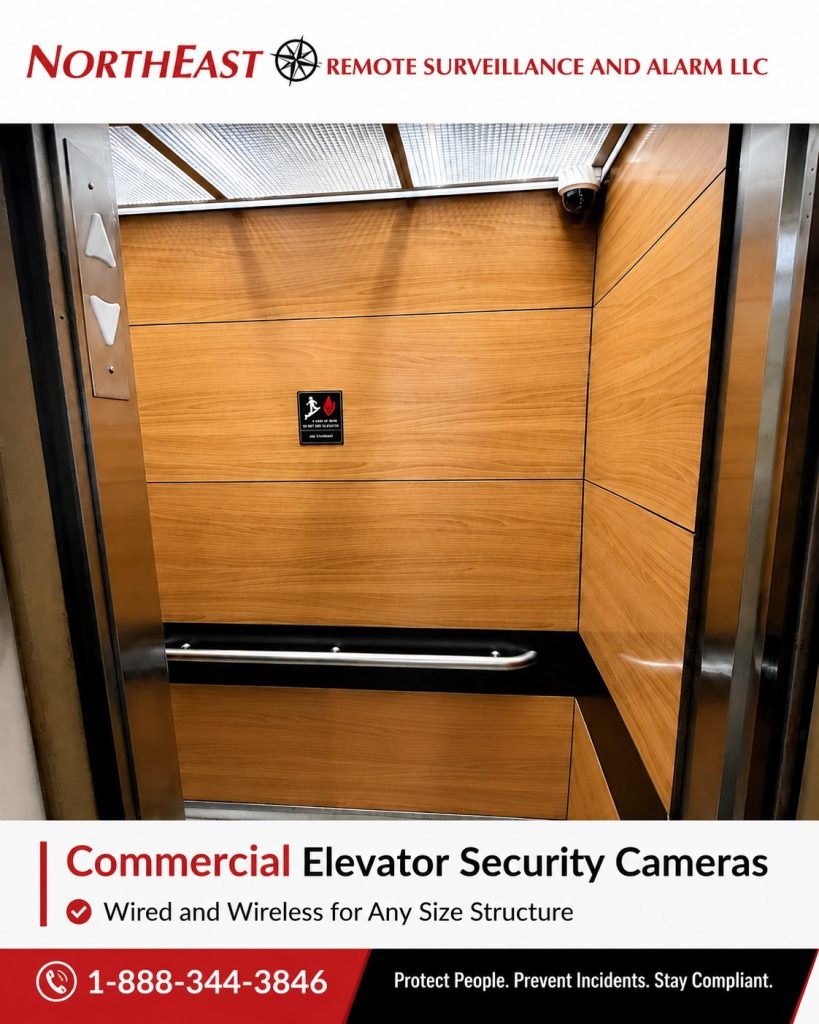
Why Commercial Elevator Cameras Matter
Elevator cameras help document activity in a space that is otherwise difficult to observe. They can support incident review, vandalism investigations, tenant complaints, guest safety review, after-hours activity review, and property-management documentation.
A properly designed elevator camera system can help answer practical questions such as:
- Who entered the elevator cab?
- What happened during the ride?
- Did the incident begin in the lobby or inside the cab?
- Which floor or lobby area was involved?
- Was there vandalism, damage, harassment, theft, or a medical event?
- Can management review video with surrounding hallway or lobby footage?
Elevator cameras are strongest when they are part of a larger building security plan that includes elevator lobby cameras, hallway cameras, parking garage cameras, access control, recording, remote access, and monitoring where appropriate.
Commercial Buildings That Use Elevator Security Cameras
Elevator security cameras are commonly used in:
- Commercial office buildings
- Healthcare and medical office buildings
- Hotels and hospitality properties
- Schools and institutional buildings
- Municipal buildings
- Parking garages
- Mixed-use commercial properties
- Multi-tenant commercial buildings
- Commercial multifamily common areas
- Retail and public-access buildings
- Corporate campuses
This page is focused on commercial and institutional elevator camera systems, not residential camera packages.
Elevator Cab Camera Placement
Camera placement inside an elevator cab must be planned carefully. The goal is to capture useful activity inside the cab while accounting for ceiling height, lighting, reflections, vandal resistance, door position, camera angle, and the size of the elevator.
A poor camera angle may show that something happened without providing enough detail to support a useful review. A camera that is too wide, too low-quality, poorly lit, or mounted in the wrong location may not provide the documentation the property expects.
Commercial elevator camera designs may use:
- Compact dome cameras
- Vandal-resistant cameras
- Low-profile cameras
- Wide-angle cameras
- Specialty elevator cameras
- Cameras selected for low-light or mixed-light conditions
The best camera is not always the most obvious one. The right camera depends on the cab design, mounting location, recording system, service access, and image-quality expectations.
Elevator Lobby and Common-Area Camera Coverage
Elevator cab cameras are more useful when they are supported by surrounding camera coverage. Many incidents begin before someone enters the elevator or continue after someone exits the cab.
Supporting camera locations may include:
- Elevator lobbies
- Hallway approaches
- Parking garage elevator entrances
- Main lobby areas
- Stairwell approaches
- Controlled-access doors
- Reception areas
- Building entrances
This is especially important in office buildings, hotels, healthcare facilities, schools, municipal properties, parking garages, and multi-tenant commercial buildings.
For properties that need broader facility coverage, NERSA also designs office building security systems and commercial camera systems for common areas, entrances, parking areas, and tenant spaces.
Wired Elevator Camera Systems
Wired elevator camera systems are often preferred when the building has a usable pathway or an approved method to transmit video from the moving cab to the building’s recording system.
A wired elevator camera system may provide:
- More consistent video transmission
- Predictable bandwidth
- Cleaner recording
- Easier troubleshooting
- Lower dependence on wireless signal conditions
- Better long-term serviceability when properly installed
Wired elevator camera planning may involve coordination with the building owner, property manager, elevator contractor, low-voltage contractor, and security provider. Elevator cabling, traveling cable conditions, shaft limitations, controller-room access, code-sensitive areas, and service requirements should be reviewed before installation.
NERSA does not treat elevator camera wiring as a casual cable pull. Elevator environments are specialized, and the security design should be coordinated so the camera system supports the property without interfering with elevator operation, maintenance access, emergency communication, or life-safety functions.
Wireless Elevator Camera Systems
Wireless elevator camera systems may be considered when a wired pathway is not available, spare conductors are not usable, running new cable is impractical, or the building needs a retrofit solution without major elevator-cable work.
Wireless elevator camera systems may use carefully selected transmission equipment to send video from the elevator cab or elevator-related location back to the building’s recording system.
Wireless systems can be useful in older buildings and retrofit projects, but they must be designed carefully. Elevator cabs, shafts, metal structures, movement, reflections, interference, bandwidth, power availability, cybersecurity, and service access can all affect performance.
A wireless elevator camera should not be selected simply because it appears easier to install. The system still needs reliable video transmission, usable image quality, proper recording, secure access, stable power, and a maintenance plan.
Wired vs. Wireless Elevator Cameras
The best elevator camera option depends on the building.
A wired elevator camera system is usually stronger when the building has a usable path and the installation can be properly coordinated. Wired systems can provide better consistency, less signal interference, and more predictable video performance.
A wireless elevator camera system may be useful when wiring is not practical, but it must be designed around the building’s signal behavior, elevator movement, power, bandwidth, cybersecurity, and long-term serviceability.
The right answer is not automatically wired or wireless. The right answer is the option that gives the property dependable video, reliable recording, secure remote access, manageable service, and a clean path for long-term operation.
Recording, Retention and Remote Access
Elevator camera footage should be recorded reliably and retained long enough to support the property’s review needs. Retention planning should consider the number of cameras, video resolution, storage capacity, incident frequency, building policy, insurance expectations, and how often management needs to review events.
Remote access may be useful for building owners, property managers, facility teams, security staff, or approved administrators. Access should be controlled so only authorized users can view live video, review recordings, export footage, or manage system settings.
For properties that need active event review beyond local recording, elevator cameras may also be part of a remote video monitoring strategy.
Elevator Cameras and Access Control Integration
Elevator security may involve more than cameras. Some commercial buildings use access control for elevator lobbies, restricted floors, tenant floors, staff-only levels, parking garage access, or after-hours elevator use.
Video surveillance can document elevator activity, while access control can help manage who can reach certain areas. When these systems are planned together, property managers can better review access events, visitor movement, and after-hours activity.
Elevator-area cameras can support:
- Controlled floor access review
- Tenant access documentation
- Staff-only floor visibility
- Parking garage access review
- After-hours elevator activity
- Visitor movement review
- Incident timeline reconstruction
For properties that need card access, mobile credentials, floor control, tenant access, or controlled elevator-area access, see our commercial access control systems page.
Monitoring and Incident Review
Some buildings may want elevator cameras connected to monitoring or event-review workflows. This can be useful when elevator cameras are part of a larger building security system that includes intrusion alarms, access control, intercoms, parking garage cameras, or after-hours response procedures.
Monitoring and review workflows may support:
- After-hours incident review
- Alarm verification
- Elevator lobby event review
- Parking garage activity review
- Access-control event review
- Property management investigations
- Security staff visibility
Not every elevator camera needs live monitoring. Some properties only need reliable recording and controlled access to footage. The right approach depends on the building, staffing, risk level, and response expectations.
Privacy, Audio and Policy Considerations
Commercial elevator cameras should be planned responsibly. Building owners and managers should consider signage, privacy expectations, user permissions, footage retention, who may access video, and how footage may be exported or shared.
Audio recording should be treated separately from video. Laws and policies around audio recording can be different from video surveillance, so property owners should review their requirements before enabling any audio feature.
NERSA designs the technical security system, but building owners and property managers should maintain appropriate policies for camera use, footage review, retention, and access permissions.
Compliance, Life Safety and Elevator Coordination
Elevator camera projects should be planned with awareness of elevator operation, emergency communication, fire/life-safety systems, inspection access, cab conditions, maintenance access, privacy expectations, and authority coordination where applicable.
Security cameras should not interfere with elevator operation, emergency communication, required signage, fire-service features, life-safety systems, inspection access, maintenance access, or required controls.
Depending on the scope, elevator camera work may require coordination with:
- Building owners
- Property managers
- Elevator contractors
- Fire alarm providers
- Electrical contractors
- Low-voltage contractors
- Security integrators
- Authority having jurisdiction where applicable
For broader compliance-aware security planning, see our code and compliance for commercial security systems.
Elevator Camera Upgrades and Retrofits
Many buildings already have elevator cameras, but the system may no longer provide useful footage. Common problems include poor image quality, failed cabling, unstable wireless transmission, outdated recorders, short retention, unreliable remote access, unclear camera views, or equipment that is difficult to service.
An elevator camera upgrade may include:
- Replacing outdated cameras
- Improving cab image quality
- Correcting wireless transmission issues
- Evaluating wired pathways
- Upgrading the recorder
- Improving remote access
- Increasing retention
- Adding lobby camera coverage
- Coordinating with the elevator contractor
- Connecting elevator footage to a larger video system
The best upgrade is not always a full replacement. The best upgrade is the one that improves reliability, image quality, recording, serviceability, and review value for the property.
Why Businesses Choose NERSA for Commercial Elevator Security Cameras
Northeast Remote Surveillance and Alarm, LLC focuses on commercial and industrial security systems, not residential camera packages. Elevator camera projects require practical planning around cab conditions, wiring options, wireless reliability, recording, building operations, monitoring, and long-term support.
NERSA helps building owners and facility managers evaluate whether a wired elevator camera, wireless elevator camera, or hybrid approach makes the most sense for the property.
Businesses choose NERSA for:
- Commercial camera system planning
- Elevator cab and lobby camera design
- Wired and wireless video options
- Recording and remote-access planning
- Access control and video integration
- Monitoring workflow coordination
- Commercial-grade equipment
- Code-aware and compliance-aware planning
- Long-term service support
Our goal is to design elevator camera systems that provide usable footage, dependable recording, secure remote access, practical serviceability, and better visibility for the building.
Request a Commercial Elevator Camera Assessment
If your commercial property needs new elevator cameras, wired elevator camera planning, wireless elevator camera transmission, elevator cab surveillance, lobby camera coverage, recording upgrades, remote access, or integration with a broader security system, NERSA can help.
Northeast Remote Surveillance and Alarm, LLC can review your elevator areas, cab conditions, available wiring paths, wireless options, recording needs, remote-access requirements, monitoring goals, and commercial security system design.
Call 1-888-344-3846 or request a Security Assessment for your commercial elevator camera project.
FAQ: Commercial Elevator Security Cameras
What is an elevator security camera?
An elevator security camera is a camera installed inside or around an elevator cab to help document activity, review incidents, improve common-area visibility, and support building security.
Are wired elevator cameras better than wireless elevator cameras?
Wired elevator cameras are usually preferred when a proper wiring path is available because they can provide more consistent video transmission and easier troubleshooting. Wireless elevator cameras may be useful when wiring is not practical, but they must be carefully designed around signal reliability, bandwidth, power, cybersecurity, and service access.
Can wireless cameras work in elevators?
Yes. Wireless elevator cameras can work in some buildings, but they require careful planning. Elevator cabs, shafts, metal structures, movement, interference, bandwidth, and power conditions can all affect wireless performance.
Why are elevator cameras different from normal building cameras?
Elevator cameras are different because the camera is often located in a moving cab with unique wiring, power, transmission, mounting, lighting, service, and coordination requirements. The elevator environment is more specialized than a standard hallway, office, or parking lot camera location.
Where should elevator cameras be installed?
Elevator cameras are commonly installed inside the cab in a position that provides a clear view of activity inside the elevator. Many buildings also benefit from cameras at elevator lobbies, hallway approaches, and parking garage elevator entrances.
Can elevator cameras connect to the main video surveillance system?
Yes. Elevator cameras can often connect to the building’s main recorder, cloud-connected video system, or video management platform when the transmission path, network, recorder, and permissions are properly planned.
Do elevator cameras need to be coordinated with the elevator company?
Often, yes. Elevator cabling, cab conditions, controller-room access, shaft conditions, traveling cable, and elevator service requirements may require coordination with the elevator contractor or building owner.
Can elevator cameras be monitored remotely?
Yes. Elevator cameras can be included in remote access or monitoring workflows if the system is designed with reliable recording, network connectivity, permissions, and a response process.
Can elevator cameras work with access control?
Yes. Elevator-area cameras can support access-control review, especially in buildings with controlled floors, tenant access, staff-only areas, parking garage access, or after-hours elevator restrictions.
Can NERSA upgrade existing elevator cameras?
Yes. NERSA can review existing elevator cameras, cabling, wireless transmission, recording, remote access, image quality, and system reliability to determine whether the system should be repaired, upgraded, redesigned, or replaced.