
Commercial security camera installation can range from a few thousand dollars for a smaller business system to well over $100,000 for a large, complex commercial deployment.

Request a Commercial Video Surveillance Assessment
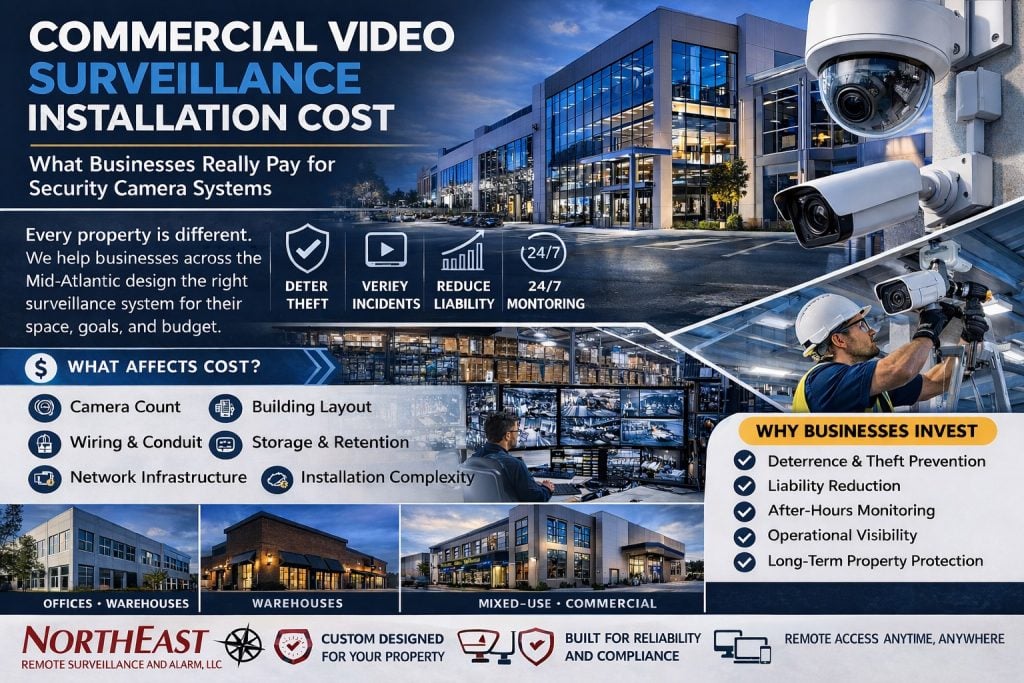
Commercial Video Surveillance Pricing, Installation Factors and Budget Planning
The number of cameras matters, but it is only one part of the total. Building size, mounting height, cable pathways, storage requirements, camera type, network infrastructure, exterior conditions and installation difficulty can change the final project cost substantially.
Northeast Remote Surveillance and Alarm, LLC designs and installs commercial video surveillance systems for offices, warehouses, retail properties, mixed-use buildings and other qualifying business facilities.
For complete system-design and installation information, visit Commercial Video Surveillance Systems.
The pricing below is intended for budget planning, not as a substitute for a site-specific proposal.
Average Commercial Security Camera Installation Cost
Commercial video surveillance systems commonly fall into the following planning ranges.
Small Commercial Systems
Typical installed range: $2,500 to $8,500
Typical camera count: 4 to 10 cameras
Smaller systems may be appropriate for:
- Professional offices
- Small commercial buildings
- Storefronts
- Smaller retail spaces
- Light commercial properties
Typical coverage may include:
- Main entrances
- Rear or side doors
- Reception areas
- Interior hallways
- Small parking areas
- Selected exterior approaches
A straightforward installation in an accessible building may remain near the lower portion of the range. Difficult cable routes, exterior cameras, additional storage or network improvements can increase the total.
Mid-Size Commercial Systems
Typical installed range: $8,500 to $24,000
Typical camera count: 10 to 28 cameras
These systems may be appropriate for:
- Larger offices
- Mixed-use buildings
- Multi-tenant commercial properties
- Larger retail locations
- Office and warehouse combinations
- Properties with several entrances or exterior areas
Coverage may extend to:
- Multiple entrances
- Side and rear doors
- Parking areas
- Common spaces
- Shipping or receiving areas
- Exterior approaches
At this size, storage capacity, switching, cable pathways and installation conditions generally become more important parts of the overall budget.
Large Commercial and Multi-Area Systems
Typical installed range: $24,000 to $60,000
Typical camera count: 24 to 60 cameras
Larger projects may involve:
- Warehouses
- Commercial campuses
- Multi-building properties
- Large office or mixed-use facilities
- Business properties with extensive exterior coverage
These projects frequently require:
- Longer cable runs
- Larger recording systems
- Greater storage capacity
- Additional PoE switching
- Lift equipment
- More extensive exterior coverage
- More complicated cable pathways
The difference between two 40-camera projects can be substantial when one property has accessible ceilings and short cable runs while the other requires lifts, conduit and long exterior routes.
Enterprise and High-Demand Commercial Systems
Typical installed range: $60,000 to $125,000+
Typical camera count: 50+ cameras
Large deployments may include:
- Multiple buildings
- Large warehouses
- Large business campuses
- Multiple recording locations
- Extensive parking or exterior areas
- More demanding infrastructure requirements
- Multi-site administration
Projects at this level are normally designed around the property rather than estimated from camera count alone.
Installed Cost Per Commercial Security Camera
Businesses frequently ask for a simple price per installed camera.
That number can be useful when developing an early budget, but it should not be treated as a final project price. One camera mounted ten feet above an accessible ceiling is very different from a camera requiring a boom lift, exterior conduit and a long cable pathway.
Standard Fixed Commercial Cameras
Typical equipment cost: $300 to $900 per camera
Typical installed planning range: $600 to $1,500 per camera
Standard fixed cameras are commonly used for:
- Entrances
- Hallways
- Reception areas
- Interior business spaces
- Parking views
- Exterior building coverage
The installed figure can increase when the location requires difficult cabling, lift access, conduit, weatherproof mounting or additional network infrastructure.
Varifocal and Advanced Commercial Cameras
Typical installed planning range: $800 to $1,800 per camera
Varifocal cameras provide greater flexibility in determining the field of view and level of scene detail.
They may be useful where a standard fixed view does not provide the required identification or coverage.
PTZ Cameras
Typical installed planning range: $2,000 to $6,000+ per camera
Pan-tilt-zoom cameras may be appropriate for:
- Large parking areas
- Open exterior spaces
- Large commercial properties
- Business yards
- Locations requiring controllable situational awareness
PTZ cameras should normally be selected because the application requires their capabilities—not simply because they can move.
Thermal Cameras
Typical installed planning range: $3,500 to $11,500+ per camera
Thermal cameras are more specialized and are generally used for demanding exterior or perimeter applications.
Their cost can vary considerably depending on detection requirements, viewing distance, analytics and installation conditions.
What Changes the Cost of a Commercial Camera System?
Two businesses can purchase the same number of cameras and receive very different installation proposals.
The reason is usually the property.
Mounting Height
Higher mounting positions increase installation time and may require specialized access equipment.
Examples include:
- Warehouse ceilings
- Two-story building elevations
- Exterior walls
- Canopies
- Poles
- High loading or receiving areas
A camera installed from a ladder at normal ceiling height will generally cost less to install than one requiring a boom lift or scissor lift.
Cable Distance and Routing
Longer cable runs require more material and more installation labor.
Cost may also increase when technicians must route cabling through:
- Finished ceilings
- Multiple floors
- Warehouse structures
- Exterior walls
- Mechanical spaces
- Underground pathways
- Separate buildings
The difficulty of reaching the camera location is often as important as the physical distance.
Conduit and Cable Protection
Some commercial installations require cable to be protected rather than simply routed above an accessible ceiling.
Depending on the property, installation may require:
- EMT
- Exterior conduit
- Weatherproof fittings
- Sealed penetrations
- Protective raceways
- Organized pathways through exposed areas
These materials and the labor required to install them can significantly affect project cost.
Lift and Access Equipment
Commercial buildings with high ceilings or elevated exterior mounting positions may require:
- Scissor lifts
- Boom lifts
- Specialty access equipment
Lift rental, delivery, operating conditions and the amount of elevated work all affect the budget.
Video Storage and Retention
Recording requirements are a major component of system design.
A business retaining footage for 30 days will generally require less storage than an organization requiring 60 or 90 days.
Storage requirements are also affected by:
- Camera count
- Camera resolution
- Frame rate
- Recording schedule
- Compression
- Motion levels
- Continuous versus event-based recording
Storage should be calculated before the recorder is selected rather than treated as an afterthought.
Network Infrastructure
Modern IP surveillance often depends on the property’s network infrastructure.
A project may require:
- PoE switches
- Network uplinks
- UPS backup
- Surge protection
- Secure device configuration
- Remote viewing configuration
- Additional network capacity
A property with suitable infrastructure already in place may require less work than one that needs new switching, pathways or network equipment.
Lighting Conditions
Difficult lighting can change the type and placement of cameras needed.
Examples include:
- Dark parking areas
- Backlit entrances
- Uneven exterior lighting
- Low-light side doors
- Areas with deep shadows
- Headlights facing cameras
Correcting the camera selection at the design stage is normally less expensive than discovering after installation that important views are unusable.
Camera Type
A standard fixed camera, PTZ camera and thermal camera do not perform the same job and should not be budgeted the same way.
Specialized optics, analytics, low-light performance, environmental ratings and other capabilities can increase equipment cost.
Commercial Video Surveillance Cost by Property Type
The property itself often provides a better starting point for budgeting than camera count alone.
Office Building Security Camera Cost
Typical project range: $5,000 to $18,000
Office systems commonly cover:
- Main entrances
- Vestibules
- Reception areas
- Hallways
- Side and rear doors
- Parking areas
- Selected common spaces
Costs can increase when the building contains multiple tenants, several entrances, larger parking areas or more difficult cable pathways.
Retail Security Camera Cost
Typical project range: $3,500 to $15,000
Retail properties may require coverage of:
- Entrances and exits
- Customer-facing areas
- Sales floors
- Point-of-sale areas
- Stockrooms
- Rear doors
- Parking areas
The correct system should provide usable coverage of the locations that matter rather than simply maximize camera quantity.
Warehouse Security Camera Cost
Typical project range: $10,000 to $45,000
Warehouse properties commonly require coverage around:
- Dock doors
- Shipping and receiving
- Employee entrances
- Overhead doors
- Warehouse aisles
- Exterior approaches
- Parking areas
- Office-to-warehouse transitions
Warehouse projects often cost more than ordinary office installations because of high mounting locations, long cable distances and larger interior and exterior areas.
For broader facility planning beyond camera pricing, see Warehouse Security Systems.
Mixed-Use and Multi-Tenant Property Cost
Typical project range: $8,000 to $30,000+
These properties may require:
- Shared entrance coverage
- Common-area visibility
- Parking surveillance
- Rear access coverage
- Delivery-area views
- Exterior coverage
Multi-tenant buildings can also require additional planning around shared areas, administrative access and responsibility for the system.
What Is Typically Included in a Commercial Video Surveillance Installation?
A professional installation involves considerably more than attaching cameras to a building.
Depending on the project, the system may include:
- Site and coverage planning
- Camera hardware
- NVR or video recorder
- Recording storage
- Cable and connectivity
- Mounts and brackets
- PoE switching
- Network configuration
- Remote viewing
- Mobile access
- Recorder configuration
- Camera aiming and adjustment
- System testing
- User setup
- Customer training
Additional project requirements may include:
- Conduit
- Lift equipment
- Network upgrades
- Exterior weatherproofing
- Penetration sealing
- UPS backup
- Coordination with building or IT personnel
A proposal should make clear which of these items are included so that two apparently similar bids can be compared accurately.
Common Commercial Camera Budgeting Mistakes
Budgeting Only for the Cameras
Cameras are only one component of a complete system.
The budget must also account for recording, storage, cabling, switching, mounting, labor and the condition of the property.
Choosing Cameras Before Determining the Required View
A camera should be selected according to what the business needs to see.
A wide general view, facial identification view, parking-lot overview and long-distance perimeter view may require different equipment.
Ignoring Installation Conditions
Mounting height, inaccessible ceilings, exterior conduit and long cable routes can materially change labor costs.
These conditions should be identified during the site review rather than discovered after installation begins.
Underestimating Storage
Insufficient storage can result in recorded footage being overwritten sooner than expected.
Retention requirements should be established before recorder and hard-drive capacity are finalized.
Ignoring the Existing Network
An IP camera system depends on reliable connectivity.
Existing switches, network capacity, power availability and remote-access requirements should be evaluated before assuming the existing infrastructure can support the new system.
Selecting Equipment on Price Alone
A lower-cost camera is not a savings if it cannot produce useful images under the conditions where it is installed.
Camera selection should consider the required view, lighting, distance, environment and operational purpose.
How to Build a Realistic Commercial Surveillance Budget
Before establishing a budget, answer several basic questions.
What needs to be seen?
Identify the areas where recorded video would provide an actual business or security benefit.
What level of detail is required?
A general parking-lot overview does not require the same view as a doorway where identification is important.
How long must recordings be retained?
Determine whether the business requires 30, 60, 90 or another number of days before sizing storage.
How difficult is the building?
Consider mounting heights, ceilings, conduit requirements, exterior routes and access equipment.
Is suitable network infrastructure already available?
Existing PoE switching and network pathways may be reusable when properly evaluated.
Will the property expand?
Recorder capacity, switching and infrastructure can sometimes be planned to accommodate reasonable future growth.
Establishing these requirements before requesting proposals makes it easier to compare systems based on what they actually provide rather than camera count alone.
Why the Lowest Camera Quote May Not Be the Lowest Project Cost
Two proposals listing the same number of cameras are not necessarily equivalent.
One may include:
- Proper storage sizing
- Commercial-grade cabling
- PoE switching
- UPS protection
- Lift access
- Exterior mounting hardware
- Remote viewing configuration
- Final camera aiming
- Documentation
- Training
Another proposal may exclude several of those items.
When comparing commercial video surveillance proposals, review what is included, what is excluded, the expected recording retention and whether the quoted equipment is appropriate for the required views.
The useful comparison is the complete installed system, not simply the advertised price of each camera.
Are Commercial Security Camera Systems Worth the Cost?
For many businesses, a properly designed system can provide value well beyond simply recording activity.
Commercial video surveillance may support:
- Incident verification
- Theft deterrence
- After-hours review
- Property protection
- Operational visibility
- Investigation of reported events
- Documentation of activity
- Employee and visitor safety planning
The value comes from obtaining useful video when an event occurs—not merely from having cameras mounted around the property.
That requires appropriate camera placement, suitable equipment, reliable recording and infrastructure designed for the environment.
Why Businesses Choose Northeast Remote Surveillance and Alarm
Northeast Remote Surveillance and Alarm, LLC has provided commercial and industrial security and low-voltage services since 2008.
NERSA designs video surveillance systems around the property and the required coverage rather than relying on a predetermined camera package.
Projects may include:
- New commercial surveillance systems
- Existing-system replacements
- Camera additions
- Recorder upgrades
- Storage expansion
- Network and PoE improvements
- Exterior surveillance
- Multi-building systems
Where useful existing infrastructure can be retained, it can be evaluated before unnecessary replacement is recommended.
NERSA supports qualifying commercial and industrial video surveillance projects throughout the Lehigh Valley, Reading and Berks County, Greater Philadelphia, northeastern Pennsylvania and other selected Pennsylvania markets.
Frequently Asked Questions About Commercial Security Camera Installation Cost
How much does commercial security camera installation cost?
Smaller commercial systems may begin around $2,500 to $8,500, while larger systems can range from $24,000 to $60,000 or more. Enterprise and high-demand projects may exceed $125,000 depending on size, infrastructure and complexity.
What is the average installed cost per commercial security camera?
A useful planning range for a standard commercial camera is approximately $600 to $1,500 installed. Advanced, PTZ, thermal and difficult-to-install cameras can cost considerably more.
Why can two systems with the same number of cameras have different prices?
Mounting height, cable distance, conduit, lift requirements, camera type, storage, network infrastructure and exterior conditions can make two projects with identical camera counts very different to install.
How much does a warehouse camera system cost?
A typical planning range from the project types described above is approximately $10,000 to $45,000, although large or difficult warehouse installations can exceed that range.
How much storage do commercial security cameras need?
Storage depends on camera count, resolution, frame rate, compression, recording activity and required retention. The storage system should be calculated according to the required recording period before equipment is selected.
Does a commercial surveillance quote normally include installation?
It depends on the proposal. A complete installed-system proposal may include cameras, recorder, storage, cabling, mounting, switching, configuration, testing and training, while conduit, lift equipment or network upgrades may be separate depending on the project.
Can an existing camera system be upgraded instead of replaced?
Potentially. Existing cameras, cabling, network equipment, recorders and infrastructure should be evaluated for condition, compatibility and future support before complete replacement is recommended.
Is the cheapest commercial camera system usually the best value?
Not necessarily. Equipment price should be considered together with installation quality, recording retention, camera suitability, infrastructure, reliability and long-term support.
Get a Commercial Video Surveillance Quote
Budget ranges are useful for planning, but the final installed cost depends on the building, required views, infrastructure and operating conditions.
If your business is installing a new surveillance system, replacing an older system or evaluating an existing camera network, Northeast Remote Surveillance and Alarm, LLC can review the property and develop a project-specific scope.
Request a Commercial Video Surveillance Assessment.
Northeast Remote Surveillance and Alarm, LLC
Commercial & Industrial Security Systems
Serving Qualifying Business Properties Throughout Pennsylvania