
Coordinate Lehigh Valley warehouse security around receiving, storage, dispatch, employee access, exterior approaches, and recorded events.

Request a Lehigh Valley Warehouse Security Assessment
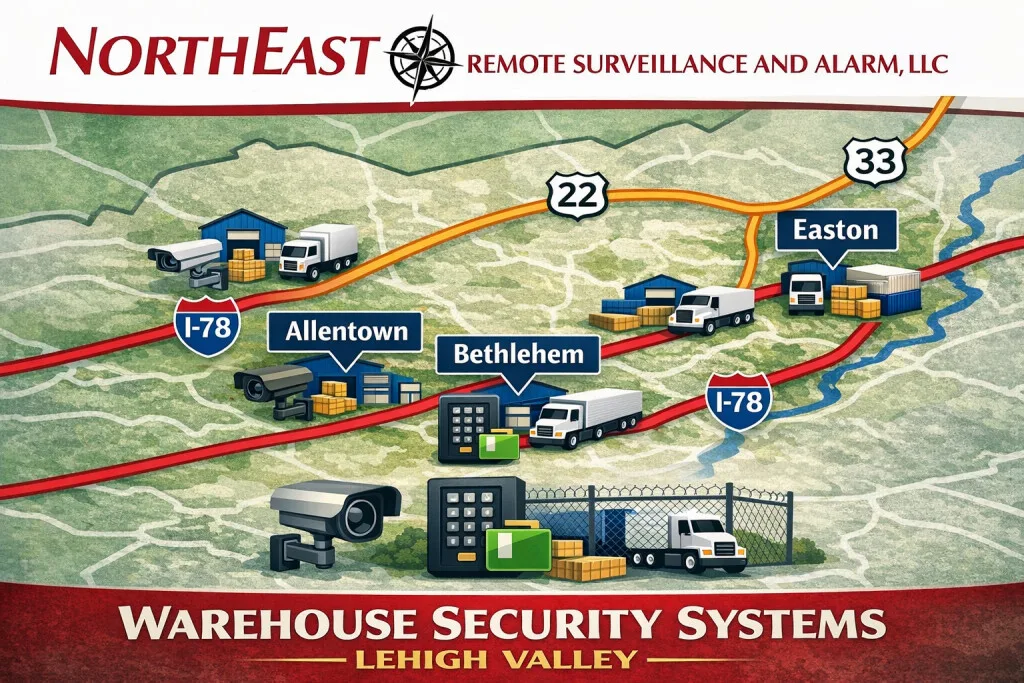
These facilities often involve loading docks, trailer yards, employee entrances, shipping offices, restricted rooms, inventory areas, vehicle movement and significant after-hours exposure.
Northeast Remote Surveillance and Alarm, LLC (NERSA) designs and installs warehouse security systems across the Lehigh Valley. We plan around camera coverage, controlled entry, incident records and intrusion protection. The system should fit how the warehouse operates.
NERSA supports warehouse and logistics properties throughout:
- Allentown
- Bethlehem
- Easton
- I-78
- Route 22
- Route 33
- Lehigh County
- Northampton County
- Industrial parks
- Logistics corridors
- Distribution markets throughout the Lehigh Valley
A warehouse security system may need to account for:
- Loading docks
- Overhead doors
- Employee entrances
- Driver entrances
- Shipping offices
- Receiving areas
- Warehouse aisles
- Inventory areas
- Restricted rooms
- Parking
- Truck courts
- Trailer rows
- Vehicle gates
- Fence lines
- Exterior storage
- Detached buildings
- After-hours activity
The objective is not simply to install cameras and alarms.
The objective is to provide usable visibility, controlled access, meaningful detection, reliable documentation and a system that helps management understand what occurred when something goes wrong.
For broader commercial and industrial security throughout the region, visit Lehigh Valley Commercial and Industrial Security Systems.
Why Lehigh Valley Warehouses Need Specialized Security
The Lehigh Valley is one of Pennsylvania’s strongest warehouse, distribution and logistics markets.
Warehouses can have heavy truck traffic, busy loading docks and frequent employee movement. Exterior areas may also need more coverage than those at a typical commercial property. These conditions affect sites across Allentown, Bethlehem, Easton and industrial parks near I-78, Route 22 and Route 33.
A warehouse may have several different operating environments within the same site.
Employees may enter through controlled personnel doors.
Drivers may report to shipping or receiving offices.
Trailers may remain staged outside overnight.
Forklifts and freight may move continuously through loading areas.
Management may need visibility across parking lots, warehouse aisles, loading docks, gates and exterior storage.
Some parts of the facility may operate around the clock while other portions are closed and alarmed.
The security system should reflect those differences.
A Lehigh Valley warehouse assessment may consider:
- Employees and shift schedules
- Drivers and deliveries
- Vendors and contractors
- Loading docks
- Shipping and receiving
- Overhead doors
- Warehouse interiors
- Restricted inventory
- Office areas
- Employee parking
- Truck courts
- Trailer staging
- Vehicle gates
- Exterior storage
- Fence lines
- Lighting
- Existing security equipment
- Alarm response
- Monitoring
- Cabling and networks
- Documentation
- Future expansion
What a Warehouse Security System Should Accomplish
A useful warehouse security system should help authorized personnel answer practical questions.
Who entered the building?
Which controlled door was used?
What happened at a loading dock?
Which vehicle entered the yard?
Was an overhead door opened after hours?
Can recorded video provide enough detail to review the incident?
Was activity expected or unusual?
Which employee, driver or contractor had permission to be in the area?
The system should support these questions with useful cameras, access records, alarm information, monitoring procedures and appropriate documentation.
Lehigh Valley Warehouse Security Resources
Warehouse Video Surveillance
For camera coverage of loading docks, employee entrances, warehouse interiors, parking, trailer areas and exterior approaches, visit Commercial and Industrial Video Surveillance Systems.
For a new system in this region, review Lehigh Valley commercial security camera installation to define cabling, recording, commissioning and customer handover.
Warehouse Access Control
For employee entrances, office-to-warehouse transitions, inventory areas, shipping offices and other controlled spaces, visit Commercial Access Control Systems.
Warehouse Intrusion Alarms
For exterior doors, overhead openings, warehouse interiors, restricted rooms and monitored after-hours intrusion protection, visit Commercial Alarm Systems.
Loading Dock Security
For dock doors, trailer positions, shipping lanes, receiving activity, freight movement and dock-area incident documentation, visit Loading Dock Security Systems.
Truck Yard & Trailer Security
For truck courts, trailer rows, gate lanes, fenced areas, service drives and exterior yard activity, visit Truck Yard and Trailer Security Systems.
Remote Video Monitoring
For professional review of selected docks, yards, gates, trailer areas and other exterior zones during defined after-hours schedules, visit Remote Video Monitoring.
License Plate Recognition
For dedicated vehicle documentation at truck gates, employee parking entrances, contractor lanes and controlled approaches, visit License Plate Recognition Camera Systems.
Compliance-Aware Warehouse Security
For commercial projects involving controlled doors, life-safety coordination, documentation and other regulated building conditions, visit Code and Compliance for Commercial Security Systems.
Warehouse Security by Lehigh Valley City
Allentown
For warehouse and distribution properties in Allentown, visit Warehouse Security Systems in Allentown, PA.
Bethlehem
For warehouse, distribution and industrial properties in Bethlehem, visit Warehouse Security Systems in Bethlehem, PA.
Easton
For warehouse, logistics and Route 33-connected properties in Easton, visit Easton Warehouse Security Systems.
Warehouse Security Along Lehigh Valley Freight Corridors
Route 33
For warehouse and distribution properties connected to the Route 33 industrial corridor, visit Warehouse Security Systems Along the Lehigh Valley Route 33 Industrial Corridor.
Route 22
For warehouse properties connected to the Route 22 industrial corridor, visit Warehouse Security Systems Along the Route 22 Industrial Corridor.
I-78
For warehouse, distribution and logistics properties connected to I-78, visit I-78 Warehouse and Logistics Security Systems.
Loading Dock Security
Loading docks are among the busiest areas of many warehouse properties.
They combine:
- Freight
- Drivers
- Employees
- Forklifts
- Trailers
- Overhead doors
- Shipping offices
- Receiving offices
- Vendors
- Delivery paperwork
That activity can create disputes, damage claims, shrink, unauthorized movement and after-hours exposure.
Security planning should consider both the dock face and the surrounding operational area.
Useful visibility may be required at trailer positions, freight-transfer points, dock doors, shipping offices and approaches leading into the dock area.
For focused dock planning, visit Loading Dock Security Systems.
Truck Yard & Trailer Security
Truck yards and trailer areas often require different security than the warehouse interior.
These areas may include:
- Trailer rows
- Truck courts
- Gate lanes
- Fleet parking
- Fence lines
- Service drives
- Exterior equipment
- Outdoor storage
- Detached structures
They may remain exposed after normal warehouse operations end.
A few cameras mounted on the warehouse wall may not provide enough visibility across a large exterior property.
Yard security should be designed around distance, lighting, vehicle movement, fence lines, available power and the areas where useful identification is required.
Employee & Contractor Access
Warehouse access should be organized around the way employees, supervisors, contractors, vendors and temporary workers use the property.
Controlled areas may include:
- Employee entrances
- Shipping offices
- Receiving offices
- Inventory cages
- Tool rooms
- Management spaces
- Maintenance areas
- IT rooms
- Restricted storage
- Office-to-warehouse transitions
Electronic credentials can provide more manageable control than uncontrolled mechanical keys.
Permissions should reflect each user’s role and should be updated as staffing changes.
For detailed controlled-entry planning, visit Commercial Access Control Systems.
After-Hours Warehouse Security
Warehouse risk often changes when staffing drops.
A property that is busy throughout the day may become lightly occupied overnight while trailers, equipment, materials and exterior areas remain exposed.
After-hours planning may include:
- Exterior door protection
- Overhead-door monitoring
- Interior intrusion detection
- Trailer-area visibility
- Gate activity
- Remote camera review
- Alarm communication
- Video verification
- Defined response procedures
The objective is not simply to create more alerts.
The objective is to provide meaningful information that authorized personnel or monitoring operators can understand and act upon.
Vehicle Documentation
Warehouses with heavy truck traffic may need more than general parking-lot video.
Vehicle documentation may be important at:
- Truck gates
- Delivery lanes
- Employee parking
- Contractor entrances
- Fleet areas
- Service drives
- Trailer-yard entrances
A general overview camera and a dedicated license plate camera perform different functions.
Plate capture depends on distance, angle, lighting, lane position, vehicle speed and camera selection.
Common Warehouse Security Problems
Warehouse security weaknesses often occur around predictable areas.
Common problems include:
- Loading-dock blind spots
- Poor nighttime video
- Uncontrolled side doors
- Weak overhead-door protection
- Unmanaged employee credentials
- Shared alarm codes
- Trailer areas with little visibility
- Poor vehicle documentation
- Gate blind spots
- Missing after-hours monitoring
- Cameras mounted too far from important activity
- Inadequate recording retention
- Difficult video retrieval
- Missing system documentation
- Weak network infrastructure
- Outdated equipment
The correct first step is identifying whether the problem requires repair, repositioning, additional coverage, better controlled access, monitoring changes, improved infrastructure, provider takeover or modernization.
Best-Fit Warehouse & Logistics Properties
NERSA designs warehouse security systems for:
- Distribution centers
- Industrial warehouses
- Manufacturing warehouses
- Storage buildings
- Logistics terminals
- Fulfillment facilities
- Contractor supply properties
- Fenced industrial compounds
- Office-warehouse facilities
- Multi-tenant industrial buildings
- Truck-oriented commercial properties
Commercial and industrial properties only.
Existing Warehouse Security Systems
An older warehouse security system does not automatically require complete replacement.
NERSA can evaluate existing:
- Cameras
- Recorders
- Cabling
- Access-control equipment
- Alarm panels
- Sensors
- Door hardware
- Gates
- Network equipment
- Power supplies
- Monitoring communications
- User accounts
- Documentation
Existing equipment may sometimes remain useful when it is compatible, serviceable and appropriate for the completed system.
The goal is to preserve useful infrastructure where practical while correcting the areas that no longer meet the warehouse’s operating requirements.
Compliance & Life-Safety Coordination
Warehouse security can support incident documentation, access accountability, restricted-area control and better review of dock, yard, vehicle and employee movement.
Security systems do not replace workplace-safety programs, required fire and life-safety systems, applicable inspections, employee training or other owner responsibilities.
Security equipment involving controlled doors, emergency egress or other regulated building functions should be coordinated appropriately for the property.
For broader information, visit Code and Compliance for Commercial Security Systems.
Request a Lehigh Valley Warehouse Security Assessment
NERSA can assess your warehouse, distribution center, industrial building or logistics property. We review camera coverage, controlled entry, intrusion protection, docks, yards, remote monitoring and vehicle records. Recommendations follow how the property operates.
A warehouse assessment may review:
- Loading docks
- Employee entrances
- Driver access
- Shipping offices
- Receiving areas
- Warehouse interiors
- Inventory
- Restricted rooms
- Overhead doors
- Parking
- Truck courts
- Trailer areas
- Gates
- Exterior approaches
- Camera coverage
- Access control
- Intrusion alarms
- Monitoring
- Vehicle documentation
- Networks
- Power
- Existing equipment
- Documentation
- Future expansion
The objective is to create a dependable warehouse security environment that provides useful visibility, controlled access, meaningful detection and practical incident review.
Frequently Asked Questions About Lehigh Valley Warehouse Security Systems
What is a warehouse security system?
A warehouse security system is a layered commercial security environment designed around loading docks, doors, yards, employees, inventory, restricted areas, alarms, cameras, monitoring and vehicle movement.
Why do Lehigh Valley warehouses need specialized security?
Many Lehigh Valley warehouses operate near major industrial and freight corridors, which can mean greater truck traffic, dock activity, employee movement, exterior exposure and need for documentation.
Where should warehouse security cameras be installed?
Common locations include loading docks, employee entrances, rear doors, shipping and receiving areas, warehouse aisles, parking areas, trailer yards, fence lines and exterior approaches.
Do warehouses need access control?
Many warehouses benefit from access control at employee entrances, restricted rooms, office-to-warehouse transitions, inventory areas and shipping offices.
Are intrusion alarms useful for warehouses?
Yes. Intrusion alarms can protect exterior doors, overhead openings, offices, warehouse interiors and other vulnerable areas when the facility is closed or lightly staffed.
What are common warehouse security risks?
Common concerns include unauthorized entry, loading-dock disputes, internal shrink, yard trespassing, exposed trailers, poor nighttime video, uncontrolled side doors and weak vehicle documentation.
Should warehouse yards and trailer areas have separate security planning?
Yes. Exterior yards often require dedicated camera coverage, gate visibility, vehicle documentation, fence-line awareness and after-hours monitoring.
Can NERSA support warehouses throughout the Lehigh Valley?
Yes. NERSA supports commercial warehouse and logistics projects throughout Allentown, Bethlehem, Easton and surrounding Lehigh Valley industrial and freight markets.
Does NERSA install single-family home systems?
No. NERSA focuses on commercial and industrial properties.
Contact Northeast Remote Surveillance and Alarm
For warehouse, distribution, logistics, fulfillment or industrial security projects throughout the Lehigh Valley, call 1-888-344-3846.
For related planning, explore Pennsylvania and Mid-Atlantic Warehouse Security.
Request a Lehigh Valley Warehouse Security Assessment
Review access-control planning for Lehigh Valley warehouses.
- Lehigh Valley Warehouse Access Control Systems — Plan controlled access for staff, visitors and restricted warehouse spaces.
Midea warehouse managed alarm case study
See the Midea warehouse managed alarm case study in the Lehigh Valley, covering 76 overhead doors and 27 personnel doors—103 doors in total.
Compliance, Codes & Project Standards
NERSA plans commercial and industrial security work with applicable code, documentation, inspection and authority-having-jurisdiction requirements in mind. Requirements vary by system, property and jurisdiction. These resources support project planning; they do not establish legal compliance, certification or AHJ approval.
Related guidance: Warehouse & logistics compliance · NERSA project standards · Documentation, testing & inspection readiness