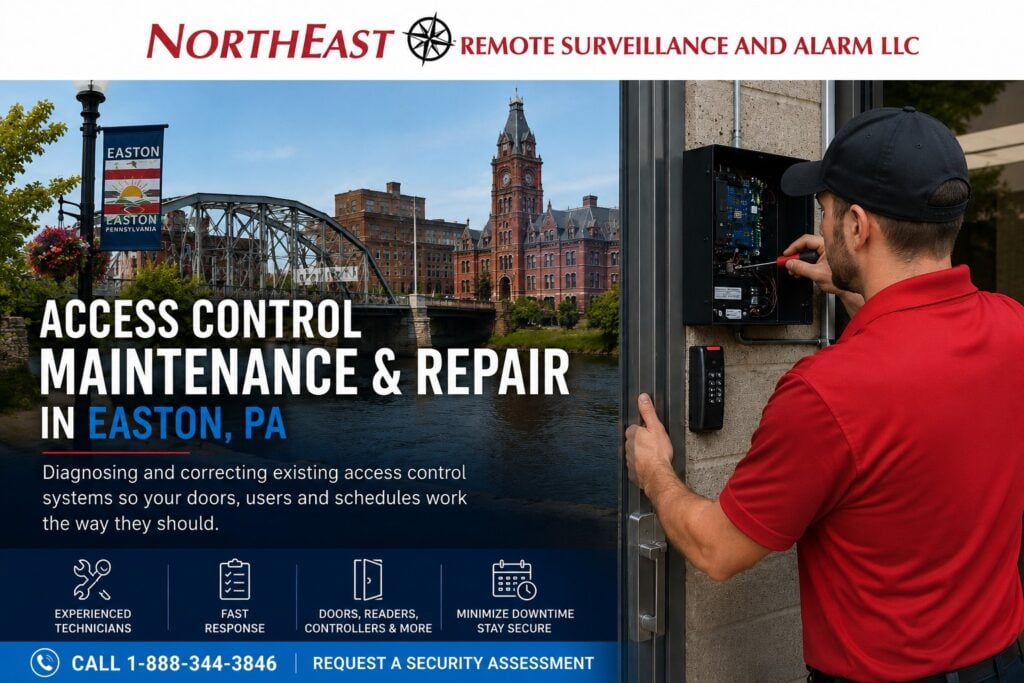
Access Control Maintenance & Repair in Easton, PA

Commercial access control maintenance and repair in Easton, PA should focus on diagnosing and correcting existing access-control systems that are not operating reliably, including readers, keypads, credentials, controllers, power supplies, door contacts, request-to-exit devices, communication, programming, and controlled-door operation.

Northeast Remote Surveillance and Alarm, LLC provides commercial access control maintenance and repair in Easton, Pennsylvania for qualifying offices, warehouses, manufacturing facilities, healthcare properties, industrial buildings, contractor facilities, multi-tenant properties, and other non-residential environments.

For broader Easton access-control planning, visit Commercial Access Control Systems in Easton, PA.

Commercial access control maintenance and repair in Easton Pennsylvania with technician testing card reader controlled door controller wiring and power supply

Access Control Service for Existing Systems

An access-control system may remain fundamentally appropriate for the property while developing individual problems that need diagnosis and repair.

Common service concerns can include:

  • Reader not accepting credentials
  • Intermittent card or fob response
  • Keypad not responding
  • Door not unlocking
  • Door remaining unlocked
  • Door not relatching
  • Controller communication faults
  • Failed door contacts
  • Request-to-exit problems
  • Weak or failed power supplies
  • Battery problems
  • Incorrect schedules
  • User-permission problems
  • Failed network communication
  • Unexplained access events
  • Administrator-access problems

The first objective should be to determine what has actually failed before replacing equipment unnecessarily.

Reader and Credential Problems

A reader problem can present in several ways.

Users may report that:

  • A card works intermittently
  • One reader rejects valid credentials
  • Multiple credentials stop working
  • Mobile credentials respond inconsistently
  • The reader has no power
  • The reader indicates access granted but the door remains locked

The reader itself may not always be the cause.

Potential issues can involve:

  • Reader hardware
  • Cabling
  • Controller input
  • Credential enrollment
  • Access permissions
  • Schedules
  • Power
  • Communication
  • Locking hardware

A proper service call should separate credential, reader, controller, and door-operation problems rather than assuming the visible device is responsible.

Keypad Problems

Commercial keypads may develop issues such as:

  • Keys not responding
  • Users unable to enter valid PINs
  • Shared codes that should be removed
  • Incorrect programming
  • Power problems
  • Communication failures
  • Damaged equipment

Where the existing keypad remains appropriate, repair or programming correction may be sufficient.

Where the equipment is no longer dependable or supported, a broader modernization decision may be appropriate.

Doors That Do Not Unlock

A credential may be accepted while the controlled door remains locked.

Possible causes can include:

  • Failed electric strike
  • Failed electrified lock
  • Failed electrified trim
  • Insufficient lock power
  • Controller relay problem
  • Broken wiring
  • Improper programming
  • Mechanical pressure on the latch
  • Door or frame misalignment

The service process should determine whether the problem is electronic, electrical, mechanical, or a combination of those conditions.

Doors That Do Not Relock

A controlled opening can also fail after successful entry.

Potential symptoms include:

  • Door remains physically open
  • Latch does not engage
  • Strike does not return correctly
  • Door closer does not pull the opening shut
  • Exit hardware does not reset
  • Door is reported secure when it has not latched

Reliable access control requires the door to release, open, close, and relatch properly.

Intermittent Door Problems

Intermittent failures can be more difficult to diagnose than complete failures.

A door may work:

  • At certain times of day
  • For some users but not others
  • After a controller reset
  • Until the building becomes busy
  • Only when the door is pulled or pushed
  • Until a power fluctuation occurs

Intermittent problems may involve:

  • Loose connections
  • Weak power supplies
  • Failing batteries
  • Damaged cable
  • Marginal hardware
  • Door alignment
  • Communication instability
  • Programming
  • Environmental conditions

Service should address the underlying condition rather than repeatedly resetting the system without identifying the cause.

Controller Troubleshooting

Controllers coordinate the readers, credentials, door hardware, schedules, inputs, outputs, and communication used by the access-control system.

Possible controller-related problems include:

  • Controller offline
  • Doors not communicating
  • Reader inputs failing
  • Lock outputs failing
  • Inconsistent event reporting
  • Communication interruptions
  • Programming loss
  • Network configuration problems
  • Power problems

A controller should not automatically be replaced simply because a door is malfunctioning.

Testing should determine whether the controller, field device, wiring, power, or programming is responsible.

Power Supply Problems

Commercial access-control systems rely on dependable power for:

  • Controllers
  • Readers
  • Locking hardware
  • Request-to-exit devices
  • Auxiliary equipment
  • Communication devices

Power-related problems can cause:

  • Intermittent unlocking
  • Weak lock operation
  • Controller resets
  • Offline equipment
  • Reader failures
  • Unreliable door operation

Service may require evaluation of:

  • Output voltage
  • Power-supply capacity
  • Fuses
  • Distribution
  • Batteries
  • Connections
  • Lock current requirements

Power problems can appear to be access-control software problems when the underlying issue is electrical.

Battery Backup

Battery backup helps supported access-control equipment continue operating appropriately during temporary power interruptions.

Batteries should be reviewed when there are concerns involving:

  • Short backup duration
  • Repeated controller resets
  • Failed charging
  • Swollen or deteriorated batteries
  • Low-voltage conditions
  • Aging power supplies

Battery replacement should be based on system requirements and actual condition.

Door Contact Problems

Door-position contacts help the system determine whether a controlled opening is open or closed.

Problems may include:

  • Door always showing open
  • Door always showing closed
  • Intermittent status
  • False held-open events
  • False forced-door events
  • Physical contact misalignment
  • Damaged wiring

The door contact, wiring, programming, and physical opening may all need to be evaluated.

Request-to-Exit Problems

Request-to-exit equipment helps the system recognize authorized exit activity.

Problems may involve:

  • Motion device not detecting correctly
  • Exit-device switch failure
  • Improper placement
  • Damaged wiring
  • Programming
  • Intermittent operation

Request-to-exit equipment should operate consistently while maintaining required egress.

User and Credential Troubleshooting

Some service calls involve administration rather than failed hardware.

Common issues may include:

  • New employee cannot enter
  • Former employee remains active
  • Credential assigned to wrong user
  • Incorrect door permission
  • Incorrect schedule
  • Duplicate user records
  • Lost credential still active
  • Employee changed departments
  • Temporary credentials never removed

A properly administered system should make user permissions understandable and manageable.

Schedule Problems

Access may fail because the user’s credential is outside the permitted schedule.

Schedule problems can include:

  • Incorrect business hours
  • Wrong employee shift
  • Holiday schedule errors
  • Weekend restrictions
  • Contractor schedules
  • After-hours permissions
  • Daylight-saving or system-time issues

The service process should confirm that hardware is actually failing before replacing components when the problem is caused by scheduling.

Access-Control Communication Problems

Modern systems may depend on local networks, cloud communication, cellular connections, or other communication paths.

Problems may include:

  • Controller offline
  • Remote administration unavailable
  • Events not updating
  • Cloud connection interrupted
  • Network-address changes
  • Switch or cabling problems
  • Firewall or communication changes

Local door operation and remote management may behave differently during communication failures depending on the system.

Service should determine which functions are affected and why.

Administrator Access Problems

A business may discover that:

  • Nobody knows the administrator password
  • A former employee controls the account
  • A previous provider retains system access
  • Account recovery information is outdated
  • Administrator roles are unclear

Recovering appropriate customer administration can be an important part of restoring an existing system to dependable operation.

Broad account migration or system-wide modernization belongs with Easton Access Control System Upgrades.

Controlled Door Hardware Problems

Access-control service may identify a physical problem at the opening rather than an electronic failure.

Possible concerns include:

  • Misaligned strike
  • Worn latch
  • Failing electrified trim
  • Damaged exit hardware
  • Door closer problem
  • Frame movement
  • Power-transfer failure
  • Door not closing properly

Minor adjustment may be part of repairing the immediate access-control problem.

When the primary project becomes physical modernization of the existing controlled opening, visit Easton Door Hardware & Access Control Retrofits.

Existing Wiring Problems

Existing access-control wiring may develop problems because of:

  • Damage
  • Loose terminations
  • Previous repairs
  • Abandoned conductors
  • Poor labeling
  • Moisture
  • Construction activity
  • Unsupported modifications

Troubleshooting may require tracing circuits and verifying continuity, voltage, communication, and device operation.

The goal is to identify the failed condition rather than replacing equipment that remains functional.

Service After Employee or Tenant Changes

Access-control problems sometimes become apparent after operational changes.

Examples include:

  • Large employee turnover
  • New tenant occupancy
  • Department changes
  • New work shifts
  • Contractor projects
  • Management changes
  • Former administrator departure

These conditions may require user cleanup, schedule correction, credential changes, or minor configuration work without requiring complete system replacement.

Maintenance for High-Use Commercial Doors

Some controlled openings experience much heavier use than others.

Examples may include:

  • Main employee entrances
  • Warehouse personnel doors
  • Manufacturing employee entrances
  • Shared office entrances
  • Healthcare staff entrances
  • Shipping-office doors

High-use doors may experience wear involving:

  • Readers
  • Locking hardware
  • Closers
  • Door contacts
  • Request-to-exit devices
  • Power transfer
  • Cabling

Periodic service can help identify deteriorating components before the opening becomes completely unreliable.

Repair vs. Upgrade

Repair and modernization are different requirements.

Maintenance and repair is appropriate when an existing system remains suitable but has a specific fault that needs diagnosis and correction.

Examples include:

  • Failed reader
  • Bad power supply
  • Incorrect schedule
  • Communication fault
  • Door-contact problem
  • Request-to-exit failure
  • Individual door not unlocking
  • Credential problem

A broader upgrade may be appropriate when the problem involves:

  • Unsupported controllers
  • Obsolete software
  • System-wide credential replacement
  • Platform migration
  • Major expansion
  • Lost system ownership
  • Repeated failures across multiple doors
  • Architecture that no longer meets the property’s needs

For those projects, visit Easton Access Control System Upgrades.

Commercial Access Control Maintenance in Easton and Northampton County

NERSA provides qualifying commercial access-control service throughout Easton, Palmer Township, Forks Township, Wilson, West Easton, Williams Township, the Route 33 corridor, I-78, and surrounding Northampton County commercial and industrial areas.

Properties may include:

  • Offices
  • Warehouses
  • Distribution centers
  • Manufacturing facilities
  • Healthcare properties
  • Industrial buildings
  • Contractor facilities
  • Multi-tenant properties
  • Commercial campuses

The service approach should reflect the existing system, controlled openings, users, equipment, and actual symptoms being experienced.

Frequently Asked Questions

Do you repair existing commercial access-control systems?

Yes. Existing systems can be evaluated to determine whether the problem involves readers, credentials, controllers, power, wiring, locking hardware, door contacts, request-to-exit equipment, communication, programming, or another supported component.

Why does my reader accept the card but the door stay locked?

Possible causes include failed locking hardware, insufficient power, wiring problems, controller-output problems, mechanical pressure on the latch, or door alignment.

Why does one employee’s credential not work?

The issue may involve the credential itself, user permissions, access schedules, enrollment, reader compatibility, or system programming.

Can a failed power supply cause intermittent access-control problems?

Yes. Weak or overloaded power supplies can cause unreliable lock operation, controller resets, communication problems, and other intermittent symptoms.

Can door contacts be repaired or replaced?

Yes. Door-position contacts and associated wiring can be evaluated when door status or forced/held-open reporting is unreliable.

Can request-to-exit devices be serviced?

Yes. Existing request-to-exit equipment can be evaluated for device, placement, wiring, programming, and operational problems.

Can you troubleshoot an access-control controller that is offline?

Yes. An offline controller may involve network communication, power, cabling, configuration, controller hardware, or supporting infrastructure.

Can existing access-control wiring be repaired?

Sometimes. Existing wiring can be evaluated for damage, continuity, connections, labeling, routing, and compatibility.

Is repair the same as an access-control upgrade?

No. Repair addresses specific faults in an existing system. Broader modernization, migration, expansion, and system-wide changes are handled separately.

Do you service residential access control?

No. Northeast Remote Surveillance and Alarm focuses on commercial and industrial systems.

Request Easton Access Control Maintenance & Repair

If your Easton commercial or industrial property has an access-controlled door that will not unlock, an intermittent reader, controller communication problems, failed door contacts, request-to-exit issues, credential problems, unreliable power, or another existing access-control fault, Northeast Remote Surveillance and Alarm, LLC can evaluate the system and determine the appropriate repair approach.

Request a Security Assessment or call 1-888-344-3846.

Scroll to Top
1-888-344-3846