Warehouse access control systems in Easton, PA should be designed around the controlled doors, restricted interior areas, inventory-related spaces, office-to-warehouse transitions, support rooms, and operational areas where tighter accountability is required.
Northeast Remote Surveillance and Alarm, LLC designs, installs, upgrades, expands, repairs, and supports warehouse access control systems in Easton, Pennsylvania for warehouses, distribution centers, logistics facilities, industrial storage buildings, and mixed office-warehouse properties.
This page owns one specific intent: access control for warehouse doors, restricted areas, and controlled interior movement in Easton warehouse environments.
For broader Easton access-control planning, visit Commercial Access Control Systems in Easton, PA.
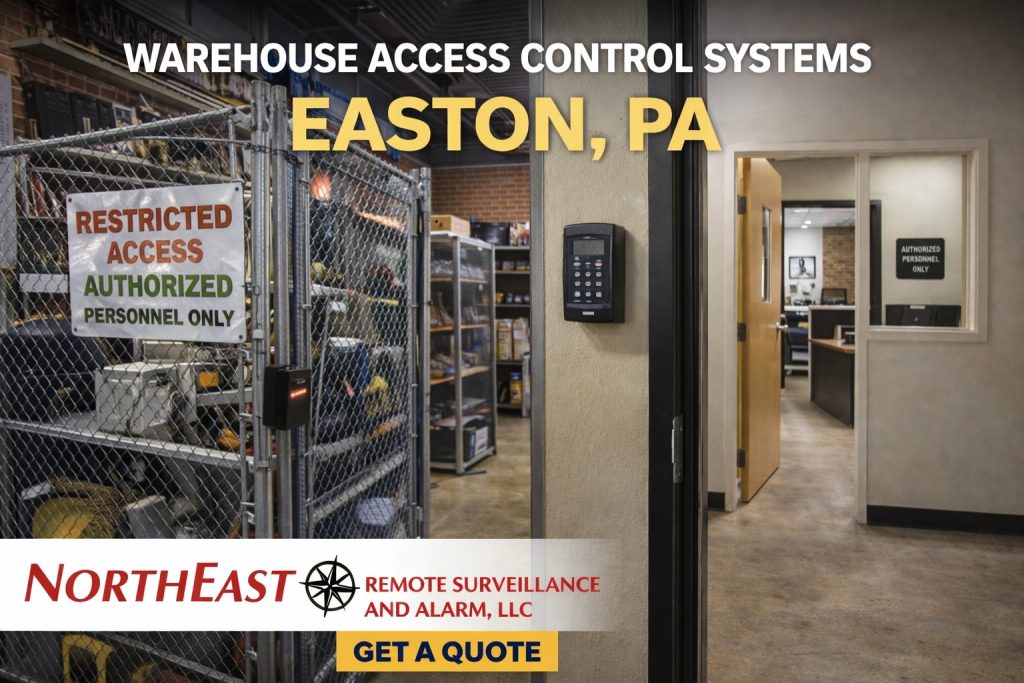
Access Control Built Around Warehouse Operations
Warehouses often combine large open operational areas with offices, inventory spaces, restricted rooms, maintenance areas, shipping functions, and interior transition points.
Those different spaces should not automatically have the same access permissions.
Warehouse access control should help determine:
- Which doors require electronic control
- Which interior areas should remain restricted
- Who may enter each controlled space
- When access is permitted
- How controlled-door activity is recorded
- How permissions should change as employees and responsibilities change
The objective is not to install readers throughout the building simply because doors exist.
The objective is to control the openings that have a legitimate operational or security requirement.
Warehouse Personnel Doors
Personnel entrances are common controlled openings in warehouse properties.
These may include:
- Main employee entrances
- Rear employee entrances
- Side personnel doors
- Shipping-office entrances
- Maintenance entrances
- Interior operational doors
- After-hours entrances
Each opening should be evaluated according to its use, traffic level, existing hardware, access requirements, and required egress.
Office-to-Warehouse Transitions
Many Easton warehouse properties combine administrative offices with active warehouse space.
Office employees, warehouse personnel, supervisors, contractors, vendors, maintenance staff, and visitors may use the same facility without needing the same access.
Office-to-warehouse transition doors can help define movement between:
- Administrative areas
- Warehouse operations
- Restricted storage
- Shipping offices
- Maintenance areas
- Employee-only spaces
Permissions should reflect actual job responsibilities rather than granting unrestricted movement throughout the building.
Secure Inventory and Storage Areas
Certain warehouse spaces may require tighter control than the general warehouse floor.
Examples may include:
- Secure inventory rooms
- High-value storage
- Returns areas
- Parts rooms
- Tool cribs
- Restricted cages
- Controlled storage rooms
Electronic access control can replace broad shared-key practices with individual credentials and defined permissions.
That can make it easier to determine who was authorized to enter a restricted space and when the credential was used.
Tool Rooms and Parts Areas
Tool rooms and parts storage areas can become difficult to manage when access is based entirely on shared keys or common codes.
Access control may allow management to:
- Limit entry to approved employees
- Assign individual credentials
- Apply schedules
- Remove access when responsibilities change
- Review credential activity at the controlled opening
The access-control system should remain simple enough for authorized staff to administer reliably.
Maintenance and Support Spaces
Warehouse facilities may contain support spaces that should not be open to all employees.
These can include:
- Maintenance rooms
- Mechanical spaces
- Electrical rooms
- IT rooms
- Communications rooms
- Equipment rooms
- Supervisor offices
Access should be assigned according to operational responsibility.
An employee who needs access to the warehouse floor does not automatically need access to maintenance, IT, or equipment spaces.
Restricted Interior Zones
Some warehouse operations require controlled movement between different interior areas.
Examples can include:
- Inventory control spaces
- Returns processing
- Restricted storage
- Office-to-warehouse doors
- Staff-only support areas
- High-value material areas
- Specialized operational rooms
The system should define those boundaries without interfering unnecessarily with normal warehouse workflow.
Dock-Adjacent Personnel Doors
Warehouse access-control projects may include personnel doors located near shipping and receiving operations.
These doors may serve:
- Employees
- Dispatch staff
- Receiving personnel
- Supervisors
- Contractors
- Vendors
This page owns the controlled personnel doors associated with warehouse operations.
It does not expand into dock surveillance, trailer positions, freight movement, or broader loading-dock security.
Warehouse Door Hardware
Reliable warehouse access control depends on the complete physical opening.
Warehouse-controlled doors may involve:
- Hollow-metal doors
- Exterior personnel doors
- Exit-device doors
- Fire-rated openings
- Interior restricted-area doors
- Office-to-warehouse doors
- Heavy-use operational openings
The controlled opening may require:
- Reader or keypad
- Electric strike
- Electrified lock
- Electrified trim
- Compatible exit hardware
- Door contact
- Request-to-exit device
- Power-transfer hardware
- Power supply
- Battery backup
- Field wiring
A valid credential does not create dependable access control if the door fails to release, close, or relatch correctly.
The physical opening and electronic access-control system must operate together.
Credentials and User Permissions
Warehouse access-control systems may use compatible:
- Cards
- Key fobs
- Mobile credentials
- Individual PINs
- Other supported electronic credentials
Individual credentials generally provide better accountability than shared cards or common codes.
Permissions can be assigned according to:
- Employee
- Department
- Door
- Restricted area
- Job responsibility
- Contractor assignment
- Management role
This page addresses credentials and permissions only as they relate to warehouse controlled doors and restricted areas.
For employee-specific entry, staff credentials, workforce permissions, and shift-based personnel access, visit Warehouse Employee Access Control Systems in Easton, PA.
Access Schedules
Warehouse operations may require different access periods for different users.
Schedules can reflect:
- Normal operating hours
- Multiple shifts
- Weekend work
- Cleaning periods
- Contractor access
- Maintenance windows
- Temporary projects
- After-hours authorization
A user should receive access when operationally necessary without automatically receiving unrestricted access at all times.
Access Records
Compatible systems may provide records associated with controlled warehouse doors.
Authorized administrators may be able to review:
- Access granted
- Access denied
- Credential use
- Selected door activity
- Selected held-open conditions
- Selected forced-door conditions
These records can provide useful accountability around controlled openings.
They do not replace broader incident investigation or video surveillance, and this page does not develop those separate systems.
Warehouse Access Control Infrastructure
A dependable installation may require:
- Reader cabling
- Door-contact wiring
- Request-to-exit wiring
- Lock-power wiring
- Controller cabling
- Network connectivity
- Equipment enclosures
- Power supplies
- Backup batteries
Infrastructure should be organized, labeled, and documented so the system remains understandable and serviceable.
Warehouse environments may also require careful equipment placement because of distances, building layout, environmental conditions, and available pathways.
Controller and Door Configuration
The completed system should be configured around the actual warehouse layout.
Configuration may include:
- Door names
- Users
- Credentials
- Door permissions
- Schedules
- Access levels
- Selected alerts
- Administrator accounts
- Communication settings
Door names should be understandable to the people managing the facility.
Names such as Main Employee Entrance, Warehouse Office Door, Tool Room, or Parts Storage are generally more useful than generic labels such as Door 4 or Reader 7.
Warehouse Access Control for Existing Facilities
Many Easton warehouses already have some access-control equipment in place.
Existing readers, controllers, credentials, wiring, locks, power supplies, and door hardware may remain useful when they are compatible, supported, serviceable, and appropriate for the intended system.
Common existing-system concerns may include:
- Unsupported controllers
- Aging readers
- Poor credential management
- Former employees remaining active
- Lost administrator access
- Weak power supplies
- Door hardware problems
- Undocumented wiring
- Limited expansion capacity
When the primary project is modernization, takeover, migration, or correction of an existing access-control system, visit Easton Access Control System Upgrades.
Planning for Expansion
A warehouse may begin with only a few controlled openings and later require additional restricted areas.
Future expansion may include:
- Additional personnel doors
- More restricted rooms
- Additional inventory areas
- New departments
- Additional buildings
- More users
- Additional administrators
The initial system should support present requirements without unnecessarily limiting reasonable future growth.
Warehouse Access Control in Easton and Northampton County
NERSA supports qualifying warehouse and distribution properties throughout Easton, Palmer Township, Forks Township, Wilson, West Easton, Williams Township, the Route 33 corridor, I-78, and surrounding Northampton County commercial and industrial areas.
Properties may include:
- Warehouses
- Distribution centers
- Logistics facilities
- Industrial storage buildings
- Mixed office-warehouse properties
- Contractor facilities
- Multi-building industrial operations
Each project should be designed around the actual building, doors, restricted spaces, employees, contractors, operating schedules, existing equipment, and future requirements.
Warehouse Access Control vs. Warehouse Employee Access
These pages have separate ownership.
Warehouse Access Control Systems in Easton owns:
- Warehouse controlled doors
- Restricted interior zones
- Inventory rooms
- Tool rooms
- Parts rooms
- Support areas
- Office-to-warehouse transitions
- Door hardware associated with warehouse access
Warehouse Employee Access Control Systems in Easton owns:
- Employee entrances
- Employee credentials
- Shift-based permissions
- Workforce access
- Temporary personnel
- Employee onboarding and offboarding
Keeping those topics separate gives each page one clear purpose.
Frequently Asked Questions
What is warehouse access control?
Warehouse access control manages entry through selected warehouse doors and into restricted interior areas where access should be limited to approved users.
What warehouse areas can be controlled?
Common examples include office-to-warehouse transition doors, inventory rooms, parts rooms, tool cribs, maintenance spaces, IT rooms, dispatch areas, restricted storage, and employee personnel doors.
How is warehouse access control different from warehouse employee access?
Warehouse access control focuses on the controlled openings and restricted areas throughout the facility, while warehouse employee access focuses specifically on workforce credentials, employee entrances, shift permissions, and personnel administration.
Can warehouse employees have different permissions?
Yes. Compatible systems can assign access according to employee, department, job responsibility, door, restricted area, and schedule.
Can lost credentials be disabled?
Yes. Individual electronic credentials can generally be disabled without rekeying every controlled warehouse opening.
Can existing warehouse doors be used?
Often, yes. Existing doors, frames, locks, exit hardware, wiring, and power should be evaluated for condition and compatibility before electronic control is added.
Can existing access-control equipment be reused?
Sometimes. Existing readers, controllers, credentials, wiring, power supplies, and locking hardware should be evaluated for compatibility, condition, supportability, and reliability.
Does this page include vehicle gate access?
No. This spindle owns warehouse building doors and restricted interior areas, not dedicated commercial vehicle-gate systems.
Does this page include loading-dock security?
No. Dock-adjacent personnel doors may be part of warehouse access control, but broader loading-dock security remains a separate subject.
Does warehouse access control include video surveillance?
No. Video surveillance is a separate security discipline and is not developed on this page.
Request an Easton Warehouse Access Control Assessment
If your Easton warehouse has uncontrolled doors, shared keys, poorly managed credentials, office-to-warehouse transitions, restricted inventory spaces, tool rooms, support areas, or controlled openings that are not operating reliably, Northeast Remote Surveillance and Alarm, LLC can evaluate the facility and discuss the appropriate access-control approach.
Request a Security Assessment or call 1-888-344-3846.