Greater Reading Area Industrial Park Directory

Commercial & Industrial Security Integration Guide

by Northeast Remote Surveillance and Alarm, LLC

Serving Berks County and beyond

Industrial Parks in the Greater Reading Area

The Greater Reading Area — anchored by the City of Reading and extending across Berks County — is one of Pennsylvania’s most strategically positioned industrial corridors. With direct access to I-78, US-422, Route 61, Route 222, and proximity to the Port of Philadelphia and Lehigh Valley logistics hubs, TheGreater Lehigh Valley, The Greater Hazelton Industrial Corridor and Berks County has evolved into a powerful concentration of:

  • Distribution centers
  • Advanced manufacturing facilities
  • Food processing plants
  • Packaging operations
  • Corporate headquarters
  • Multi-tenant industrial parks
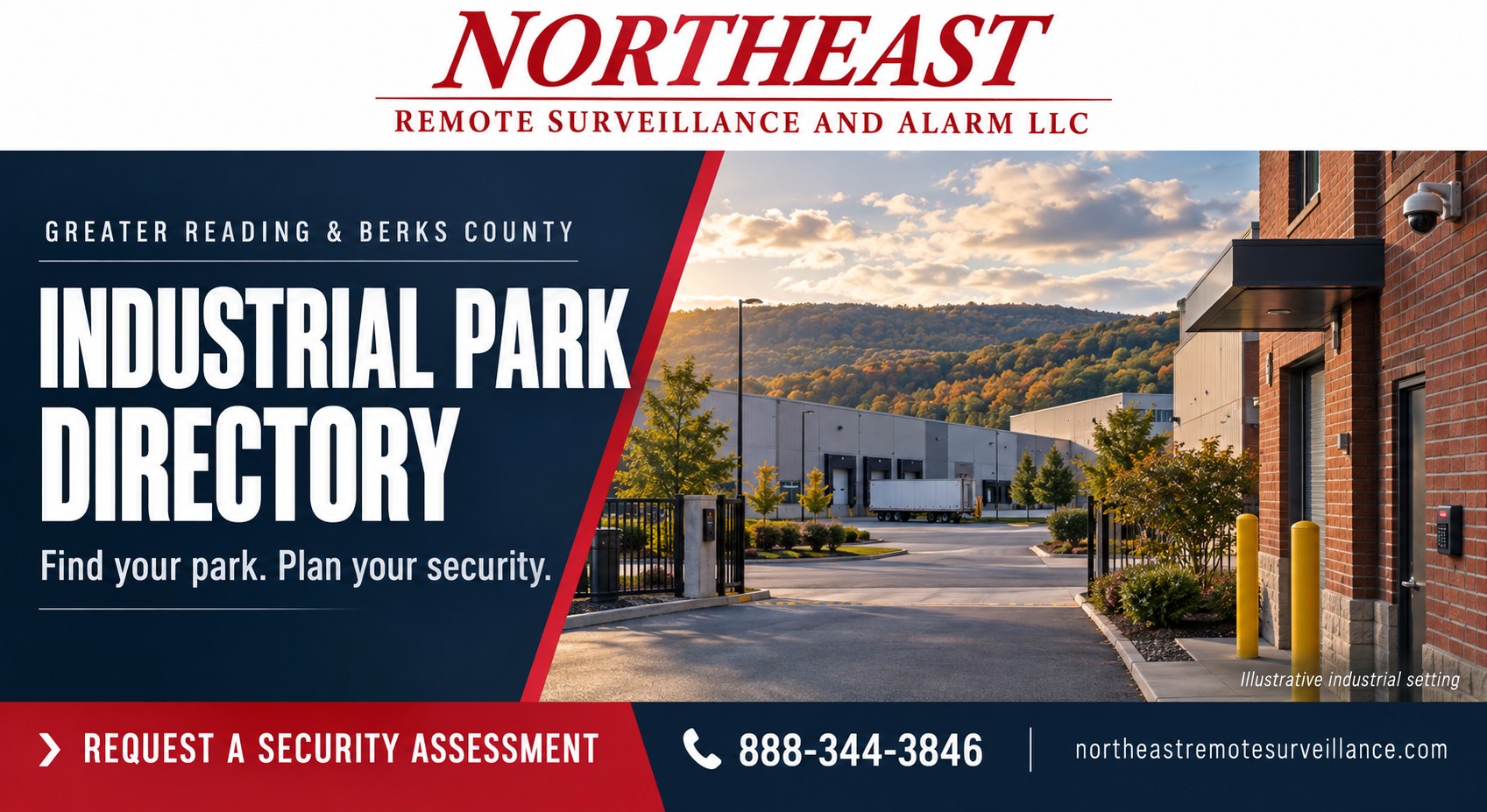
Aerial view of a modern industrial park in Berks County, Pennsylvania with branded overlay text Greater Reading Area Industrial Park Directory and Northeast Remote Surveillance and Alarm LLC logo with phone numAerial view of a modern industrial park in Berks County, Pennsylvania with branded overlay text Greater Reading Area Industrial Park Directory and Northeast Remote Surveillance and Alarm LLC logo with phone number 1-888-344-3846.ber 1-888-344-3846.
Greater Reading Area Industrial Park Directory – Commercial & Industrial Security Integration in Berks County, PA. Call Northeast Remote Surveillance & Alarm LLC at 1-888-344-3846.

This directory is designed to serve three purposes:

  1. Comprehensive Industrial Park Listing
  2. Operational & Security Consideration Guide
  3. Commercial Security Integration Reference

For property owners, facility managers, REITs, corporate tenants, and developers, this page provides actionable intelligence on the industrial landscape — and outlines how Northeast Remote Surveillance and Alarm, LLC supports infrastructure protection throughout the region.


Regional Overview: Berks County Industrial Ecosystem

Map of Hamburg Pennsylvania showing Hamburg Logistics Center, Hamburg Commerce Park, and Hamburg Logistics Park along I-78 and Route 61 in Berks County with NERSA branding
Hamburg Logistics Center, Commerce Park, and Logistics Park form one of the fastest-growing industrial and distribution clusters in Berks County along the I-78 corridor.

The industrial growth of Berks County is driven by:

  • I-78 corridor expansion
  • Amazon and national 3PL growth
  • Cold storage development
  • Food-grade manufacturing compliance demand
  • Increased multi-tenant light industrial leasing
  • Foreign Trade Zone activity in surrounding regions

Security requirements in these environments are increasingly sophisticated, often involving:

  • Enterprise video management systems
  • AI-based video analytics
  • Access control with audit trail compliance
  • Fire alarm and life safety integration
  • Network infrastructure hardening
  • Perimeter intrusion detection
  • Two-way communication / IP speaker talk-down
  • Solar and cellular mobile surveillance

This directory organizes the major industrial parks and commercial centers throughout the Greater Reading Area and outlines security considerations specific to each.


Major Industrial Parks & Commercial Centers – Greater Reading Area


1. Reading Regional Airport Business Park

📍 Bern Township / Reading, PA

Located adjacent to Reading Regional Airport, this business park supports aviation-related services, warehousing, and light manufacturing.

Key Characteristics:

  • Air freight adjacency
  • Corporate hangars
  • Logistics operations
  • Industrial flex space

Security Considerations:

  • Airside perimeter monitoring
  • Gate access control integration
  • FAA-compliant perimeter detection
  • Hangar intrusion protection
  • Camera systems resistant to aviation fuel vapor environments

2. Grings Hill Road Industrial Corridor

📍 Spring Township

One of the primary industrial corridors serving distribution and warehousing operations.

Key Characteristics:

  • Large-format warehouses
  • Truck court-heavy facilities
  • Cross-dock layouts
  • Multi-tenant distribution buildings

Security Considerations:

  • Dock door monitoring (rail-mounted contacts)
  • AI vehicle tracking analytics
  • Trailer yard monitoring
  • License plate recognition
  • Centralized VMS for multi-tenant management

3. Reading Industrial Park (South Reading Corridor)

📍 Cumru Township

Mixed-use heavy industrial and manufacturing properties.

Key Characteristics:

  • Legacy manufacturing buildings
  • Food production
  • Packaging plants
  • Metal fabrication

Security Considerations:

  • Explosion-rated camera environments (where applicable)
  • Temperature and refrigeration monitoring alarms
  • OSHA-compliant safety monitoring
  • PPE detection analytics
  • Access zoning for shift management

4. Green Hills Corporate Center

📍 Wyomissing, PA

Corporate office and light industrial campus.

Key Characteristics:

  • Corporate headquarters
  • Professional offices
  • Light R&D
  • High visitor traffic

Security Considerations:

  • Integrated visitor management
  • Frictionless entry access control
  • Enterprise cloud-based VMS
  • Cyber-secured network switching
  • ADA-compliant access points

5. Berks 222 Business Corridor

📍 Muhlenberg Township

Growing commercial-industrial mix with high traffic flow.

Key Characteristics:

  • Mid-size warehouse
  • Equipment yards
  • Fleet operations

Security Considerations:

  • Fleet yard perimeter analytics
  • After-hours vehicle detection
  • Cellular surveillance for detached yards
  • Integrated intrusion and video verification

6. Buttonwood Street Industrial Cluster

📍 Reading, PA

Urban industrial cluster with multi-tenant occupancy.

Key Characteristics:

  • Shared loading zones
  • Mixed light manufacturing
  • Urban freight access

Security Considerations:

  • Shared camera infrastructure
  • Zoned tenant access
  • Alarm partitioning
  • Video verification monitoring

7. Morgantown Industrial Corridor

📍 Southern Berks County

Strategically located along I-176 and I-76 (PA Turnpike).

Key Characteristics:

  • High-clear warehouse
  • E-commerce distribution
  • National 3PL occupancy

Security Considerations:

  • AI analytics for dock traffic flow
  • Centralized multi-site video monitoring
  • Card + mobile credential access
  • Integrated fire alarm & suppression monitoring

8. Exeter Business Park

📍 Exeter Township

Commercial and light industrial mix.

Key Characteristics:

  • Office flex
  • Medical and commercial tenants
  • Warehousing

Security Considerations:

  • Controlled interior access zoning
  • Audit trail compliance
  • Fire alarm upgrades for mixed occupancy
  • IP speaker emergency paging

9. West Reading Commercial District (Light Industrial)

📍 West Reading

Converted industrial spaces now used for light manufacturing and specialty production.

Security Considerations:

  • Retrofit cabling solutions
  • Wireless intrusion sensors
  • Compact enterprise NVR systems
  • Multi-tenant alarm partitioning

10. Shoemakersville Industrial Area

📍 Northern Berks County

Smaller distribution facilities and equipment yards.

Security Considerations:

  • Solar/cellular surveillance trailers
  • Remote gate control
  • Yard analytics
  • Cellular alarm communicators

Industrial Growth Trends in the Greater Reading Area

1. High-Bay Warehouse Expansion

New developments increasingly exceed 32-40 ft clear heights.

Security Implication:

  • Elevated camera mounting
  • Advanced PTZ analytics
  • Thermal imaging in large spaces

2. Food-Grade Manufacturing Compliance

Facilities require:

  • Audit trail documentation
  • Controlled access to production zones
  • Temperature monitoring alarms
  • Cleanable camera enclosures

3. Multi-Tenant Industrial Conversions

Older buildings subdivided for multiple tenants.

Security Implication:

  • Partitioned alarm systems
  • Shared infrastructure VMS
  • Access segmentation
  • Central management with tenant autonomy

Comprehensive Security Services for Greater Reading Industrial Parks

Northeast Remote Surveillance and Alarm, LLC supports:

Commercial & Enterprise Video Surveillance

  • 4K and multi-sensor cameras
  • AI-based analytics
  • License plate recognition
  • Thermal imaging
  • Cloud and on-prem VMS
  • Centralized monitoring

Applications:

  • Dock doors
  • Trailer yards
  • Manufacturing floors
  • Cold storage
  • Equipment yards
  • Corporate campuses

Lear more about Commercial and Enterprise Video Surveillance in the Greater Reading Area Industrial Parks and Commerce Centers


Industrial Intrusion Alarm Systems

  • Wireless and hardwired sensors
  • Heavy-duty overhead door contacts
  • Gate monitoring
  • Environmental sensors
  • Temperature & water level alarms
  • Video verification triggers

Alarm monitoring outputs:

  • Text
  • Email
  • Central station dispatch
  • On-site alerting
  • Talk-down activation

Learn how NERSA Intrusion Alarms and Custom Monitoring for any sensor Improves physical plant security


Access Control Systems

  • OSDP-secured readers
  • Mobile credentials
  • Keycard & biometric options
  • Frictionless entry
  • Elevator control
  • Multi-site enterprise platforms

Compliance support:

  • Audit logs
  • Access level segmentation
  • Visitor management
  • OSHA and safety control integration

Learn how Enterprise Access Control Installations in the Greater Reading Area help meet OSHA Compliance


Fire Alarm & Life Safety

  • Code-compliant systems
  • Warehouse high-bay detection
  • Mixed-use occupancy integration
  • Monitoring and inspection
  • Mass notification integration

Improve Life Safety and meet the AHJ Intrepeted Code and Compliance Requirements with NERSA Fire Alarms


Two-Way Communication & IP Speaker Talk-Down

  • Dock area announcements
  • After-hours intrusion deterrence
  • Emergency broadcast
  • Integration with video analytics
  • Integration with DMP Intrusion Alarms

Learn how two-way communication through IP Speakers and Talk-Down improves security in Reading


Solar & Cellular Surveillance

Ideal for:

  • Construction sites
  • Detached storage yards
  • Temporary staging areas
  • Rural industrial properties

Learn how both Mobile and Permenate Solar & Cellular Surveillance Solutions can improve your Reading security plan


Security Design Considerations for Industrial Park Developers

Developers should consider:

  1. Fiber backbone infrastructure
  2. Structured cabling (plenum vs riser environments)
  3. Redundant switching
  4. Dedicated MDF/IDF planning
  5. PoE budget planning
  6. Perimeter conduit planning
  7. Gate automation integration
  8. Dock camera raceways
  9. Centralized monitoring room
  10. Expansion pathways

Security is no longer an afterthought — it is part of industrial real estate value.


Risk Factors in Greater Reading Industrial Parks

Theft & Cargo Diversion

Unauthorized Yard Access

Copper Theft

After-Hours Trespass

Vandalism

Workplace Violence

OSHA Safety Violations

Refrigeration Failure

Equipment Tampering

AI analytics now allow proactive detection before escalation.


Why Property Owners Choose Northeast Remote Surveillance and Alarm, LLC

  • Industrial-focused specialization
  • Enterprise-level system design
  • Integration-first philosophy
  • Code-driven installations
  • Local Berks County expertise
  • Scalable infrastructure
  • Centralized multi-site management
  • Long-term service partnership

Greater Reading Industrial Park Directory – Extended Listing

  • Reading Regional Airport Business Park – Bern Township
  • Grings Hill Industrial Corridor – Spring Township
  • Green Hills Corporate Center – Wyomissing
  • Morgantown Industrial Corridor – Caernarvon Township
  • Shoemakersville Industrial Area – Perry Township
  • Buttonwood Industrial Cluster – Reading
  • Exeter Business Park – Exeter Township
  • Berks 222 Industrial Corridor – Muhlenberg Township
  • West Reading Light Industrial District – West Reading
  • Cumru Township Industrial District – Cumru Township
  • Hamburg Logistics Cluster – Hamburg
  • Temple Industrial Corridor – Temple
  • Sinking Spring Commercial Park – Sinking Spring
  • Fleetwood Industrial Area – Fleetwood
  • Birdsboro Industrial District – Birdsboro


Industrial Security Planning Checklist

For any industrial facility in Greater Reading:

  • ☐ Perimeter risk assessment
  • ☐ Dock monitoring strategy
  • ☐ Yard coverage plan
  • ☐ Access zoning design
  • ☐ Fire code review
  • ☐ Redundant network design
  • ☐ AI analytics configuration
  • ☐ Alarm escalation mapping
  • ☐ Emergency communication integration
  • ☐ Central monitoring deployment

Future Development Outlook

Berks County continues to attract:

  • E-commerce operators
  • Food distribution chains
  • Cold storage developers
  • Third-party logistics providers
  • Advanced manufacturing firms

Security infrastructure is now expected to be:

  • AI-driven
  • Integrated
  • Remotely accessible
  • Cyber-hardened
  • Compliance-aligned

Contact & Consultation

For industrial park property owners, developers, and corporate facility managers in the Greater Reading Area:

Northeast Remote Surveillance and Alarm, LLC
📞 1-888-344-3846
Serving DE, MD, NJ, Pennsylvania – Berks County and surrounding regions

Comprehensive services include:


The Greater Reading Area industrial landscape is expanding rapidly. With that growth comes complexity, compliance requirements, and risk exposure.

Security is no longer a commodity — it is infrastructure.

This directory is designed to support:

  • Property investors
  • Industrial developers
  • Corporate real estate managers
  • Logistics operators
  • Manufacturing leadership

If you are operating, leasing, building, or expanding within any Greater Reading industrial park, strategic security integration should be part of your capital planning process from day one.

For consultation, system design and quote call 1-888-344-3846

Regulatory & Compliance Authority Section

Greater Reading Area Industrial Park Directory

Commercial & Industrial Security Compliance Framework

Industrial parks in the Greater Reading Area (Berks County, PA) house warehousing, logistics, food manufacturing, cold storage, heavy manufacturing, and corporate facilities. Each of these environments operates under federal, state, and industry regulatory oversight.

Security systems are not isolated infrastructure — they intersect directly with:

  • Life safety compliance
  • Workplace safety enforcement
  • Food-grade traceability
  • Emergency response planning
  • Critical infrastructure protection
  • Fire code enforcement
  • Access audit requirements
  • Incident documentation standards

Below is a structured regulatory authority framework relevant to industrial park operations and security integration.

Learn more about Code and Compliance realated to Enterprise Security


Federal Workplace & Safety Authorities


Occupational Safety and Health Administration (OSHA)

Primary Authority: Workplace safety enforcement
Jurisdiction: Federal (Pennsylvania operates under federal OSHA)
Website: https://www.osha.gov

Relevant Standards for Industrial Facilities:

  • 29 CFR 1910 – General Industry Standards
  • 29 CFR 1910.36–37 – Means of Egress
  • 29 CFR 1910.303 – Electrical Safety
  • 29 CFR 1910.165 – Employee Alarm Systems
  • 29 CFR 1910 Subpart O – Machinery & Machine Guarding
  • 29 CFR 1910.147 – Lockout/Tagout

Security System Relevance:

  • Emergency notification systems must be audible/visible
  • Fire alarm integration must not obstruct egress
  • Surveillance may support safety audits and incident documentation
  • Access control can restrict hazardous areas
  • PPE detection analytics can assist with safety monitoring

OSHA citations frequently intersect with video evidence and alarm documentation.


Fire & Life Safety Authorities


National Fire Protection Association (NFPA)

Primary Authority: Fire codes & life safety standards
Website: https://www.nfpa.org

Key Codes Impacting Industrial Parks:

  • NFPA 72 – National Fire Alarm & Signaling Code
  • NFPA 70 – National Electrical Code (NEC)
  • NFPA 101 – Life Safety Code
  • NFPA 13 – Sprinkler Systems
  • NFPA 25 – Inspection, Testing & Maintenance

Security System Relevance:

  • Fire alarm systems must meet NFPA 72
  • Wiring types (plenum vs riser) must comply with NEC
  • Mass notification must integrate with fire systems
  • Fire alarm monitoring must meet supervision standards
  • Emergency communication systems must not conflict with evacuation systems

Industrial park buildings undergoing tenant improvements must ensure security cabling does not violate fire ratings or penetrations.


Infrastructure Protection & Critical Industry Guidance


Cybersecurity and Infrastructure Security Agency (CISA)

Primary Authority: National infrastructure protection
Website: https://www.cisa.gov

Relevant Programs:

  • Chemical Facility Anti-Terrorism Standards (CFATS)
  • Infrastructure Security Guidance
  • Active Shooter Preparedness Resources
  • Cybersecurity advisories

Security System Relevance:

  • Perimeter security best practices
  • Risk assessment frameworks
  • Access control planning for critical sites
  • Cybersecurity requirements for networked surveillance
  • Insider threat mitigation

Industrial parks housing chemical, energy, or critical logistics tenants may fall under enhanced guidance.


Food, Beverage & Cold Storage Regulatory Oversight


U.S. Food and Drug Administration (FDA)

Primary Authority: Food safety regulation
Website: https://www.fda.gov

Relevant Regulations:

  • Food Safety Modernization Act (FSMA)
  • 21 CFR Part 117 – Current Good Manufacturing Practices
  • Food Defense Plans
  • Sanitary Transportation Rule

Security Relevance:

  • Controlled access to food production zones
  • Video documentation for contamination investigation
  • Audit trail access logs
  • Temperature monitoring alarms
  • Tamper detection systems

Security infrastructure often becomes part of Food Defense audit documentation.


United States Department of Agriculture (USDA)

Primary Authority: Meat, poultry, agricultural processing oversight
Website: https://www.usda.gov

Security Relevance:

  • Facility access restriction in processing areas
  • Incident documentation
  • Cold storage temperature monitoring
  • Traceability support

Berks County contains multiple food-grade facilities requiring USDA-compliant documentation.


Electrical & Building Code Enforcement


International Code Council (ICC)

Primary Authority: International Building Code (IBC) & Fire Code
Website: https://www.iccsafe.org

Relevant Codes:

  • IBC (adopted by Pennsylvania UCC)
  • International Fire Code
  • Occupancy classification standards

Security integration must respect:

  • Rated wall penetrations
  • Fire-stopping requirements
  • Egress path clearances
  • Emergency lighting visibility

Pennsylvania Department of Labor & Industry

Primary Authority: Pennsylvania Uniform Construction Code (UCC)
Website: https://www.dli.pa.gov

Security Relevance:

  • Low-voltage permitting requirements
  • Fire alarm inspection compliance
  • Third-party inspection coordination

Industrial park construction and retrofits in Berks County must comply with PA UCC.


Communications & Monitoring Compliance


Federal Communications Commission (FCC)

Primary Authority: Radio & wireless spectrum
Website: https://www.fcc.gov

Security Relevance:

  • Cellular alarm communicators
  • Wireless bridge licensing
  • RF interference compliance

Insurance & Risk Management Standards


FM Global

Authority: Property insurance engineering standards
Website: https://www.fmglobal.com

FM Global often requires:

  • Perimeter protection
  • Monitored fire alarm systems
  • Impairment notification
  • High-value cargo protection

UL Solutions

Authority: Equipment listing & certification
Website: https://www.ul.com

Security equipment may require:

  • UL Listed fire alarm panels
  • UL 294 access control compliance
  • UL central station monitoring certification

Cybersecurity & Data Protection Considerations

Industrial video surveillance and access control systems are IP-based networks.

Relevant guidance bodies:


National Institute of Standards and Technology (NIST)

Website: https://www.nist.gov

Relevant Frameworks:

  • NIST Cybersecurity Framework
  • SP 800-53
  • SP 800-61 (Incident Handling)

Security system integrators must design:

  • VLAN segmentation
  • Secure OSDP encryption
  • Encrypted credential transmission
  • Role-based administrative control

Environmental & Hazardous Materials Oversight


Environmental Protection Agency (EPA)

Website: https://www.epa.gov

Industrial parks with chemical storage may require:

  • Restricted access
  • Incident recording
  • Spill monitoring alerts

How These Authorities Intersect With Security Design

Security in Greater Reading industrial parks intersects with regulation in five major areas:

1. Life Safety Integration

Fire alarms and security must coexist without interference.

2. Workplace Safety Documentation

Video analytics assist in OSHA incident reviews.

3. Food Defense & Traceability

Access logs support FDA and USDA audits.

4. Cybersecurity Hardening

CISA and NIST frameworks influence secure deployment.

5. Insurance Compliance

UL and FM Global influence system selection and monitoring.


Compliance-Driven Security Design Strategy

For industrial park property owners in Berks County, recommended approach:

  1. Conduct code review with AHJ
  2. Verify occupancy classification
  3. Design fire-rated cable pathways
  4. Use UL-listed components
  5. Implement encrypted OSDP readers
  6. Integrate monitored fire & intrusion
  7. Maintain inspection documentation
  8. Segment networks per NIST guidance
  9. Retain audit trail logs
  10. Coordinate with insurance carrier requirements

Berks County Authority Having Jurisdiction (AHJ)

In the Greater Reading Area, compliance oversight typically involves:

  • Local township code enforcement
  • Fire marshal inspection
  • Third-party UCC inspectors
  • Insurance engineering inspections

Security infrastructure should be engineered with documentation available for inspection.


Conclusion: Compliance Is Infrastructure

Industrial park security in the Greater Reading Area is not optional infrastructure. It is intertwined with:

  • Federal workplace safety
  • Fire code compliance
  • Food safety regulation
  • Insurance requirements
  • Infrastructure protection mandates
  • Cybersecurity standards

Northeast Remote Surveillance and Alarm, LLC designs systems aligned with recognized regulatory bodies to ensure:

  • Code compliance
  • Inspection readiness
  • Insurance support
  • Risk mitigation
  • Long-term operational resilience

For compliance-driven industrial security assessment in Berks County:

Call 1-888-344-3846

Greater Reading Area

  • Berks County, PA
  • Commercial facilities
  • Industrial parks
  • Warehouses & logistics
  • Manufacturing plants
  • Enterprise campuses


Greater Reading Area Commercial, Industrial & Enterprise Security FAQ

Serving Berks County, PA


General Commercial Security – Local Area

1. What types of commercial security systems are most common in the Greater Reading Area?
Video surveillance, access control, intrusion alarms, fire alarm integration, and monitored environmental sensors are most common across Berks County facilities.

2. Do warehouses in Reading, PA require monitored alarm systems?
Most insurance carriers require monitored intrusion and fire alarm systems for warehouse operations.

3. How much does commercial video surveillance cost in Berks County?
Costs vary based on square footage, camera count, and infrastructure, but enterprise systems are typically capital investments scaled per facility size.

4. What is the best security system for a distribution center in Berks County?
Integrated systems combining AI video analytics, dock door monitoring, access control, and central monitoring provide the strongest protection.

5. Are industrial parks in Wyomissing and Spring Township seeing increased security demand?
Yes, due to logistics growth and multi-tenant industrial conversions.

6. Do commercial properties in Reading need fire alarm inspections?
Yes. Fire alarm systems must comply with Pennsylvania UCC and NFPA standards.

7. Can security systems be monitored remotely from corporate headquarters?
Yes. Enterprise VMS platforms allow centralized multi-site management.

8. What areas of a warehouse should always have cameras?
Dock doors, trailer yards, shipping/receiving, employee entrances, and high-value storage zones.

9. Can security cameras help reduce OSHA liability?
Video documentation can support incident investigations and workplace safety reviews.

10. Is cellular backup recommended for industrial alarms in Berks County?
Yes. Cellular or dual-path communication protects against ISP outages.


Industrial Warehouse Security

11. How do you secure 40-foot-high warehouse ceilings?
With elevated multi-sensor cameras and strategically placed PTZ units.

12. What is dock door monitoring?
It uses heavy-duty contacts and video analytics to detect unauthorized openings.

13. Are license plate recognition systems effective for Reading industrial parks?
Yes. LPR systems help track vehicle entry and exit activity.

14. Can AI cameras detect loitering in truck yards?
Yes, advanced analytics can trigger alerts before escalation.

15. What security risks are common in Berks County warehouses?
Cargo theft, after-hours trespass, copper theft, and trailer diversion.

16. Can environmental sensors monitor freezer failure?
Yes. Temperature alarms can trigger text/email alerts immediately.

17. Should trailer yards have lighting integrated with surveillance?
Yes. Lighting improves camera clarity and deterrence.

18. What is the benefit of video verification alarms?
They reduce false dispatches and provide real-time situational awareness.

19. How often should industrial security systems be maintained?
Annual inspections are recommended, with quarterly checks for high-risk facilities.

20. Are wireless intrusion sensors reliable in warehouses?
Modern encrypted systems are highly reliable for large facilities.


Access Control – Enterprise & Industrial

21. Do industrial parks in Reading require access control?
While not mandatory, most enterprise facilities implement access control for compliance and safety.

22. What is OSDP and why is it important?
OSDP is an encrypted reader protocol that improves access control security.

23. Can access control restrict forklift-only zones?
Yes, by segmenting facility access permissions.

24. Are mobile credentials used in Berks County?
Increasingly, especially in corporate campuses.

25. Can access control integrate with HR systems?
Yes, enterprise platforms allow automated onboarding/offboarding.

26. How does access control support OSHA compliance?
It restricts entry to hazardous or controlled areas.

27. What happens if power fails?
Systems include battery backup and fail-safe configurations.

28. Can access logs be used for investigations?
Yes, audit trails document who accessed what areas and when.

29. Are biometric readers common in industrial facilities?
They are used in high-security environments.

30. Can multiple Berks County sites be managed from one dashboard?
Yes, enterprise platforms support multi-site management.


Fire Alarm & Life Safety

31. Are fire alarm systems required in warehouses in Berks County?
Yes, depending on occupancy classification and square footage.

32. What code governs fire alarms?
NFPA 72 and Pennsylvania UCC.

33. Can fire alarms integrate with mass notification?
Yes, with properly engineered systems.

34. Are inspections required annually?
Yes, typically annually per code requirements.

35. Can high-bay warehouses use beam detectors?
Yes, where appropriate.

36. Is monitoring required for industrial fire systems?
Most insurance carriers require central monitoring.

37. Can security systems interfere with fire systems?
Improper installation can — proper integration prevents this.

38. Are strobe lights required in commercial facilities?
Yes, for ADA compliance in many occupancies.

39. Can IP speakers be tied into fire messaging?
Yes, when engineered properly.

40. Who enforces fire compliance in Berks County?
Local AHJs and code officials.


AI Video Analytics

41. Can AI detect unauthorized entry after hours?
Yes.

42. Can AI detect missing PPE in manufacturing plants?
Advanced analytics can identify safety compliance issues.

43. Does AI reduce security staffing costs?
It enhances efficiency and proactive detection.

44. Can AI track vehicle movement patterns?
Yes.

45. Is AI effective in low light?
With proper cameras, yes.

46. Does AI replace security guards?
It enhances, not replaces, physical security.

47. Can analytics detect perimeter breaches?
Yes.

48. Are false alarms common?
Modern systems greatly reduce false positives.

49. Can AI detect tailgating at access doors?
Yes.

50. Is AI suitable for cold storage facilities?
Yes, with appropriate hardware.


Solar & Remote Security

51. Are solar surveillance trailers used in Berks County?
Yes, especially in detached yards.

52. Do they require trenching?
No.

53. Can solar units operate year-round?
Yes, with battery storage systems.

54. Are they cellular connected?
Typically LTE or 5G connected.

55. Are they ideal for construction sites?
Yes.


Enterprise Network & Infrastructure

56. Does industrial security require dedicated VLANs?
Yes, for cybersecurity.

57. Are PoE switches used for cameras?
Yes.

58. Is fiber recommended for large warehouses?
Yes.

59. Should MDF/IDF rooms be secured?
Absolutely.

60. Can systems scale as companies expand?
Yes.


Insurance & Compliance

61. Do insurers require monitored fire alarms?
Often, yes.

62. Are UL-listed components important?
Yes.

63. Does FM Global require special protection?
In many cases.

64. Can video assist in insurance claims?
Yes.

65. Are security audits common?
Yes.


Local Area Specific Questions

66. Are Reading industrial parks experiencing cargo theft?
Like many logistics hubs, theft risk exists.

67. Do Wyomissing corporate centers require enterprise systems?
Most implement them.

68. Are Morgantown logistics centers high-security?
Yes.

69. Are Hamburg industrial yards secured?
Many now use remote surveillance.

70. Is Berks County growing industrially?
Yes, especially logistics.


Operational Questions

71. Can security systems send text alerts?
Yes.

72. Can systems integrate with gates?
Yes.

73. Do industrial sites require perimeter fencing?
Highly recommended.

74. How long is video typically stored?
30–90 days, depending on policy.

75. Can systems detect internal theft?
Yes.


Enterprise Scalability

76. Can multiple states be monitored from Reading HQ?
Yes.

77. Can access control integrate with visitor kiosks?
Yes.

78. Are cloud-based systems common?
Increasingly so.

79. Is hybrid cloud/on-prem common?
Yes.

80. Can security integrate with building automation?
Yes.


Environmental Monitoring

81. Can alarms monitor water leaks?
Yes.

82. Can they monitor tank levels?
Yes.

83. Can freezer alarms send email alerts?
Yes.

84. Are flood sensors recommended in basements?
Yes.

85. Can sensors monitor equipment vibration?
Yes.


Workforce & Safety

86. Can panic buttons be installed in offices?
Yes.

87. Are lockdown systems available?
Yes.

88. Can speakers provide emergency instructions?
Yes.

89. Can cameras monitor evacuation?
Yes.

90. Are industrial facilities adopting mass notification?
Increasingly.


Long-Term Strategy

91. How often should systems be upgraded?
Every 5–10 years depending on technology.

92. Is cybersecurity part of security design?
Absolutely.

93. Should industrial parks have master security plans?
Yes.

94. Can security increase property value?
Yes.

95. Are industrial developers planning security during construction?
Increasingly.


Service & Support

96. Is local service important?
Yes.

97. Are emergency service calls available?
Yes.

98. Can systems be customized?
Yes.

99. Is long-term maintenance recommended?
Yes.

100. Who provides commercial and industrial security in the Greater Reading Area?
Northeast Remote Surveillance and Alarm, LLC provides integrated commercial, industrial, and enterprise security solutions throughout Berks County. Call 1-888-344-3846 for an Assessment


Scroll to Top
1-888-344-3846