
Solar powered and cellular video surveillance helps commercial and industrial properties protect areas where utility power, structured cabling, or wired internet are unavailable, delayed, unreliable, or too expensive to extend.

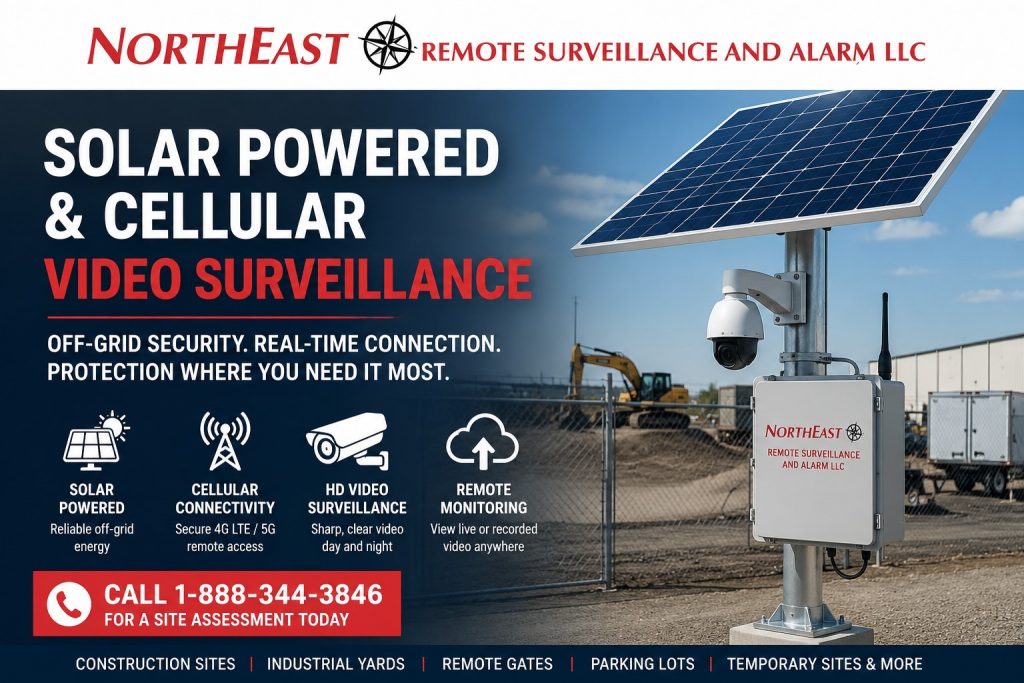
Commercial Off-Grid Video Surveillance for Construction Sites, Industrial Yards, Remote Gates, Trailer Lots, Vacant Buildings, and Temporary Commercial Properties
Off-grid projects may use solar power, battery storage, cellular connectivity, wireless bridge options, local recording, cloud access, remote monitoring, and temporary or semi-permanent camera deployment.
For broader camera planning across commercial and industrial facilities, use the Commercial and Industrial Video Surveillance Systems page.
For a broader jobsite plan that connects temporary cameras, monitoring, power, communications, and changing site conditions, review construction site security systems.
Solar Powered Video Surveillance Where Power and Internet Are Not Ready
Some sites need cameras before permanent power, cabling or internet service is available. Examples include remote gates, construction sites, trailer yards, laydown areas and industrial park buildouts. Vacant buildings, municipal or utility yards, equipment lots and temporary staging areas can face the same gap.
Solar powered and cellular video surveillance can help close that gap. When properly designed, these systems can provide camera coverage, remote viewing, alert support, recording, and deterrence in places where a traditional wired camera system would be delayed, expensive, or impractical.
Northeast Remote Surveillance and Alarm, LLC designs solar and cellular surveillance around the site’s purpose. We review what cameras must show, required operating time, communications, recording storage and alert handling. Those needs guide the equipment choice.
What Solar Powered and Cellular Video Surveillance Means
A solar powered and cellular video surveillance system typically combines solar generation, battery storage, camera equipment, mounting hardware, and remote connectivity to support camera coverage in infrastructure-limited areas.
Common deployment models include:
- Solar powered cameras with cellular connectivity
- Solar powered cameras with wireless bridge connectivity
- Pole-mounted off-grid camera systems
- Trailer-based surveillance deployments
- Hybrid systems using available power with cellular backup
- Temporary camera systems for construction or staging areas
- Semi-permanent camera systems for remote gates, yards, or property edges
Some sites need true off-grid deployment. Other sites have partial infrastructure and only need cellular backup, wireless network extension, or a temporary bridge until permanent construction is complete.
Where Solar and Cellular Surveillance Makes Sense
Solar powered and cellular video surveillance is useful when the security need exists before the infrastructure does.
Common applications include:
- Construction sites
- Industrial park development
- Truck yards
- Trailer lots
- Equipment laydown areas
- Remote gates
- Fence lines and perimeter points
- Vacant commercial buildings
- Municipal yards
- Public works facilities
- Utility compounds
- Agricultural and rural commercial properties
- Temporary staging areas
- Parking and exterior overflow areas
- Expansion zones on large industrial sites
These locations often have one thing in common: the risk is active now, but the site may not be ready for a full wired surveillance build.
What a Custom Solar Surveillance System Can Include
Solar surveillance is not one rigid product. A properly designed commercial system should be built around the site conditions, security objective, available infrastructure, budget, and expected deployment length.
A custom system may include:
- Solar array and battery storage
- Fixed cameras
- PTZ cameras where appropriate
- Pole-mounted cameras
- Trailer-mounted cameras
- LTE or 5G connectivity
- Industrial cellular routers
- External antennas for stronger signal
- Wireless bridges where line of sight is available
- Existing ISP service where usable
- Local recording
- Edge recording
- Cloud-connected video access
- Hybrid local-plus-cloud recording
- AI analytics and event filtering
- Speaker talk-down or deterrence devices
- Remote health monitoring for power, battery, cameras, and connectivity
The best design depends on what the site needs to accomplish. A remote gate may need vehicle documentation. A construction site may need tool and equipment protection. A trailer yard may need after-hours monitoring and live deterrence. A vacant commercial property may need cameras, alerts, and remote review until the property is occupied again.
Connectivity Options for Solar Powered Video Surveillance
Connectivity is one of the most important design decisions for solar powered surveillance. The correct answer is not always cellular-only.
Cellular Connectivity
Cellular connectivity is often used when wired internet is unavailable, delayed, or impractical to extend. A properly designed cellular deployment should account for signal strength, carrier availability, antenna placement, data usage, video quality, event upload settings, remote access needs, and long-term service reliability.
Cellular may be appropriate for:
- Construction sites
- Temporary lots
- Remote gates
- Trailer yards
- Laydown areas
- Vacant buildings
- Utility sites
- Sites waiting for permanent internet
Wireless Bridges
Wireless bridges may be the better answer when the camera location has line of sight to a building, pole, structure, or network point that already has internet service.
Wireless bridge designs can help extend a local network to:
- Remote camera poles
- Yard edges
- Gate lanes
- Detached buildings
- Trailer areas
- Outdoor storage areas
- Expansion zones
This can reduce reliance on cellular data when a stable point-to-point path is available.
Existing Internet or ISP-Supplied Modems
Some sites have utility power or a temporary structure but still need camera coverage before a full network is built. In those cases, the system may use ISP-supplied modem service, fixed wireless internet, temporary internet, or a hybrid design that uses available service with backup connectivity.
Hybrid Connectivity
Some commercial and industrial properties need a mixed approach. A hybrid system may combine primary ISP service, cellular backup, wireless bridge links, local recording, and selective remote upload.
This is especially useful for phased construction sites, industrial park buildouts, larger yards, multi-building properties, and sites that will eventually transition into permanent infrastructure.
Storage and Recording Options
Storage strategy matters because remote surveillance often has power, bandwidth, and data limitations. The system should be designed so important footage is recorded, searchable, and accessible without wasting bandwidth or shortening battery performance.
Edge or Onboard Recording
Some deployments use camera-based or edge recording close to the device. This can help preserve footage locally while limiting constant streaming over cellular.
Edge recording may be useful for:
- Remote gates
- Low-traffic sites
- Construction entrances
- Vacant properties
- Utility compounds
- Temporary yard deployments
Local NVR or On-Site Storage
Where a hardened cabinet, trailer, shelter, or building exists, a local recorder may support longer retention, more cameras, and less dependence on cellular upload.
Local recording may be useful for:
- Larger construction sites
- Trailer lots
- Industrial yards
- Multi-camera temporary deployments
- Sites with limited cellular data budgets
- Sites that need stronger evidence retention
Cloud Access and Cloud Storage
Cloud-connected video can support remote access, centralized review, multi-site visibility, and easier event search. Cloud storage may be useful when management needs authorized users to review clips without being on-site.
For broader cloud and hybrid recording planning, use the Cloud Video Surveillance Recording with AI page.
Hybrid Local and Cloud Recording
Many commercial sites benefit from a hybrid model that preserves local recording while allowing remote access, alert review, or selected cloud storage. This can be a strong approach when the site needs evidence, alerts, and remote visibility without streaming every camera continuously over cellular.
Solar Surveillance Trailers, Pole Mounts, and Fixed Remote Installations
Solar powered and cellular video surveillance can be deployed in several ways depending on the property and the security mission.
Mobile Surveillance Trailers
Mobile surveillance trailers may be useful for temporary or changing sites where cameras need to be deployed quickly and relocated later. This can include construction projects, event-driven risk, temporary staging areas, outdoor storage areas, industrial park development, and theft-prone remote sites.
A trailer deployment may support:
- Elevated camera views
- Solar charging
- Battery storage
- Cellular connectivity
- Live viewing
- Event-based alerts
- Speaker deterrence
- Temporary site protection
Pole-Mounted Off-Grid Systems
Some sites need a more permanent or semi-permanent solution. A pole-mounted solar camera system may be appropriate for remote gates, fence lines, yard corners, exterior storage areas, parking areas, or property edges.
A pole-mounted design should consider:
- Solar exposure
- Mounting height
- Wind loading
- Battery enclosure security
- Camera angle
- Maintenance access
- Tamper resistance
- Snow, shade, and seasonal performance
Hybrid Fixed Installations
Some properties have partial infrastructure but still need remote camera points. A hybrid fixed installation may use existing power, cellular backup, wireless bridge connectivity, local recording, or staged network expansion.
This is often useful for industrial facilities, warehouse yards, municipal yards, and commercial sites that are expanding over time.
AI Analytics, Alerts, and Talk-Down
Solar and cellular surveillance becomes more valuable when the system is designed around meaningful alerts instead of constant video noise. AI-supported detection can help filter events by people, vehicles, line crossing, intrusion zones, after-hours activity, or restricted-area movement.
AI analytics may support:
- Person detection
- Vehicle detection
- Line-crossing alerts
- Restricted-area alerts
- After-hours event filtering
- Reduced false alarms
- Faster clip review
- Better event search
For broader analytics planning, use the AI Video Analytics for Commercial Security page.
For sites that need monitored event review or live audio deterrence, use the Remote Video Monitoring and Live Talk-Down page.
Common Commercial and Industrial Use Cases
Solar powered and cellular video surveillance can support many different commercial and industrial conditions.
Construction Sites
Construction sites often need cameras before permanent utilities are available. Solar and cellular deployments can help monitor entrances, material staging, equipment areas, trailers, temporary offices, and after-hours activity.
Truck Yards and Trailer Lots
Truck yards and trailer lots may need camera coverage around trailer rows, gate lanes, side approaches, parking areas, and after-hours vehicle movement. Solar systems may help cover areas where trenching would be expensive or delayed.
Industrial Park Buildouts
New industrial park phases often have active work, stored materials, equipment, and partially completed infrastructure. Solar and cellular cameras can help protect the site before permanent security is installed.
For broader industrial park planning, use the Industrial Park Security Systems page.
Warehouses and Logistics Properties
Warehouses and logistics sites may need remote cameras around yard edges, trailer staging areas, fence lines, overflow parking, dock approaches, and expansion zones.
For warehouse-specific camera planning, use the Warehouse Video Surveillance Systems page.
Manufacturing and Industrial Sites
Manufacturing properties may need cameras around outdoor storage, service gates, remote equipment areas, detached buildings, loading areas, or expansion zones.
For broader industrial camera planning, use the Industrial Video Surveillance Systems page.
Vacant Commercial Buildings
Vacant buildings can become vulnerable when normal occupancy, tenant activity, lighting, and management presence are reduced. Solar and cellular cameras may support exterior approaches, service doors, parking areas, utility areas, and after-hours events until the property is occupied or redeveloped.
Key Benefits of Solar Powered Video Surveillance
Solar powered and cellular video surveillance can help commercial and industrial properties protect areas that would otherwise remain uncovered.
Key benefits may include:
- Faster deployment than trenching or hardwired infrastructure
- Camera coverage where power or internet is unavailable
- Temporary or semi-permanent deployment options
- Reduced dependency on immediate utility work
- Remote visibility for owners and managers
- Event-based alerts for after-hours activity
- Redeployable equipment for changing sites
- Scalable design for phased projects
- Deterrence when paired with monitoring and talk-down
- Evidence review when incidents occur
The system should be designed around the mission. A camera at a remote gate, a trailer yard, a vacant building, and a construction site may all require different power, connectivity, storage, and alert strategies.
Solar Powered Video Surveillance Engineering Challenges That Must Be Planned Correctly
Solar surveillance can fail when it is treated like a plug-and-play camera kit. Commercial and industrial deployments require real planning.
Important challenges include:
- Solar power budget
- Seasonal sunlight changes
- Winter performance
- Battery autonomy
- Cellular signal quality
- Data consumption
- Camera power draw
- Weather exposure
- Wind loading
- Tampering or theft of the hardware
- Mounting location
- Lighting conditions
- Recording retention
- Alert noise
- Maintenance access
- Remote health monitoring
The system should be sized for the actual cameras, expected recording behavior, connectivity equipment, environmental conditions, and how long the site needs to operate without ideal sunlight.
Design Best Practices for Solar and Cellular Surveillance
A strong solar surveillance design starts with the security objective, not the equipment list.
Northeast Remote Surveillance and Alarm, LLC evaluates:
- What the site needs to see
- Whether the deployment is temporary or long-term
- Whether the site needs evidence, alerts, deterrence, or all three
- Where the best camera views are located
- Whether cellular, wireless bridge, ISP service, or hybrid connectivity is best
- How many days of battery autonomy are needed
- Whether local, cloud, or hybrid recording is appropriate
- Whether AI analytics should be used to reduce false alerts
- How the system will be maintained
- Whether the system can later become part of permanent infrastructure
A properly engineered system should protect the site now without creating problems later.
Power and Connectivity for Remote Sites
Solar powered and cellular video surveillance supports commercial and industrial locations where power, internet, cabling, or permanent infrastructure are unavailable, delayed, unreliable, or impractical.
Planning addresses off-grid, remote, rapid-deployment, cellular-connected, solar-powered, wireless-bridge, and infrastructure-limited surveillance design.
Solar Powered and Cellular Video Surveillance Installation
Northeast Remote Surveillance and Alarm, LLC installs solar powered and cellular video surveillance systems for commercial and industrial sites that need protection before or beyond traditional infrastructure.
A proper design starts with the site mission, camera locations, available sunlight, battery requirements, connectivity options, storage strategy, monitoring workflow, alert logic, environmental exposure, and long-term plan for the property.
The result should be a system that gives the property useful visibility, reliable recording, and a practical response path without waiting for full utility, cabling, or internet infrastructure.
Request a Solar Powered Video Surveillance Assessment
Solar-powered and cellular surveillance may suit sites without power, internet, or structured cabling. These options can also help where trenching or extending infrastructure is impractical. The design must match the site’s power and communication needs.
NERSA can assess coverage goals, power demand, battery runtime, connectivity, storage, analytics, and alert handling. We can compare solar, cellular, wireless-bridge, and hybrid options. The review also considers trailer or pole mounting and a phased move toward permanent infrastructure.
Frequently Asked Questions About Solar Powered Video Surveillance
What is Solar Powered Video Surveillance?
Solar powered and cellular video surveillance uses solar panels, battery storage, camera equipment, and wireless connectivity to provide camera coverage where conventional power, internet, or cabling are unavailable, delayed, unreliable, or impractical.
What types of sites use Solar Powered Video Surveillance?
Common sites include construction projects, truck yards, trailer lots, industrial park buildouts, remote gates, vacant commercial buildings, municipal yards, utility compounds, equipment laydown areas, and temporary staging sites.
Is cellular the only connectivity option for remote cameras?
No. Cellular is common, but some sites may use wireless bridges, fixed wireless internet, ISP-supplied modems, existing building internet, or a hybrid design that combines multiple connectivity paths.
Can solar surveillance systems record video locally?
Yes. Depending on the system design, video may record locally, on the camera edge, to an on-site recorder, to the cloud, or through a hybrid local-plus-cloud storage model.
Can solar surveillance systems support remote monitoring?
Yes. Solar and cellular surveillance can support remote viewing, event alerts, monitored video review, and live talk-down when the system is designed with enough power, bandwidth, storage, and alert logic.
How long can a Solar Powered Video Surveillance run without sunlight?
Runtime depends on camera power draw, battery size, solar array size, recording behavior, cellular equipment, weather conditions, shade, and seasonal sunlight. Commercial systems should be sized around realistic autonomy requirements, not ideal conditions only.
Are solar surveillance trailers better than pole-mounted systems?
Not always. Trailers are useful for rapid deployment and temporary sites. Pole-mounted systems may be better for longer-term gates, fence lines, yard corners, and fixed remote views. The right choice depends on the site mission.
Can AI analytics be used with solar cameras?
Yes. AI analytics can help filter people, vehicles, line crossings, restricted-area activity, and after-hours events. Analytics should be configured carefully so alerts are useful and do not waste power, bandwidth, or operator attention.
Can Solar Powered Video Surveillance become part of a permanent security system later?
Yes. Some deployments are designed as temporary protection until permanent infrastructure is installed. Others can be reused, relocated, or integrated into a longer-term camera, monitoring, or access control plan.
How do I start a Solar Powered Video Surveillance project?
Request a Security Assessment.
Northeast Remote Surveillance and Alarm, LLC can review the site layout, infrastructure limitations, camera objectives, power requirements, connectivity options, recording needs, and deployment strategy.
Customer Project: Pocono Springs Civic Association
See a custom-designed solar-powered camera installation at the Pocono Springs community lake spillway, used to monitor water flow.
Read the Pocono Springs camera takeover and upgrade case study.
Compliance, Codes & Project Standards
NERSA plans commercial and industrial security work with applicable code, documentation, inspection and authority-having-jurisdiction requirements in mind. Requirements vary by system, property and jurisdiction. These resources support project planning; they do not establish legal compliance, certification or AHJ approval.
Related guidance: Regulatory compliance & inspection readiness · Video surveillance compliance · NERSA project standards