
Northeast Remote Surveillance and Alarm, LLC designs, installs, upgrades, and supports commercial intrusion alarm systems in Harrisburg, PA for offices, warehouses, manufacturers, healthcare properties, schools, municipal facilities, multi-tenant buildings, and other nonresidential sites.

request a commercial security assessment
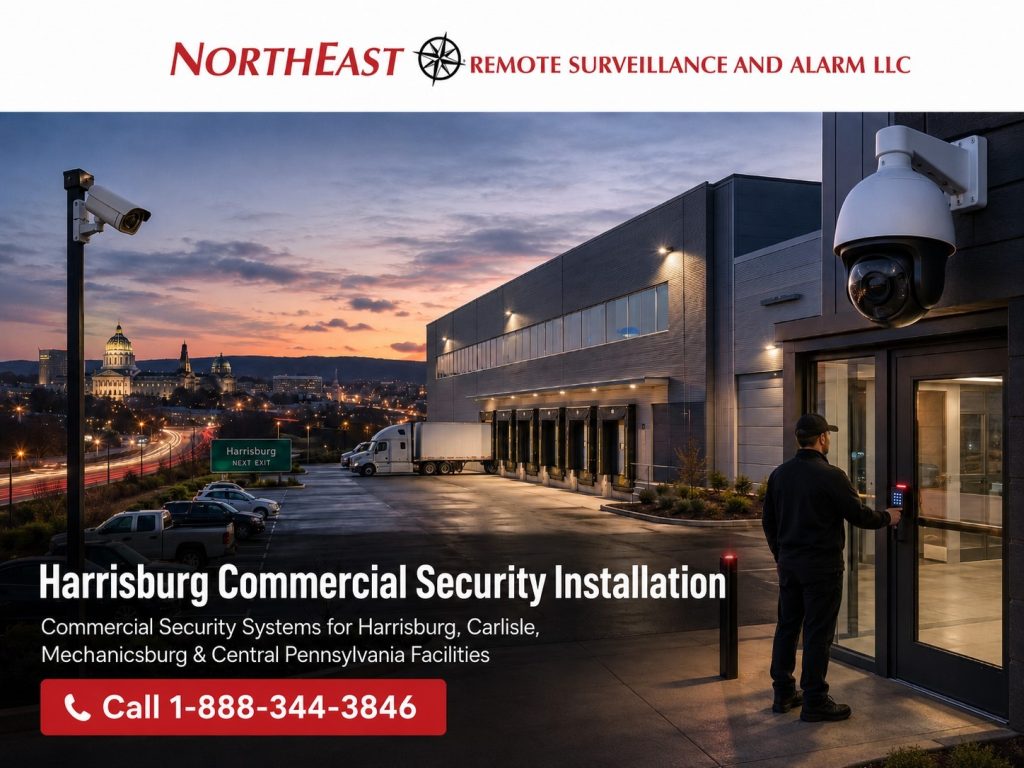
This page focuses on business intrusion detection and alarm planning.
For cameras, access control, intercoms, monitoring, and broader system design, start with our Harrisburg commercial security installation guide.
Commercial Alarm Systems Planned Around the Building
A business alarm system should reflect the doors, rooms, schedules, and operating patterns of the property. We review employee entrances, overhead doors, office areas, stockrooms, restricted spaces, production areas, and after-hours activity before deciding where detection is needed.
Depending on the application, a system may include door contacts, motion detection, glass protection, overhead-door contacts, panic or duress devices, environmental inputs, communication supervision, and separate partitions for different operating areas.
Alarm Zones That Make Sense to the Customer
Clear zone naming matters when an event occurs. A signal labeled only with a device number is less useful than one tied to a real door, room, or operating area.
We organize zones, partitions, user permissions, schedules, and notification procedures so the customer can understand what happened and where to look next.
Monitoring and Communication Paths
Commercial alarm monitoring should be planned separately from simple app notifications. A monitored system needs a defined communication path, contact list, test procedure, and response instructions that match the property.
Where appropriate, alarm events can also be paired with video verification or related camera views to provide better context during an incident.
New Installations, Upgrades, and System Takeovers
NERSA supports new alarm installations as well as takeovers of existing commercial systems. We can assess panels, keypads, detection devices, communication modules, batteries, wiring, zone programming, user setup, and monitoring connections before recommending a plan.
Existing equipment can sometimes remain in service when it is compatible, dependable, supportable, and appropriate for the customer’s needs. Unsupported or unreliable components can be replaced in phases when a complete replacement is not necessary.
Warehouses, Offices, and Industrial Facilities
Different properties need different alarm strategies. A warehouse may need overhead-door protection, employee entrance coverage, office partitions, and after-hours detection around storage areas. An office may need exterior door protection, interior motion detection, and controlled arming schedules. A manufacturing facility may need separate areas for offices, production, maintenance, and restricted rooms.
The design should match how the building is actually used rather than forcing every property into the same alarm layout.
Reduce False Alarms Through Better Commissioning
Repeated false alarms can result from more than a failed sensor. Loose doors, changing room layouts, incorrect schedules, shared user codes, poor zone descriptions, untrained staff, communication problems, and detection that does not suit the environment can all contribute. Test the system under realistic operating conditions and correct the cause of recurring problems rather than masking them with broad programming changes.
Partitions, Users, and After-Hours Operations
Facilities with multiple shifts, tenant spaces, warehouse offices, production areas, or late cleaning crews may benefit from separate alarm areas when the selected platform supports them. Define who may arm or disarm each area, who administers users, and how temporary personnel are handled.
Use clear zone and area names so staff and the monitoring process can identify the affected location quickly. Remove obsolete users and update contact lists when responsibilities change.
Testing and Customer Handoff
Before completion, verify representative zones, user functions, communication paths, monitoring signals, partitions, schedules, notifications, and any supported video or access-control workflows. Provide current service contacts, zone information, account responsibilities, and secure administrator credentials to the operating team.
Harrisburg and Central Pennsylvania Service Area
NERSA supports qualified commercial and industrial alarm projects in Harrisburg and surrounding Central Pennsylvania communities, including Camp Hill, Mechanicsburg, Carlisle, and nearby business and industrial areas.
Request a Commercial Alarm Assessment
If your Harrisburg-area property needs a new intrusion alarm, a system takeover, monitoring changes, additional protection, or an upgrade to an aging panel, call 1-888-344-3846 or request a commercial security assessment.
Frequently Asked Questions
Can NERSA take over an existing commercial alarm system?
In many cases, yes. We review the installed equipment, account ownership, programming, communication path, and monitoring requirements before recommending a takeover plan.
Can commercial alarms be integrated with cameras?
Yes, when compatible systems and workflows support it. Video can provide useful context around selected alarm events.
Do you install residential alarm systems?
No. NERSA focuses on commercial, industrial, institutional, and professionally managed properties.