Greater Philadelphia Industrial & Logistics Corridor Security

Commercial & Industrial Park Security for Warehouses, Logistics Facilities, Manufacturing Sites & Distribution Centers

The Greater Philadelphia Industrial & Logistics Corridor includes some of the most important warehouse, manufacturing, freight, port, and distribution properties in the Mid-Atlantic. Northeast Remote Surveillance and Alarm, LLC provides commercial and industrial security systems for industrial parks, logistics hubs, warehouses, manufacturing facilities, truck yards, contractor yards, and multi-site operations across Greater Philadelphia and nearby regional corridors. This page supports the Greater Philadelphia Commercial & Industrial Security Installation hub by focusing specifically on industrial parks, logistics corridors, freight movement, large commercial properties, and high-risk operational environments.

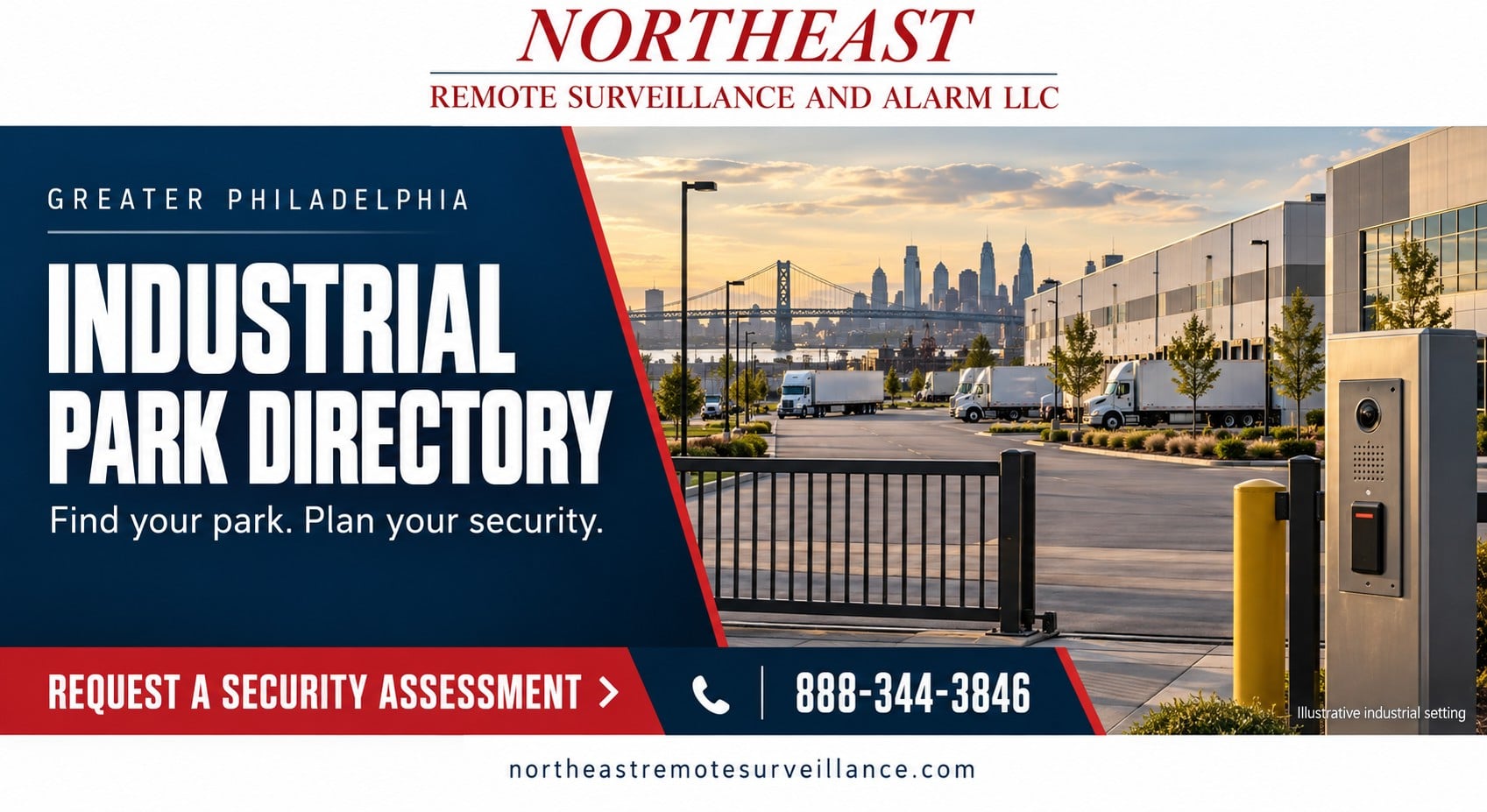
Security operator monitoring AI-enabled surveillance cameras for the Greater Philadelphia industrial and logistics corridor with highways, freight traffic, port activity, access control, live monitoring, and Northeast Remote Surveillance and Alarm LLC branding.

Security Across the Greater Philadelphia Industrial & Logistics Corridor Security

Greater Philadelphia is a major commercial corridor connecting Philadelphia, Montgomery County, Bucks County, Chester County, Delaware County, South Jersey, Northern Delaware, port-adjacent industrial areas, airport logistics facilities, and regional freight routes. These properties often operate with large square footage, multiple shifts, high-value inventory, employee and vendor traffic, loading docks, trailer yards, truck gates, parking areas, shared tenant spaces, and after-hours exposure.

Security in this environment should not be treated as a basic camera or alarm installation. Industrial and logistics facilities need layered systems designed around perimeter risk, access control, video documentation, intrusion detection, vehicle movement, employee flow, vendor access, fire and life-safety coordination, monitoring, and long-term service support.

Northeast Remote Surveillance and Alarm, LLC designs commercial security systems for industrial facilities that need scalable infrastructure, clean documentation, secure user management, and practical integration between cameras, access control, alarms, intercoms, monitoring, and network infrastructure.

Related Greater Philadelphia Security Resources

Industrial and logistics properties often need more than one security system. These related Philadelphia pages provide deeper planning by service type:

Commercial Security Installation Philadelphia — broad local planning for commercial and industrial security installation in Philadelphia.

Philadelphia Security Camera Installation — commercial video surveillance, warehouse cameras, parking lot cameras, loading dock cameras, and facility camera coverage.

Access Control Installation in Philadelphia — keycard systems, fob systems, mobile credentials, door hardware, controlled entry, and gate access planning.

Unified Security Systems Philadelphia — connected video, access control, alarms, intercoms, monitoring, and management platforms.

Philadelphia Security Integration — integration planning for facilities with disconnected cameras, doors, alarms, intercoms, and monitoring systems.

Greater Philadelphia Industrial Corridor Risk

Industrial corridors face different security risks than standard office buildings. Large commercial sites often have exterior yards, employee parking, loading areas, staging zones, dock doors, contractor entrances, shared roads, tenant spaces, equipment storage, and after-hours movement.

Common risk factors include:

  • Trailer yard intrusion
  • Cargo theft
  • Dock door access risk
  • After-hours trespassing
  • Copper and scrap theft
  • Catalytic converter theft
  • Employee credential misuse
  • Vendor and contractor access gaps
  • Unauthorized yard entry
  • Equipment tampering
  • Parking lot incidents
  • Multi-tenant access overlap
  • Poor video evidence after an event
  • Disconnected cameras, doors, and alarms

A strong industrial security strategy should reduce opportunity, improve detection, document activity, support investigations, and give management better visibility into the site.

Key Industrial and Logistics Areas Served

NERSA supports commercial and industrial security projects throughout Greater Philadelphia and nearby regional corridors when the project fits the service footprint.

Key areas may include:

  • Philadelphia Navy Yard
  • South Philadelphia industrial areas
  • Northeast Philadelphia industrial properties
  • Airport-area logistics facilities
  • Port-adjacent facilities
  • Montgomery County industrial parks
  • Bucks County distribution properties
  • Chester County commercial corridors
  • Delaware County industrial areas
  • King of Prussia and Upper Merion
  • Lansdale and North Penn commercial corridors
  • Horsham and Willow Grove
  • Trevose and Bensalem
  • Chester Waterfront industrial areas
  • Camden County business corridors
  • Gloucester County logistics areas
  • Burlington County freight corridors
  • New Castle County commercial and port-related areas
  • Northern Maryland corridor extensions when the project fits the regional footprint

This page remains focused on the Greater Philadelphia Industrial & Logistics Corridor. It should not duplicate the main Pennsylvania, Mid-Atlantic, Lehigh Valley, Reading, New Jersey, Delaware, or Maryland service-area pages.

Greater Philadelphia Industrial & Logistics Corridor Security for Warehouses and Distribution Centers

Warehouses and distribution centers need security systems that match the movement of people, products, vehicles, and inventory. A large building with multiple dock doors, employee entrances, offices, IT rooms, storage areas, and truck traffic should not be protected with a residential-style alarm or a few disconnected cameras.

Warehouse security planning may include:

  • Loading dock cameras
  • Shipping and receiving coverage
  • Employee entrance access control
  • Office-to-warehouse controlled doors
  • Truck gate access control
  • Trailer yard cameras
  • LPR cameras at entrances and exits
  • Intrusion alarm zoning
  • Overhead door monitoring
  • Tool room and inventory room protection
  • After-hours remote video monitoring
  • Video review tied to access events

For camera-specific planning, use Philadelphia Security Camera Installation. For controlled door planning, use Access Control Installation in Philadelphia.

Greater Philadelphia Industrial & Logistics Corridor Security for Manufacturing and Industrial Facilities

Manufacturing and industrial facilities often need protection for production areas, employee entrances, machinery zones, raw material storage, finished goods, maintenance rooms, tool rooms, quality-control areas, shipping departments, and restricted offices.

Manufacturing security planning may include:

  • Production floor cameras
  • Restricted-area access control
  • Employee credential management
  • Tool room access control
  • Parts room protection
  • Shipping department cameras
  • Contractor and vendor access review
  • Intrusion detection
  • Parking lot cameras
  • Incident documentation
  • Integration with alarms and monitoring

Industrial security should be designed around how the facility operates. A system that works for a warehouse may not be enough for a plant with restricted production areas, sensitive processes, machinery risks, or regulated operations.

Greater Philadelphia Industrial & Logistics Corridor Security for Industrial Parks and Multi-Tenant Properties

Industrial parks and multi-tenant commercial campuses require careful security planning because multiple businesses may share roads, parking areas, entrances, gates, loading areas, and utility spaces. Poor access segmentation can create risk for every tenant.

Industrial park security may include:

  • Shared perimeter cameras
  • Entrance and exit cameras
  • LPR camera placement
  • Tenant access segmentation
  • Shared gate access control
  • Visitor and contractor workflows
  • Parking lot surveillance
  • After-hours monitoring
  • Incident documentation
  • Property manager reporting

For properties that need connected cameras, doors, alarms, and monitoring, use Unified Security Systems Philadelphia or Philadelphia Security Integration.

Trailer Yard, Truck Gate and Vehicle Access Security

Truck yards, trailer lots, and vehicle entrances are common weak points in industrial corridors. These areas often have after-hours exposure, limited staffing, high-value vehicles, staged trailers, and large blind spots.

Vehicle-area security may include:

  • Truck gate cameras
  • Gate access control
  • LPR camera systems
  • Trailer yard surveillance
  • PTZ cameras
  • Long-range cameras
  • Perimeter detection
  • Speaker talkdown
  • Remote video monitoring
  • Incident review workflows

The goal is to document vehicles entering and leaving, reduce unauthorized access, improve deterrence, and support investigations when incidents occur.

Access Control for Industrial Facilities

Access control is critical in industrial and logistics environments because facilities must manage employees, vendors, contractors, drivers, temporary labor, visitors, tenants, and management users.

Industrial access control may include:

  • Employee entrance control
  • Office-to-warehouse door control
  • Restricted room access
  • Tool room access
  • IT and mechanical room access
  • Gate access control
  • Mobile credentials
  • Keycards and fobs
  • Keypad readers
  • Door position monitoring
  • Request-to-exit devices
  • Access reports
  • Multi-site user management

For full door access planning, use Access Control Installation in Philadelphia.

Video Surveillance for Greater Philadelphia Industrial & Logistics Corridor

Industrial video surveillance must account for distance, lighting, weather, vehicle movement, building layout, dock activity, and evidence quality. A camera that works in a small office may not be appropriate for a truck yard, loading dock, industrial park entrance, or warehouse perimeter.

Industrial video surveillance may include:

  • Perimeter cameras
  • Parking lot cameras
  • Dock door cameras
  • Interior warehouse cameras
  • Shipping and receiving cameras
  • PTZ cameras
  • LPR cameras
  • Long-range cameras
  • Low-light cameras
  • AI-enabled event detection
  • Video review tied to alarms and access control

For camera-specific planning, use Philadelphia Security Camera Installation.

Intrusion Alarm Planning for Large Facilities

Large commercial and industrial buildings require alarm systems designed around the actual facility, not a small-building template. Warehouses, distribution centers, and manufacturing plants may need partitioned alarm areas, overhead door contacts, grouped dock doors, motion detection, environmental sensors, panic devices, and remote management.

Industrial alarm planning may include:

  • Overhead door monitoring
  • Dock door contacts
  • Personnel door contacts
  • Interior motion detection
  • Partitioned alarm areas
  • Equipment room protection
  • IT room protection
  • Environmental sensors
  • Power failure alerts
  • Panic and duress options
  • Video verification
  • Monitoring communication paths

A commercial intrusion alarm system should support the way the facility opens, closes, shifts, receives deliveries, and manages after-hours activity.

Remote Video Monitoring and Live Talkdown

Remote video monitoring can help industrial facilities move from passive recording to proactive deterrence. When cameras, analytics, monitoring operators, and speaker talkdown are planned correctly, a facility can respond to unauthorized activity while it is happening.

Remote monitoring and talkdown may support:

  • After-hours yard intrusion
  • Trailer lot activity
  • Equipment tampering
  • Trespassing
  • Parking lot incidents
  • Construction phase security
  • Vacant property monitoring
  • Scrap and material theft deterrence
  • Gate and perimeter events

Remote monitoring should be designed around camera placement, lighting, event rules, audio coverage, response procedures, and documentation.

Solar and Cellular Surveillance for Temporary or Remote Sites

Some industrial locations need surveillance before permanent power, network, or trenching is available. Solar and cellular surveillance can support temporary or remote risk areas.

Common uses include:

  • Construction sites
  • Vacant industrial properties
  • Overflow lots
  • Equipment yards
  • Temporary laydown areas
  • Remote parking areas
  • Utility yards
  • Short-term project sites
  • Sites waiting for permanent infrastructure

Solar surveillance should be engineered around power load, camera type, lighting, cellular signal, battery capacity, monitoring needs, and site conditions.

Compliance-Aware Industrial Security Planning

Commercial and industrial security systems must be planned around life safety, fire code, building code, ADA considerations, OSHA concerns, emergency egress, cybersecurity expectations, insurance requirements, and authority-having-jurisdiction expectations.

Compliance-aware planning may include:

  • Proper egress from controlled doors
  • Door hardware coordination
  • Fire alarm interface where required
  • Alarm permitting considerations
  • Monitoring documentation
  • User access records
  • System labeling
  • Network segmentation
  • Backup power planning
  • Incident documentation
  • Coordination with property managers, IT teams, fire alarm contractors, and code officials when needed

Security systems can support safer operations, better documentation, and stronger risk management, but they do not replace OSHA, NFPA, building code, fire code, ADA, insurance, or AHJ requirements. Final requirements should always be confirmed with the property owner, design team, fire alarm contractor, and authority having jurisdiction when controlled openings, alarms, fire systems, emergency exits, or regulated spaces are involved.

Cybersecurity and Network Infrastructure

Modern physical security systems often operate on IP networks. Cameras, access control panels, intercoms, monitoring systems, mobile credentials, and cloud platforms must be planned with cybersecurity in mind.

Cybersecurity-aware security planning may include:

  • Network segmentation
  • Secure user permissions
  • Strong password policies
  • Multi-factor authentication where supported
  • Firmware management
  • Encrypted communication where available
  • Remote access control
  • Role-based permissions
  • Secure cloud configuration
  • Coordination with IT teams

For facilities with multiple systems that need to communicate cleanly, use Philadelphia Security Integration.

Greater Philadelphia Industrial & Logistics Corridor Security Design Checklist

Before installing equipment, NERSA evaluates the facility and the operational risk profile.

Industrial security planning may review:

  • Site perimeter
  • Parking lots
  • Truck gates
  • Loading docks
  • Employee entrances
  • Visitor entrances
  • Tenant spaces
  • Restricted rooms
  • IT and mechanical rooms
  • Trailer yards
  • Lighting conditions
  • Existing camera coverage
  • Existing access control
  • Existing alarm system
  • Network infrastructure
  • Monitoring needs
  • Service expectations
  • Documentation requirements
  • Expansion plans

This planning helps the finished system work for daily operations instead of becoming a disconnected collection of devices.

Why Greater Philadelphia Industrial & Logistics Corridor Security Facilities Choose NERSA

Northeast Remote Surveillance and Alarm, LLC focuses on commercial and industrial security systems. NERSA designs systems for businesses that need practical recommendations, commercial-grade equipment, clean documentation, scalable infrastructure, and long-term support.

Industrial corridor clients choose NERSA for:

  • Commercial and industrial security experience
  • Warehouse and logistics facility planning
  • Manufacturing security planning
  • Industrial park security strategy
  • Video surveillance system design
  • Access control and door hardware planning
  • Intrusion alarm design
  • Remote monitoring and talkdown options
  • LPR and vehicle access planning
  • Solar and cellular surveillance options
  • Unified security integration
  • Cybersecurity-aware planning
  • Structured cabling and infrastructure support
  • Clear documentation and client training

NERSA designs systems around the facility layout, risk profile, operating hours, user groups, vehicle movement, emergency egress needs, network environment, and long-term expansion plan.

Request an Greater Philadelphia Industrial & Logistics Corridor Security Assessment

If your industrial park, warehouse, manufacturing facility, logistics property, truck yard, or multi-site operation has outdated cameras, unmanaged keys, disconnected alarms, weak perimeter coverage, poor after-hours visibility, or limited documentation, NERSA can help design a stronger system.

Northeast Remote Surveillance and Alarm, LLC installs commercial and industrial security systems for warehouse, logistics, manufacturing, distribution, contractor yard, industrial park, and multi-site facilities throughout Greater Philadelphia and nearby regional corridors.

For broader local planning, use Commercial Security Installation Philadelphia. For camera planning, use Philadelphia Security Camera Installation. For door access planning, use Access Control Installation in Philadelphia. For connected platforms, use Unified Security Systems Philadelphia.

Call 1-888-344-3846 or request an industrial corridor security assessment.

FAQ: Greater Philadelphia Industrial & Logistics Corridor Security

What facilities does this industrial corridor page support?

This page supports warehouses, logistics facilities, distribution centers, industrial parks, manufacturing plants, truck yards, contractor yards, port-adjacent properties, multi-tenant industrial buildings, and large commercial campuses.

What security risks are common in industrial corridors?

Common risks include cargo theft, trailer yard intrusion, unauthorized access, dock door incidents, copper theft, catalytic converter theft, employee credential misuse, vendor access gaps, parking lot incidents, and after-hours trespassing.

Does NERSA install security cameras for industrial facilities?

Yes. NERSA installs commercial camera systems for industrial facilities, including parking lot cameras, dock cameras, perimeter cameras, warehouse cameras, PTZ cameras, LPR cameras, and camera systems integrated with access control or alarms.

Can access control be used in industrial parks?

Yes. Access control can help manage employee entrances, tenant spaces, restricted rooms, gates, tool rooms, IT rooms, contractor access, and multi-tenant credential separation.

Can security systems monitor truck gates and trailer yards?

Yes. Truck gates and trailer yards can be protected with cameras, LPR systems, gate access control, perimeter detection, remote video monitoring, and speaker talkdown.

Are industrial alarm systems different from basic alarm systems?

Yes. Industrial alarm systems may require overhead door contacts, dock door monitoring, partitioned areas, large-space motion detection, environmental sensors, panic devices, video verification, and communication redundancy.

Can remote video monitoring help industrial properties?

Yes. Remote video monitoring can help deter after-hours trespassing, equipment tampering, yard intrusion, parking lot incidents, and unauthorized activity when cameras, analytics, operators, and speaker talkdown are properly designed.

Does NERSA support multi-site industrial operations?

Yes. NERSA can design scalable systems for multi-site operators that need centralized camera review, access control management, alarm visibility, user permissions, reporting, documentation, and long-term support.

Can access control and cameras work together?

Yes. Access control and video surveillance can be integrated so managers can review camera footage tied to credential use, forced-door events, door-held-open events, visitor access, vendor activity, and after-hours entries.

Is this page different from the main Greater Philadelphia security page?

Yes. The main Greater Philadelphia page covers broad commercial and industrial security installation. This page focuses specifically on industrial parks, logistics corridors, warehouses, distribution centers, manufacturing sites, truck yards, and freight-related risk.

Should industrial facilities use consumer-grade cameras?

No. Industrial facilities usually need commercial-grade video surveillance designed around lighting, distance, weather exposure, storage needs, network reliability, evidence quality, and long-term support.

How do I start an industrial corridor security project?

Call 1-888-344-3846 or request an industrial corridor security assessment from Northeast Remote Surveillance and Alarm, LLC.

Scroll to Top
1-888-344-3846