
Commercial intrusion alarm systems in Lancaster, PA should be planned around the way the property operates when it is closed, partially occupied, or working outside normal business hours.

Request a commercial security assessment
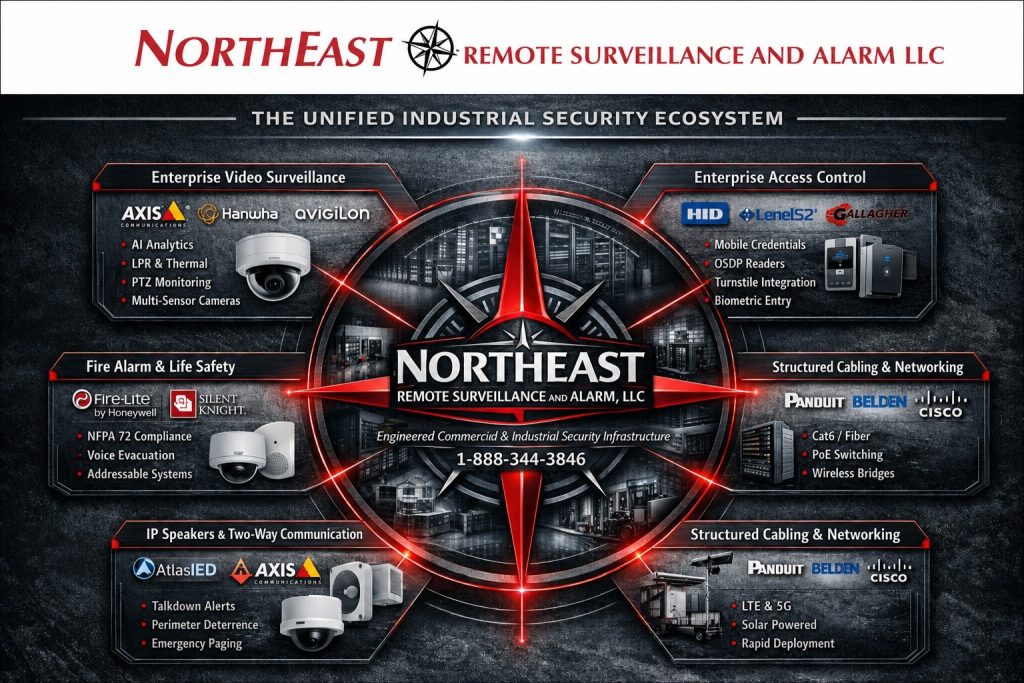
Northeast Remote Surveillance and Alarm, LLC supports warehouses, manufacturing facilities, offices, healthcare properties, schools, municipal facilities, multi-tenant buildings, and other nonresidential sites with intrusion detection, monitoring coordination, upgrades, and system takeovers.
For broader facility planning, see Lancaster Commercial Security Systems.
For cameras, controlled doors, or supporting infrastructure, explore the Lancaster video-surveillance, access-control, or low-voltage guides.
Commercial Alarm Planning Starts With the Property
Before selecting devices, identify the entrances, overhead doors, loading areas, offices, restricted rooms, storage spaces, production areas, and other locations that matter after hours. Document opening and closing routines, late shifts, cleaning crews, contractors, deliveries, and any area that remains occupied while another part of the building is armed.
A warehouse, office, manufacturing plant, medical office, and multi-tenant building can need very different alarm layouts. The system should reflect the building and operating routine rather than force every customer into the same device package.
Doors, Overhead Openings, and Interior Detection
Perimeter protection may include contacts on personnel doors, receiving doors, overhead doors, or other appropriate openings. Interior protection can add motion or other compatible detection in selected areas when the property is unoccupied. Device selection should account for the environment, equipment movement, HVAC conditions, shelving, changing layouts, and the routes authorized staff use during partially armed periods.
Zone names should describe actual doors and areas. When an event occurs, “Shipping Office Rear Door” or “Warehouse Overhead Door 4” gives the customer and monitoring process more useful information than an unexplained device number.
Partitions, Schedules, and User Management
Commercial buildings do not always open and close as one area. A warehouse office may close while shipping remains active. A manufacturer may operate production overnight while administrative areas are armed. A multi-tenant property may have separate suites and common areas. Where the selected platform supports it, partitions and schedules can make these operating differences manageable.
Define who can arm or disarm each area, who administers users, how temporary workers are handled, and what happens when personnel leave the organization. Individually managed users provide clearer accountability than unnecessarily shared codes.
Panic and Duress Applications
Panic or duress devices may be appropriate at reception areas, cash-handling positions, offices, healthcare workspaces, or other locations where staff need a defined method to request help. The device, activation method, monitoring instruction, notification path, and staff procedure should be planned together.
A duress device is only one part of the workflow. Responsible personnel should understand what happens after activation and how the response process is tested and maintained.
Commercial Alarm Monitoring in Lancaster
A monitored intrusion system needs a dependable communication path, current account information, clear zone descriptions, authorized contacts, and documented response instructions. Monitoring should be planned separately from ordinary app notifications so the customer understands which events are transmitted and what action follows.
Where supported by the selected equipment and project scope, internet and cellular communications may provide appropriate paths for modern commercial systems. The actual communication method should be verified for the installed platform and site conditions.
Video Verification and Camera Context
Compatible alarm and video systems can support faster incident review when there is a defined operational reason. A selected alarm event may help staff or a monitoring process locate the relevant camera view around an entrance, dock, yard, or other protected area.
Camera design remains a separate discipline.
For placement, recording, retention, and evidence planning, use Lancaster Commercial Video Surveillance Systems.
Access Control and Intrusion Alarms Have Different Roles
Access control manages authorized entry. Intrusion alarms detect selected conditions when a property or area is armed. The systems can support coordinated workflows when compatible, but their purposes should remain clear so credentials, alarm users, schedules, door events, and after-hours response are administered correctly.
For readers, credentials, electrified hardware, employee entry, and controlled openings, use Lancaster Commercial Access Control.
Warehouses and Distribution Facilities
Lancaster warehouse and distribution projects may require protection at employee entrances, shipping offices, overhead doors, loading areas, inventory spaces, maintenance rooms, and selected interior zones. Multiple shifts and late freight activity should be documented before partitions and schedules are finalized.
Manufacturing and Industrial Properties
Manufacturing facilities may need separate consideration for offices, production support areas, tool rooms, maintenance spaces, material storage, and restricted rooms. Environmental conditions and equipment movement can affect detector selection, so field conditions should be reviewed rather than assumed.
Offices, Healthcare, and Multi-Tenant Properties
Office and multi-tenant properties often combine shared entrances with separately controlled suites. Clarify landlord, tenant, and property-management responsibilities before deciding who controls alarm areas and users. Healthcare and other public-facing properties may need practical opening/closing procedures, protected staff areas, and panic or duress workflows that fit normal operations.
Existing Alarm Systems, Takeovers, and Upgrades
An existing commercial alarm does not automatically need complete replacement. Review the panel, keypads, detection devices, communication modules, batteries, wiring, programming access, account ownership, monitoring arrangement, and service history. Suitable equipment may remain when it is compatible, supportable, and appropriate for the new scope.
When replacement is needed, a phased plan can preserve useful infrastructure while correcting unsupported or unreliable components. Document what remains, what changes, and any limitations that affect future expansion.
Low-Voltage Infrastructure and Power
Alarm performance depends on reliable wiring, power, communication paths, equipment mounting, and serviceable locations. Existing cable should be evaluated before reuse, especially when documentation is incomplete or building renovations have changed pathways.
For broader cabling, fiber, network-room, PoE, and pathway planning, use Lancaster Low-Voltage Security Infrastructure.
Testing, Documentation, and Customer Handoff
Before completion, verify the agreed zones, user functions, partitions, communication path, monitoring signals, notifications, and supported integrations. Authorized staff should receive understandable operating instructions, current zone information, service contacts, and a secure process for administrator credentials.
The final records should distinguish installed work, retained equipment, known limitations, deferred improvements, and recurring services. That makes later troubleshooting, personnel changes, and expansion easier to manage.
Frequently Asked Questions
Does NERSA install commercial alarm systems in Lancaster?
Yes. NERSA supports commercial and industrial intrusion-alarm installation, monitoring coordination, upgrades, and takeovers for nonresidential properties.
Can an alarm system have separate areas or partitions?
Many commercial platforms support separate areas. The appropriate layout depends on the selected system and how the property operates.
Can existing alarm equipment be reused?
Sometimes. Ownership, condition, compatibility, programming access, supportability, wiring, communications, and the customer’s operating needs should be reviewed before reuse is recommended.
Can alarm events be coordinated with cameras?
Compatible systems can support useful video context around selected alarm events. The workflow should be designed around a specific response need rather than integration for its own sake.
Request a Lancaster Commercial Alarm Assessment
Tell us about the Lancaster property, operating hours, entrances and areas you need to protect, existing equipment, monitoring needs, and the problem you want to solve.
Request a commercial security assessment or call 1-888-344-3846.