
Legacy phone lines can become the weakest part of an otherwise usable commercial security system.

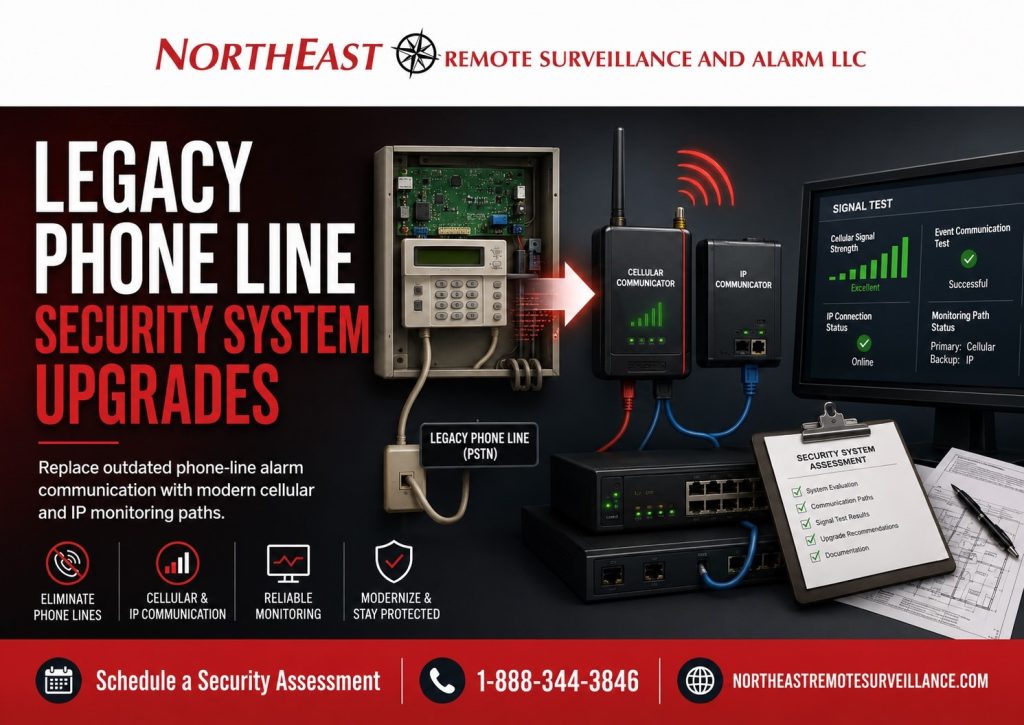
Northeast Remote Surveillance and Alarm, LLC helps commercial and industrial facilities replace outdated phone-line communication paths with modern cellular, IP, or approved monitoring solutions for intrusion alarms, fire alarm communicators, and related security systems.
For related guidance, see our Commercial Security System Upgrades, Retrofits & Takeovers service for businesses that need to modernize old alarm communication without automatically replacing every device in the building.
Commercial Security Systems Still Using Old Phone Lines
Many commercial buildings still have security systems connected to old phone lines.
The alarm panel may still work. The keypad may still arm and disarm. The door contacts and motion detectors may still be usable. The fire alarm panel may still be serviceable. But the communication path may be outdated, expensive, unreliable, poorly documented, or no longer aligned with the way the building operates.
That creates a serious support problem.
A security system is only useful if the right signals can reach the right monitoring center, from the right account, with the right contact information, at the right time.
Why Legacy Phone Line Security Systems Need Review
Older security systems were commonly installed with traditional phone-line communication. That worked for many years, but many businesses now face problems when old phone service is changed, removed, converted, or no longer reliable enough for the system.
Common problems include:
- Alarm communication trouble conditions
- Failed or inconsistent signal reporting
- Unclear monitoring account information
- Expensive legacy phone-line bills
- Phone service changes that affect alarm reporting
- Old dialers that are difficult to support
- Poor documentation from prior providers
- Unknown signal testing history
- Alarm panels still using outdated communication methods
- Fire alarm communicators still tied to older lines
- Business owners unsure where signals are going
- Monitoring contacts that are outdated or wrong
A legacy phone-line upgrade helps the business move the communication path into a more supportable condition.
What a Legacy Phone Line Security Upgrade Can Include
A legacy phone line security system upgrade may involve one or more communication paths, depending on the building and system type.
NERSA may review and upgrade:
- Commercial intrusion alarm communicators
- Burglar alarm monitoring paths
- Fire alarm communicators
- Cellular alarm communicators
- IP alarm communicators
- Dual-path communication options where appropriate
- Monitoring account information
- Alarm signal testing
- Trouble signal testing
- Supervisory signal testing where applicable
- User and contact lists
- Zone descriptions
- Panel programming where authorized
- Backup power requirements
- Network and low-voltage infrastructure
- Documentation and service records
The goal is not just to remove a phone line. The goal is to make sure the system reports properly after the upgrade.
When a Legacy Phone Line Upgrade Is Needed
A commercial facility should consider a legacy phone line security system upgrade if:
- The alarm system still uses traditional phone lines.
- The building owner is removing or changing phone service.
- The keypad shows communication trouble.
- The monitoring center is not receiving signals consistently.
- Alarm signals are not clearly documented.
- Phone-line costs are increasing.
- The system was inherited from a prior owner or tenant.
- The current provider cannot clearly explain the communication path.
- The building is preparing for renovation or tenant turnover.
- The business wants to upgrade to cellular or IP communication.
- The fire alarm communicator is still tied to old phone-line service.
- The intrusion alarm panel is still using an old dialer.
- The business wants a cleaner long-term support plan.
A phone-line upgrade is often one of the first security improvements a commercial building should make before larger system modernization.
The Problem With Assuming the Alarm Still Reports
Many businesses assume the alarm system reports properly because the keypad still works.
That is not enough.
A keypad can arm and disarm locally even if the communication path is weak, outdated, or not reporting correctly. The panel may still make noise inside the building, but the owner also needs to know whether alarm, trouble, and supervisory signals are reaching the monitoring center.
A proper upgrade should confirm:
- Which panel is installed
- Which communicator is being used
- What phone line or communication path is active
- Where signals are being sent
- Whether the monitoring center receives the signals
- Whether the account information is correct
- Whether contact lists are current
- Whether zone descriptions make sense
- Whether trouble conditions are resolved
- Whether the system can be supported going forward
Signal reporting should be tested, not assumed.
Intrusion Alarm Phone Line Upgrades
Commercial intrusion alarm systems often rely on older dialer communication.
These systems may still protect doors, offices, warehouses, storage rooms, and motion detection areas, but the communicator may no longer be the best path for monitoring.
An intrusion alarm communication upgrade may include:
- Reviewing the alarm panel
- Reviewing keypad trouble conditions
- Reviewing user codes
- Reviewing alarm zones
- Replacing an old phone-line dialer with a cellular or IP communicator
- Testing alarm signals
- Testing trouble signals
- Confirming monitoring center receipt
- Updating contact lists
- Cleaning up documentation
- Reviewing backup battery condition
- Reviewing opening and closing reporting where applicable
For related intrusion alarm planning, see Commercial Burglar Alarm and Intrusion Detection Systems.
Fire Alarm Phone Line and Communicator Upgrades
Fire alarm communication upgrades require separate life-safety awareness.
A commercial fire alarm panel may still be serviceable, but the communicator may be outdated or tied to old phone-line service. In that case, a fire alarm communicator upgrade may be the correct path instead of a full fire alarm replacement.
Fire alarm communicator upgrades may involve:
- Reviewing the fire alarm control panel
- Reviewing the existing communicator
- Reviewing phone-line dependence
- Reviewing cellular or IP communication options
- Reviewing monitoring account information
- Testing alarm, trouble, and supervisory signals where applicable
- Updating documentation
- Supporting inspection readiness
- Coordinating with the monitoring center
- Considering AHJ expectations
For the dedicated fire alarm page, see Fire Alarm Communicator Upgrades.
Cellular Communicator Upgrades
Cellular communicators are a common option for replacing old phone-line alarm communication.
A cellular upgrade can help reduce dependence on legacy phone service and create a more supportable monitoring path. The correct device depends on the alarm panel, system type, signal strength, monitoring center, power requirements, backup battery needs, and the long-term support plan.
Cellular communicator planning may include:
- Cellular signal review
- Antenna placement
- Panel compatibility review
- Communicator installation
- Account programming
- Signal testing
- Trouble condition review
- Monitoring center confirmation
- Documentation updates
A cellular communicator should not simply be installed and left untested. The system must be verified with the monitoring center.
IP Communicator Upgrades
Some commercial alarm systems can use IP-based communication where appropriate.
IP communication may be useful when the building has reliable network infrastructure, backup power, and a supportable internet connection. It must be planned carefully because alarm communication should not depend on unmanaged network equipment or unknown power conditions.
IP communication planning may include:
- Network connection review
- Router and switch location review
- UPS backup review
- Communicator compatibility
- Monitoring center compatibility
- Supervision requirements
- Account setup
- Signal testing
- IT coordination
- Documentation
For related infrastructure planning, see Commercial Low Voltage and Network Infrastructure Services.
Dual-Path Communication Options
Some systems may require or benefit from dual-path communication.
Dual-path communication may combine cellular, IP, or other approved methods depending on the system, monitoring provider, building requirements, and AHJ direction where applicable.
Dual-path planning may support:
- Better communication redundancy
- Improved supervision
- Cleaner transition away from phone lines
- Stronger monitoring path documentation
- Better long-term support
The right path depends on the specific system. NERSA reviews the existing panel, communicator, building conditions, and monitoring requirements before recommending a communication method.
Monitoring Account Review
A communication upgrade should include monitoring account review.
The communicator is only part of the system. The monitoring center must also have the correct account, site, contact, and signal information.
Monitoring account review may include:
- Site name
- Site address
- Account number
- Emergency contact list
- Call list order
- Alarm response instructions
- Zone descriptions
- User information where applicable
- Signal types
- Trouble conditions
- Supervisory signals where applicable
- Opening and closing reports where applicable
- Test records
- Monitoring center receipt confirmation
A business should know who is being called, what signals are being received, and whether the monitoring center has the correct information.
Signal Testing and Verification
The most important part of any legacy phone line upgrade is signal testing.
A new communicator must be tested to confirm that signals are actually being received. The system should not be considered complete just because the communicator has power or shows signal strength.
Signal testing may include:
- Alarm signal testing
- Trouble signal testing
- Supervisory signal testing where applicable
- Restoral signal testing
- Communication trouble testing where applicable
- Account identification confirmation
- Zone description confirmation
- Monitoring center receipt confirmation
- Documentation of test results
Testing protects the building owner from assuming the upgrade worked when signal reporting was never confirmed.
Existing System Review
Before replacing a phone line or communicator, NERSA reviews the existing system.
The review may include:
- Alarm panel condition
- Fire alarm panel condition where applicable
- Existing communicator
- Phone-line connection
- Cellular signal availability
- IP/network availability
- Monitoring account information
- Alarm zones
- User codes
- Keypads
- Door contacts
- Motion detectors
- Fire alarm points where applicable
- Trouble conditions
- Backup battery condition
- Power supply condition
- Network equipment
- Available documentation
- Service history
- Future upgrade needs
This review helps determine whether the system needs a simple communicator upgrade, a larger retrofit, or full system replacement.
Legacy Phone Line Upgrade vs. Full System Replacement
Not every phone-line problem requires a full security system replacement.
A communication upgrade may be the right path when the panel and field devices are still serviceable but the old phone-line path is weak or outdated.
A full replacement may be needed when:
- The panel is obsolete
- The panel is locked or unsupported
- The system cannot be programmed
- Devices are failing
- Wiring is unreliable
- Documentation is missing
- The system cannot support modern communication
- The building layout no longer matches the security design
- The system is not worth continued service cost
NERSA evaluates the system before recommending whether the correct path is upgrade, retrofit, takeover, or replacement.
Legacy Phone Line Upgrades and System Takeovers
Many legacy phone-line upgrades happen during system takeovers.
A business may inherit an old alarm system and not know which phone lines are used, who monitors the system, what the account number is, or whether the signals report correctly.
A takeover review may include:
- Previous provider status
- Panel access
- Communicator model
- Monitoring account information
- Phone-line identification
- User code cleanup
- Zone documentation
- Signal testing
- Trouble condition review
- Upgrade recommendations
For related takeover planning, see Commercial Security System Takeovers.
Legacy Phone Line Upgrades and Retrofits
A phone-line upgrade may also be part of a broader security retrofit.
A business may keep some existing sensors, panels, doors, and camera locations while replacing the weak communication path and cleaning up documentation.
A retrofit may include:
- Replacing the old communicator
- Reusing serviceable alarm wiring
- Updating monitoring account information
- Cleaning up user codes
- Correcting zone descriptions
- Reviewing backup batteries
- Testing signal transmission
- Improving documentation
- Planning future upgrades
For related retrofit planning, see Commercial Security System Retrofits.
Before and After
| Before Legacy Phone Line Upgrade | After Legacy Phone Line Upgrade |
|---|---|
| Alarm system depended on old phone lines | Modern cellular, IP, or approved communication path |
| Signal reporting was uncertain | Signals tested with the monitoring center |
| Phone service changes created risk | Reduced dependence on outdated telecom service |
| Monitoring contacts may be outdated | Account and contact information reviewed |
| Trouble conditions may be unresolved | Communication problems reviewed and corrected where possible |
| Documentation was incomplete | Communication path and signal testing documented |
| Owner did not know how signals reported | Clearer monitoring path and support plan |
| Old system was harder to support | More supportable long-term security platform |
Commercial Facilities That Need Legacy Phone Line Upgrades
Legacy phone line security upgrades are common in:
- Warehouses
- Distribution centers
- Manufacturing facilities
- Office buildings
- Healthcare offices
- Schools and education facilities
- Retail stores
- Contractor shops
- Auto repair shops
- Laundromats
- Industrial parks
- Multi-tenant buildings
- Logistics facilities
- Truck yards
- Professional offices
- Municipal buildings
- Institutional properties
- Buildings with older intrusion alarms
- Buildings with older fire alarm communicators
- Buildings changing phone providers or removing old phone service
Each building should be reviewed based on its panel, monitoring requirements, communication path, users, and long-term support needs.
Related Planning
Review the existing panel before choosing a replacement communication path. Some systems need equipment changes.
Why Businesses Choose NERSA for Legacy Phone Line Security Upgrades
Northeast Remote Surveillance and Alarm, LLC focuses on commercial, industrial, institutional, and business and facility security and life-safety systems.
Legacy phone line upgrades require more than removing a wire. They require panel review, communicator compatibility, monitoring center coordination, signal testing, contact list review, backup power review, documentation, and a practical support plan.
NERSA helps businesses modernize alarm communication paths without forcing unnecessary full system replacement when a targeted upgrade is the better choice.
When to Request a Legacy Phone Line Security Upgrade
A business should request a legacy phone line security system review if:
- The alarm system still uses phone lines.
- Phone service is being changed or removed.
- The keypad shows communication trouble.
- Monitoring signals are not clearly verified.
- Alarm contacts or call lists are outdated.
- The system was inherited from another provider.
- The communicator is old or unsupported.
- The building has recurring phone-line issues.
- Fire alarm communication needs review.
- Intrusion alarm communication needs review.
- The owner wants to reduce old telecom dependence.
- The business needs a cleaner long-term support plan.
Legacy Phone Line Security Upgrade Checklist
Before upgrading a legacy phone-line security system, evaluate:
- Alarm panel
- Fire alarm panel where applicable
- Existing communicator
- Phone-line connection
- Current monitoring provider
- Account information
- Emergency contact list
- Signal types
- Alarm zone descriptions
- User codes
- Trouble conditions
- Backup battery
- Cellular signal strength
- IP/network availability
- Power supply
- Network equipment
- Documentation
- Service history
- AHJ expectations where fire alarm is involved
- Future upgrade needs
Request a Legacy Phone Line Security System Review
NERSA can review older phone lines used for alarm or fire alarm monitoring at your commercial property. The assessment can help identify a suitable path for updating communications.
Frequently Asked Questions About Legacy Phone Line Security System Upgrades
What is a legacy phone line security system upgrade?
A legacy phone line security system upgrade replaces or modernizes the old phone-line communication path used by a commercial alarm, fire alarm communicator, or related monitored security system. The upgrade may involve cellular, IP, or another approved monitoring method depending on the system.
Why should a business replace old alarm phone lines?
Old phone-line communication can become expensive, unreliable, difficult to support, or affected by telecom service changes. A modern communicator can help create a more supportable monitoring path.
Does replacing the phone line mean replacing the whole alarm system?
Not always. If the existing panel and devices are still serviceable, the communication path may be upgraded without replacing the entire system. If the panel is obsolete, locked, unsupported, or unreliable, replacement may be recommended.
Can a commercial intrusion alarm use cellular communication?
Yes. Many commercial intrusion alarm systems can use cellular communicators when compatible with the panel and monitoring provider. Signal strength, power, programming, and testing must be reviewed.
Can a fire alarm system use a cellular communicator?
Yes, where appropriate and accepted. Fire alarm communicator upgrades require panel review, monitoring coordination, signal testing, documentation, and AHJ-aware planning.
Can an alarm system use IP communication instead of a phone line?
Some systems can use IP communication when the network, power, supervision, and monitoring provider requirements are properly reviewed. IP communication should not depend on weak or unmanaged network infrastructure.
What signals should be tested after a phone-line upgrade?
Alarm signals, trouble signals, restorals, and supervisory signals where applicable should be tested with the monitoring center. The goal is to confirm that the correct signals are received from the correct account.
Can NERSA review an inherited alarm system that still uses phone lines?
Yes. NERSA can review the panel, communicator, monitoring path, user codes, zones, account information, and documentation to determine whether the system can be taken over, upgraded, retrofitted, or replaced.
Is this the same as a fire alarm communicator upgrade?
It can include fire alarm communicator upgrade planning, but fire alarm communication has its own life-safety requirements and should be reviewed separately.
For that topic, see Fire Alarm Communicator Upgrades.
How do we start a legacy phone line security upgrade?
Call 1-888-344-3846 or use Request a Security Assessment.
NERSA can review your current alarm panel, communicator, phone-line connection, monitoring account, signal reporting, and upgrade options before recommending a path.
Compliance, Codes & Project Standards
NERSA plans commercial and industrial security work with applicable code, documentation, inspection and authority-having-jurisdiction requirements in mind. Requirements vary by system, property and jurisdiction. These resources support project planning; they do not establish legal compliance, certification or AHJ approval.
Related guidance: Regulatory compliance & inspection readiness · NERSA project standards · Documentation, testing & inspection readiness