Plan manufacturing cameras around how the facility works.
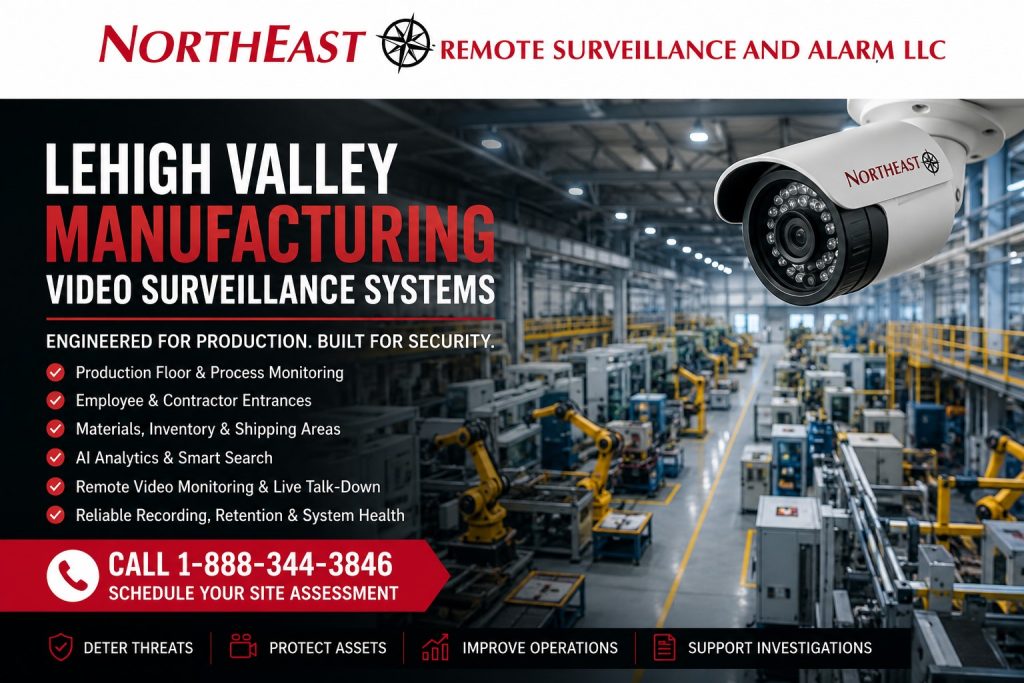
Review production, employee movement, contractor access, raw materials, finished goods and shipping. Restricted rooms, parking, exterior equipment and activity after hours also affect camera placement.
Manufacturing sites across Allentown, Bethlehem, Easton, Route 33, and I-78 can have different surveillance needs. Planning should account for camera views, recording capacity, environmental protection, network connections, retention, analytics, and system management.
NERSA designs, installs, upgrades, and supports manufacturing video systems across Allentown, Bethlehem, Easton, and the surrounding Lehigh Valley.
Service areas include Lehigh and Northampton counties and the Route 22, Route 33, and I-78 corridors.
Projects can include system integration and monitoring within the agreed scope.
For regional planning, explore Lehigh Valley commercial video surveillance.
NERSA plans manufacturing camera systems around:
- Employee and contractor entrances
- Production-support areas
- Restricted processes
- Raw-material storage
- Finished-goods storage
- Tool rooms and maintenance spaces
- Quality-control areas
- Shipping and receiving
- Loading docks
- Industrial parking
- Exterior equipment and utility areas
- Vehicle entrances
- Recording quality and retention
- AI-supported search
- Secure remote access
- Remote video monitoring
- Camera and recorder health
- Network and power infrastructure
- Multi-building administration
- Long-term service and lifecycle planning
Place cameras where footage can help staff review an incident. Relevant events may include access concerns, workplace incidents, shipment disputes, inventory discrepancies and equipment events. Contractor issues, property damage and after-hours alarms may also require useful views and supporting context.
Call 1-888-344-3846 to schedule a Lehigh Valley manufacturing video-surveillance assessment.
For regional camera-system planning across all property types, visit Lehigh Valley Commercial Video Surveillance Systems.
For complete manufacturing protection involving video surveillance, access control, intrusion alarms, monitoring, fire alarm coordination, intercoms, and infrastructure, continue to Lehigh Valley Manufacturing Security Systems.
For NERSA’s main sitewide camera-system resource, visit Commercial and Industrial Video Surveillance Systems, which addresses cameras, recording, storage, remote access, analytics, integrations, and long-term commercial support.
Manufacturing Cameras Should Follow the Operation
A manufacturing camera layout should reflect how employees, contractors, materials, equipment, and vehicles move through the facility.
Before selecting cameras, recorders, storage, or analytics, the organization should identify:
- Where employees enter and leave
- Where contractors report
- Which production-support areas require visibility
- Which processes or rooms have restricted access
- Where raw materials arrive
- Where finished goods are staged
- Which areas contain valuable tools or equipment
- Where quality-control inspections occur
- How freight enters and leaves
- Which exterior areas are difficult to supervise
- Which incidents require identification-level detail
- How long recordings must remain available
- Who requires live or recorded access
- Whether several buildings need centralized management
- Which locations require after-hours monitoring
A high-mounted overview may show general production movement while failing to capture enough detail at an employee entrance, tool room, restricted doorway, loading area, material-transfer point, or piece of equipment.
Many manufacturing facilities benefit from a layered camera design that combines:
- Wide production-area overviews
- Focused employee-entrance cameras
- Contractor check-in views
- Restricted-room cameras
- Tool-room and maintenance-area coverage
- Raw-material and finished-goods views
- Shipping and receiving cameras
- Loading-dock coverage
- Industrial parking cameras
- Exterior equipment views
- Vehicle-gate cameras
- Selected license plate recognition
- Remote-monitoring cameras
Every camera should have a documented purpose.
Production-Floor Video Surveillance
Production floors can be challenging camera environments because they may contain:
- Moving machinery
- Conveyors
- Forklifts
- Work cells
- Tall equipment
- Changing production layouts
- Strong lighting differences
- Dust
- Heat
- Vibration
- Reflective surfaces
- Restricted service access
A production-area camera may help authorized personnel review:
- The sequence surrounding an incident
- Movement near a restricted process
- Material flow
- Contractor activity
- Equipment-area access
- Workplace claims
- After-hours movement
- Activity near production-support spaces
The system should be designed around legitimate security and operational-review needs. Video surveillance does not replace machine guarding, supervision, training, safety procedures, process controls, or emergency planning.
Camera placement should avoid unnecessary obstruction and should not interfere with production, maintenance, or required access to machinery.
Employee and Contractor Entrances
Manufacturing properties may have separate entrances for:
- Production employees
- Office staff
- Contractors
- Vendors
- Temporary labor
- Maintenance personnel
- Engineers
- Drivers
- Visitors
Camera coverage may provide visual context for:
- Employee arrival and departure
- Contractor check-in
- Access granted
- Access denied
- Forced-door events
- Doors held open
- After-hours entry
- Reported incidents near an opening
An access-control event shows what the electronic system recorded. It does not independently establish who physically entered or whether another person followed through the opening.
Compatible video and access-control systems may help authorized users associate selected credential and door events with nearby footage.
For ongoing credential administration, controller-health awareness, door-status oversight, remote diagnostics, and lifecycle support, visit Managed Access Control Systems and System Health Monitoring.
Restricted Production and Support Areas
Manufacturing facilities may restrict access to:
- Tool rooms
- Engineering areas
- Quality-control rooms
- Laboratories
- Maintenance departments
- Utility rooms
- Electrical spaces
- IT rooms
- Chemical or material storage
- Prototype areas
- Records rooms
- Specialized production zones
Video surveillance may help provide context around:
- Entry into the area
- Material movement
- Contractor activity
- Door events
- After-hours access
- Reported loss or damage
- Activity near secured equipment
The camera should be positioned around the actual business purpose.
A general hallway view may document movement toward the area, while a focused entrance view may provide better identification detail. Interior cameras should be planned around employee policies, privacy-sensitive spaces, customer procedures, and applicable legal requirements.
Raw-Material and Finished-Goods Surveillance
Raw materials and finished products may move through several stages before shipment.
Camera planning may include:
- Receiving areas
- Material staging
- Raw-material storage
- Quality-control checkpoints
- Production transitions
- Finished-goods staging
- Secured inventory
- Shipping preparation
- Returns
- Scrap or waste areas
Useful video may help authorized personnel review:
- Material arrival
- Transfer between areas
- Product condition
- Inventory discrepancies
- Damage claims
- Shipment preparation
- Unauthorized movement
- After-hours activity
Clear camera naming is important.
Useful names may include:
- North receiving entrance
- Raw materials staging
- Quality lab entrance
- Finished goods row A
- West shipping office
- Returns cage
- Production transition 2
Generic labels such as “Camera 17” slow incident review and make multi-building administration more difficult.
Tool Rooms, Maintenance Areas, and Equipment Storage
Manufacturing facilities often maintain valuable:
- Tools
- Replacement parts
- Specialized instruments
- Maintenance equipment
- Portable machinery
- Calibration equipment
- Contractor supplies
- Fleet or facility equipment
Camera planning may focus on:
- Tool-room entrances
- Secured cages
- Maintenance counters
- Parts storage
- Equipment checkout
- Utility spaces
- Detached maintenance buildings
- Exterior equipment storage
The camera design should support legitimate documentation without relying on one distant production-floor overview to capture detailed activity inside a restricted support area.
When a room also uses access control, compatible integration may help authorized users review footage associated with selected credential events.
Shipping, Receiving, and Loading-Dock Cameras
Manufacturing shipping areas frequently combine employees, drivers, vendors, forklifts, freight, paperwork, trailers, and exterior personnel doors.
Camera planning may need to document:
- Vehicle arrival
- Trailer positioning
- Freight condition
- Material transfer
- Finished-goods loading
- Returns
- Driver activity
- Employee interaction
- Shipping-office entry
- Activity near adjacent personnel doors
One camera rarely provides every required view.
A stronger design may combine:
- Truck-court overview
- Exterior dock camera
- Interior dock-door camera
- Freight-transfer view
- Shipping-office entrance camera
- Driver check-in camera
Planning should account for:
- Dock numbering
- Trailer angles
- Lighting transitions
- Nighttime conditions
- Obstructions
- Mounting height
- Weather exposure
- Required identification detail
- Recording retention
For broader dock protection involving cameras, access control, intrusion alarms, and monitoring, visit Lehigh Valley Loading Dock Security Systems.
Industrial Parking and Exterior Approaches
Manufacturing parking and exterior areas may affect:
- Employee safety
- Vehicle-damage claims
- Contractor activity
- Visitor movement
- Theft investigations
- After-hours awareness
- Exterior equipment protection
- General property documentation
Camera planning should evaluate:
- Employee parking
- Visitor parking
- Shift-change activity
- Pedestrian walkways
- Building approaches
- Rear and side lots
- Vehicle entrances
- Accessible parking
- Lighting zones
- Pole locations
- Exterior storage
- Utility areas
- Fence lines
A broad parking-lot camera may show that an event occurred while failing to identify a person, vehicle, or direction of travel.
Some properties benefit from a combination of:
- Wide parking overviews
- Focused employee-entrance views
- Vehicle-lane cameras
- Pedestrian-approach cameras
- Dedicated LPR at selected entrances
Exterior Equipment, Utilities, and Perimeter Areas
Manufacturing properties may have exterior:
- Utility equipment
- Tanks
- Generators
- Transformers
- Material storage
- Waste areas
- Cooling equipment
- Detached buildings
- Fleet vehicles
- Contractor work zones
- Fence lines
- Remote sections of the property
These areas may require:
- Long-range cameras
- Vandal-resistant equipment
- Thermal cameras in selected applications
- Wireless or fiber connections
- Perimeter analytics
- Solar or cellular cameras where engineered appropriately
- Remote video monitoring
- Live audio talk-down
A building-mounted camera should not be expected to provide identification-level detail at the far edge of a large industrial property.
Exterior planning should evaluate distance, lighting, weather, vibration, mounting structures, network communication, power, environmental exposure, and the response process associated with an alert.
AI Video Analytics and Smart Search
AI-supported video can help authorized users locate selected activity more efficiently.
Depending on the platform and configuration, analytics may assist with:
- People detection
- Vehicle classification
- Line crossing
- Restricted-area activity
- Loitering
- Direction of travel
- Perimeter events
- After-hours movement
- Object appearance or removal
- Faster recorded-video search
AI should not replace proper camera design.
Analytics perform best when:
- The camera view is stable
- Lighting is suitable
- The subject is large enough in the image
- Detection zones are configured correctly
- The network is reliable
- Recording is functioning
- The selected feature matches the operating objective
Glare, steam, dust, moving machinery, vibration, shadows, blocked views, and changing layouts may affect analytic performance.
The organization should begin by defining what it needs to detect or locate rather than enabling every available feature.
Remote Video Monitoring for Manufacturing Facilities
Some manufacturing properties require more than passive recording.
Remote video monitoring may be appropriate for:
- Employee parking
- Loading docks
- Exterior storage
- Contractor entrances
- Equipment yards
- Vehicle gates
- Fence lines
- Utility areas
- Rear entrances
- Vacant sections
- Repeat trespassing locations
A defined monitored-video program may include:
- Analytics-generated events
- Monitoring-operator review
- Video verification
- Live audio warnings
- Customer notification
- Escalation under approved procedures
Remote video monitoring is different from viewing cameras through a mobile application. A monitored service uses selected cameras, event rules, schedules, response contacts, and documented escalation instructions. Review Remote Video Monitoring and Live Talk-Down for camera coverage, analytics, operator review, audio intervention, and approved response workflows.
Recording and Video Retention
Manufacturing video is useful only when the required footage records properly and remains available long enough to support the organization’s investigation process.
Actual retention depends on:
- Number of cameras
- Resolution
- Frame rate
- Compression
- Scene activity
- Recording schedule
- Continuous or event-based recording
- Storage capacity
- Audio recording
- Analytic metadata
- Added cameras
- Failed or degraded drives
A recorder initially designed for a specific retention period may no longer provide that retention after cameras are added or recording settings change.
Businesses should verify the oldest available footage rather than rely only on an estimated setting.
Retention planning should consider:
- Workplace-incident reporting delays
- Product or shipment disputes
- Internal investigations
- Contractor concerns
- Vehicle claims
- Insurance expectations
- Evidence-export requirements
- Management procedures
A retention target should be treated as a measurable requirement rather than an assumption.
Local, Cloud, and Hybrid Manufacturing Video Systems
Manufacturing camera systems may use on-premises, cloud-managed, or hybrid architectures.
On-Premises Recording
On-premises systems may be appropriate for:
- Large camera counts
- Longer retention
- High recording bandwidth
- Local storage control
- Limited internet capacity
- Specialized integrations
- Customer-managed infrastructure
These systems still require:
- Recorder or server maintenance
- Hard-drive monitoring
- Software support
- Secure remote access
- User administration
- Cybersecurity
- Backup planning
- Lifecycle management
Cloud-Managed Video
Cloud-managed platforms may provide:
- Remote administration
- Central user management
- Multi-site viewing
- Mobile access
- Device-health information
- Software coordination
The organization should understand:
- Recurring subscription costs
- Retention limits
- Internet requirements
- Primary account ownership
- Video export procedures
- Outage behavior
- Local recording capabilities
- Long-term platform support
Hybrid Video Surveillance
Hybrid systems can combine local recording with cloud-based:
- Administration
- Remote viewing
- Health alerts
- Event management
- AI-supported search
- Selected backup functions
- Multi-site dashboards
The correct architecture depends on camera count, retention, network capacity, cybersecurity, internal IT resources, remote access, subscription preferences, and long-term operating cost.
For the full comparison, visit Cloud vs.
Managed Camera and Recorder Health Monitoring
Manufacturing camera systems can fail without creating an obvious interruption in production.
A camera may remain powered but stop recording. A recorder may appear online while a drive becomes degraded. Retention may shrink without management noticing. A remote building may stop communicating while employees continue operating normally.
Compatible health-monitoring services may help identify:
- Offline cameras
- Repeated camera disconnections
- Recording interruptions
- Recorder failures
- Storage trouble
- Degraded drives
- Reduced retention
- Network communication loss
- Cloud gateway trouble
- Licensing problems
- Time-synchronization issues
- Sites that stop reporting
Health monitoring does not guarantee uninterrupted operation and does not replace physical inspection. It improves awareness of technical conditions that might otherwise remain hidden until footage is needed.
For camera-specific oversight, visit Managed Video Surveillance and Camera System Health Monitoring.
For broader technical monitoring across cameras, access control, alarms, networks, servers, and power systems, visit Commercial Security System Health Monitoring.
Preventive Maintenance and Physical Inspection
Remote system-health information cannot identify every physical camera problem.
Scheduled maintenance may include:
- Cleaning camera lenses
- Removing dust, insects, and spiderwebs
- Verifying camera views
- Checking focus
- Inspecting mounting stability
- Reviewing nighttime performance
- Inspecting enclosures
- Testing recording
- Confirming time synchronization
- Reviewing actual retention
- Testing remote access
- Reviewing user accounts
- Checking recorder condition
- Inspecting UPS and backup power
- Updating documentation
Manufacturing environments change.
New machinery, racks, signs, partitions, stored materials, production cells, and temporary equipment can block views that were useful when installed.
Critical camera positions should be reviewed periodically against their original purpose.
Network Infrastructure for Manufacturing Cameras
Many apparent camera problems are actually infrastructure problems.
Potential causes include:
- Damaged cabling
- Failed PoE switch ports
- Insufficient bandwidth
- Fiber-link trouble
- Wireless-bridge interruption
- Power outages
- Weak backup power
- Incorrect IP addressing
- VLAN or firewall changes
- Inadequate equipment enclosures
- Poor surge protection
- Undocumented network changes
A manufacturing video system may require:
- Cat6 or Cat6A cabling
- Fiber-optic backbones
- PoE switching
- Wireless building links
- Equipment racks
- UPS systems
- Backup batteries
- Surge protection
- VLANs
- Network segmentation
- Secure remote access
- Cable labeling
- Closeout documentation
The network and power architecture should be designed as part of the video-surveillance system.
For broader NERSA infrastructure planning, use the relevant commercial low-voltage, fiber, and network-support resources from the Lehigh Valley Commercial and Industrial Security Systems structure.
Video Integration With Access Control and Intrusion Alarms
Manufacturing cameras may provide context for:
- Access granted
- Access denied
- Forced doors
- Held-open doors
- Contractor entry
- Intrusion alarms
- Overhead-door activity
- After-hours entry
- Restricted-area events
- Visitor releases
- Vehicle-gate activity
Compatible integration may allow authorized users to move from an alarm or access event to relevant footage more quickly.
Integration should solve a defined operational problem. It should not create unnecessary complexity or interfere with required egress, fire alarm functions, emergency procedures, or other life-safety systems.
For broader coordination between cameras, controlled doors, alarms, intercoms, monitoring, and reporting, visit Unified and Integrated Commercial Security Systems.
Multi-Building and Multi-Site Manufacturing Video Management
Organizations operating several plants or buildings may inherit:
- Different camera manufacturers
- Separate recorders
- Inconsistent camera names
- Different retention periods
- Shared passwords
- Unclear account ownership
- Unsupported software
- Multiple mobile applications
- Missing documentation
- Different service providers
A multi-site program may establish:
- Centralized user administration
- Location-specific permissions
- Standard camera naming
- Camera and recorder inventories
- Retention standards
- Health reporting
- Service-ticket tracking
- Preventive maintenance
- Recurring-failure analysis
- Platform-migration planning
- Lifecycle priorities
Every plant does not need immediate replacement.
Supportable systems may remain in operation while the organization develops a phased standardization and migration plan.
For ongoing portfolio administration, documentation, service coordination, and lifecycle planning, visit Multi-Site Security System Management.
For larger enterprise camera environments, NERSA also maintains a dedicated Enterprise Video Surveillance Systems resource covering centralized architecture, recording, permissions, health monitoring, and future expansion. (Northeast Remote Surveillance)
Manufacturing Video Surveillance Upgrades and Takeovers
A manufacturing facility may need modernization because of:
- Poor image quality
- Weak nighttime performance
- Cameras offline
- Failed recorders
- Inadequate storage
- Short retention
- Difficult footage retrieval
- Insecure remote access
- Installer-owned accounts
- Unsupported software
- Incorrect camera positions
- Weak network infrastructure
- Limited expansion capacity
An assessment may determine which components can be:
- Retained
- Repositioned
- Reconfigured
- Repaired
- Expanded
- Integrated
- Migrated
- Replaced in phases
A successful takeover should provide:
- Customer-controlled accounts
- Documented camera locations
- Clear camera names
- Verified recording
- Known retention
- Secure user access
- Supportable infrastructure
- Defined service procedures
- A future modernization plan
Existing equipment does not need to be replaced merely because another provider installed it. It may remain when it is compatible, dependable, secure, accessible, serviceable, and appropriate for the completed system.
For broader modernization involving cameras, access control, alarms, infrastructure, and inherited systems, visit Commercial Security System Upgrades, Retrofits and Takeovers.
Manufacturing Video Surveillance From Small Plants to Enterprise Networks
A smaller manufacturing operation may require:
- Employee-entrance cameras
- Production overview
- Tool-room coverage
- Shipping visibility
- Parking-area cameras
- Local recording
- Secure remote access
A larger plant may require:
- Multiple production-area views
- Restricted-room cameras
- Shipping and receiving coverage
- Loading-dock cameras
- Industrial parking surveillance
- Exterior equipment coverage
- Longer retention
- Fiber infrastructure
- AI-supported search
- Remote monitoring
- Managed system health
An enterprise manufacturing network may require:
- Centralized users
- Regional permissions
- Standard camera naming
- Consistent retention
- Multi-site dashboards
- Health reporting
- Service coordination
- Documented platform standards
- Lifecycle planning
The system should solve the current operating requirement without preventing future expansion.
The NERSA Manufacturing Video Surveillance Process
Facility and Operations Review
NERSA reviews:
- Property layout
- Production activity
- Employee movement
- Contractor procedures
- Restricted areas
- Materials and inventory
- Shipping and receiving
- Loading docks
- Parking
- Exterior equipment
- Existing systems
- Known incidents
Camera-Purpose Planning
Each proposed camera receives a defined objective, such as:
- General production overview
- Entrance identification
- Restricted-area documentation
- Material-transfer review
- Tool-room visibility
- Shipping documentation
- Vehicle coverage
- Parking-area awareness
- Perimeter monitoring
- Alarm verification
Recording and Retention Planning
The design may evaluate:
- Camera count
- Resolution
- Frame rate
- Compression
- Recording mode
- Storage capacity
- Actual retention
- Expansion needs
- Export requirements
Infrastructure Review
Planning may include:
- Cabling
- Fiber
- Wireless links
- PoE switching
- Bandwidth
- Power
- Backup power
- Network segmentation
- Cybersecurity
- Equipment locations
Installation and Configuration
Approved systems are configured around:
- Camera views
- Recording requirements
- Camera names
- User permissions
- Remote access
- Analytics
- Monitoring
- Included integrations
Testing and Commissioning
Testing may include:
- Live-image verification
- Recording checks
- Playback
- Search
- Video export
- Retention verification
- Remote access
- User permissions
- Analytic events
- System-health functions
- Included integrations
Training and Documentation
Authorized personnel may receive instruction on:
- Live viewing
- Recorded-video search
- Exporting footage
- Mobile access
- User administration
- Incident review
- Requesting service
Project documentation may identify:
- Camera names
- Camera locations
- Recorder information
- Storage
- Expected retention
- User roles
- Network requirements
- Primary accounts
- Service information
Related Manufacturing Planning Resources
For shared entrances, loading areas, and multi-building operations, use the industrial park and manufacturing security guide. The NERSA company overview describes the broader service scope.
Frequently Asked Questions About Lehigh Valley Manufacturing Video Surveillance
What is a manufacturing video-surveillance system?
A manufacturing video-surveillance system uses commercial cameras, recording equipment, storage, network infrastructure, software, remote access, analytics, and user permissions to document activity across production, shipping, storage, parking, exterior, and restricted areas.
Where should manufacturing cameras be installed?
Common priorities include employee entrances, contractor entrances, production-support areas, restricted rooms, tool rooms, raw-material storage, finished-goods storage, shipping and receiving, loading docks, parking areas, exterior equipment, vehicle gates, and building approaches.
Should cameras cover production machinery?
Possibly, when there is a legitimate security, incident-review, or operational purpose. Camera placement should not interfere with machinery, safety procedures, employee policies, maintenance access, or privacy-sensitive activity.
Can cameras support workplace investigations?
Recorded video may provide useful context around a reported event when the area is visible, recording is functioning, footage remains available, and authorized personnel follow the organization’s procedures.
Can cameras help document material or shipment disputes?
Cameras may provide context around material arrival, staging, transfer, product condition, loading, driver activity, and shipment preparation. Their usefulness depends on placement, image detail, recording, and retention.
Can manufacturing cameras identify license plates?
Dedicated LPR cameras may capture plates at selected vehicle lanes when angle, distance, lighting, mounting position, and speed are properly controlled. Standard overview cameras should not be assumed to provide reliable plate capture.
Can cameras integrate with manufacturing access control?
Compatible systems may associate selected door events with nearby footage, helping authorized users review denied credentials, forced doors, doors held open, contractor entry, and after-hours access.
Can NERSA monitor camera and recorder health?
Compatible systems may provide health information for cameras, recorders, storage, network communication, cloud gateways, licensing, and other supported conditions through Managed Video Surveillance and Camera System Health Monitoring.
Is remote viewing the same as active monitoring?
No. Remote viewing allows authorized personnel to access cameras. Remote video monitoring is a separate service involving defined cameras, event rules, schedules, monitoring personnel, and response instructions.
Should a manufacturing facility use local or cloud recording?
The correct architecture depends on camera count, retention, network capacity, cybersecurity, remote-access needs, subscriptions, internal IT resources, and multi-site requirements.
Can an existing manufacturing camera system be upgraded?
Possibly. NERSA can assess cameras, views, cabling, switches, recorders, storage, accounts, software, remote access, and network infrastructure to determine what may be retained, repaired, expanded, migrated, or replaced.
Can several plants be managed from one platform?
Compatible systems may support centralized users, location-specific permissions, standard camera naming, health reporting, retention standards, multi-site viewing, and coordinated administration.
Does NERSA install single-family home camera systems?
No. Northeast Remote Surveillance and Alarm, LLC focuses on commercial, industrial, manufacturing, warehouse, logistics, institutional, municipal, healthcare, educational, and multi-site properties.
Request a Lehigh Valley Manufacturing Video Surveillance Assessment
NERSA can evaluate your manufacturing facility’s:
- Existing cameras
- Employee entrances
- Contractor entrances
- Production-support areas
- Restricted rooms
- Tool and maintenance spaces
- Raw-material storage
- Finished-goods storage
- Shipping and receiving
- Loading docks
- Parking areas
- Vehicle entrances
- Exterior equipment
- Lighting
- Required image detail
- Recording
- Storage
- Retention
- Remote access
- User permissions
- Account ownership
- AI analytics
- Network infrastructure
- Remote monitoring
- Camera-health capabilities
- Future expansion
Call Northeast Remote Surveillance and Alarm at 1-888-344-3846 to schedule a Lehigh Valley manufacturing video-surveillance assessment.
For regional camera planning, return to Lehigh Valley Commercial Video Surveillance Systems.
Plan Your Next Security Improvement
Tell NERSA about your commercial facility, existing systems, and project priorities. We can help you plan an installation, evaluate an upgrade, or coordinate security across multiple locations.
Compliance, Codes & Project Standards
NERSA plans commercial and industrial security work with applicable code, documentation, inspection and authority-having-jurisdiction requirements in mind. Requirements vary by system, property and jurisdiction. These resources support project planning; they do not establish legal compliance, certification or AHJ approval.
Related guidance: Regulatory compliance & inspection readiness · Video surveillance compliance · NERSA project standards