
Mobile surveillance trailers give commercial, industrial, construction, logistics, municipal, and temporary-use properties a fast way to add visible security coverage where permanent cameras are not yet available or where fixed infrastructure is not practical.

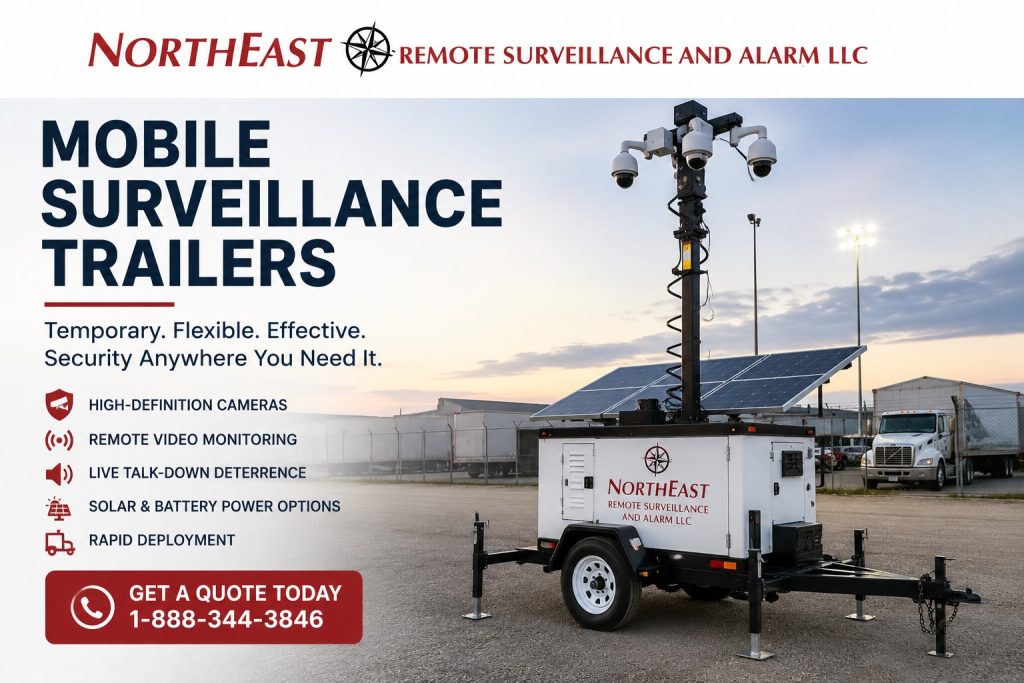
Northeast Remote Surveillance and Alarm, LLC designs and deploys mobile surveillance trailer solutions that can support commercial video surveillance systems, remote video monitoring, live talk-down, perimeter protection, and temporary site security.
These systems are useful for job sites, truck yards, warehouses, parking lots, industrial properties, event areas, equipment yards, utility sites, and facilities that need rapid security coverage without waiting for full permanent infrastructure.
For a broader jobsite plan that connects temporary cameras, monitoring, power, communications, and changing site conditions, review construction site security systems.
For sites that need professional review of selected video events and an approved audio response, see remote video monitoring and live talk-down.
Mobile Surveillance Trailers for Temporary and Remote Security
Not every property has power, network cabling, poles, buildings, or finished infrastructure ready for a permanent security system. Mobile surveillance trailers help fill that gap by placing cameras, communication equipment, lighting, and deterrence tools where security coverage is needed quickly.
NERSA can use mobile surveillance trailers to help monitor:
- Construction sites
- Truck yards
- Trailer lots
- Equipment yards
- Material storage areas
- Warehouses under construction
- Industrial expansion areas
- Parking lots
- Utility sites
- Municipal properties
- Remote gates
- Temporary entrances
- Outdoor storage areas
- Event areas
- Vacant commercial properties
- Properties waiting for permanent cameras
A mobile surveillance trailer can provide a visible deterrent, capture video evidence, support remote monitoring, and help property owners respond to after-hours activity.
Security Coverage Without Permanent Infrastructure
Many properties need security before the final camera system can be installed. A construction site may not have permanent power. A warehouse expansion may not have finished network pathways. A parking lot may need temporary monitoring during a special event. A truck yard may need added coverage while a permanent pole camera system is being planned.
Mobile surveillance trailers are useful when fixed cameras are delayed, impractical, or only needed for a limited period.
They can help protect areas where:
- Power is limited
- Network access is not available
- Buildings are not completed
- Poles are not installed
- Cable pathways are not ready
- Security needs are temporary
- Activity changes by phase
- The risk area moves over time
- Permanent construction is not allowed
- A rapid deployment is required
The system can be placed where coverage is needed and adjusted as the site changes.
Cameras, Monitoring, and Live Talk-Down
A mobile surveillance trailer should do more than record video. When designed correctly, it can support active security response.
Depending on the project, a trailer may include:
- High-definition surveillance cameras
- PTZ cameras
- Wide-area overview cameras
- Nighttime viewing capability
- Motion-based event detection
- Remote access to video
- Live monitoring support
- Two-way audio or talk-down speakers
- Warning lights
- Cellular or wireless communication
- Solar or battery-supported power options
- Local recording
- Remote event review
- Site-specific response instructions
When activity occurs after hours, cameras can help determine whether the event is an employee, vendor, delivery, trespasser, vandal, theft attempt, or false condition.
For active camera review and response, NERSA can pair trailer coverage with remote video monitoring.
Visible Deterrence for High-Risk Areas
Mobile surveillance trailers are highly visible by design. Their presence can help discourage trespassing, theft, vandalism, dumping, unauthorized parking, loitering, and after-hours activity.
Visible security can be especially useful in areas where people may not expect cameras, lighting, speakers, or active monitoring.
Common deterrence uses include:
- Construction material protection
- Equipment theft prevention
- Fuel storage areas
- Copper and metal theft concerns
- Trailer yard protection
- Loading area monitoring
- Gate and fence-line coverage
- Vacant property protection
- Parking lot security
- Temporary event security
- After-hours site control
- Remote perimeter visibility
The right placement matters. A trailer should be positioned to cover the highest-risk area without creating blind spots or unnecessary false alerts.
Mobile Surveillance for Construction Sites
Construction sites change constantly. Entrances move, materials shift, equipment is relocated, fencing changes, and different trades may be on site at different times. A permanent camera system may not be ready until later in the project.
Mobile surveillance trailers can help provide temporary security during active construction phases.
They may be used to monitor:
- Main site entrances
- Equipment storage areas
- Material laydown yards
- Fuel tanks
- Temporary offices
- Tool storage areas
- Fenced perimeters
- Parking areas
- After-hours access points
- Delivery zones
- Open building shells
- Areas with repeated trespassing
As the project changes, trailer placement and camera views can be adjusted to match the new risk areas.
Mobile Surveillance for Truck Yards and Logistics Sites
Truck yards, trailer lots, and logistics properties often have wide outdoor areas, long fence lines, remote gates, and high-value assets. These sites may need added visibility before a full permanent system is installed or during periods of increased activity.
Mobile surveillance trailers can help monitor:
- Trailer parking areas
- Yard entrances
- Gate areas
- Fueling areas
- Loading zones
- Fence lines
- Overnight parking
- Remote corners
- High-value trailers
- Temporary overflow lots
- Seasonal yard expansion areas
For logistics properties, the trailer can support theft deterrence, incident review, after-hours visibility, and managed response.
Mobile Surveillance for Warehouses and Industrial Properties
Warehouses and industrial facilities may use mobile surveillance trailers during expansions, renovations, temporary yard changes, building transitions, seasonal storage, or security upgrades.
A trailer can help provide coverage for areas that are outside the current permanent camera layout.
This may include:
- New loading dock areas
- Temporary storage zones
- Construction staging areas
- Expansion areas
- Detached lots
- Outdoor equipment storage
- Temporary employee parking
- Gate changes
- Perimeter gaps
- Areas waiting for pole cameras or cabling
Mobile surveillance can bridge the gap between an immediate security need and the final permanent system design.
Solar, Battery, Cellular, and Wireless Options
Some mobile surveillance trailer deployments need to operate where normal power and network connections are not available. Depending on the site, trailer systems may use solar power, battery backup, cellular communication, wireless bridges, or a combination of technologies.
The best setup depends on:
- Camera quantity
- Power demand
- Lighting requirements
- Monitoring needs
- Site conditions
- Available sunlight
- Cellular signal strength
- Distance to buildings
- Recording requirements
- Seasonal weather
- Expected deployment length
NERSA evaluates the site before recommending the proper trailer configuration. A trailer that works well in one location may not be the right fit for another site with different power, network, or visibility conditions.
Remote Monitoring and Managed Response
Mobile surveillance trailers become more effective when they are connected to a clear response process. Video alone is helpful, but monitored video with documented response instructions can provide stronger security value.
A managed response plan may include:
- Monitoring schedules
- Alert zones
- Authorized contacts
- Escalation procedures
- Live talk-down rules
- Site-specific instructions
- Alarm verification
- Event documentation
- Manager notification
- Emergency response procedures when appropriate
For properties that need organized event handling, NERSA can connect trailer monitoring with security operations center and managed security response.
This helps reduce confusion and gives owners, managers, or authorized personnel a better process for handling events.
Trailer Placement and Site Planning
Mobile surveillance trailers are most effective when they are placed intentionally. The goal is not just to park the trailer on site. The goal is to cover the right area, reduce blind spots, avoid unnecessary triggers, and support the response plan.
NERSA considers:
- Primary threat areas
- Entrance and exit points
- Camera field of view
- Lighting conditions
- Blind spots
- Power and solar exposure
- Cellular signal strength
- Distance to activity
- Vehicle movement
- Fence lines
- Property boundaries
- Wind exposure
- Ground conditions
- Trailer visibility
- Safety and access for service
A properly placed trailer can improve visibility, deterrence, and response quality.
When Mobile Surveillance Trailers Make Sense
Mobile surveillance trailers are often the right fit when a property needs fast, flexible, or temporary security coverage.
They are commonly used for:
- Short-term projects
- Construction phases
- Temporary yards
- Vacant properties
- Parking lots
- Utility work
- Seasonal storage
- Special events
- Expansion projects
- Emergency coverage
- Theft-prone areas
- Sites waiting for permanent cameras
- Areas with no power or network infrastructure
They can also be used as a temporary security layer while a full unified security system is being designed or installed.
Related Planning
- commercial video surveillance systems — Compare temporary coverage with fixed camera-system planning.
- remote video monitoring — Define which events require operator review and response.
- commercial alarm systems — Coordinate trailer coverage with intrusion-detection needs.
- unified security systems — Plan how temporary cameras fit with the property’s other systems.
Why Choose Northeast Remote Surveillance and Alarm
Northeast Remote Surveillance and Alarm, LLC designs commercial and industrial security systems for properties that need practical protection, fast deployment, and reliable support. We understand that construction sites, warehouses, truck yards, industrial properties, parking lots, and temporary-use sites often need security before permanent infrastructure is ready.
Our team helps determine whether a mobile surveillance trailer is the right fit, where it should be placed, what cameras and communication options are needed, and how events should be handled.
Businesses choose NERSA for mobile surveillance trailers because we provide:
- Commercial and industrial security experience
- Site-specific trailer placement
- Camera and monitoring design
- Remote video monitoring options
- Live talk-down support
- Cellular, wireless, solar, and battery planning
- Temporary and long-term deployment support
- Integration with permanent security systems
- Clear response procedures
- Service and support after deployment
A mobile surveillance trailer should do more than sit on a property. It should support real visibility, real deterrence, and a clear response process.
Schedule a Mobile Surveillance Trailer Consultation
If your property needs temporary security cameras, rapid deployment, construction site monitoring, truck yard coverage, parking lot surveillance, remote perimeter visibility, or live monitoring support, Northeast Remote Surveillance and Alarm, LLC can help.
Call 1-888-344-3846 or contact NERSA to schedule a mobile surveillance trailer consultation.
We design and support mobile surveillance trailer solutions for commercial, industrial, municipal, construction, logistics, and temporary-use properties throughout the Lehigh Valley, Northeastern Pennsylvania, Central Pennsylvania, Greater Philadelphia, New Jersey, Delaware, and the Mid-Atlantic region.
Frequently Asked Questions
What is a mobile surveillance trailer?
A mobile surveillance trailer is a movable security platform that can provide temporary or remote camera coverage for areas where permanent cameras, power, or network infrastructure may not be available.
Where are mobile surveillance trailers used?
Mobile surveillance trailers are commonly used at construction sites, truck yards, parking lots, equipment yards, warehouses, industrial properties, municipal sites, events, utility areas, and vacant commercial properties.
Can a mobile surveillance trailer be monitored remotely?
Yes. Mobile surveillance trailers can support remote viewing and, depending on the design, remote video monitoring, event alerts, and live talk-down.
Do mobile surveillance trailers need power?
Some deployments can use available site power, while others may require solar, battery, or hybrid power options. The right configuration depends on the cameras, communication equipment, lighting, monitoring needs, and site conditions.
Can mobile surveillance trailers work without internet?
Many mobile surveillance trailers can use cellular communication or wireless connectivity when wired internet is not available. Signal strength and bandwidth should be reviewed before deployment.
Can a trailer provide live talk-down?
Yes. Depending on the system design, a mobile surveillance trailer can include speakers for live talk-down or recorded warning messages to help deter unauthorized activity.
Are mobile surveillance trailers only temporary?
They are often used for temporary coverage, but they can also be used for longer-term remote security where permanent infrastructure is not practical.
Can a mobile surveillance trailer replace a permanent security system?
Sometimes a trailer is the best temporary solution, but it does not always replace a permanent camera, alarm, access control, or monitoring system. NERSA can help determine whether a trailer, a permanent system, or a combined approach is the best fit.
Plan Your Next Security Improvement
Tell NERSA about your commercial facility, existing systems, and project priorities. We can help you plan an installation, evaluate an upgrade, or coordinate security across multiple locations.
Local temporary surveillance planning
These guides connect temporary coverage with local property needs.
Confirm power, communications, deployment conditions, and response responsibilities before choosing equipment.
- Scranton temporary coverage — Assess changing sites and temporary monitoring needs.
- Pittston temporary coverage — Review coverage for active logistics properties.
- Wilkes-Barre temporary coverage — Plan temporary observation of yards and work areas.
Compliance, Codes & Project Standards
NERSA plans commercial and industrial security work with applicable code, documentation, inspection and authority-having-jurisdiction requirements in mind. Requirements vary by system, property and jurisdiction. These resources support project planning; they do not establish legal compliance, certification or AHJ approval.
Related guidance: Regulatory compliance & inspection readiness · Warehouse & logistics compliance · NERSA project standards