
Managed security response organizes how commercial and industrial properties review, escalate, and document selected alarm, camera, access-control, and facility events.

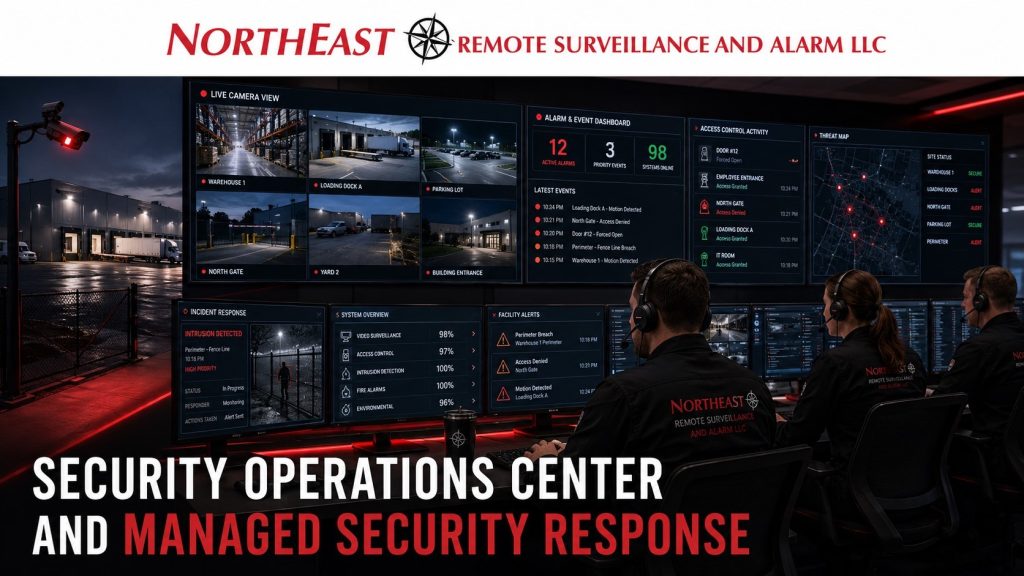
Northeast Remote Surveillance and Alarm, LLC designs managed security response solutions that connect remote video monitoring with intrusion alarms, access control, video surveillance, facility alerts, and documented response procedures.
Instead of relying on disconnected alerts, a managed security response plan helps owners, managers, and authorized personnel know what happened, where it happened, and what action should be taken.
Connect Events With an Agreed Response
Security systems create information. A managed security response plan helps turn that information into action.
A camera may detect activity. An alarm may report a door opening after hours. An access control system may show a forced door event. A facility alert may report water, temperature, or power trouble. Without a clear response process, those signals can become confusing, delayed, or ignored.
NERSA helps commercial and industrial facilities organize security response around the property, the risk, the schedule, and the people responsible for making decisions.
Managed security response can support:
- Warehouses
- Manufacturing facilities
- Distribution centers
- Logistics properties
- Truck yards
- Contractor yards
- Office buildings
- Schools
- Municipal buildings
- Multi-building commercial properties
- Industrial parks
- Medical offices
- Retail and service businesses
- Equipment yards
- Remote or lightly staffed facilities
The goal is not just to install devices. The goal is to create a response structure that helps protect the property when activity occurs.
What a Security Operations Center Supports
A security operations center, often called a SOC, is the central point where security events can be reviewed, prioritized, escalated, and documented. For a commercial property, that may include monitoring screens, alarm signals, access control events, camera clips, remote notifications, dispatch instructions, and site-specific response procedures.
NERSA designs systems that support managed response by connecting the right security technologies together.
A managed security response program may include:
- Video surveillance review
- Remote video monitoring
- Live talk-down capability
- Intrusion alarm response
- Access control event review
- Forced door alerts
- Door-propped-open alerts
- Gate activity alerts
- After-hours activity notifications
- Facility condition alerts
- Escalation lists
- Site-specific instructions
- Event documentation
- Manager notifications
- Police, fire, or emergency contact procedures when appropriate
For the property owner or facility manager, the value is better information and a more consistent response.
Event-Based Monitoring and Response
Not every camera needs to be watched every second. Many commercial properties benefit from event-based monitoring, where cameras, alarms, analytics, access control, or facility sensors trigger attention when something important happens.
This approach helps focus response on actual activity instead of passive recording alone.
Event-based monitoring may be used for:
- After-hours motion near buildings
- Activity at loading docks
- People entering fenced yards
- Unauthorized gate access
- Door-forced-open events
- Door-left-open events
- Intrusion alarm activations
- Vehicle activity in restricted areas
- Loitering around entrances
- Activity near trailers or equipment
- Facility alerts in critical rooms
- Repeated alarms or trouble conditions
A managed response plan helps decide what should happen next. That may include reviewing video, issuing an audio warning, notifying a manager, escalating to a call list, or following a documented site procedure.
Remote Video Monitoring and Live Talk-Down
Remote video monitoring can bring selected camera events to a reviewer’s attention during the agreed coverage hours. The available views, connection, event rules, and approved instructions determine what the reviewer can assess and which actions are available.
Live talk-down can also be used at certain sites to warn unauthorized individuals that they are being observed and should leave the property. This can be especially useful for truck yards, fenced lots, loading docks, contractor yards, storage areas, and properties with repeated after-hours trespassing.
For a deeper look at this service, visit remote video monitoring.
Managed video response can support:
- Perimeter activity
- Gate and fence-line events
- Loading dock activity
- Trailer yard activity
- Parking lot activity
- Exterior door activity
- Equipment yard activity
- Rooftop or restricted area activity
- After-hours loitering
- Suspicious vehicle activity
The right response depends on the property, the camera layout, the monitoring schedule, and the approved escalation plan.
Intrusion Alarm Response With Better Information
An intrusion alarm tells you that something triggered. A managed security response plan helps determine what should happen next.
When intrusion detection is connected with cameras and site procedures, alarm events can be reviewed with more context.
See the alarm and video verification integration guide for event mapping and interface checks.
Instead of only knowing that an alarm occurred, managers can know which door, dock, room, gate, or area created the event.
NERSA can support response planning for:
- Front doors
- Employee entrances
- Rear doors
- Overhead doors
- Loading docks
- Interior restricted rooms
- Tool rooms
- Inventory areas
- Electrical rooms
- IT rooms
- Detached buildings
- Fenced yard gates
For businesses that need alarm protection, visit commercial alarm systems.
For alarm events supported by video, visit video verification for intrusion alarms.
Access Control Event Response
Access control systems can generate important security information. A forced door, held door, denied credential, after-hours entry, or restricted area event may require attention.
Managed security response can help owners and managers respond to access control activity in a more organized way.
Access control response may include:
- Forced door alerts
- Door-held-open alerts
- After-hours employee entry
- Vendor access events
- Restricted room access
- Gate access events
- Multiple denied credential attempts
- Entry into sensitive areas
- Alarm disarming tied to user activity
- Event review with video footage
For sites that need alarms, door access, schedules, and video to work together, visit access control and intrusion alarm integration.
Facility Alerts and Non-Intrusion Events
Managed security response is not limited to break-ins. Many commercial properties also need to respond to environmental and facility alerts.
These events may not involve a person entering the building, but they can still cause damage, downtime, or operational disruption.
Managed response can support alerts for:
- Water leaks
- Flood detection
- Temperature issues
- Freezer or cooler temperature changes
- Power loss
- Equipment room trouble
- Communication trouble
- Door-left-open conditions
- Sump pump issues
- Mechanical room conditions
- Network room issues
For facilities that need alerts for temperature, water, power, or equipment conditions, visit environmental monitoring and facility alerts.
Site-Specific Response Instructions
A strong managed response program should be based on the actual property. A generic response plan may not fit a warehouse, manufacturing plant, office building, municipal property, or truck yard.
NERSA helps clients define response procedures that match the site.
A response plan may include:
- Authorized contacts
- Escalation order
- Business hours and after-hours schedules
- Areas that require immediate attention
- Areas where activity is expected
- Vendor and employee access rules
- Gate and dock activity procedures
- When to notify management
- When to issue an audio warning
- When to request emergency response
- When to document and review the event later
- When to ignore expected activity
This reduces confusion and helps the system support the business instead of overwhelming it with unnecessary alerts.
Security Response for Warehouses and Logistics Sites
Warehouses, distribution centers, and logistics properties often have larger footprints, more exterior activity, more dock doors, more vehicles, and more after-hours risk than a standard office building.
Managed security response can help protect:
- Loading docks
- Shipping and receiving areas
- Trailer yards
- Truck gates
- Employee entrances
- Visitor entrances
- Storage areas
- Fenced perimeters
- Equipment areas
- Parking lots
- Remote corners of the property
- Restricted interior rooms
For logistics and industrial operations, response planning is especially important because activity may be normal in one area and suspicious in another. A site-specific plan helps separate expected activity from real security concerns.
Security Response for Manufacturing Facilities
Manufacturing facilities may need managed response for more than perimeter security. Internal areas, production support spaces, tool rooms, parts rooms, electrical rooms, chemical storage areas, and employee entrances may all require different levels of protection.
Managed response can support manufacturing security by helping review:
- After-hours entry
- Restricted room access
- Production floor activity
- Employee entrance activity
- Vendor and contractor access
- Door-forced-open events
- Interior alarm events
- Equipment room alerts
- Parking lot activity
- Perimeter activity
For manufacturing environments, the response process should support safety, accountability, and operational continuity without interfering with production.
Reducing Noise, False Alarms, and Missed Events
One of the biggest problems with security technology is noise. Too many unnecessary alerts can cause managers to ignore important events. Too little monitoring can allow real issues to go unnoticed.
NERSA designs managed response systems to reduce noise and improve event quality.
This may include:
- Better camera placement
- Proper analytics setup
- Alarm zone review
- Access control schedule review
- Event filtering
- Site-specific rules
- Clear escalation paths
- User training
- Regular review of recurring alerts
- Adjustment of nuisance devices or conditions
A good managed response plan should make the security system more useful, not more complicated.
Related Planning
Use these guides to coordinate managed response with the cameras, alarms, facility sensors, and system interfaces generating the events.
- commercial video surveillance systems — Plan the camera views operators need to assess activity.
- commercial alarm systems — Coordinate event signals and alarm-response responsibilities.
- remote video monitoring — Review camera-event handling and live response workflows.
- environmental monitoring and facility alerts — Plan how facility-condition alerts reach the responsible staff.
- unified security systems — Coordinate information from cameras, alarms and access control.
Confirm Service Boundaries and Test the Response
The service agreement should identify the monitoring provider, covered locations, event types, coverage hours, and authorized actions. Specify which events reach professional operators, which go directly to customer staff, and which remain available only for later review. An event-based service does not mean every camera is continuously watched, and an emergency-response request does not guarantee a particular arrival time or outcome.
Before activation, arrange representative tests with the responsible monitoring and site teams. Confirm that an event arrives with the correct property and location, that the reviewer can access the agreed supporting information, and that the notification or escalation follows the approved instructions. Record the result and correct missing labels, unavailable views, or outdated contacts before relying on that workflow.
Define the fallback when video or communications are unavailable, a primary contact does not answer, or an event falls outside the service scope. Identify who receives equipment-fault notices and who arranges repair. Review recurring nuisance events without quietly disabling meaningful coverage, and update instructions when hours, occupants, cameras, or responsible contacts change.
Schedule a Managed Security Response Consultation
If your property needs better response to alarms, cameras, access control events, facility alerts, after-hours activity, or remote monitoring events, Northeast Remote Surveillance and Alarm, LLC can help.
Call 1-888-344-3846 or contact NERSA to schedule a security operations center and managed security response consultation.
We design, install, and support managed security response solutions for commercial and industrial properties throughout the Lehigh Valley, Northeastern Pennsylvania, Central Pennsylvania, Greater Philadelphia, New Jersey, Delaware, and the Mid-Atlantic region.
Frequently Asked Questions about Security Operations Center and Managed Security Response
What is a security operations center?
A security operations center is a central point for reviewing, managing, documenting, and escalating security events. For commercial properties, it may involve cameras, alarms, access control events, remote monitoring, facility alerts, and response procedures.
What is managed security response?
Managed security response is the process of organizing how security events are handled. It can include reviewing video, responding to alarms, notifying managers, using live talk-down, following escalation procedures, and documenting events.
Does a security operations center replace my alarm system?
No. A security operations center does not replace the alarm system. It helps manage and respond to events created by alarms, cameras, access control, and facility sensors.
Can managed response work with video surveillance?
Yes. Managed response is often strongest when connected to video surveillance. Cameras can help verify activity, review events, and provide better information during an alarm or after-hours situation.
Can managed response include live talk-down?
Yes. Depending on the property and system design, live talk-down can be used to warn unauthorized individuals that they are being observed and should leave the property.
Can access control events be part of managed response?
Yes. Forced door alerts, held door alerts, after-hours entry, restricted area access, and gate activity can all be included in a managed response plan.
Is managed security response useful for warehouses?
Yes. Warehouses, distribution centers, truck yards, and logistics properties often benefit from managed response because they have large footprints, many access points, after-hours activity, and high-value assets.
Can facility alerts be included?
Yes. Environmental and facility alerts such as water detection, temperature problems, power loss, and equipment room trouble can be included in a managed response plan.
Do all properties need the same response plan?
No. Every property should have site-specific response instructions based on building layout, operating hours, risk areas, employee activity, vendor access, and management preferences.
Plan Your Next Security Improvement
Tell NERSA about your commercial facility, existing systems, and project priorities. We can help you plan an installation, evaluate an upgrade, or coordinate security across multiple locations.
Enterprise planning resources
For the wider enterprise framework, see Enterprise Security Operations.
- Enterprise Multi-Site Incident Escalation Workflows
- Enterprise Security Event Taxonomy and Dashboards
Compliance, Codes & Project Standards
NERSA plans commercial and industrial security work with applicable code, documentation, inspection and authority-having-jurisdiction requirements in mind. Requirements vary by system, property and jurisdiction. These resources support project planning; they do not establish legal compliance, certification or AHJ approval.
Related guidance: Regulatory compliance & inspection readiness · NERSA project standards · Documentation, testing & inspection readiness